

Your waste management strategy is now a $123.43 billion industry variable that can either stabilize your bottom line or erode your margins through inefficiency. If you treat your commercial dumpster rental as a background utility rather than a logistical asset, you are likely losing money to opaque pricing and missed pickups. Managing business debris in 2026 requires more than just a bin; it requires a firm handle on shifting local regulations and precise volume control.
We understand the frustration of navigating city-specific permits in cramped urban corridors or facing unexpected fines as new waste zones roll out in major hubs. You need a system that works without constant oversight. This guide provides the expert framework to master your waste logistics through smart sizing and cost-efficient rental strategies. We will walk you through the specifics of 10 to 40-yard options, explain how to stay compliant with 2026 disposal mandates like the NYC Commercial Waste Zone deadlines, and show you how to secure predictable overhead costs with zero logistical friction.
Key Takeaways
- Distinguish between recurring front-load service and temporary roll-off containers to match your waste strategy with daily operations.
- Master the logistics of commercial dumpster rental by selecting the right size based on volume and tight loading dock footprints.
- Navigate 2026 city-specific compliance, including NYC’s commercial waste zone rollout, to avoid operational disruptions and permit fines.
- Lower waste overhead by implementing audits that reveal recycling opportunities and eliminate hidden costs like dry-run charges.
- Simplify your scheduling with a digital-first booking system that provides immediate access to local expertise and reliable pickups.
Defining Commercial Dumpster Rental: Permanent vs. Project-Based Solutions
Identifying the right commercial dumpster rental strategy starts with understanding your waste stream. Commercial waste differs significantly from residential debris in both volume and regulatory oversight. Most businesses fall into two categories: those requiring a permanent disposal solution for daily operations and those managing short-term surges from construction or cleanouts. You're likely losing money if you choose the wrong setup for your specific output. Choosing the wrong equipment leads to either overflowing bins or wasted spend on empty space.
Front-Load Containers for Recurring Waste
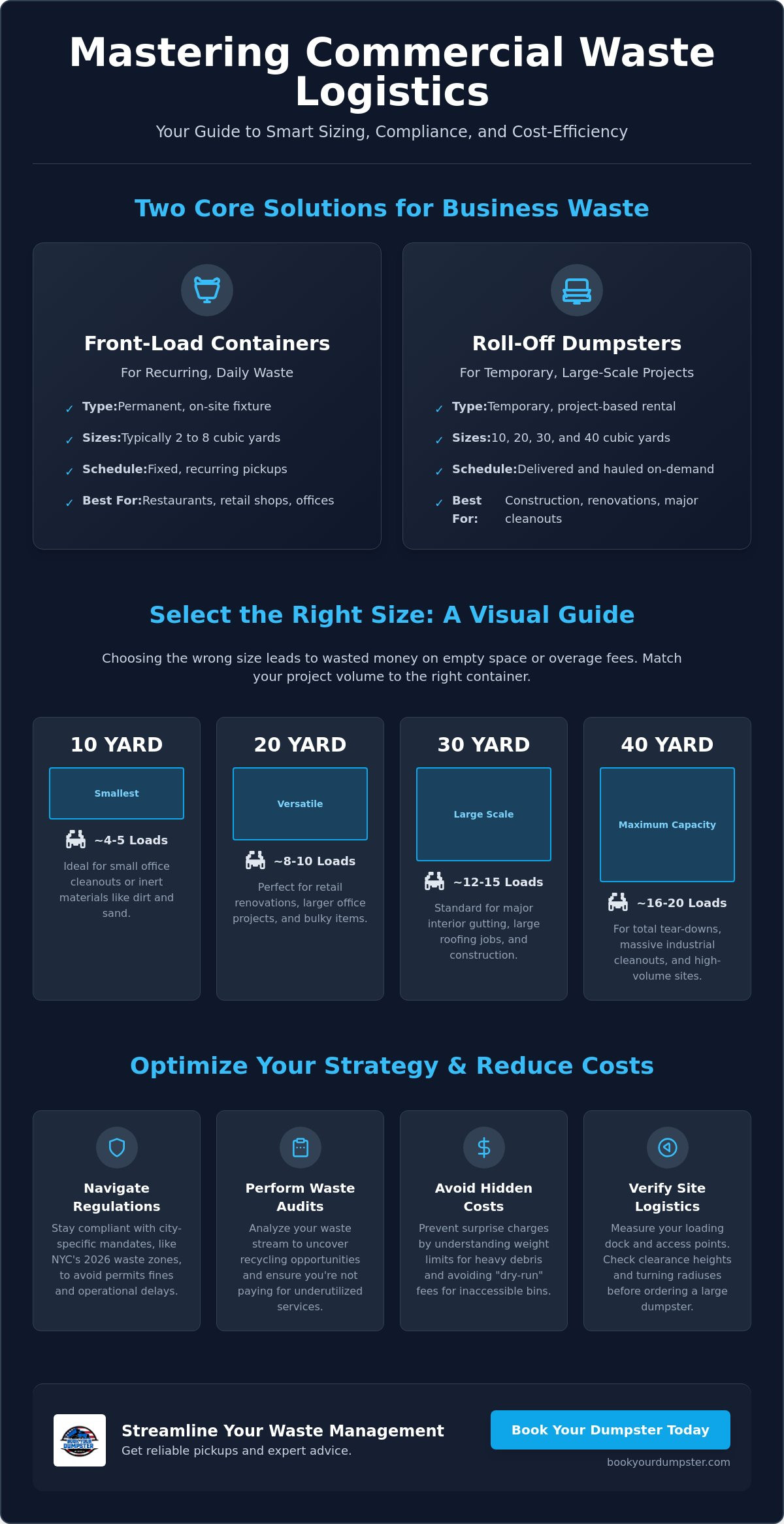
These are the permanent fixtures found behind restaurants, retail shops, and small office buildings. Front-load containers typically range from 2 to 8 cubic yards and stay on-site indefinitely. You set a pickup frequency based on your generation rates. High-volume businesses like grocery stores often require multiple weekly collections, while smaller boutiques might only need one. This setup handles standard bagged trash and lightweight packaging. It's the standard for maintaining a clean, professional exterior for your business every day of the year.
Roll-Off Dumpsters for Commercial Projects
When your project generates bulky debris that exceeds the capacity of a standard bin, you need a roll-off dumpster. These are the heavy-duty tools for structural renovations, roofing, and large-scale facility cleanouts. We offer 10, 20, 30, and 40-yard capacities to handle everything from concrete to office furniture. Their open-top design and rear swing doors allow for fast, efficient loading of heavy materials. Unlike permanent bins, these are delivered for a set timeframe and hauled away once the project is complete. Visit Book Your Dumpster USA to schedule a temporary container for your next site project.
Certain industries require a hybrid approach to maintain operational flow. A manufacturing facility might use front-load containers for office waste while keeping a 40-yard roll-off on the dock for scrap metal or pallet disposal. Retail chains undergoing nationwide rebranding often secure temporary roll-offs for store renovations alongside their existing permanent contracts. Analyze your current project scope and daily output to determine if a single solution or a combined strategy is the most cost-effective path forward. You don't want to pay for a permanent service when a temporary commercial dumpster rental is the more efficient tool for the job.
Choosing the Right Commercial Dumpster Size for Your Business
Selecting the wrong size for your commercial dumpster rental leads to two distinct failures: paying for empty space or facing overage penalties for heavy debris. Start by auditing your waste stream to identify exactly what you're throwing away. Use the EPA's guide for commercial buildings to track your output before you book. You must account for the physical footprint of the unit alongside the volume. A 40-yard container won't fit in a standard 20-foot loading dock. Always check your clearance heights and turning radiuses for the delivery truck before finalizing your order.
Small Business Solutions: 10 and 20 Yard Options
Small-scale operations and targeted cleanouts don't require massive industrial units. The 10-yard dumpster is the primary choice for small office cleanouts or disposing of inert materials like dirt and sand. It holds about 4 to 5 pickup truck loads. If you're managing a retail renovation or a larger office project, the 20-yard dumpster is the most versatile option. It accommodates roughly 8 to 10 pickup truck loads of debris. This size is manageable for tight parking lots but provides enough volume for carpet, drywall, and display fixtures. Don't underestimate the weight of these materials. If you're filling a bin with shingles or concrete, the weight limit becomes your primary constraint rather than the volume. This is a common pitfall for first-time commercial dumpster rental users.
Industrial and Construction Sizes: 30 and 40 Yard Units
Large-scale commercial building renovations and industrial sites require maximum capacity. The 30-yard container is the standard for major interior gutting and large roofing jobs. It holds approximately 12 to 15 pickup truck loads. For total tear-downs and massive industrial cleanouts, the 40-yard dumpster is the only logical choice, holding about 16 to 20 pickup truck loads. Loading these high-walled containers requires specific safety protocols. Never attempt to throw heavy objects over the 8-foot side walls. Use the rear swing door to walk heavy items into the container. This prevents injury and ensures the load is distributed evenly, which is critical for a safe haul-away. You can compare dimensions and book your unit directly through our platform to ensure site readiness.
Match the dumpster size to the specific phase of your commercial project. You might start with a 40-yard unit for initial demolition and switch to a 20-yard unit for the finishing stages. This flexibility keeps your site clear without paying for excess capacity. Efficient waste management is about using the right tool for the specific job at hand.
Navigating Local Regulations and Urban Placement Logistics
Logistics determine the success of your commercial dumpster rental. Choosing a 30-yard unit is useless if the delivery truck cannot clear the narrow gates of a Boston alleyway or the tight corners of a Chicago industrial park. You must account for overhead obstructions like power lines and low-hanging tree branches before the truck arrives. Most delivery vehicles require at least 23 feet of vertical clearance to raise the hoist and drop the container. If your site has a gate, ensure it provides a minimum 10-foot width for safe entry. Noise ordinances also dictate your operational schedule. Many municipalities restrict waste collection to specific windows, often starting after 7:00 AM, to minimize residential disruption. Confirm these local windows before scheduling your pickup to avoid municipal fines.
Permit Requirements in Major Metro Areas
Permit requirements vary by borough and block. If you plan to place a container on a public street or sidewalk in high-density areas like New York City or San Francisco, a right-of-way permit is mandatory. In Manhattan and Queens, the Department of Transportation (DOT) strictly regulates these placements to maintain pedestrian and vehicle traffic flow. You cannot simply drop a bin on the curb without prior approval. Failure to secure authorization before delivery results in immediate citations and the potential removal of the equipment at your expense. We recommend applying for these permits at least 72 hours in advance. For businesses in the NYC Commercial Waste Zones, stay alert to the 2026 rollout schedule. Lower Manhattan must comply with new zone-specific hauling regulations by May 31, 2026, while Midtown South and Staten Island businesses have until August 31, 2026, to finalize their transitions.
Strategic Placement for Safety and Accessibility
Site safety is a non-negotiable priority for any professional operation. Follow the safety standards established by the National Waste & Recycling Association to ensure a secure environment for your crew and our drivers. Maintain a clear 60-foot linear path for the roll-off truck to approach the drop-off point. Heavy containers can damage asphalt or cracked concrete, especially during the peak heat of summer. Place 4x8 sheets of plywood under the wheels to distribute the weight and protect your pavement from scarring. Ensure the placement is OSHA-compliant by keeping the area around the dumpster free of tripping hazards. Never block emergency exits, fire hydrants, or utility meters. This level of foresight prevents job site accidents and keeps your project moving without unnecessary friction. A well-placed commercial dumpster rental functions as a high-efficiency tool rather than a site obstacle.
Optimizing Your Commercial Waste Strategy and Reducing Costs
Waste management is a controllable expense. Most businesses overpay because they treat their commercial dumpster rental as an automated utility rather than a strategic variable. Start with a waste audit. Document exactly what goes into your bins for one week. This data allows you to identify recycling opportunities that reduce your total landfill volume. Lower volume translates to fewer pickups and lower monthly overhead. You must manage your waste stream with the same precision you apply to your inventory or payroll.
Identifying Hidden Fees in Commercial Contracts
Opaque pricing structures often hide fees that trigger during operational friction. Dry-run charges occur when a driver cannot access your container due to blocked gates, parked vehicles, or snow. Clear the path before your scheduled window to avoid these unnecessary costs. Weight limit awareness is equally critical. Filling a 40-yard bin to the brim with heavy debris like roofing shingles often exceeds legal hauling limits. This results in heavy overage penalties that could have been avoided by using multiple smaller units. Prohibited items like hazardous chemicals, electronics, or tires trigger contamination surcharges. Know your debris type and communicate it clearly before you load. You can book your commercial dumpster rental online to lock in transparent pricing and eliminate the guesswork of traditional quotes.
Improving Efficiency through Waste Stream Analysis
Strategic separation is the fastest way to cut costs. Divert heavy, dense materials like concrete, brick, or dirt into 10-yard dumpsters. These smaller units are engineered for weight, while larger bins are better suited for high-volume, lightweight trash. Consolidating your pickups also reduces logistical overhead. If your bin is only 60% full on pickup day, adjust your frequency to match your actual output. Online booking platforms provide immediate, competitive rates without the friction of back and forth sales calls. This digital-first approach ensures you only pay for the capacity you actually use.
Understand the impact of debris types on your final bill. Mixed waste is generally more expensive to process than clean-fill loads of a single material. If you are managing a large-scale project, separate your cardboard and scrap metal. These materials often have lower disposal fees at local facilities. Precision in your waste stream equals predictability in your budget. Don't let logistical oversights or poor planning drain your capital. Efficiency is a choice that starts with better data and smarter equipment selection.
Streamlining Commercial Waste with Book Your Dumpster USA
Managing a commercial dumpster rental shouldn't require multiple phone calls or waiting days for a callback. We have modernized the waste management process by removing the friction between your project site and the disposal facility. Our system is built for the pace of professional contractors and facility managers who need immediate, reliable results. We act as a high-functioning tool in your logistical kit, ensuring that your debris management never slows down your operations. Trust our commitment to pricing integrity and punctuality to keep your project on schedule and within budget.
The Digital Advantage: Online Booking for Pros
Secure your roll-off container in minutes through our streamlined digital platform. You no longer need to navigate opaque sales structures to find out what is available. We provide real-time availability for 10, 20, 30, and 40-yard dumpsters across our service areas. This transparency allows you to make immediate decisions based on your current site requirements. If you're managing multiple job sites, use our centralized platform to coordinate deliveries and pickups across different locations. This single-point-of-control approach reduces administrative overhead and prevents the missed pickups that often disrupt commercial workflows. Get the equipment you need exactly when you need it without the traditional industry runaround.
Local Support for Complex Commercial Projects
Urban delivery requires more than just a truck; it requires deep regional knowledge. We specialize in navigating the complex regulatory environments of NY, NJ, IL, MA, and San Francisco. Whether you're dealing with the narrow streets of Boston or the strict permit requirements of Manhattan, our team understands the local logistics. We help you stay compliant with shifting municipal codes, including the rollout of new waste zones and diversion mandates. This expertise ensures that your commercial dumpster rental arrives at the correct location without triggering municipal fines or access issues.
For projects involving heavy debris like concrete or roofing, learn about our 10-yard dumpster rentals to optimize your hauling costs. Choosing the right partner means gaining a dependable expert who understands the specific challenges of your region. We provide the support you need to manage site-specific obstacles like low-hanging wires, tight alleyways, and strict noise ordinances. Stop struggling with unreliable haulers and opaque contracts. Visit Book Your Dumpster USA today to schedule your delivery and experience a waste management strategy built for 2026 business demands.
Master Your Business Waste Logistics
Effective waste management in 2026 is a matter of logistical precision. You now have the framework to distinguish between permanent front-load services and project-based roll-offs. By conducting a waste audit and matching your debris volume to 10, 20, 30, or 40-yard containers, you eliminate the overhead of unused capacity. Staying ahead of localized regulations in major metros ensures your operations remain uninterrupted by municipal fines or delivery delays.
Reliable debris disposal is the backbone of an efficient job site. We provide the local expertise and digital tools needed to manage complex waste streams across NY, NJ, IL, MA, and SF. Use our streamlined system to secure your commercial dumpster rental without the friction of traditional quotes or long wait times. Book Your Commercial Dumpster Online Now to lock in your schedule. Take control of your site logistics today and keep your project moving forward with total confidence.
Frequently Asked Questions
What is the difference between a commercial dumpster and a roll-off dumpster?
A commercial dumpster usually refers to a permanent front-load bin used for recurring, daily business trash. A roll-off dumpster is a temporary, open-top container designed for project-based waste like renovations or large cleanouts. Use a front-load bin for steady retail or restaurant waste and a roll-off for short-term logistical surges. Both serve distinct needs depending on your waste volume and pickup frequency.
Do I need a permit to place a commercial dumpster on the street in New York?
Yes, you must obtain a right-of-way permit from the NYC Department of Transportation for any street or sidewalk placement. Areas like Manhattan and Queens have strict enforcement to maintain pedestrian flow and vehicle traffic. Secure your permit at least 72 hours before your scheduled delivery. Failure to do so results in immediate citations or the removal of your equipment at your expense.
What items are prohibited in a commercial dumpster rental?
Prohibited items include hazardous waste, chemicals, electronics, tires, and appliances containing freon. These materials pose environmental risks and require specialized disposal at certified facilities. Loading these into your commercial dumpster rental will trigger contamination surcharges. It may also result in the driver refusing the pickup until the prohibited items are removed from the container.
How much weight can a 20-yard commercial dumpster hold?
A 20-yard container typically handles between 2 and 3 tons of debris, which equals roughly 4,000 to 6,000 pounds. While it holds about 10 pickup truck loads of volume, the weight limit is your primary constraint. If you fill it with dense materials like shingles or concrete, you'll hit the weight cap before the bin is physically full. Always estimate your material density before loading.
Can I rent a dumpster for a one-time commercial cleanout?
You can absolutely rent a roll-off container for a single cleanout project. These project-based solutions are ideal for office relocations, warehouse purges, or seasonal renovations. Select a size from 10 to 40 yards based on your estimated debris volume. Schedule a one-time haul-away once your site is clear to keep your project moving without the commitment of a permanent service contract.
How far in advance should I book a commercial dumpster rental?
Book your commercial dumpster rental at least 24 to 48 hours in advance to ensure your preferred size is available. During peak construction seasons or in high-demand urban areas like San Francisco, a lead time of one week is safer. Early booking allows us to coordinate delivery around your site's specific access windows and local noise ordinances to prevent operational delays.
What happens if my commercial dumpster exceeds the weight limit?
Exceeding the weight limit results in additional fees calculated per ton over the agreed cap. It also creates safety hazards for the truck's hydraulic system and may violate legal road weight limits. If a container is dangerously overloaded, the driver will require you to remove debris before they can safely haul the unit. This leads to dry-run fees and project disruptions.
Are there specific dumpster requirements for construction debris removal?
Construction debris removal often requires separating heavy materials like concrete, brick, and dirt into dedicated 10-yard bins. This prevents the hauling truck from exceeding legal weight limits and allows for more efficient recycling at the disposal facility. Check your local diversion mandates. Many municipalities now require a specific percentage of construction waste to be recycled rather than sent to a landfill.


