

Mismanaging your waste stream is the fastest way to bleed profit through unexpected overage fees and logistical bottlenecks. Whether you're managing a retail site in Queens or a construction project in Chicago, the choice between a front load vs roll off dumpster determines your daily operational efficiency. You likely feel the pressure of tightening city regulations and the frustration of waiting on a pickup that's already three days late. It's a logistical headache that distracts you from your actual work.
This guide helps you master these logistical differences so you can select the most cost-effective disposal strategy for your commercial site. We'll break down the specific use cases for 10 to 40-yard roll-offs compared to permanent front-load services. You'll learn how to navigate 2026 permit requirements in major hubs like New York and San Francisco. Expect a clear path to predictable pricing and a streamlined digital booking experience that removes the stress from your waste management plan.
Key Takeaways
- Categorize your waste stream to decide between permanent lidded containers for daily trash or open-top roll-offs for temporary project debris.
- Understand the mechanical differences in the front load vs roll off dumpster comparison to prevent site damage and ensure delivery vehicle access.
- Match your debris volume to specific bin sizes, ranging from 10-yard entry points for small renovations to 40-yard industrial-grade containers.
- Factor in city-specific permit requirements and local terrain challenges in areas like Queens and Chicago to maintain compliance.
- Leverage digital-first logistics to achieve pricing integrity and punctual service for a more efficient commercial disposal strategy.
Understanding the Basics: What is the Difference Between Front Load and Roll Off?
Choosing between a front load vs roll off dumpster isn't just about size. It's about how your business functions on a daily basis. Front-load bins are permanent fixtures. They stay on your property for years, handling recurring office, restaurant, or retail trash. Roll-off containers are temporary tools. They arrive for a specific project and disappear once the job is finished. This fundamental distinction dictates your site’s traffic flow and loading efficiency. Understanding various waste container types helps you avoid costly site planning errors before the truck even arrives.
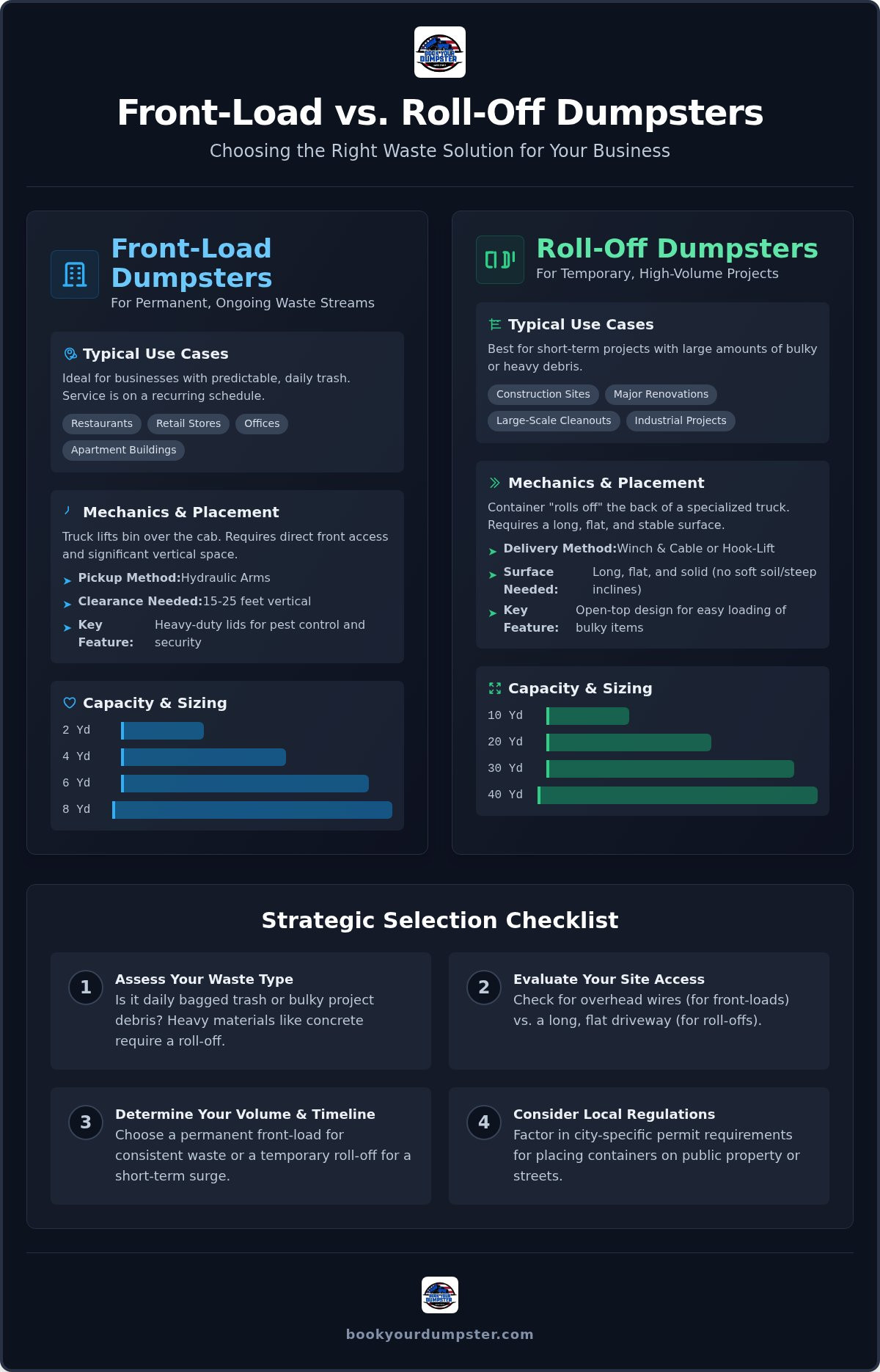
The mechanical operation of a front load vs roll off dumpster differs significantly. Front-load systems use hydraulic arms to lift bins over the truck's cab. Roll-off systems use a cable-and-winch or hook-lift mechanism to slide the container off a flatbed. These differences aren't just technical; they determine where you can physically place the bin on your property. A mistake in selection leads to blocked fire lanes or damaged overhead utilities. Match the container to your site's physical constraints to maintain a safe, high-functioning environment.
The Mechanics of Front-Load Pickup
Front-load trucks require specific approach paths. The driver pulls directly up to the bin, inserts the overhead arms into side slots, and lifts the container over the cab to dump it into the hopper. You must ensure at least 15 to 25 feet of vertical clearance. Low-hanging wires, tree limbs, or parking garage ceilings will block service. These bins feature heavy-duty lids to keep pests out and maintain urban security. If your site has high foot traffic, choose locking mechanisms to prevent unauthorized dumping. This setup is ideal for businesses with a predictable, daily waste stream that fits into smaller, 2 to 8-yard increments.
The Logistics of Roll-Off Delivery
Roll-off containers arrive on specialized flatbed trucks. The driver tilts the bed and uses a cable system to slowly "roll" the bin onto the ground. This process requires a long, flat surface to prevent the container from shifting or damaging the pavement. Don't place these on soft soil or steep inclines. Roll-offs are the industry standard for construction debris removal because their open-top design allows you to toss in bulky items like lumber, drywall, or old furniture with ease. They handle the massive surges of waste that a standard front-load bin simply cannot accommodate. Once the container is full, a truck hauls the entire unit away, replacing it with an empty one if your project is ongoing.
Capacity and Design: Comparing Sizes and Mechanical Requirements
Size selection is the most critical variable in your waste management budget. When evaluating a front load vs roll off dumpster, you're choosing between small-scale daily consistency and large-scale project capacity. Front-load bins typically range from 2 to 8 cubic yards. In contrast, roll-off containers start at 10 yards and scale up to 40 yards. This massive difference in volume dictates what you can throw away and how much you'll pay in weight-related fees.
Material density also limits your choice. Heavy debris like concrete, brick, or dirt belongs exclusively in roll-off containers. A front-load truck's overhead arms aren't designed to lift several tons of masonry. Attempting to overload a permanent bin leads to equipment failure and missed pickups. For high-volume projects, Book Your Dumpster USA provides a versatile range of 10, 20, 30, and 40-yard options to keep your site clear. Proper industrial waste management requires matching the right container to your specific material density to avoid logistical delays.
Front-Load Size Guide for Businesses
Permanent bins are designed for space efficiency. Small 2-4 yard bins fit perfectly behind boutique retail shops or small offices. They handle standard bagged trash and cardboard with ease. Mid-sized 6-8 yard bins are the industry standard for restaurants and apartment complexes. You must balance the bin size with your pickup frequency. If your 4-yard bin overflows twice a week, it's often more cost-effective to upgrade to an 8-yard bin rather than paying for extra weekly service visits.
Roll-Off Size Guide for Projects
For temporary surges, you need the footprint of a roll-off. A 10 yard dumpster rental is the smartest move for small shop fit-outs or office cleanouts. It holds roughly three pickup truck loads of debris. 20 and 30-yard containers are the workhorses of commercial renovations, while 40-yard dumpsters are essential for new construction sites where wood framing and drywall pile up fast. A 40-yard unit can hold between five and six tons of material, making it the most efficient choice for large-scale debris removal.
Weight limits play a massive role in your final bill. Exceeding these limits often results in overage fees ranging from $50 to $100 per ton. Consult our team to review dumpster rental prices and weight allowances before you book. You can view our full inventory online to find the exact dimensions for your loading dock or parking lot.
Strategic Selection: When Your Business Needs a Permanent Bin vs. a Temporary Rental
View your waste management as a logistical lever rather than a utility bill. The choice between a front load vs roll off dumpster depends entirely on your waste velocity. If you generate a steady, predictable volume of trash every week, a permanent bin acts as your operational anchor. If you're facing a sudden surge from a renovation or a warehouse cleanout, a temporary rental is the surgical tool you need. Assess your site's physical footprint before you commit to a service. A permanent bin requires a dedicated enclosure, while a roll-off needs temporary clearance for delivery and pickup.
Cost-benefit analysis should drive your decision. Monthly service fees for front-load bins offer consistency for your accounting department. One-time rental costs for roll-offs are project expenses that you can often bill back to a client or include in a renovation budget. Don't let a temporary project clutter your permanent waste area. Mixing construction debris with daily office trash leads to overage fees and safety hazards. Match the container to the specific waste stream to maintain pricing integrity and site safety.
Choosing Front-Load for Daily Operations
Retail stores, hotels, and corporate offices benefit most from front-load services. These bins provide operational stability through fixed pickup schedules. You don't have to call for service every time the bin is full. Instead, you rely on a rhythmic schedule that keeps your loading dock clear. These lidded containers are essential for managing odors and deterring pests in high-density urban areas. Following best practices for managing commercial waste ensures you remain compliant with local health codes while maintaining a professional appearance for your customers.
Choosing Roll-Off for Construction and Cleanouts
Project-based work demands a different approach. Secure a dumpster rental when your waste volume exceeds your daily capacity. Roll-offs offer the flexibility to place the container exactly where the debris is generated. On active job sites, high-velocity waste removal is key. We swap full bins for empty ones to keep your crew moving without delays. This strategy prevents the "Queens Challenge" of overflowing bins blocking public access. It also helps you navigate the front load vs roll off dumpster decision when your waste stream is erratic rather than rhythmic.
Regulatory compliance is no longer optional. As of June 1, 2026, New York City mandates containerization for all commercial waste to improve street cleanliness. Choosing a permanent bin helps you meet these requirements without daily logistical management. However, if your site lacks the space for a permanent enclosure, a temporary roll-off with a specific DOT permit might be your only legal path. Always verify your local zoning laws before finalizing your disposal strategy.
Local Logistics: Navigating Placement and Permits in Major Metro Areas
City-specific logistics often dictate whether you choose a front load vs roll off dumpster. The "Queens Challenge" refers to the difficulty of managing dumpster delivery in tight, high-density urban corridors where every inch of curb space is contested. If you place a container on a public street, you must secure a "Right-of-Way" or "Street Occupancy" permit. For 2026, NYC regulations require a DOT permit for any street-side placement. Additionally, all commercial haulers in New York City must be licensed by the Business Integrity Commission (BIC). We ensure our operations meet these strict standards so your business avoids heavy fines.
Topography and climate add another layer of complexity. San Francisco’s steep grades require specialized braking and leveling for roll-off delivery. In Chicago, winter weather accessibility is the primary concern. If a truck can't reach your bin due to snow accumulation, your waste sits. You must maintain clear access paths during the winter months to ensure punctual service and avoid logistical delays.
NYC and Queens Placement Rules
Pedestrian safety is the top priority for urban site managers. You must provide at least five feet of sidewalk clearance when placing a bin near a walkway. Use sidewalk protection boards to prevent cracks in the concrete from the heavy weight of a 40-yard container. Coordinate your delivery and pickup times to avoid peak rush hours or local street cleaning schedules. Improper placement on public property creates legal liabilities that can stop your project in its tracks. Always verify your specific block's regulations before scheduling a drop-off.
Chicago and Massachusetts Standards
Chicago’s grid system relies heavily on alleyway access for front-load trucks. You must verify that your alley provides enough width for the truck’s overhead arms to operate without hitting adjacent buildings. Matching the front load vs roll off dumpster to your specific alleyway clearance is essential for avoiding property damage. In Massachusetts, you must comply with strict waste bans. As of 2026, textiles and mattresses are banned from all state-regulated disposal facilities. Including these items in your commercial bin will result in violations ranging from $50 to $200. Clear snow from your loading area immediately after a storm so our drivers can complete your scheduled pickup without delay.
Avoid the stress of municipal red tape by working with a partner who knows the local landscape. Book your dumpster online today to secure the right equipment for your specific city and stay compliant with 2026 mandates.
Streamlining Your Waste Strategy with Book Your Dumpster USA
Stop wasting professional hours on hold with traditional haulers. Most national providers force a "call for quote" model that stalls your operations and complicates your accounting. Modern facility management requires digital-first tools that respect your time and project urgency. Whether you've finally decided on a front load vs roll off dumpster, the execution of your waste strategy should be the easiest part of your day. Book Your Dumpster USA removes the logistical friction by offering a fully integrated online platform for businesses in NY, NJ, IL, MA, and SF.
Pricing integrity is our core promise. We believe in transparent, flat-rate billing that eliminates the "sticker shock" of hidden environmental fees or administrative surcharges. In an industry often plagued by opaque pricing, our digital checkout provides immediate clarity. This transparency acts as a verbal handshake; it ensures you can budget for your 40-yard construction bin or your permanent front-load service with total confidence. We don't hide costs in fine print because we value long-term reliability over short-term gains.
How to Book Your Commercial Dumpster Online
Our streamlined system allows you to secure waste services in minutes. Follow these three steps to resolve your site's clutter:
- Step 1: Select your metro area and specific container size. Choose from our 10, 20, 30, or 40-yard options based on your material density and project scale.
- Step 2: Choose your delivery date through our real-time calendar. We provide live availability so you can coordinate exactly with your crew's schedule or facility needs.
- Step 3: Secure your rental with our transparent, no-hidden-fee checkout. Receive an immediate confirmation and digital receipt for your records without waiting for a callback.
The Book Your Dumpster USA Reliability Promise
We treat waste management as a high-functioning tool for your business. Reliability isn't just a goal; it's our standard operating procedure. You get direct access to professional waste experts who understand the nuances of urban delivery and 2026 municipal mandates. We provide punctual delivery and pickup to respect your project timeline, ensuring that a full bin never stops your progress. Our commitment to roll off dumpster rental excellence means we handle the logistics while you focus on the build. Trust our team to manage the front load vs roll off dumpster transition with the speed and honesty your commercial site demands.
Optimize Your Commercial Waste Strategy Today
Mastering the logistics of a front load vs roll off dumpster is the first step toward a high-functioning site. Use permanent front-load bins for daily retail or office trash to maintain operational consistency. Deploy roll-off containers for temporary construction surges where material weight and volume fluctuate. By matching the right container to your specific waste velocity, you eliminate overage fees and keep your site compliant with 2026 city mandates.
Book Your Dumpster USA provides the professional tools you need to manage these logistics without the industry friction. We offer transparent pricing with no hidden fees and real-time online booking to respect your project timeline. We serve NY, NJ, IL, MA, and SF with a focus on punctuality and pricing integrity. Take control of your site's cleanup today.
Book Your Commercial Dumpster Online Now and secure a streamlined disposal strategy that keeps your business moving forward.
Frequently Asked Questions
What is the primary difference between a front load and a roll off dumpster?
The primary difference between a front load vs roll off dumpster is the service duration and loading method. Front-load bins are permanent containers for ongoing commercial waste, emptied into a truck's hopper via overhead arms. Roll-off containers are temporary, open-top units delivered for specific projects and hauled away entirely when full. Choose front-load for daily retail or office trash and roll-off for one-time debris removal or construction surges.
Can I use a front-load dumpster for construction debris?
No, you shouldn't use a front-load dumpster for heavy construction debris. The hydraulic arms on front-load trucks are designed for bagged garbage and cardboard; they cannot lift the weight of concrete, brick, or masonry. Attempting to dispose of heavy materials in a permanent bin leads to equipment damage and missed collections. Use a roll-off container for all structural renovations to ensure safe mechanical handling and avoid weight-limit violations.
How do I know what size roll-off dumpster I need for a commercial renovation?
Select a 10-yard dumpster for small shop fit-outs or minor office cleanouts. For standard commercial renovations involving drywall and flooring, a 20 or 30-yard container is usually the most efficient choice. If you're managing a large-scale new construction site, opt for the 40-yard model. Match your container size to your estimated tonnage to avoid overage fees, which typically range from $50 to $100 per ton in 2026.
Do I need a permit for a dumpster in San Francisco or Queens?
Yes, you need a permit to place a dumpster on a public street in San Francisco or Queens. In New York City, as of June 1, 2026, you must comply with mandatory containerization laws and obtain a Department of Transportation (DOT) permit for any street-side placement. San Francisco requires debris recovery plans for commercial projects. Always verify localized requirements with the Department of Public Works before scheduling your delivery to avoid project delays.
How often are front-load commercial dumpsters picked up?
Front-load commercial dumpsters are picked up on a recurring schedule that matches your business's waste volume. Typical frequencies include weekly, twice-weekly, or daily service for high-volume restaurants and grocery stores. Consistent scheduling provides operational stability and prevents the overflow of lidded containers. Adjust your frequency rather than overfilling the bin to maintain site cleanliness and avoid penalties for lid-closure violations in high-density urban corridors.
What items are prohibited in commercial waste containers in 2026?
Prohibited items include hazardous materials, chemical waste, and electronic equipment. In Massachusetts, state landfill bans prohibit mattresses and textiles from being discarded in general waste containers; violations can result in fines between $50 and $200. Many jurisdictions, including parts of New York and Illinois, require commercial haulers to have specific permits for local drop-off facilities. Always check current state-level bans for electronics and tires before loading your bin to ensure you stay compliant with local environmental laws.
Can a roll-off dumpster be placed on a city street?
You can place a roll-off dumpster on a city street provided you have the correct municipal "Right-of-Way" permit. In high-density areas like Queens, you must coordinate placement to avoid blocking fire hydrants or pedestrian walkways. Ensure you use sidewalk protection boards if the container sits on a public pavement. Failure to secure the proper permit before delivery results in immediate fines and the potential removal of the container at your expense.
How much does it cost to rent a commercial dumpster for a one-time project?
One-time project costs vary based on container size, debris weight, and rental duration. Factors like landfill tipping fees, which typically range from $20 to $50 per ton in 2026, and local permit fees influence the final total. Street permits generally range from $20 to $150 depending on your city. Use our online booking system to view current availability and secure flat-rate billing for your specific metro area without hidden administrative surcharges.


