
If your business waste management strategy consists of crossing your fingers every Tuesday morning, you aren't running an efficient operation; you're managing a recurring crisis. It's frustrating to pay for a service that leaves bins overflowing or surprises you with hidden fees that weren't in your initial agreement. You need to focus on your customers, not whether your waste will still be on the curb when the health inspector arrives. Securing reliable commercial trash pickup is no longer just about cleanliness. In 2026, it's a matter of staying compliant with strict new laws like New York's Commercial Waste Zones and mandatory containerization requirements.
We agree that waste disposal should be a silent, high-functioning utility rather than a logistical burden. This guide will help you master the logistics of commercial waste management and find a schedule that keeps your business compliant and clean. We will walk through the latest municipal regulations in cities like San Francisco and NYC, explain how to achieve predictable monthly costs, and show you how a streamlined online booking process can handle your extra hauls without the usual stress.
Key Takeaways
- Identify the fundamental differences between residential pickup and commercial waste contracts to secure the right capacity for your specific facility needs.
- Compare the utility of front-load dumpsters for recurring waste against roll-off containers for large-scale construction or renovation debris.
- Stay compliant with 2026 mandates like NYC’s Commercial Waste Zones and specialized recycling laws in Illinois and Massachusetts to avoid penalties.
- Analyze the variables behind your commercial trash pickup invoice to eliminate hidden fees and establish predictable monthly expenses.
- Use a digital-first booking system to manage your waste logistics with punctuality and transparent pricing across key metropolitan areas.
What is Commercial Trash Pickup and Why Does Your Business Need It?
Commercial trash pickup is a structured logistical service designed to collect and manage waste from non-residential sources. Unlike residential curbside service provided by the city, commercial waste management relies on private contracts tailored to a company's specific volume and material types. Understanding What is Commercial Waste is the first step in recognizing that your business isn't just throwing things away; it's managing a regulated byproduct of your operations. This service ensures that your facility remains operational by removing debris that would otherwise obstruct your workflow.
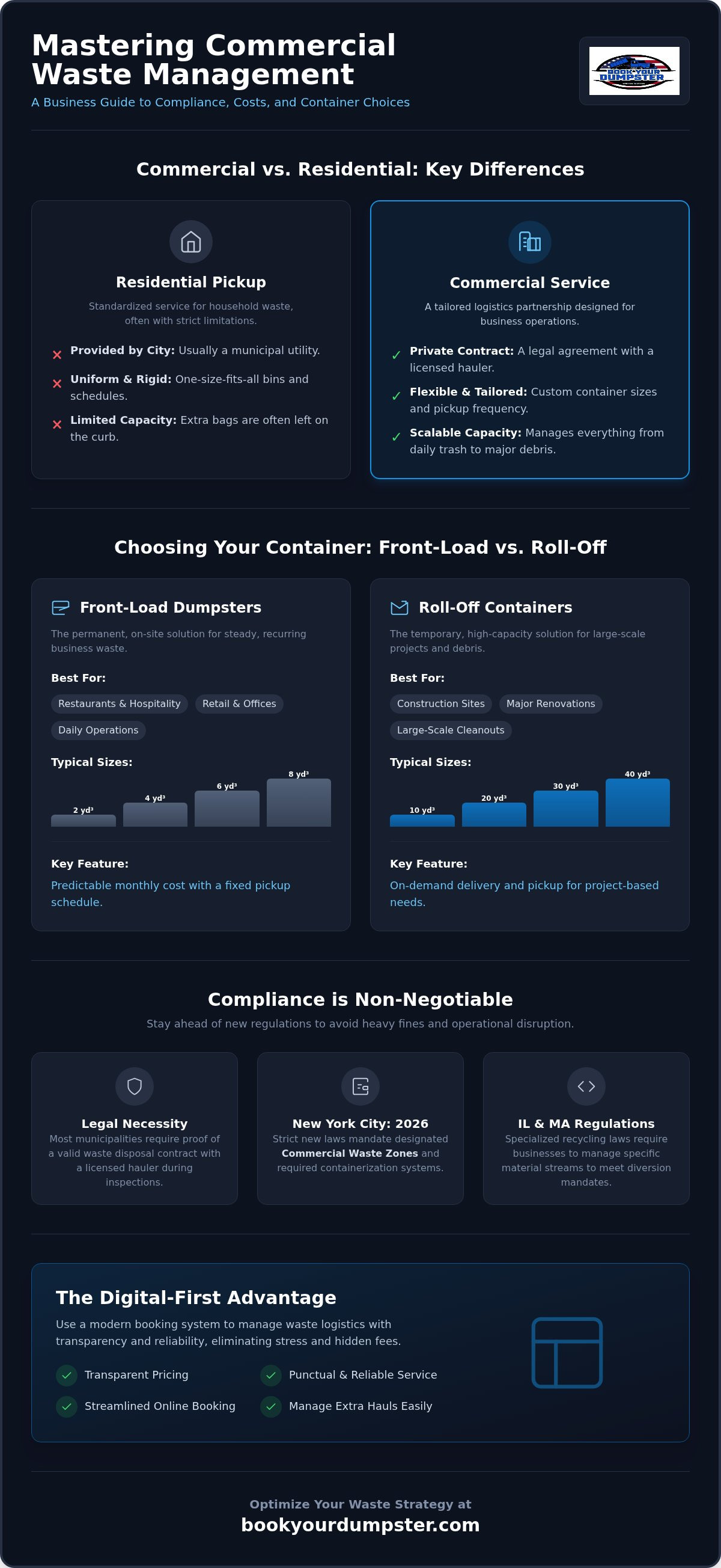
The differences between residential and commercial services are stark. Residential programs are usually uniform and rigid. If you have extra bags after a spring clean-up, the city carter might leave them on the curb. Commercial contracts offer flexibility in container sizes and pickup frequency. You aren't just paying for a truck to stop by; you're paying for a partner to ensure your facility remains functional. This level of service is essential for maintaining health and safety standards. A pile of trash behind a restaurant or retail store is a magnet for pests and a red flag for customers. It signals a lack of control and can damage your brand reputation instantly.
A "one-size-fits-all" approach fails because waste streams vary by industry. A retail shop produces high volumes of light packaging, while a construction site generates tons of heavy, dense materials. Reliable commercial trash pickup must be calibrated to these specific needs to avoid overflow and safety hazards.
The Legal Necessity of Commercial Waste Contracts
Most municipalities require businesses to prove they have a valid waste disposal contract with a licensed hauler. Inspectors often ask for these documents during routine checks. If you can't produce a current agreement, you face heavy daily fines and potential citations. In cities like New York, the transition to zoned collection makes these contracts even more critical for staying on the right side of the law. Commercial waste compliance in 2026 requires businesses to utilize designated, containerized collection systems that meet specific municipal zoning and diversion mandates.
Types of Businesses That Require Specialized Pickup
Waste needs are not universal. Different sectors produce different types of clutter that require specific handling and equipment.
- Retail and Office Spaces: These environments generate massive amounts of cardboard, paper, and packaging. High-frequency recycling is necessary to prevent fire hazards in storage areas.
- Restaurants and Hospitality: Organic waste and food scraps require leak-proof containers and strict sanitation schedules to prevent odors and health code violations.
- Industrial and Construction Sites: These sites deal with heavy debris like concrete, metal, and timber. They require heavy-duty roll-off containers rather than standard front-load bins to handle the weight.
Choosing the right service level prevents you from paying for empty air or dealing with the mess of an overfilled bin. It's about matching the tool to the task.
Choosing Between Front-Load and Roll-Off Dumpster Services
Selecting the right equipment is the difference between a clean facility and a logistical nightmare. Most businesses require a permanent solution for daily operations; others need a temporary high-capacity container for specific tasks. Your choice hinges on waste density and volume. Following Federal Guidelines for Commercial Waste ensures your storage and collection methods meet safety standards for urban environments. Matching your hardware to your waste stream prevents overfilled bins and safety hazards.
Front-load bins are the standard for recurring commercial trash pickup. These containers usually range from 2 to 8 cubic yards and stay on-site indefinitely. Roll-off dumpsters are much larger, ranging from 10 to 40 yards. Trucks deliver these for a set duration and haul them away once your job is complete. Understanding this distinction allows you to manage costs while keeping your site clear of debris.
When to Choose Permanent Front-Load Service
If your business generates a steady stream of low-density waste, like office paper or restaurant scraps, a front-load service is the most cost-effective path. You pay a fixed rate for scheduled collections. This creates a predictable budget. Standard frequencies range from weekly to daily pickups depending on your volume. Ensure your loading dock or alleyway has at least 14 feet of overhead clearance for the truck's lift arms to operate safely.
When to Rent a Roll-Off Dumpster for Commercial Projects
Project-based waste requires more muscle. If you are managing construction debris removal during an office renovation, a standard bin will overflow in minutes. Choose a roll-off container size based on the weight and scale of the debris:
- 10-Yard Dumpster: Ideal for heavy materials like concrete or small office cleanouts.
- 20-Yard Dumpster: The versatile choice for mid-sized renovations and roofing projects.
- 30-Yard Dumpster: Best for large-scale inventory liquidation or commercial landscaping.
- 40-Yard Dumpster: Necessary for major demolition or high-volume industrial waste.
Space is a critical factor for roll-off delivery. These trucks need a straight approach of at least 60 feet and significant vertical clearance to tilt the container into place. If you are unsure which size fits your footprint, you can use our online booking system to compare container dimensions before you schedule. Matching the container to your output prevents overage fees and ensures a punctual haul-away once your project is complete.
Local Regulations for Commercial Waste in NY, IL, and MA
Local laws dictate the efficiency and legality of your waste strategy. In 2026, major metropolitan areas have shifted toward highly regulated, zoned collection systems to reduce traffic and increase recycling rates. Failing to adapt to these changes results in more than just a missed collection; it leads to heavy municipal fines that hit your bottom line directly. Staying compliant requires a proactive approach to commercial trash pickup and a clear understanding of your specific city's mandates.
New York City's Commercial Waste Zones (CWZ) program is now in full effect as of January 6, 2026. Businesses must contract with a DSNY-designated carter for their specific geographic zone. Loose garbage bags are officially banned; all commercial waste must be stored and set out in containers. Pickups are restricted to a fixed window from 6 am to 9 am daily. Businesses in Brooklyn South and Queens Northeast had to sign their agreements by February 28, 2026, while those in Midtown South must finalize contracts between July 1 and August 31, 2026.
Illinois has intensified its focus on producer responsibility and urban recycling. As of 2026, the state's Extended Producer Responsibility (EPR) program for batteries requires sellers and distributors to manage recycling programs. In Chicago, commercial and high-density residential buildings must provide source-separated recycling services. If your facility generates significant battery waste or electronic scrap, you must utilize specialized collection streams to remain compliant with state disposal bans.
Massachusetts enforces a strict 0.5-ton weekly threshold for organic waste. If your business generates more than this amount, you are legally required to divert it from the landfill through composting or conversion. San Francisco continues its aggressive zero-waste push, mandating that all commercial entities separate compostables and recyclables from landfill trash. These regulations mean your choice of hauler must include robust diversion reporting to prove you are meeting local recovery goals.
Compliance Checklist for Urban Business Owners
Placement is a major hurdle in dense environments. If you need a container placed on the street in Queens or San Francisco, you must secure a municipal permit before delivery. Containers must be clearly labeled and often require specific enclosures to prevent illegal dumping by third parties. Understanding how dumpster rental in New York differs from suburban service is vital; urban carters operate on tighter schedules and face stricter spatial constraints that require precise coordination.
Navigating Commercial Recycling Mandates
Effective commercial trash pickup depends on proper sorting at the source. State laws in MA and IL require businesses to separate cardboard, metals, and electronics from general waste streams. Separating these materials reduces your "tip fees" at the landfill and can lower your overall service costs. Landfill taxes in major metropolitan areas are projected to increase by a minimum of 8% annually through 2026 as cities prioritize waste diversion. Compliance is the only way to avoid these rising costs.
Calculating the Real Cost of Commercial Trash Pickup
Your monthly invoice should be predictable, yet many businesses struggle with fluctuating waste expenses. Understanding the anatomy of your bill is the only way to maintain pricing integrity. Most commercial trash pickup agreements consist of a fixed base rate and several variable fees. The base rate covers the container rental and the scheduled stops. Variable fees often include fuel surcharges, environmental fees, and disposal costs based on weight. To avoid surprises, compare dumpster rental prices across your specific region to establish a baseline for your budget.
Pickup frequency and container size are the primary levers of your total cost. A smaller bin picked up daily often costs more than a larger bin picked up twice a week because you are paying for the truck's time and fuel. However, choosing a bin that is too large means you are paying to haul air. Audit your waste output over a 30-day period. Adjust your schedule until you find the balance where your bin is full on pickup day but never overflowing. This optimization prevents "dry run" fees where a hauler charges you even if the bin is empty.
Tonnage Limits and Overage Protection
Stay under your weight limit to avoid the most common hidden expense: overage charges. Every container size comes with a specific tonnage allowance. If you fill a 10-yard dumpster with heavy roofing shingles or concrete, you will likely exceed the limit. Lightweight materials like cardboard and office paper rarely trigger these fees. Estimate your waste density before you order. If your business experiences seasonal spikes, such as a retail surge in December, negotiate flexible terms that allow for temporary increases in frequency without permanent contract changes.
The Digital Advantage: Online Booking and Transparent Pricing
Traditional haulers often rely on opaque pricing models that require multiple phone calls and "custom" quotes. Digital platforms have modernized this industry by providing immediate, transparent pricing. You can see exactly what you are paying for before you commit. This is especially valuable for companies managing multiple locations; a single online portal allows you to track hauls and invoices across different metros from one dashboard. Punctuality is the ultimate cost-saver. A missed pickup leads to overflow, which results in municipal fines or emergency haul-away fees. Use a partner that prioritizes digital tracking to ensure your waste is removed on schedule every time. Book your commercial pickup online to secure a reliable schedule with no hidden fees.
Optimizing Your Waste Strategy with Book Your Dumpster USA
Book Your Dumpster USA functions as a precision tool for your business logistics. We provide a streamlined online booking system for 10, 20, 30, and 40-yard containers across major metros including New York, New Jersey, Illinois, Massachusetts, and San Francisco. Our approach removes the traditional stress of waste management by replacing vague schedules with punctual, digital-first service. We understand the specific municipal demands of these high-density markets and the urgency of your daily operations. Whether you need a permanent front-load solution for daily refuse or a temporary roll-off for a specific project, we act as a reliable partner that respects your operational timeline and your bottom line.
Managing waste in 2026 requires more than just a truck; it requires a data-driven strategy. Our platform allows you to oversee your entire waste stream from a single dashboard. This transparency ensures that you are never paying for empty hauls or dealing with the fallout of a missed collection. We focus on pricing integrity so you can budget with confidence, knowing that the price you see online is the price you pay on your invoice. We don't believe in the opaque communication styles common in this industry. Instead, we offer a direct, professional experience that treats waste removal as the silent utility it should be.
Customized Solutions for Homeowners and Contractors
We bridge the gap between permanent commercial needs and high-stakes project requirements. Contractors managing tight construction timelines depend on us for reliable debris containers that arrive and depart exactly when scheduled. If you are a property manager or business owner, you can transition seamlessly from a standard commercial trash pickup schedule to a temporary roll off dumpster rental during facility cleanouts or renovations. Our promise remains the same regardless of the project scale: pricing integrity and absolute punctuality. You won't find hidden surcharges or unexplained delays on our watch. We treat debris removal as a high-functioning tool that keeps your site safe and compliant.
How to Get Started Today
Getting your waste strategy under control takes less than five minutes. Start by visiting BookYourDumpster.com and entering your service address to see available options in your specific metro area. Selecting the right size is critical for maintaining a clean commercial footprint:
- 10-20 Yard Dumpsters: Best for small retail cleanouts, roofing projects, or urban sites with limited street access.
- 30-40 Yard Dumpsters: Necessary for large-scale construction, demolition, or high-volume industrial waste.
- Front-Load Service: The pragmatic choice for recurring, daily, or weekly business trash collection.
Once you choose your container and frequency, the system provides a transparent total. Confirm your booking through our digital portal to manage all your hauls from one centralized location. Stop worrying about your waste and start focusing on your business. Secure your commercial trash pickup service today.
Secure Your Business Waste Strategy for 2026
Reliable waste disposal is a silent utility that keeps your operations running without interruption. You've learned how to choose between front-load and roll-off hardware, navigate strict municipal mandates, and audit your invoices for hidden fees. Effective commercial trash pickup depends on a partner that values punctuality as much as you do. Don't let logistical stress or complex contracts distract you from your customers.
Book Your Dumpster USA provides transparent, no-nonsense pricing across NY, NJ, IL, MA, and San Francisco. Whether you need a 10-yard container for a quick cleanout or a 40-yard dumpster for a major project, our digital-first platform puts you in control. Secure a schedule that matches your specific business footprint and stay ahead of evolving city regulations with ease. Our streamlined system removes the friction from your logistics so you can focus on growth.
Book your reliable commercial trash pickup online now. It's time to turn your waste management into a high-functioning asset for your business.
Frequently Asked Questions
How often can commercial trash be picked up for my business?
Your pickup frequency depends on your specific waste volume and local health codes. Most businesses select a schedule ranging from once-weekly to daily collection. High-volume environments like restaurants often require daily service to manage organic waste and prevent odors. Use our online portal to select the frequency that matches your 30-day waste audit results for maximum efficiency.
What is the difference between a front-load and a roll-off commercial dumpster?
Front-load dumpsters are permanent fixtures for recurring commercial trash pickup and usually range from 2 to 8 cubic yards. Roll-off dumpsters are temporary, larger containers delivered for specific projects like renovations or cleanouts. We offer roll-offs in 10, 20, 30, and 40-yard sizes. Front-load bins are emptied on-site by a truck, while roll-offs are hauled away entirely when full.
Are there items that are prohibited from commercial trash pickup?
You cannot place hazardous materials, liquid waste, or flammable items in standard containers. Specific state laws also prohibit certain items; for example, Massachusetts bans the disposal of electronics and commercial organic waste over 0.5 tons per week. Illinois has strict Extended Producer Responsibility rules for batteries. Always check your local metropolitan guidelines to ensure your waste stream remains compliant and avoids heavy municipal fines.
How do I determine the right dumpster size for my retail store?
Start by evaluating your weekly volume of packaging and cardboard waste. A retail store usually benefits from a permanent front-load service for daily refuse. If you are performing a seasonal inventory liquidation or a store remodel, a 10 or 20-yard roll-off dumpster is more appropriate. Select a size that allows the lid to close completely to avoid overflow penalties and pest issues.
Can I change my pickup frequency if my business needs change?
You can adjust your service frequency through our digital booking system as your business needs evolve. This flexibility is vital for managing seasonal spikes in retail or hospitality. If your bins are consistently overflowing before your scheduled date, increase your frequency immediately to remain compliant with municipal health standards. Direct digital management ensures these changes take effect without the delay of traditional phone-based carters.
What happens if my dumpster exceeds the weight limit?
Exceeding the weight limit results in overage fees and potential safety hazards. If a container is too heavy, the truck's hydraulic system may be unable to lift it safely. This is common when mixing heavy debris like concrete or dirt into standard containers. Estimate your waste density before booking. If you anticipate heavy loads, choose a larger container with a higher tonnage allowance to maintain pricing integrity.
How do I set up commercial trash pickup in a city like New York or Chicago?
In New York City, you must contract with a DSNY-designated carter for your specific Commercial Waste Zone as of January 2026. All waste must be containerized because loose bags are prohibited. In Chicago, you must provide source-separated recycling services for commercial buildings. Use our platform to enter your address and automatically view the authorized commercial trash pickup options and container requirements for your specific metro area.
Does commercial trash pickup include recycling services?
Most commercial waste contracts now include or mandate recycling services to meet state diversion goals. San Francisco and Massachusetts require businesses to separate recyclables and organic waste from general trash. Separating these materials can reduce your overall disposal costs by lowering landfill tip fees. Our system helps you coordinate both trash and recycling streams through a single, transparent management portal to ensure total compliance.


