

Most businesses treat their trash like a background utility, but in 2026, efficient business waste removal is actually a high-stakes logistics strategy. You're likely tired of seeing "environmental surcharges" inflate your monthly bill or dealing with the health code headaches of a missed pickup. It’s frustrating when you can't get a straight answer on whether a 20-yard or 30-yard dumpster actually fits your specific project.
This guide shows you how to take back control. You will learn to optimize your waste strategy, select the exact container sizes you need, and stay fully compliant with the shifting municipal laws in New York, New Jersey, Illinois, and Massachusetts. We'll break down the 2026 regulatory landscape, from New York’s new waste zones to the strict organic diversion mandates in Massachusetts. Stop guessing about your overhead. Use these insights to lock in predictable monthly costs and eliminate logistical friction with total confidence.
Key Takeaways
- Learn how to optimize your business waste removal strategy by distinguishing between recurring front-load services and project-based roll-off dumpsters.
- Identify the correct container capacity for your square footage, ranging from 10-yard units for small retail updates to 40-yard dumpsters for major construction.
- Stay compliant with 2026 state-specific mandates, including New York’s waste zones and organic diversion requirements in Massachusetts and New Jersey.
- Protect your budget from hidden fees by mastering the difference between flat-rate and variable pricing models before you book.
- Use a streamlined online booking system to manage debris removal with minimal logistical effort and total pricing transparency.
Business Waste Removal vs. Residential Service: Key Differences
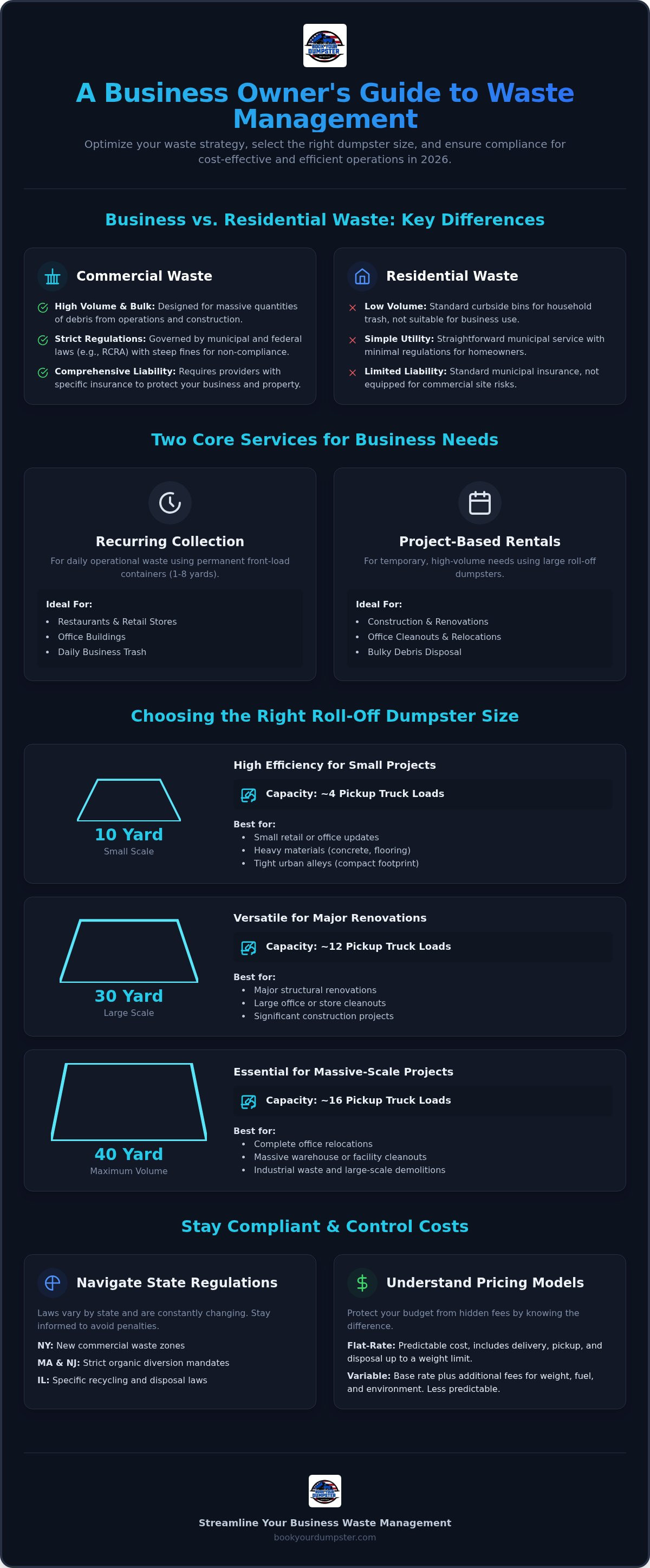
Residential trash pickup is a straightforward utility. You place a bin on the curb, and the city hauls it away. In contrast, commercial waste management is a complex logistics operation. It involves massive volumes, specific material regulations, and strict legal requirements that vary by municipality. Most local governments legally bar businesses from using residential curbside programs. Using the wrong service can lead to steep fines or service interruptions that halt your operations. Professional business waste removal bridges this gap by providing the right equipment and ensuring your company stays on the right side of local laws.
Liability is another major differentiator. Commercial sites are active environments with employees, customers, and heavy machinery. A residential hauler isn't typically insured for the risks associated with a commercial loading dock or a construction site. You must partner with a provider that carries comprehensive insurance. This protects your property from damage during container placement and shields your business from liability if an accident occurs during a pickup. It is a matter of protecting your bottom line from unexpected legal or repair costs.
Recurring Waste Collection for Daily Operations
Retail stores, restaurants, and office buildings rely on front-load containers for their daily trash needs. These containers typically range from 1 to 8 yards and stay on your property permanently. You choose a pickup frequency that matches your waste output. For a restaurant, daily service is often necessary to maintain health standards and prevent pest issues. A small retail shop might only require a weekly pickup. The key is to find a rhythm that keeps your site clean without paying for unnecessary hauls. It's about maintaining a professional appearance while controlling your monthly overhead.
Project-Based Roll-Off Rentals for Business Growth
When your business undergoes a major change, your standard bins won't suffice. Office renovations, store cleanouts, and construction projects generate bulky debris like drywall, old furniture, and heavy packaging. This is where roll-off dumpsters become essential. These are temporary, high-capacity containers designed for heavy-duty disposal. You can book a 10, 20, 30, or 40-yard dumpster through Book Your Dumpster to handle these one-time surges. This project-based approach to business waste removal offers more flexibility than a long-term contract, allowing you to scale your waste capacity up or down based on the specific phase of your project.
Choosing the Right Dumpster Size for Your Commercial Project
Selecting the wrong container size is the fastest way to blow your budget. If you choose a dumpster that's too small, you'll pay for extra hauls. If it's too large, you're paying to haul air. Match your project's square footage and material density to the right capacity to keep your business waste removal costs predictable. Most commercial projects fall into distinct categories based on the volume of debris they generate.
10 Yard Dumpster: Small Scale, High Efficiency
This is the surgical tool of waste management. Use a 10-yard dumpster for small boutique updates or when you're tearing up heavy materials like roofing shingles, flooring, or concrete. It features a compact footprint, making it the only viable choice for tight urban alleys in Queens or Boston where a larger truck cannot maneuver. One 10-yard dumpster holds approximately four pickup truck loads of debris. It's efficient, easy to load, and keeps your job site organized without taking up valuable parking spaces.
30 And 40 Yard Dumpsters: Large Scale Commercial Waste
Large-scale projects require serious volume. The 30 and 40-yard containers are the primary solutions for major structural renovations, complete office relocations, or massive warehouse cleanouts. A 40-yard dumpster handles high-volume waste that would overwhelm smaller units. Don't make the mistake of overfilling a 20-yarder to save money; haulers cannot legally transport overloaded containers, and you'll end up paying for a secondary rental anyway.
When dealing with industrial waste or massive amounts of construction debris, you must account for weight limits. The Resource Conservation and Recovery Act (RCRA) provides the framework for how these materials are managed, but on a practical level, you need to ensure your container can handle the tonnage. If you're clearing out a 10,000 square foot facility, the 40-yard option is your best bet for a single-trip resolution. You can view specific dimensions and book your container directly through our online system to ensure you have the right tool for the job.
For mid-sized renovations, the 20-yard dumpster remains the industry workhorse. It's ideal for removing carpet and drywall from a 2,000 to 3,000 square foot office suite. By choosing a size that slightly exceeds your estimated waste, you create a buffer for the unexpected debris that inevitably appears during a commercial tear-out. This proactive planning is the hallmark of professional business waste removal and keeps your project on schedule.
Navigating Local Regulations in NY, NJ, IL, and MA
Municipal codes for business waste removal aren't mere suggestions; they are legal requirements with significant financial consequences. In New York, the commercial waste zone system is currently in a critical transition. If your business operates in the Midtown South zone, you must have a contract with an authorized hauler by August 31, 2026. Missing this deadline will result in service interruptions and daily fines. In New Jersey, verify that your service provider holds a valid A-901 license. This is a mandatory requirement for any entity transporting or brokering solid waste within the state. These localized rules ensure that commercial debris doesn't overwhelm public infrastructure or violate environmental safety standards.
Street Permits and Placement Rules
You must secure a "Right of Way" permit if your dumpster cannot fit on private property. This is a common hurdle in dense urban centers like Chicago or Manhattan. You're responsible for the container's placement and visibility. Local ordinances often require safety markings, such as reflectors or high-visibility cones, to protect nighttime traffic. Failing to mark a container properly can lead to immediate citations or liability for accidents. For a detailed breakdown of these requirements, consult our guide on Dumpster Rental in New York, Illinois, and Massachusetts before scheduling your delivery.
Commercial Recycling Compliance
State-level mandates are becoming stricter regarding what you can legally throw away. As of 2026, Massachusetts businesses generating more than one-half ton of organic waste per week are banned from sending it to landfills. You must implement a verified composting or diversion program to remain compliant. In Illinois, the Consumer Electronics Recycling Act has been extended through 2031; this law bans most electronics from landfills and requires you to use registered e-waste collectors. Proper sorting protects your company from the EPA's maximum RCRA fines, which can reach $87,249 per day per violation in 2026. Use the EPA Guide for Commercial Buildings to help your staff identify and sort banned materials correctly.
Be aware of specific prohibited items that vary by town. In Lexington, Massachusetts, mattresses and box springs carry a $49.50 fee per item as of September 1, 2026. In New Jersey, disposing of more than ten auto tires can cost $300 per ton. Identifying these items before they hit the dumpster prevents unexpected surcharges and keeps your business waste removal budget on track. Always confirm the current list of banned materials with your provider to avoid municipal penalties.
The True Cost of Commercial Waste: Pricing and Efficiency
Pricing for business waste removal shouldn't be a mystery. Most providers use either a flat-rate or a variable-rate model. A flat rate is generally safer for budgeting because it covers the delivery, pickup, and a set tonnage limit in one upfront cost. Variable models might look cheaper initially but can skyrocket once the landfill scales record the final weight. Always confirm the weight limit before the container hits your site to avoid unexpected overage charges. For a detailed breakdown of these variables, consult our guide on Understanding Dumpster Rental Prices.
Tonnage is the hidden factor that determines your final bill. If you're clearing out a retail space and toss in heavy fixtures or masonry, you might quickly exceed the limit of a 20-yard unit. Additionally, ensure the drop-off zone is clear. If a driver cannot access the site due to locked gates, parked vehicles, or low-hanging wires, you'll face "dry run" fees. These are avoidable expenses that stem from poor site preparation. Clear the path and keep the site accessible to maintain your budget.
Avoiding Hidden Surcharges
Many legacy haulers rely on "call for a quote" models that hide fuel surcharges and environmental fees until the invoice arrives. Transparent online pricing is superior because it allows you to compare costs in real-time without the sales pressure. Schedule your pickups at least 24 hours in advance. This simple step eliminates rush fees and ensures your site stays clean without the premium cost of an emergency haul.
Maximizing Dumpster Space to Save Money
Strategic loading is a skill that directly saves money. Place heavy, bulky items at the bottom to create a stable base and layer flat materials like plywood or broken-down cardboard on top to fill the gaps. Air gaps in a dumpster are wasted money for a business. If you are hauling high-density debris like concrete, brick, or dirt, renting two 10-yard dumpsters is often cheaper than triggering a "heavy load" penalty on a 30-yarder. This approach keeps you within legal weight limits while maximizing every cubic yard of space you've rented.
Get a transparent price today. Book your commercial dumpster online and eliminate the guesswork from your project budget.
Streamlining Your Business Waste with Book Your Dumpster
Effective business waste removal requires a partner that values your time as much as you do. We take a pragmatic approach to debris management. This means providing a high-functioning tool rather than a complex service agreement. Professional sites don't have room for logistical delays or opaque communication. Reliability and punctuality are the primary metrics we use to measure our success. When your project depends on a clean site, you need a partner that delivers and picks up exactly as scheduled.
We have modernized a traditional industry through digital convenience. You no longer need to navigate a maze of "Business Shop" interfaces or wait days for a sales representative to return a call. Our system is designed for speed and transparency. For a deeper look at how this process integrates into your project planning, read our Roll Off Dumpster Rental Guide. We provide the clarity you need to move from a state of clutter to a state of resolution without the cognitive load of traditional waste contracts.
Online Booking for Busy Professionals
Manage your waste logistics from your desktop or smartphone in minutes. The process is direct. Select your required size, choose your city from our service areas in NY, NJ, IL, MA, or SF (Queens), and secure your delivery date. You get real-time availability and immediate confirmation. This eliminates the friction of the "quote-and-wait" model. If your project timeline shifts, use our online system to manage extensions without the hassle of multiple phone calls. It is business waste removal built for the digital-first professional.
Dedicated Support for Contractors and Facility Managers
While our system is digital, our expertise is grounded in local reality. We understand the site constraints unique to New York alleys and Chicago construction zones. Contractors and facility managers get access to experts who provide customized solutions for heavy construction debris or high-volume warehouse cleanouts. We offer 10, 20, 30, and 40-yard dumpsters to ensure you never pay for more capacity than your site can handle. Secure your commercial dumpster today at Book Your Dumpster and experience a no-nonsense approach to waste logistics.
Master Your 2026 Waste Logistics
Business waste management is no longer a background task; it is a critical component of your operational efficiency. You now have the tools to choose between 10, 20, 30, and 40-yard containers based on your specific project volume. You also understand how to stay ahead of evolving municipal codes in New York, New Jersey, Illinois, and Massachusetts. By prioritizing transparent pricing and punctual service, you eliminate the hidden fees and missed pickups that drain your budget.
Professional business waste removal should be predictable and effortless. Don't let debris stall your growth or lead to regulatory penalties. Our no-nonsense online booking system is designed to get you from clutter to resolution in minutes. Take control of your site today. Book your professional business waste removal container online now and experience the reliability of a partner that respects your time. Clear your site and get back to work.
Frequently Asked Questions
What is the difference between commercial waste and industrial waste?
Commercial waste is generated by businesses such as offices, retail stores, and restaurants. It typically consists of packaging, food scraps, and office supplies. Industrial waste results from manufacturing, power generation, or factory processes. Industrial streams often involve chemicals, sludge, or metals that require specialized handling under stricter environmental regulations than standard commercial debris.
Do I need a permit for a business dumpster on my own property in New York?
You do not typically need a permit to place a dumpster on your own private property in New York. Permits are only mandatory when the container is placed in the public "Right of Way," such as a street or sidewalk. Always ensure the delivery truck has enough clearance to access the site without blocking public access or violating local zoning rules.
Can I throw office electronics and monitors in a rental dumpster?
No, you cannot dispose of electronics or monitors in a standard rental dumpster. States like Illinois and Massachusetts have strict bans on landfilling e-waste. You must use registered e-waste collectors for items like computers, printers, and televisions to remain compliant with state laws and avoid municipal fines that can reach thousands of dollars per violation.
How often should a business have its trash picked up to stay compliant?
Pickup frequency depends on your business type and local health codes. Restaurants often require daily or tri-weekly pickups to manage organic waste and prevent pest issues. For standard office environments, a weekly schedule is usually sufficient for business waste removal compliance. Always check your specific municipal sanitation requirements to avoid citations for overflowing containers.
What happens if my business dumpster exceeds the weight limit?
If your dumpster exceeds the agreed tonnage limit, you will face overage fees calculated per ton. If the container is too heavy for the truck to lift safely, the driver will not perform the pickup. You will then be responsible for removing the excess weight and paying a "dry run" fee for the failed pickup attempt. This is why matching container size to material density is vital.
Is recycling mandatory for businesses in Illinois and New Jersey?
Yes, recycling is mandatory for businesses in both states. New Jersey requires businesses to separate recyclable materials from their trash stream. In Illinois, the Solid Waste Management Act mandates that commercial entities implement recycling programs for cardboard and paper. Effective business waste removal strategies must include these diversion efforts to comply with state laws and protect your budget from penalties.
How much space does a 30-yard roll-off dumpster require for delivery?
A 30-yard dumpster is typically 22 feet long, but the delivery truck requires about 60 feet of straight-line clearance to drop the container. You also need at least 23 feet of vertical clearance to account for the truck's lift mechanism. Ensure the designated area is free of low-hanging wires, tree branches, and parked vehicles before the driver arrives to avoid delivery delays.
Can I rent a dumpster for a one-day office cleanout?
Yes, you can rent a dumpster for a single day. While standard rental periods often last seven to ten days, we offer the flexibility to schedule a same-day or next-day pickup once your cleanout is finished. This is an ideal solution for office relocations or quick renovations where you want to clear the site and restore parking access for your employees and customers immediately.


