
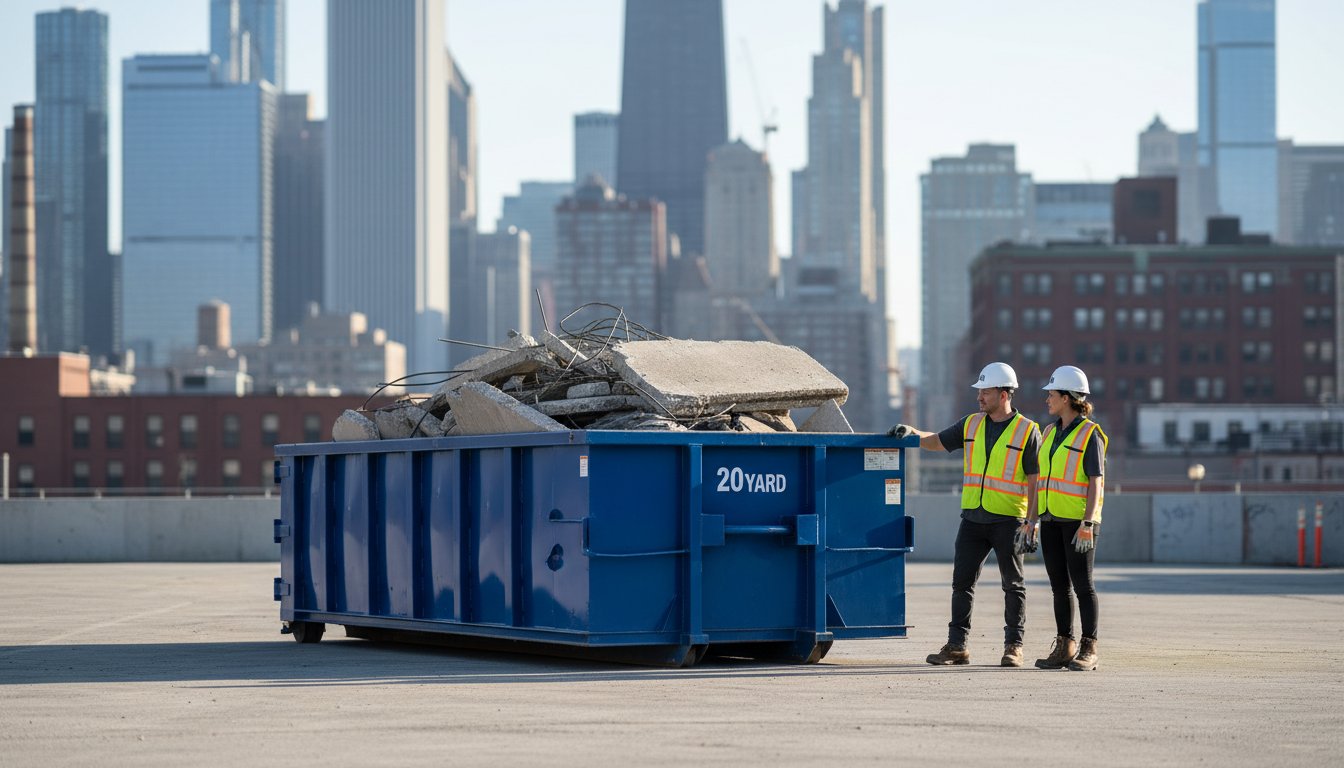
Filling a 20 yard dumpster to the brim with concrete is the fastest way to ensure your project stays stuck on the curb. While these containers have a 10-ton physical capacity, standard rental agreements in April 2026 often include only 2 to 4 tons of debris. Concrete weighs approximately 150 pounds per cubic foot, meaning a full load will quickly exceed road weight limits and truck lifting capacities. You need a 20 yard dumpster for concrete disposal that arrives on time and leaves without a hitch.
We know the headache of hidden overage fees and local permit confusion in dense areas like NYC or Chicago. You want your site cleared without the stress of a rejected haul. This guide teaches you how to manage heavy debris using the "Half-Full Rule" to stay compliant with strict regulations in New York, Illinois, and Massachusetts. You'll learn to secure transparent pricing and navigate the 2024 Illinois EPA permit requirements for recovery facilities. Follow these steps to ensure your concrete removal is successful, legal, and completed in a single trip.
Key Takeaways
- Learn why concrete density requires a specific weight-focused strategy to prevent trucks from being unable to lift your container.
- Optimize your project site by comparing the physical dimensions and lower wall heights of 10-yard versus 20-yard containers for easier loading.
- Use a 20 yard dumpster for concrete disposal while strictly following the "Half-Full Rule" to comply with heavy hauling regulations in urban corridors like Chicago and NYC.
- Avoid hidden overage charges by mastering "Clean Loading" techniques that keep dirt and trash out of your masonry bins.
- Navigate state-specific disposal bans in Massachusetts and new EPA permitting requirements in Illinois with our localized waste management expertise.
Why Concrete Disposal Requires a Specialized 20 Yard Dumpster Strategy
Concrete disposal isn't a standard cleanup task. In the waste industry, concrete is classified as "heavy debris" because of its extreme density. Unlike household junk, where you usually run out of space before you hit weight limits, masonry and asphalt work the opposite way. You'll hit the truck's lifting capacity long before the container looks full. Choosing a 20 yard dumpster for concrete disposal provides the physical footprint you need for large slabs, but it requires a specific loading strategy to avoid project delays and rejected hauls.
Standard residential dumpsters aren't built for industrial-weight loads. Using a bin not rated for heavy debris often leads to structural damage or trucks that simply cannot move. We see this often in dense urban corridors like NYC or Chicago, where narrow streets make it impossible for a secondary truck to assist an overloaded container. You must balance the physical size of the debris with the mechanical limits of the equipment picking it up.
The Volume vs. Weight Challenge
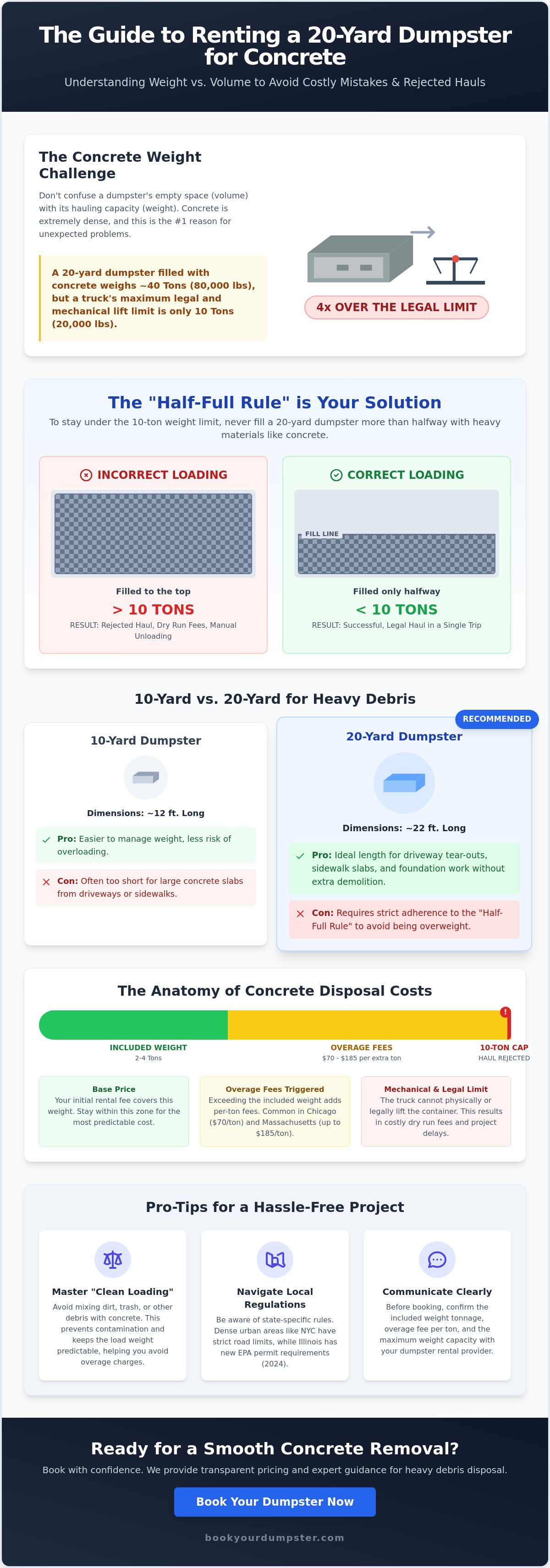
Don't confuse volume with weight capacity. A 20-yard container holds 20 cubic yards of space. However, 20 cubic yards of solid concrete weighs approximately 80,000 pounds. That's four times the legal road limit for most heavy-duty roll-off trucks in New York and Illinois. Most hydraulic arms and winches are mechanically rated for a 10-ton (20,000 lbs) maximum. If you fill the bin to the top, the truck won't be able to lift it. This results in "dry run" fees and the back-breaking task of unloading the excess by hand. Capacity refers to the space inside the walls, but the limit refers to the weight the truck can legally and safely transport.
When to Choose a 20-Yard Over a 10-Yard Bin
Many rental companies suggest using a 10-yard bin for all heavy debris. While a 10-yarder is easier to manage for weight, its 12-foot length is often too short for modern construction needs. If you're tackling driveway tear-outs or sidewalk replacements, you'll likely have slabs longer than 10 feet. A 20 yard dumpster for concrete disposal typically measures 22 feet long. This extra length allows you to lay down long sections of debris without spending hours on additional demolition. Contractors in Illinois and Massachusetts prefer this larger footprint for projects involving driveway removals, retaining walls, and foundational slabs. This size is also ideal for concrete recycling programs, as it provides enough floor space to keep materials separated and clean.
- Driveway Tear-outs: Fits long slabs without extra cutting.
- Sidewalk Replacements: Matches the typical length of municipal sections.
- Foundation Work: Handles heavy footings and reinforced masonry.
Understanding Weight Limits: The 10-Ton Cap in NY, IL, and MA
Every roll-off truck has a mechanical breaking point. The 10-ton (20,000 lbs) limit is the industry-standard physical ceiling for a 20 yard dumpster for concrete disposal. This isn't a suggestion; it's a safety requirement for the winch and hydraulic systems. In Chicago, exceeding your 3-ton allowance typically costs $70 per extra ton. In Massachusetts, some providers charge up to $185 per ton for overages. You won't know the final weight until the truck hits the transfer station scales. These facilities record the truck's weight both before and after dumping to ensure the load meets state C&D landfill regulations regarding heavy debris management.
Don't confuse the physical capacity with the included weight in your rental agreement. While the container can hold 10 tons, standard contracts in NYC often include only 2 to 3 tons (4,000 to 6,000 lbs) in the base price. Exceeding this "included" weight triggers overage fees, but exceeding the "10-ton cap" means the truck cannot legally or physically haul the load. This leads to dry run fees and requires you to unload the heavy material yourself. Check your local requirements and book your dumpster with a clear understanding of these limits.
New York and Massachusetts Road Restrictions
Urban density in NYC and Boston adds another layer of complexity. The New York Department of Transportation (DOT) strictly enforces bridge weight limits and "no-truck" zones in residential corridors. If your project site is in a historic district or a narrow street, you'll likely need a specific permit for street placement. Heavy concrete loads are high-risk for cracking asphalt on residential roads. Local regulations often require specific route planning to avoid weight-restricted infrastructure. Always verify your local zoning before you schedule your delivery to avoid permit fines or rejected drop-offs.
How to Estimate Your Concrete Weight
Don't guess your load weight. One cubic yard of solid concrete weighs roughly 4,000 pounds based on the standard density of 150 pounds per cubic foot. This means just 5 cubic yards of concrete reaches the 10-ton hauling limit. If you fill a 20-yard container to the top, you're looking at nearly 40 tons of material, which is impossible to haul. The 10-ton limit is the maximum safe hauling capacity for roll-off trucks and must never be exceeded. Use these benchmarks to stay safe:
- 1 Cubic Yard: ~4,000 lbs (2 tons).
- 3 Cubic Yards: ~12,000 lbs (6 tons).
- 5 Cubic Yards: ~20,000 lbs (10 tons - Absolute Maximum).
Comparing 10 Yard vs. 20 Yard Dumpsters for Heavy Masonry
Choosing between a 10-yard and 20-yard container isn't just about how much debris you have. It's about the physical dimensions of the waste. A 20 yard dumpster for concrete disposal typically measures 22 feet long, 8 feet wide, and 4 feet high. While a 10-yarder is often the go-to for heavy materials, its shorter length (usually 12 feet) creates a bottleneck for contractors handling long driveway slabs or sidewalk sections. If your debris consists of large, unbroken pieces of masonry, the 22-foot floor of a 20-yarder allows you to lay material flat rather than stacking it precariously.
Site space is the primary trade-off. You need at least 60 feet of straight-line clearance for a truck to drop a 20-yard container. In dense urban areas like Brooklyn or downtown Chicago, this footprint often requires a street permit that a smaller 10-yarder might avoid. However, if you have the space, the utility of the larger bin often outweighs the logistical hurdle of securing a permit. Ensure your site can accommodate the 22-foot length before you schedule your delivery.
Dimensional Advantages for Contractors
The 4-foot wall height of a 20-yarder is a major benefit for mechanical loading. Standard 30 or 40-yard bins have walls up to 8 feet high, making it impossible to load from the side with a skid steer or small excavator. The lower profile of a 20-yarder allows operators to dump buckets over the side without specialized high-lift equipment. The extra floor space also accommodates rebar and reinforced concrete chunks that don't fit in smaller bins. If your project involves smaller residential cleanups or tight driveways, consult our 10 yard dumpster guide to see if a smaller footprint fits your needs better.
Cost Efficiency in the Tri-State and Midwest
One delivery of a 20-yarder is almost always cheaper than two deliveries of a 10-yarder. You save on fuel surcharges and administrative fees. In Illinois and New York, "Clean Concrete" recycling programs offer significant financial incentives. For example, as of April 2026, clean concrete disposal at some Massachusetts facilities costs as little as $15 to $30 per ton. Mixed construction debris can cost four times that amount. By using a 20 yard dumpster for concrete disposal and keeping the load "clean" (free of trash, wood, or soil), you maximize your tonnage allowance while minimizing disposal costs. This strategy is especially effective for commercial contractors in the Midwest who manage high-volume demolition projects and need to maintain strict budget controls.
- 20-Yard Length: 22 feet (Best for long slabs).
- 10-Yard Length: 12 feet (Best for tight alleys).
- Wall Height: 4 feet (Ideal for skid steer loading).
How to Safely Load Your 20 Yard Dumpster (The Half-Full Rule)
Loading a heavy-duty container requires more than just throwing debris over the wall. To ensure a safe pickup, you must follow the "Half-Full Rule." Because concrete is significantly denser than household waste, filling a 20 yard dumpster for concrete disposal to the top will make it impossible for a truck to lift. Most roll-off trucks reach their mechanical limit when the container is only 50% full of masonry. Use the horizontal ribs on the side of the bin as a visual guide. Once the debris reaches that halfway mark, stop loading immediately.
Clean loading is the second pillar of a successful project. This means keeping your bin free of "contaminants" like soil, tree roots, or general construction trash. As established by the New York State Department of Environmental Conservation, uncontaminated masonry is easier to process at recovery facilities. If you mix in garbage, your load is reclassified as mixed C&D, which carries higher disposal fees and may be rejected by recycling centers. Focus on packing the material tightly. Minimize air pockets by placing smaller chunks into the gaps between larger slabs. This prevents the load from shifting during transport; a shifting 10-ton load can cause the truck to tip during the steep angle of a roll-off pickup.
Step-by-Step Loading Sequence
Follow a logical order to maintain balance and maximize your 10-ton allowance. Start by laying the largest, heaviest slabs flat on the bottom of the container. This creates a low center of gravity. Next, fill the voids with smaller pieces of broken concrete or brick. This "nesting" technique ensures you aren't wasting the limited space below the halfway line. Finally, level the load. No debris should stick out over the sides or ends of the bin, as this creates a significant road hazard for the driver and other motorists.
Preparing Your Site in IL, NY, or MA
The 10-ton pressure from a loaded concrete bin can easily crack a standard residential driveway. Protect your property by placing street pads or 3/4-inch thick plywood boards under the dumpster's steel rollers. You also need a clear path for the delivery vehicle. Ensure there is at least 60 feet of linear clearance for the truck to drop and hook the container. In older Massachusetts neighborhoods or dense Chicago alleys, look up for low-hanging power lines or tree branches. The truck needs roughly 22 feet of vertical clearance to safely tilt the hoist and secure your load. When you are ready to start your demolition, book your dumpster through our streamlined online system for guaranteed on-time delivery.
- The Half-Full Rule: Never exceed the 50% mark for solid concrete.
- Weight Distribution: Keep the heaviest material centered and low.
- Driveway Protection: Always use plywood to distribute the 20,000-pound pressure.
Book Your Concrete Dumpster with Book Your Dumpster USA
Stop worrying about the logistics of heavy hauling. Managing a 20 yard dumpster for concrete disposal shouldn't be the hardest part of your demolition project. Book Your Dumpster USA has modernized the process to remove the friction from waste management. Our digital-first approach ensures that whether you're a homeowner in Chicago or a contractor in Boston, you have the tools to clear your site quickly. Concrete removal is a high-stakes task where a single mistake with weight limits can stall a project for days. We understand the urgency of your construction schedule and provide the reliability you need to stay on track.
Our streamlined online system is designed to provide instant solutions. You can select your container, specify the debris type, and pick a delivery date in under five minutes. This digital convenience is backed by a professional fleet ready to handle the 10-ton requirements of masonry hauling. In the Tri-State area and across the Midwest, Book Your Dumpster USA serves as a dependable partner for both residential DIYers and professional crews. We know that a sidewalk tear-out in Queens requires different logistics than a foundation project in Springfield. Our team manages the regulatory hurdles so you don't have to. We stay updated on the latest 2024 Illinois EPA mandates and New York DOT weight restrictions to ensure your project remains compliant.
Transparent Pricing for Heavy Debris
Hidden fees are a common headache in the dumpster industry. We don't use them. Our flat-rate pricing model ensures you know the cost upfront. This includes delivery, pickup, and a set tonnage allowance tailored to your specific region. For a detailed breakdown of regional costs as of April 2026, consult our Dumpster Rental Prices Guide. Book Your Dumpster USA maintains a strong local presence in New York, Illinois, and Massachusetts. This local grounding allows us to navigate regional weight limits and disposal regulations with precision. If you're managing a large-scale commercial cleanout, our experts coordinate multiple bins and tight swap-out schedules to keep your site operational.
Ready to Start Your Project?
Your project timeline depends on reliable service. We prioritize on-time delivery and pickup because a late dumpster delays your crew and inflates your labor costs. We don't let that happen. Our system is built for speed and simplicity. You don't need to wait for a callback or a manual quote to get started. Choose your size and schedule your delivery today. Visit bookyourdumpster.com for instant availability in your zip code. Book Your Dumpster USA handles the heavy lifting so you can focus on the build. Book your dumpster now and experience a professional, no-nonsense approach to a 20 yard dumpster for concrete disposal.
- Instant Booking: Secure your bin online in minutes.
- No Hidden Fees: Transparent, flat-rate pricing for every load.
- On-Time Guarantee: Reliable delivery and pickup to protect your timeline.
Clear Your Site with Professional Concrete Hauling
Clear your site without the logistical stress of rejected loads or hidden overage fees. Managing heavy debris requires strict adherence to the "Half-Full Rule" to stay within the 10-ton mechanical limits of roll-off trucks. You've learned that the 22-foot footprint of a 20 yard dumpster for concrete disposal offers the best utility for driveway slabs and sidewalk sections while keeping your project compliant with road weight limits in New York, Illinois, and Massachusetts.
Don't risk your construction timeline with unreliable hauling. Our specialized heavy-debris equipment and on-time delivery ensure your demolition stays on schedule. We provide a no hidden fees guarantee so you can budget with total transparency. Whether you're navigating NYC bridge restrictions or the 2024 Illinois EPA permit requirements, we have the local expertise to handle the details.
Take control of your waste management today. Book your 20 yard dumpster for concrete disposal now and experience a no-nonsense service that respects your time and project urgency. Your clean site is only a few clicks away.
Frequently Asked Questions
Can I fill a 20 yard dumpster all the way to the top with concrete?
No. Filling a 20 yard dumpster for concrete disposal to the brim would create a load weighing roughly 40 tons. This far exceeds the 10-ton mechanical lifting capacity of standard roll-off trucks. You must follow the "Half-Full Rule" and stop loading once the debris reaches the halfway mark on the side walls to ensure a safe and legal pickup.
What happens if my concrete dumpster is over the 10-ton weight limit?
The truck will not be able to physically lift or legally haul the container. If the load is too heavy, the driver will leave the bin on-site and you'll be charged a dry run fee. You'll then have to manually remove the excess concrete until the weight falls below the 20,000-pound limit before we can return for a second pickup attempt.
Do I need a permit for a concrete dumpster in Chicago or New York City?
Yes, you need a permit if the dumpster is placed on a public street, sidewalk, or alley in either city. In Chicago, the Department of Transportation requires a public way permit for any container not on private property. NYC has similar DOT requirements for street placement. Always secure these permits before your scheduled delivery date to avoid municipal fines.
Can I mix dirt or brick with my concrete in a 20 yard dumpster?
You can mix these materials, but it usually disqualifies the load from "Clean Concrete" recycling rates. In Massachusetts, asphalt, brick, and concrete (ABC) can often be mixed together. However, adding soil, wood, or general trash will reclassify the bin as mixed construction debris. This change in classification significantly increases your disposal costs at the transfer station scales.
How much does a 20 yard dumpster for concrete cost in Massachusetts?
Costs depend on the tonnage and specific location within the state. As of February 2026, some Massachusetts companies offer a 20 yard dumpster for concrete disposal for a flat rate of $450. Other providers in Central Massachusetts charge $680 for a 3-ton limit, while 4-ton rentals can reach $900. Verify the included weight in your agreement to avoid overage charges.
Will the weight of the concrete dumpster damage my driveway?
A loaded 20-yard bin weighing 10 tons can easily crack residential asphalt or pavers. We strongly recommend placing 3/4-inch thick plywood boards or specialized street pads under the dumpster's steel rollers. This distributes the 20,000 pounds of pressure and prevents the wheels from sinking into your driveway or leaving permanent gouges in the surface during the pickup process.
What is considered "clean concrete" for disposal purposes?
Clean concrete consists of only concrete slabs, blocks, or chunks that are free from outside contaminants. The load must not contain trash, wood, plastic, or excessive amounts of dirt. While rebar is typically allowed if it's embedded in the concrete, the material must be "clean" to qualify for the lower recycling fees offered at many facilities in New York and Illinois.
How long can I keep the 20 yard dumpster on my job site?
Standard rental periods typically range from 7 to 10 days depending on your location. In Chicago, the baseline is usually 7 days, while providers in Southern Illinois often allow for 10 days. You can always schedule an early pickup through our online system once your loading is complete. If your project runs behind, daily extension fees are available to keep the bin on-site longer.


