
Nine pickup truck loads of debris can easily derail your job site if you don't have a plan for the waste. That is exactly what a 30 yard dumpster holds, making it the tactical "Goldilocks" choice for major home cleanouts and construction projects. It offers the volume you need without the massive footprint of a 40-yarder. Choosing the right size is the first step toward a hassle-free project.
Managing a site in New York or Chicago is stressful enough without worrying about hidden overage fees or late deliveries. You need fixed-rate pricing and a container that arrives on time. We've built this guide to help you master the logistics. You'll learn the exact dimensions of 22 feet by 8 feet, weight limits of 3 to 5 tons, and how to avoid the $40 to $200 per ton overage charges that often surprise contractors.
We'll also break down the specific local requirements. Whether you need a $50 NYC DOT permit for street placement or a $70 three-day permit in Chicago, we have the facts. This guide covers everything from Boston's annual $50 site cleanliness license to New Jersey's local municipal regulations. Book your dumpster today to keep your project moving forward.
Key Takeaways
- Learn to visualize 30 cubic yards of debris through common comparisons like washing machines to ensure you don't overfill.
- Review the 22-foot length and 3 to 5-ton weight limits of a 30 yard dumpster to prevent site obstructions and overage charges.
- Determine when your demolition or cleanout project justifies an upgrade from a mid-sized 20-yarder to a high-volume 30-yard container.
- Navigate the specific street permit and site preparation rules for major hubs like New York, Chicago, and Boston.
- Book your dumpster using our no-nonsense online system to guarantee fixed-rate pricing and reliable delivery.
Understanding the 30 Yard Dumpster: Capacity and Use Cases
The 30 yard dumpster is the heavy hitter of the waste management industry. It's designed for high-volume projects that exceed the capacity of standard residential bins. These Roll-off dumpsters are the go-to choice for professionals who need to move massive amounts of debris quickly. Whether you're clearing out a commercial warehouse or stripping a multi-story home, this size provides the volume necessary to keep your site clean and safe.
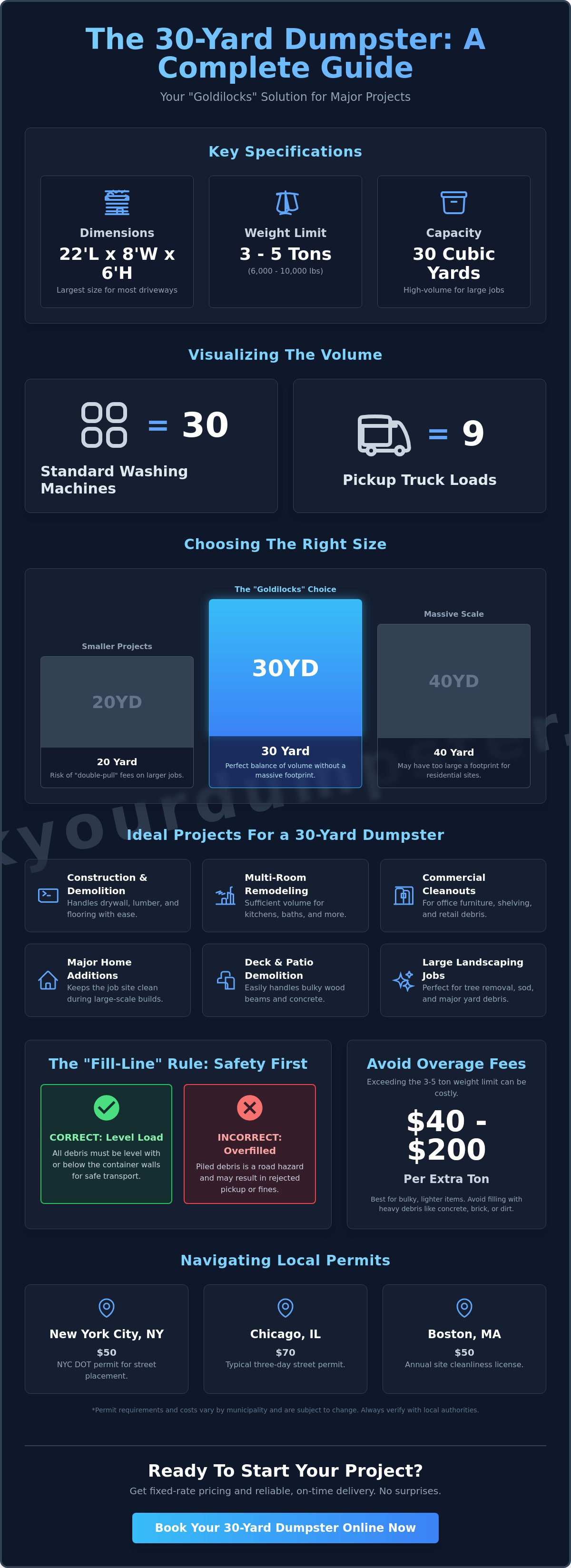
Visualizing 30 cubic yards is simple. Picture 30 standard washing machines stacked together. If you can fit your waste into that space, this is your container. It holds about 9 standard pickup truck loads of material. This capacity makes it an essential tool for contractors, property managers, and homeowners undertaking full-gut renovations. It handles everything from old furniture and appliances to heavy construction materials like drywall and lumber.
Ideal Projects for a 30 Yard Roll-Off
Large-scale projects require a container that won't overflow halfway through the week. In Massachusetts and Illinois, homeowners often choose this size for multi-room remodeling or major home additions. It's equally effective for commercial office cleanouts in New York and Queens, where retail store renovations generate high volumes of shelving, flooring, and display debris. If you're planning a large-scale landscaping project involving tree removal or deck demolition, the 30 yard dumpster offers the depth needed for long branches and bulky wood beams.
Why 30 Yards is the Professional Standard
Professional contractors prioritize efficiency. They often choose this size over a 20 Yard Dumpster to avoid "double-pull" fees. A double-pull happens when a smaller container fills up too fast, requiring the hauler to swap it out twice. This doubles your transportation costs and creates downtime on the job site. The 30-yarder provides a safety margin that smaller bins lack.
The six-foot-high walls offer a distinct advantage for bulky items. You can stand couches upright or lean long drywall sheets against the sides without debris spilling over. This vertical space allows for tighter packing, which helps you stay within the weight limit. For a deeper look at managing project waste, consult The Ultimate Guide to Construction Debris Removal. Book your dumpster today to keep your project on track.
30 Yard Dumpster Dimensions, Weight Limits, and Capacity
Precision matters when you're staging a job site. A standard 30 yard dumpster measures 22 feet long, 8 feet wide, and 6 feet high. These dimensions make it the largest container most residential driveways can accommodate without blocking the sidewalk. While it offers significant volume, you must account for the footprint. You'll need a clear, flat surface that can support the weight of the steel bin and the debris inside. Always verify the exact dimensions with our fleet team before delivery to ensure your site is ready.
This container holds roughly 9 standard pickup truck loads of waste. However, volume is only half the equation. Most 30-yard rentals come with a weight limit between 3 and 5 tons, which is 6,000 to 10,000 pounds. Properly managing these materials aligns with federal Sustainable Management of Construction and Demolition Materials guidelines. If you exceed this limit, expect overage fees ranging from $40 to $200 per extra ton. We recommend using this size for bulky, lighter items rather than "heavy debris" like concrete, dirt, or brick. Filling a 30-yarder with soil will almost certainly exceed the legal road weight limits for our trucks.
The "Fill Line" Rule and Safety
Safety is a non-negotiable part of the rental process. You must keep all debris level with the top of the container. If items stick out over the 6-foot walls, our drivers cannot legally transport the load. Overfilled dumpsters create road hazards and lead to rejected pickups or steep fines from local authorities. Materials like asphalt shingles and laminate flooring add weight quickly. Spread these heavy items across the floor of the bin instead of piling them in one corner to keep the load balanced. You can check 30 yard dumpster availability online to see if this size fits your timeline.
Visualizing Your Waste Volume
If you prefer to count by the bag, a 30-yarder holds approximately 170 to 190 standard 32-gallon trash bags. To maximize every inch of the 6-foot wall height, break down large items like furniture or cabinetry. Stack flat materials like drywall or plywood first to create a solid foundation. Contractors in New Jersey and Illinois should always verify the local tipping fees at their nearest landfill, as these costs influence the total weight allowance provided in your initial quote. Focus on efficient packing to avoid the stress of a last-minute weight overage.
30 Yard vs. 20 and 40 Yard Dumpsters: Choosing the Right Size
Selecting the right container is a financial decision as much as a logistical one. Most 20-yard and 30-yard roll-offs share the same 22-foot footprint on your driveway or job site. The critical difference is the wall height. While a 20-yarder stands about 4 feet tall, a 30 yard dumpster reaches 6 feet. This extra vertical space is vital for projects that generate awkward, non-stackable waste. Underestimating your debris volume is a common mistake that leads to "double-pull" charges. If you fill a smaller bin and need a second one, you'll pay for two separate deliveries and two disposal fees. It's almost always more cost-effective to rent the larger size upfront than to risk the expense of a second haul.
When to Choose 30 Yards Over 20 Yards
Pragmatic planning suggests choosing the 30-yard option for any project involving cabinetry, full-sized furniture, or long lumber scraps. If you're replacing flooring or carpet in a home larger than 2,500 square feet, a 20 Yard Dumpster will likely fail to hold everything. The extra two feet of wall height allows you to stack materials higher and maintain a safer, more organized work area. This is especially important in dense urban areas where you can't have debris sitting on the curb. Review our current guide on Dumpster Rental Prices to see how the cost of a single 30 yard dumpster compares to the price of two smaller units.
When the 40 Yarder is Necessary
Sometimes, even 30 yards isn't enough. You should upgrade to a 40-yarder for industrial-scale tasks like full building demolitions or massive estate cleanouts. Large commercial roofing projects also require the 40-yard capacity to handle high volumes of shingles and underlayment. This size is also the right tool for debris that is exceptionally light but occupies significant space, such as bulk insulation or large quantities of cardboard packaging. Adhering to the Massachusetts C&D materials guidance ensures your project stays compliant with state waste bans while you manage these larger volumes. For size-specific logistics and weight management tips, check our Roll Off Dumpster Rental Guide.
Site Preparation and Local Permitting in NY, NJ, IL, MA, and SF
Preparing your site for a 30 yard dumpster requires more than just clearing a spot on the driveway. While the container itself is 22 feet long, the delivery truck needs 50 to 60 feet of straight-line clearance to safely drop the load. This is a common pain point for contractors in dense urban areas. If you don't provide enough room for the truck to maneuver, the driver may have to abort the delivery, leading to dry-run fees and project delays. Measure your space twice before scheduling your drop-off.
Surface protection is another critical step, especially in suburban Illinois or New Jersey. A fully loaded 30-yard bin can weigh over 10 tons, which puts immense pressure on asphalt and concrete. Lay down large sheets of plywood where the dumpster's rollers will land. This simple step prevents cracks and scratches on your property. In cities like San Francisco or the Queens borough of New York, steep grades and narrow streets present unique challenges. If your street has a significant incline, we may need to discuss alternative placement options to ensure the bin remains stable during loading.
Local Permit Requirements
Street placement is often unavoidable in major cities. In New York City and Queens, you must obtain a permit from the Department of Transportation (DOT) if the dumpster sits on a public sidewalk or street. Chicago and other Illinois municipalities require a "Right of Way" permit for residential street placement. Massachusetts is unique because regulations vary by town; some local clerks require a fire department signature while others only need a simple application. Always check your local municipal website at least 72 hours before delivery to avoid fines. An encroachment permit is a legal authorization from a local government that allows you to temporarily place a dumpster on public property, such as a street or sidewalk.
Delivery Day Checklist
Success on delivery day depends on clear communication and a tidy site. Follow these steps to keep your project moving:
- Move all vehicles from the driveway and the street directly in front of the drop-off point.
- Trim low-hanging tree branches that might snag the truck's hoist.
- Ensure there is at least 15 feet of vertical clearance above the placement area.
- Verify that no power lines or overhead obstructions interfere with the roll-off operation.
Don't let logistics slow down your renovation or cleanout. If you've confirmed your space and checked your local permit rules, book your dumpster online now to lock in your delivery date and fixed-rate pricing.
Book Your 30 Yard Dumpster Online: Fast Delivery and Transparent Pricing
Securing a 30 yard dumpster shouldn't be the hardest part of your job. Traditional waste management companies often require multiple phone calls and long hold times just to get a simple quote. We've modernized the process with our "No-Nonsense" online booking system. You can check availability, select your rental period, and schedule a delivery in minutes. This digital-first approach respects your time and keeps your project on schedule. Whether you're managing a job site in Chicago or a home renovation in Boston, the container you need is only a few clicks away.
Transparency is the foundation of our service. We provide a clear "No Hidden Fees" promise that eliminates the anxiety of the final bill. You'll see your weight limit, rental duration, and total cost upfront. We understand the financial pressure of 2026 construction budgets. By providing fixed-rate pricing, we help you avoid the common industry trap of surprise fuel surcharges or administrative fees. You know exactly what you're paying for before the truck ever leaves our yard. It's a straightforward verbal handshake backed by digital precision.
The Book Your Dumpster Advantage
We act as a reliable partner for contractors and property managers across New York, New Jersey, Illinois, and Massachusetts. Our team handles the logistical stress of waste removal so you can focus on the actual work. We've optimized our scheduling to ensure on-time drop-offs and pickups, preventing the costly downtime that occurs when a site is cluttered with debris. Our local knowledge of regional waste regulations and traffic patterns means we anticipate problems before they happen. Book your 30 yard dumpster now to experience a more efficient way to manage your site waste.
Ready to Clear the Clutter?
The 30-yarder is the tactical choice for your major 2026 projects. It provides the high-volume capacity needed for full-gut remodels and commercial cleanouts without the footprint of an industrial-sized bin. Our deep familiarity with local requirements, from New York's DOT permits to San Francisco's narrow street logistics, makes us the best choice for urban rentals. We ensure your container is placed legally and safely every time. Don't let waste pile up and create a safety hazard. Use our instant online system to schedule your delivery and get your project moving today.
Secure Your Job Site Logistics Today
A successful renovation or commercial cleanout requires more than just labor. It demands a precise waste management plan. You now have the professional guide to dimensions, weight limits, and the critical site preparation needed for a 30 yard dumpster. Whether you're navigating the narrow streets of Queens or the residential permitting rules in Boston, you're prepared to avoid delays and extra fees. Efficiency starts with choosing the right partner for your debris removal.
Book Your Dumpster USA offers the reliability you need to keep your project on schedule. We provide transparent, flat-rate pricing and guaranteed on-time delivery in New York, New Jersey, Illinois, and Massachusetts. Our streamlined 24/7 online booking system allows you to manage your rental without the hassle of long phone calls or opaque contracts. You get the container you need exactly when you need it. It's time to clear the clutter and move your project into the next phase of construction.
Book Your 30 Yard Dumpster Online Now to secure your delivery date. We have your waste management under control so you can stay focused on the heavy lifting. Your clean job site is just a few clicks away.
Frequently Asked Questions
How much does a 30 yard dumpster rental cost in New York or Chicago?
Rental costs for a 30 yard dumpster in New York City typically range from $500 to $1,000 as of April 2026. A survey conducted in late 2025 found specific rates of $675 for a weekly rental in Yonkers, NY. In Chicago, you must also budget for city permit fees, which cost $70 for a three-day duration or $120 for a 30-day permit. Prices fluctuate based on the specific type of debris and current landfill tipping fees in your county.
What are the exact dimensions of a 30 yard roll-off container?
A standard 30 yard roll-off container measures 22 feet long, 8 feet wide, and 6 feet high. These dimensions provide a total volume of 30 cubic yards, which is equivalent to about 9 standard pickup truck loads. Ensure your designated drop-off spot can accommodate this 22-foot footprint while leaving enough room for the truck to maneuver during the delivery and pickup process.
Can I put a 30 yard dumpster on the street in Queens or San Francisco?
Street placement in Queens is allowed if you obtain a Department of Transportation permit, which typically costs between $50 and $150. In New York City, the carting company must apply for this permit rather than the property owner. San Francisco has strict regulations regarding steep grades and narrow streets that may limit placement options. Always verify local "Right of Way" rules with your municipal office at least 72 hours before your scheduled delivery.
How many tons of debris can I put in a 30 yard dumpster?
You can typically put 3 to 5 tons of debris in a 30 yard dumpster, which equals 6,000 to 10,000 pounds. Exceeding this weight limit results in overage fees that range from $40 to $200 per extra ton depending on local landfill rates. Avoid disposing of heavy materials like concrete, brick, or dirt in this size, as these items will quickly surpass the legal weight capacity of the container.
What items are prohibited in a 30 yard dumpster rental?
Hazardous materials, car batteries, tires, and appliances containing Freon are strictly prohibited in our containers. You also cannot dispose of paints, flammable liquids, or electronics like computer monitors and televisions. Disposing of these items can lead to environmental fines or rejected pickups. If you're unsure about a specific material, check our restricted items list before you start loading the bin.
How much space do I need for a 30 yard dumpster delivery?
You need at least 60 feet of straight-line clearance for the delivery truck to maneuver and drop the container. The site must also provide 15 feet of vertical clearance to allow the truck's hoist to operate without hitting power lines or tree branches. Clear all vehicles and obstructions from the path before the driver arrives to avoid dry-run fees and project delays.
Will a 30 yard dumpster damage my driveway?
A 30 yard dumpster can damage a driveway if the weight isn't distributed properly or if the steel rollers scrape the surface. We recommend placing large sheets of plywood on the driveway where the container will sit to act as a protective buffer. This simple precaution prevents cracks in asphalt and scratches on concrete, especially when the bin is filled to its 5-ton capacity.
How long can I keep a 30 yard dumpster on my job site?
Most rentals allow you to keep the container on-site for 7 to 14 days. If your project takes longer than expected, you can usually extend the rental period for a flat daily fee. Finalize your schedule during the online booking process to ensure the pickup happens exactly when you're finished. This keeps your job site organized and ensures you don't pay for more rental time than you actually need.


