
Loading your bin to the brim does not mean you have filled it correctly; in fact, it might be the most expensive mistake of your entire renovation. You likely assume that a 20 yard container simply holds 20 cubic yards of debris. While that is true for volume, the 20 yard dumpster weight limit is the actual metric that determines your final bill. It is easy to confuse space with weight, but getting it wrong leads to immediate financial penalties and logistical delays.
We understand that unexpected fees are the last thing you need when you are trying to clear a job site. This guide is specifically designed to help you navigate the 20 yard dumpster weight limits in New York, Illinois, and Massachusetts, detailing how to avoid common overage fees. Whether you're planning a project in Paterson, Ann Arbor, or any of our other service locations, Book Your Dumpster USA will help you master these limits. This guide provides the exact tonnage requirements for 2026 and teaches you how to estimate material weight accurately. You will learn how to stay compliant with local regulations and ensure your project stays on budget so you can book your dumpster with total peace of mind.
Key Takeaways
- Understand that the 20 yard dumpster weight limit typically falls between 2 and 4 tons, which is the maximum tonnage included in your flat-rate price.
- Distinguish between high-volume household junk and high-weight construction debris to estimate your load accurately and avoid costly overage fees.
- Learn how to load your roll-off strategically to eliminate air pockets and maximize space without exceeding safety limits.
- Identify environmental factors like rain and snow that can unexpectedly increase the weight of your debris and impact your final bill.
- Navigate localized disposal regulations and permit requirements specific to urban centers in New York, Illinois, and Massachusetts.
What is a 20 Yard Dumpster Weight Limit?
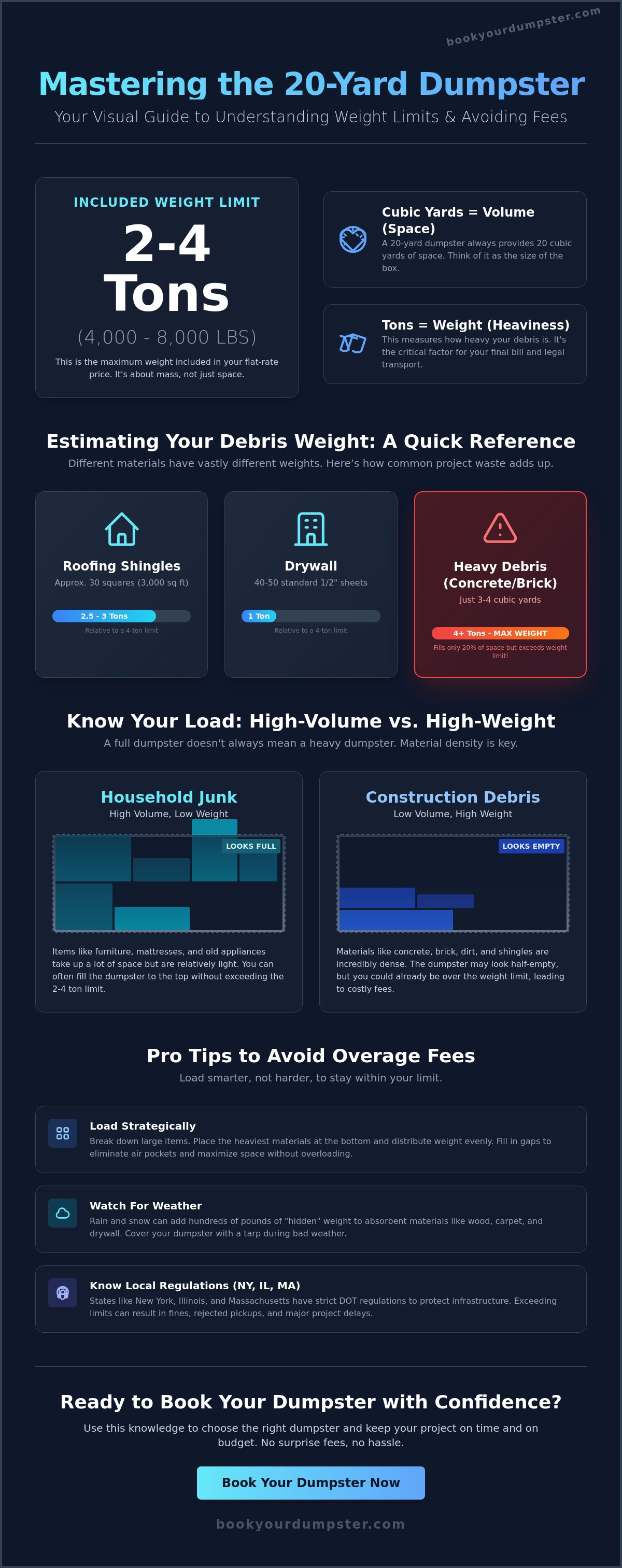
A 20 yard dumpster weight limit is the specific amount of tonnage included in your flat-rate rental price. It is not a suggestion. Most standard 20-yarders come with a weight allowance between 2 and 4 tons, which equals 4,000 to 8,000 pounds. While the steel container itself can physically hold up to 10 tons of debris, transport laws make hauling that much weight illegal on most residential streets. You must balance the volume of your project with the weight of your materials to keep your project on budget.
State authorities in New York, Illinois, and Massachusetts strictly enforce these protocols through their respective Departments of Transportation (DOT). These rules exist to protect local infrastructure. If you exceed the 20 yard dumpster weight limit, you will face overage fees. These fees occur because the landfill charges the hauler more for the extra mass, and those costs are passed directly to you. Staying within your limit ensures a professional, hassle-free pickup without surprise charges on your final statement.
Tons vs. Cubic Yards: Understanding the Difference
Think of cubic yards as the physical space inside the bin and tons as the heaviness of the load. A 20-yarder always provides 20 cubic yards of volume, typically measuring 22 feet long and 4 feet high. However, the weight varies wildly based on what you toss inside. For example, 20 yards of old carpet weighs much less than 20 yards of roof shingles. For your reference, one ton equals exactly 2,000 pounds. Most Roll-off (dumpster) units are built for versatility, but material density is the factor that drives your tonnage up the fastest.
Why Weight Limits Matter in NY, IL, and MA
Road safety is the primary concern for officials in high-density areas like Chicago, Boston, and New York City. Heavy trucks can easily crush asphalt or damage underground utility lines if they are overloaded. DOT regulations focus on the Gross Vehicle Weight Rating (GVWR), which is the maximum safe weight of the truck, the container, and your debris combined.
If a truck is over this legal limit, the driver faces heavy fines at weigh stations. In some cases, they may even be forced to dump a portion of the load on-site before they can legally move the vehicle. This creates massive legal liabilities and safety risks. By adhering to the 20 yard dumpster weight limit, you help ensure a safe, compliant haul through your neighborhood while avoiding the logistical nightmare of a rejected pickup.
Estimating Your Debris: How Much Can You Fit?
A 20 yard dumpster is the industry sweet spot. It provides enough volume for significant projects without taking up your entire driveway. However, you must understand that the 20 yard dumpster weight limit is the invisible ceiling of your rental. You might have plenty of room left at the top of the bin, but if the materials inside are dense, you have already reached your limit. Material density is the single most important factor in whether you stay under your tonnage allowance or face an overage fee.
Visualize your project before the truck arrives. If you are handling a medium-sized home renovation, a 20-yarder is usually the right choice. But the way you fill it changes based on what you are throwing away. Household junk is high-volume but low-weight. Construction debris is low-volume but high-weight. Mixing the two requires careful planning to ensure the load remains road-legal for transport through NY, IL, or MA.
Common Project Weights: A Quick Reference
Don't rely on guesswork when estimating your load. Use these verified benchmarks to calculate your total tonnage. For roofing projects, 30 squares of standard 3-tab shingles (approximately 3,000 square feet) typically weigh between 2.5 and 3 tons. This fits safely within most 3-ton weight allowances. If you are removing drywall, remember that 40 to 50 sheets of 1/2-inch material equal roughly 1 ton.
Heavy debris like concrete, brick, or dirt requires extreme caution. These materials are incredibly dense. Just 3 to 4 cubic yards of concrete can weigh 4 tons. Since a 20-yarder holds 20 cubic yards total, filling the bin only 20 percent full of concrete will already max out a standard 20 yard dumpster weight limit. Never fill a 20-yarder to the top with heavy debris; the truck will be unable to lift it, and you will be stuck with a failed trip fee.
Household Cleanouts vs. Construction Waste
Household cleanouts are generally straightforward. Bulky items like furniture, mattresses, and appliances take up a lot of space but rarely exceed a 3-ton limit. You can often clear out a 2,000-square-foot home's basement and attic without worrying about tonnage. Construction waste is a different story. If your project involves construction debris removal, pay close attention to flooring. Hardwood and ceramic tile add weight much faster than old carpeting. One thousand square feet of tile can easily weigh over 1.5 tons on its own.
Plan your load by placing the heaviest items at the bottom and the lighter, bulkier items on top. This keeps the center of gravity low and helps you see how much weight is accumulating. If you are unsure about your specific material mix, view our sizing options to confirm which weight package fits your debris profile best.
The Impact of Weight on Rental Prices and Fees
Transparent pricing is the foundation of a successful rental experience. When you book a container, your flat-rate price typically includes a specific tonnage allowance. If you stay under the 20 yard dumpster weight limit, your costs remain predictable. Problems arise when the load exceeds this limit, triggering overage fees. These charges aren't arbitrary; they exist because landfills and transfer stations charge haulers based on the exact weight of the debris they drop off. We believe in removing the guesswork by providing clear terms from the start.
Overage fees vary significantly depending on your location. In the Chicago area, for instance, you might pay $70 for each ton exceeding your 3-ton limit. In Long Island, New York, that fee often jumps to $150 per additional ton. Massachusetts presents the widest range, with some providers charging $185 per ton while others reach $400 per ton. These costs can double your rental price if you aren't careful. Our goal is to ensure you understand these variables before you start loading so your project stays on budget.
How Dumpsters are Weighed
Understanding the weighing process helps you verify your final charges. When the truck arrives at the landfill or transfer station, it drives onto a massive industrial scale. This is the "Scale In" weight, which includes the truck, the container, and your debris. After emptying the bin, the truck weighs again at the "Scale Out" station. The difference between these two numbers is the "net weight" of your waste.
This process is automated and highly regulated for accuracy. If you receive an overage charge and want to verify the data, you should always request a copy of the official weight ticket. This document provides a timestamped record of the mass disposed of at the facility. Keeping this record ensures total transparency between you and the service provider.
Avoiding Hidden Fees in New York and Massachusetts
Regional regulations can impact your final bill beyond standard tonnage. In Massachusetts, you must be aware of seasonal weight limits on residential roads. During spring thaws, local municipalities often lower the legal weight limits to prevent road damage, which can restrict the amount of debris we can safely transport. In New York City, specific disposal surcharges often apply to mixed waste or certain heavy materials that require extra processing at the landfill.
To plan your budget effectively, check our guide on dumpster rental prices for the most current local estimates. We prioritize on-time delivery and clear communication to help you avoid these logistical headaches. By choosing the right weight package for your specific debris type, you eliminate the risk of hidden surcharges and keep your cleanup moving forward without delay.
Pro Tips to Stay Within Your 20 Yard Limit
Loading your container requires a strategic approach to avoid hitting the 20 yard dumpster weight limit before you finish the job. Don't just throw items over the side randomly. You must manage the density of your load to stay within your tonnage allowance. Start by creating a flat, heavy base. This prevents the truck from becoming unbalanced during pickup and ensures you don't waste space with "air pockets" that could have held more debris. If you are handling a mix of materials, prioritize the heaviest items first to keep the center of gravity low.
Loading Strategies for Efficiency
Place heavy items like old flooring or appliances at the bottom and distribute the weight evenly across the entire floor of the bin. This is critical for safe transport on the tight streets of NYC or Chicago. Break down large furniture or wooden crates to maximize your 20 cubic yards of volume. While you want to pack the bin tightly, never over-compact materials to the point where they become stuck. Most importantly, never fill the debris above the "water line" or the top rim of the dumpster. Drivers cannot legally haul a container with items sticking out the top; you will face a "dry run" fee if the truck has to leave without the bin.
Protecting Your Load from the Elements
Weather is a silent factor that can ruin your budget. If you are working in New York, Illinois, or Massachusetts, keep a tarp nearby. Rain and snow soak into porous materials like drywall, carpeting, and wood, significantly increasing their mass. A rain-saturated load of drywall can weigh twice as much as a dry one, potentially pushing you over your limit in a single afternoon. Drain any liquids from containers or old equipment before disposal to maintain weight accuracy. If a storm is forecasted for your area, book your dumpster with a plan to cover it during downpours to avoid paying for water weight at the scale.
Be careful with "heavy fill" projects involving brick, stone, or asphalt. These materials are incredibly dense and should never be mixed with standard household junk in a 20-yarder. If your project involves these items, consult with a professional hauler first. Additionally, keep prohibited items out of your bin. In Illinois, landfills won't accept tires, batteries, or electronics. Tossing these in can result in high-weight penalties or the rejection of your entire load at the transfer station. Follow these steps to ensure your project remains safe, compliant, and cost-effective.
Book Your 20 Yard Dumpster with Confidence
Book Your Dumpster USA provides no-nonsense, reliable service for New York, Illinois, and Massachusetts. We understand that managing a 20 yard dumpster weight limit is the key to a stress-free project. We handle the complex logistics of tonnage and DOT compliance so you can focus on the work at hand. Our team ensures that your container arrives on time and that you have all the information needed to avoid overage fees. Whether you're a homeowner in Long Island or a contractor in downtown Chicago, we provide the tools to keep your site clean and compliant.
Choosing the right partner means choosing transparency. We don't hide our fees in fine print. When you rent with us, you get a dedicated professional who knows the local landfill rates and transport laws. We've modernized the traditional waste industry with digital convenience, making it easier than ever to resolve your clutter issues. We treat your timeline with the urgency it deserves, providing on-time delivery that keeps your crew on schedule and your project moving forward.
Why Choose Our 20 Yard Container?
The 20-yarder is the most versatile size in our fleet. It fits perfectly in residential driveways while offering enough capacity for roofing, basement renovations, and medium cleanouts. With dimensions typically ranging from 14 to 22 feet long and 4 to 5 feet high, it's designed for tight urban job sites in Chicago or Boston. This size holds the equivalent of 6 to 8 pickup truck loads of debris, making it the efficient choice for most residential and commercial tasks.
We provide clear, upfront communication on weight limits and local regulations to ensure your experience is hassle-free. In cities like Chicago, we help you navigate the permit process for public way placement. As of October 2025, a Class A permit for a 20-yarder outside the Central Business District costs $50 for 1 to 3 days. We ensure you have the right documentation to avoid city fines. For a deeper look at regional rules, check out our dumpster rental guide.
Ready to Start? Book Your Dumpster Now
Don't let waste management slow down your progress. Our online booking system allows you to select your location, choose your size, and schedule your delivery in minutes. You'll see your specific 20 yard dumpster weight limit clearly displayed before you confirm, ensuring there are no surprises on your final invoice. We move you from a state of clutter to a state of resolution with minimal cognitive load.
Follow these simple steps to secure your rental:
- Enter your zip code to see local availability in NY, IL, or MA.
- Select the 20-yard container for your renovation or cleanout.
- Review the included weight limit and flat-rate pricing.
- Schedule your delivery date and provide placement instructions.
Local contractors trust our pragmatic, expert service because we deliver on our promises of transparency and integrity. Everything is handled, from the initial drop-off to the final weigh-out at the landfill. Book your dumpster today at bookyourdumpster.com.
Take Control of Your Cleanup Today
Successful waste management requires more than just a large bin; it demands a clear understanding of the 20 yard dumpster weight limit. You now have the tools to estimate your debris accurately and avoid the steep overage fees common in New York and Massachusetts. By applying strategic loading techniques and protecting your container from the elements, you protect your bottom line. We've been serving contractors and homeowners across NY, IL, and MA since 2018, providing the local expertise needed for a seamless experience.
Our professional team guarantees on-time delivery and maintains a strict policy of transparent pricing with no hidden fees. We handle the logistical heavy lifting so you can focus on completing your renovation or cleanout. Don't let clutter stall your progress any longer. Book your 20 yard dumpster rental online now to secure your container. It's time to resolve your project with the reliability and directness you deserve.
Frequently Asked Questions
What is the standard weight limit for a 20 yard dumpster?
The standard 20 yard dumpster weight limit usually falls between 2 and 4 tons, which equals 4,000 to 8,000 pounds. This limit represents the amount of debris included in your flat-rate rental price. While the container can physically hold more, transport companies must follow road safety laws. Always confirm your specific tonnage allowance during the booking process to ensure it matches your project's material density.
How much does an overage fee cost if I go over the limit?
Overage fees vary by state and local landfill rates. In the Chicago area, you can expect to pay approximately $70 per ton for exceeding your limit. Long Island, New York, often charges $150 per additional ton. In Massachusetts, fees are higher, ranging from $185 to $400 per ton. These costs are calculated at the landfill scale and are billed after your container is weighed and emptied.
Can I put concrete or dirt in a 20 yard dumpster?
You can put concrete or dirt in a 20 yard dumpster, but you must be extremely careful with the total mass. These materials are incredibly dense; just 3 to 4 cubic yards of concrete will hit a 4-ton weight limit. Filling a 20-yarder to the top with heavy fill will make it impossible for the truck to lift. Most haulers recommend using smaller 10-yard bins for dedicated heavy debris projects.
How do I know if my dumpster is overweight before it is picked up?
Check the "water line" at the top of the bin and monitor the type of materials you are loading. If the container is filled to the rim with heavy items like roofing shingles or flooring, it is likely at or over the limit. You can estimate the weight by tracking the number of squares of shingles or sheets of drywall added. One ton equals 2,000 pounds, so keep a running tally of your densest materials.
Does rainwater count toward my dumpster weight limit?
Rainwater absolutely counts toward your total weight because landfills weigh the entire load upon arrival. Porous materials like old carpeting, wood, and drywall soak up water like a sponge, which can add hundreds of pounds to your bin. Use a tarp to cover your container during storms in NY or IL. This simple step prevents you from paying for water weight that wasn't part of your original debris.
What happens if the dumpster is too heavy for the truck to lift?
If the dumpster exceeds the truck's hydraulic lifting capacity or the legal road limit, the driver will leave it on-site. You will be charged a failed trip or dry run fee for the attempted pickup. You must then remove enough debris to make the load safe and legal for transport. This results in project delays and extra labor, so always monitor your tonnage during the loading process.
Are there specific weight rules for dumpsters in Chicago or New York City?
Chicago and New York City have strict Department of Transportation (DOT) rules regarding Gross Vehicle Weight Ratings (GVWR). Trucks cannot exceed specific axle weights on residential streets to prevent pavement damage. In Chicago, you must also obtain a Class A permit for dumpsters placed on public ways, which costs $50 for 1 to 3 days as of October 2025. These regulations ensure that heavy roll-off containers don't compromise urban infrastructure.
How many tons of shingles fit in a 20 yard dumpster?
A 20 yard dumpster typically holds about 30 squares of standard 3-tab roofing shingles, which weighs between 2.5 and 3 tons. This fills the bin roughly halfway by volume but reaches the standard weight limit for most residential rentals. If you are removing architectural or double-layer shingles, the weight increases significantly. Always calculate your roof's total square footage before choosing your weight package to avoid surprise charges.


