
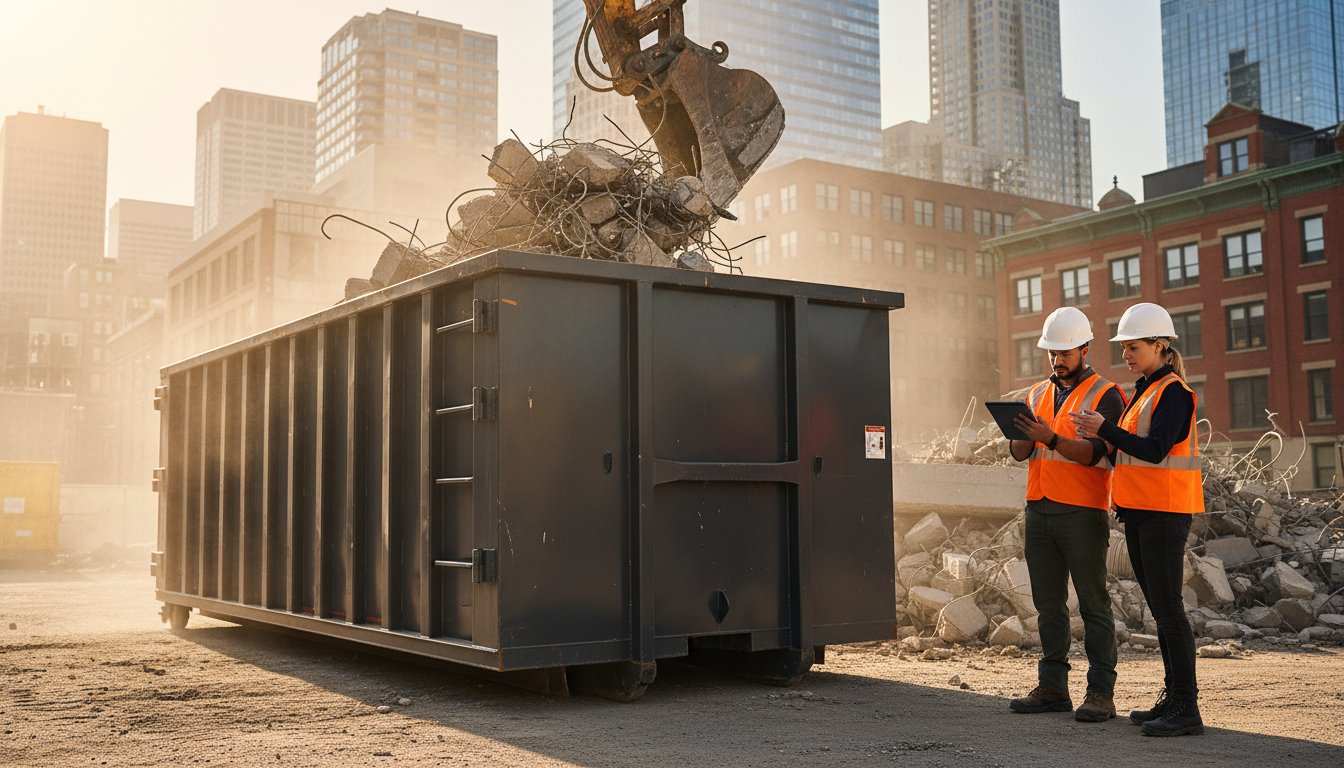
Demolition activities account for over 90% of the 600 million tons of C&D debris generated annually in the U.S. You already know that managing this massive volume requires more than just a large metal box. Choosing a 40 yard dumpster for commercial demolition is a tactical decision that either streamlines your site or stalls your progress with hidden overweight fees and permit violations. You need a partner who understands that a delivery delay in downtown Chicago or a permit error in a major New York metro area costs more than just time; it costs your project's profitability.
You're looking for a reliable way to handle tons of concrete and steel without the logistical headaches. This guide from Book Your Dumpster USA helps you master the capacity and site requirements for the largest roll-off containers available. We'll provide the 2026 requirements for New York, Illinois, and Massachusetts, ensuring you stay compliant with strict mandates like local recycling ordinances or state-level landfill bans. We break down transparent pricing and help you navigate regional cost factors. Read on to learn how to book your dumpster, manage state-specific C&D waste regulations, and maintain a reliable pickup schedule without hidden surcharges.
Key Takeaways
- Learn the exact footprint and volume capacity of the largest standard roll-off to ensure it handles your high-volume debris without site congestion.
- Master the 2026 regional compliance rules for a 40 yard dumpster for commercial demolition to meet strict recycling mandates in NY, IL, and MA.
- Identify critical site clearance requirements and vertical obstructions to guarantee a seamless delivery in dense metropolitan areas like Boston or Chicago.
- Understand the "waterline rule" and prohibited material list to prevent costly overweight fees and transportation delays.
- Leverage 24/7 online booking and next-day delivery options to keep your demolition project on schedule and under budget.
Why the 40-Yard Dumpster is the Commercial Demolition Standard
Efficiency on a commercial site depends entirely on waste flow. The 40-yard roll-off is the largest standard container in the industry, holding 40 cubic yards of material to serve as the workhorse for high-volume projects. Choosing a 40 yard dumpster for commercial demolition is a tactical move. It maximizes site capacity and minimizes the frequency of haul-away trips. Every time a truck leaves your site, work often slows down or stops to accommodate the swap. By using the largest container available, you reduce this downtime significantly. Roll-off dumpsters of this scale are essential for massive office gut-outs, roofing tear-offs, and total structural demolition where the volume of debris is relentless.
The economic impact of right-sizing your container is immediate. While a smaller bin might have a lower initial rental price, the cumulative cost of multiple hauls, fuel surcharges, and administrative fees quickly adds up. In 2026, logistics costs are a major line item for contractors. Consolidating your waste into a single 40-yard unit instead of two 20-yard units can save your project thousands of dollars in transportation fees alone. It protects your margins and keeps your bidding competitive.
Commercial vs. Residential 40-Yard Needs
Demolition debris (C&D) is not the same as standard municipal solid waste. Commercial sites generate heavy, dense materials like reinforced concrete, structural steel, and massive quantities of drywall. These materials require the high durability found in professional-grade containers. Residential cleanups rarely face the same weight pressures or volume demands. On a commercial site, managing flow is about more than just one bin. It often requires a "one-off, one-on" strategy where multiple 40-yard containers are staged to ensure the crew never waits for a place to toss debris. This keeps your labor costs in check and your project on its 2026 timeline.
The Logistics of High-Volume Waste
Large containers handle more than just volume; they accommodate difficult dimensions. A 40-yarder easily fits long items like 20-foot timber beams or steel framing that would require expensive on-site cutting to fit into smaller bins. Using these larger units also reduces the carbon footprint of your project. Fewer trips to the processing facility mean lower fuel consumption and reduced emissions across the project lifecycle. At Book Your Dumpster USA, we understand that a stalled site is a failing site. We provide the reliability needed for tight commercial schedules in New York and Illinois. Our digital platform allows you to book your dumpster instantly. We ensure your 40 yard dumpster for commercial demolition arrives exactly when your crew is ready to break ground, with no hidden fees and no delivery delays.
Capacity and Specifications: What Fits in a 40-Yard Container?
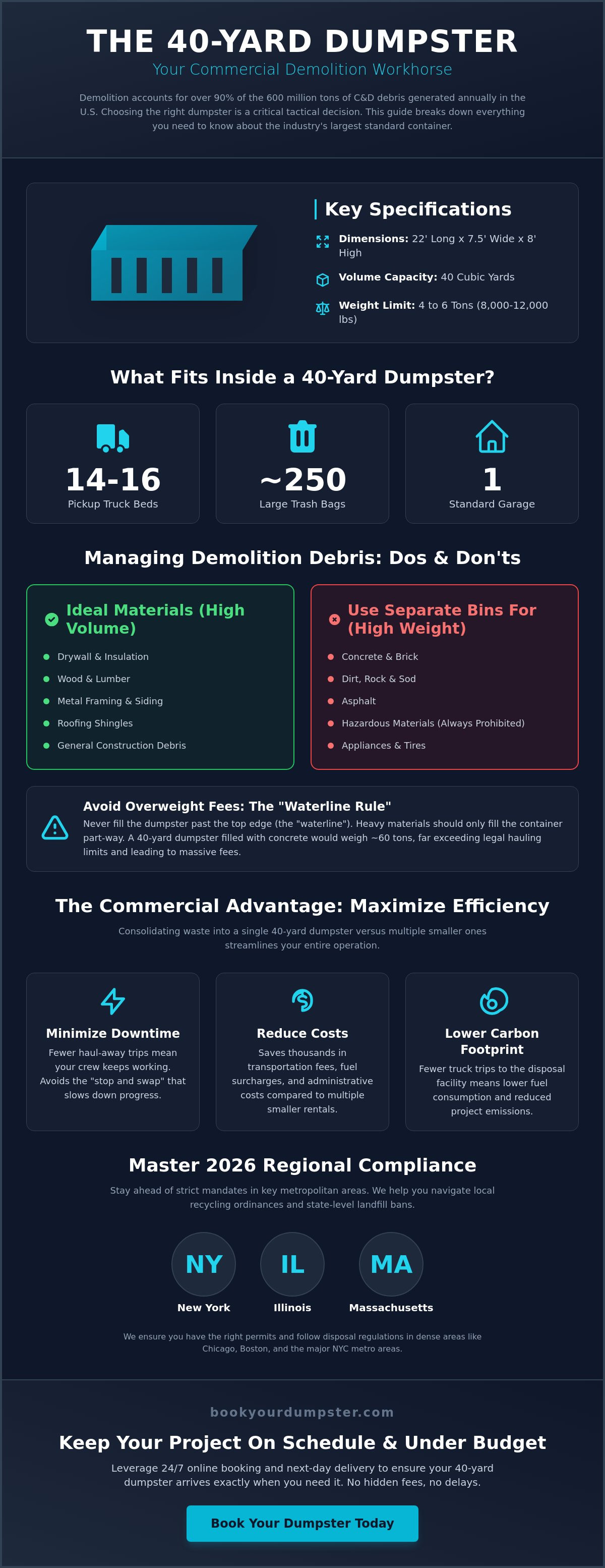
Visualize a standard one-car garage filled from floor to ceiling. That is the volume you get with a 40-yard container. These units typically measure 22 feet long, 7.5 feet wide, and 8 feet high. When you rent a 40 yard dumpster for commercial demolition, you're securing space equivalent to roughly 14 to 16 pickup truck beds or 250 large trash bags. While the volume is massive, the weight capacity is the critical metric for site supervisors. Standard commercial caps usually range from 4 to 6 tons. Exceeding these limits at a local NY or IL landfill results in immediate surcharges, so monitoring your material density is vital.
Material Breakdown for Demolition
Demolition debris varies wildly in density. Drywall and insulation are high-volume but low-weight materials. You can fill a 40-yarder to the brim with these without hitting weight caps. Wood and metal framing require strategic packing. Lay long items flat and break down larger assemblies to avoid "air pockets" that waste valuable cubic yardage. However, avoid using these large containers for "clean" heavy fill like concrete, brick, or dirt. A 40-yarder filled with concrete would weigh approximately 60 tons, far exceeding the legal hauling limit for any roll-off truck. Focus on Sustainable C&D materials management by separating heavy masonry into smaller, dedicated bins to stay compliant and safe.
Comparing the 40-Yard to Smaller Units
Not every project requires the maximum size. If you're handling a heavy roofing tear-off, a 30-yard unit is often the better choice to stay within weight limits while providing enough space. However, for general interior gut-outs, one 40-yarder is almost always more cost-effective than two 20-yarders. You pay for one delivery fee and one pickup, rather than doubling your logistical costs. If you have a smaller footprint or a specialized task, check our 10-yard dumpster guide for compact site needs. For larger commercial scopes, we recommend you choose your size based on the total estimated tonnage to avoid mid-project delays. Using a 40 yard dumpster for commercial demolition ensures your crew keeps moving without waiting for a swap-out every few hours.
Site Requirements and Permitting in NY, IL, and MA
Success on a demolition site starts with where you place the box. To safely drop a 40 yard dumpster for commercial demolition, your site needs 60 to 100 feet of clear, linear space. This allows the truck to back in, hoist the container, and roll it off without obstruction. Look up before you schedule your delivery. Low-hanging power lines or tree branches in older neighborhoods like Chicago’s Lincoln Park or Boston’s North End will block the truck’s hoist and stall your progress. Surface integrity is equally critical. A loaded 40-yarder can easily exceed 10 tons. Ensure your staging area consists of reinforced concrete or heavy-duty asphalt to prevent the container from cracking the ground or sinking into soft soil. Understanding EPA regulations for C&D debris is the first step in ensuring your site remains compliant with federal and state standards for waste separation.
Urban Logistics: NYC, Chicago, and Boston
Placing a container on a public street requires precision and paperwork. In New York City, permit fees for occupying city property range from $135 to $385 as of April 2026. Chicago contractors can secure 3-day permits for $50 or 30-day permits for $100. Boston remains a bit more affordable, with weekly street permits costing between $30 and $50. Don't forget the physical barriers. If you're working in tight Chicago alleys or narrow Boston corridors, timing is everything. Post "No Parking" signs at least 24 hours in advance to ensure the delivery truck has the turning radius it needs. If the driver can't access the spot, you'll likely face a dry run fee that eats into your budget.
State-Specific Waste Regulations
Each state has unique rules for what happens after the debris leaves your site. Massachusetts is particularly strict; the MassDEP has banned asphalt, brick, concrete, metal, wood, and gypsum wallboard from landfills. This means your demolition waste must be hauled to specialized out-of-state facilities or recycling centers. In Illinois, the City of Chicago mandates that you recycle at least 50% of the debris generated on-site. You must submit a Recycling Compliance Form to prove it. New York contractors must follow Part 360 regulations, which govern how C&D fill material is handled and processed. When you book your dumpster with us, we help you stay ahead of these mandates so you can focus on the teardown, not the red tape.
Managing Demolition Waste & Avoiding Overweight Fees
Overfilling a 40 yard dumpster for commercial demolition is the fastest way to blow your budget. You must follow the "waterline rule" without exception. This means all debris must remain level with the top of the container. Drivers cannot legally or safely transport a roll-off if materials are protruding above the rim. If your crew piles debris into a peak, our driver will refuse the pickup. This results in a dry run fee and stalls your site progress while your team levels the load. Efficiency is about packing smart, not piling high.
Weight management is the second pillar of cost control. While a 40-yard unit offers massive volume, you must distinguish between cubic yardage and tonnage. In 2026, overage fees in New York City range from $200 to $250 per ton. If you're clearing out heavy materials like soaked roofing or dense timber, you can hit your weight cap long before the bin is physically full. Our "No Hidden Fees" policy ensures you know exactly what your weight limit is from the start. We provide transparent billing so you can track your project costs without surprise surcharges on the final invoice. To keep your project on track, schedule your delivery with a partner who prioritizes pricing integrity.
Handling Hazardous Demolition Debris
Never toss hazardous materials into a standard C&D container. Asbestos-containing materials (ACM), lead-based paint, and industrial chemicals require specialized disposal protocols under New York’s Part 360 regulations or Illinois EPA mandates. If a load is contaminated with hazardous waste, the entire 40-yard container may be rejected at the landfill. This forces you to pay for expensive hazardous waste remediation, which can triple your disposal costs instantly. Always identify these materials during your pre-demolition survey and arrange for dedicated hazardous waste hauling.
Tips for Efficient Loading
Maximize your space by loading heavy, flat items like plywood or metal siding at the bottom. This creates a stable base and lowers the center of gravity for the hauling truck. Place lighter, bulkier items like insulation or ceiling tiles on top to compress the lower layers. Break down large demolition components, such as framing sections or cabinetry, to eliminate air pockets. Monitor the load daily to prevent "mountain-topping." A flat, well-distributed load ensures a safe, successful pickup on the first attempt, keeping your commercial demolition project moving at full speed.
Schedule Your Delivery: Renting Your 40-Yard Dumpster Today
Finalize your project logistics without the back-and-forth of traditional phone tag. Renting a 40 yard dumpster for commercial demolition shouldn’t be the most complicated part of your job. Our 24/7 online booking system allows busy contractors to secure equipment at any hour, fitting perfectly into the fast-paced 2026 construction schedule. We offer next-day delivery availability across most service areas in New York, Illinois, and Massachusetts. You don't have to wait for a call center representative to get back to you with a quote. Our platform provides instant access to the tools you need to keep your site moving.
Reliability is our baseline. We understand that a missed delivery window can stall an entire demolition crew, leading to thousands of dollars in wasted labor costs. We bypass the typical call center model to provide direct communication with waste management experts who understand the specific logistics of high-volume sites. Whether you need a short-term rental for a quick gut-out or a long-term solution for a multi-phase structural teardown, our flexible rental periods adapt to your timeline. We manage the logistics so you can manage the demolition.
The Booking Checklist
Ensure a seamless drop-off by following a few simple steps before the truck arrives. Confirm your delivery date and designate an on-site contact person who can direct the driver. Double-check your permit status for any containers placed on public right-of-ways in cities like Chicago or Boston. Finally, provide clear, specific drop-off instructions through our online portal. Clear any parked vehicles or equipment from the 100-foot delivery path to avoid "dry run" fees. These small details prevent delays and ensure your 40 yard dumpster for commercial demolition is positioned exactly where your crew needs it.
Why Contractors Choose Book Your Dumpster USA
We’ve built a reputation for on-time delivery across three of the most regulatory-heavy states in the country. Our team understands the nuances of NY, IL, and MA waste mandates, ensuring your debris is handled with full legal compliance. We prioritize transparent pricing structures that respect your project budget. You won't find hidden fuel surcharges or surprise administrative fees on your final invoice. We modernized waste management to provide digital convenience with old-school honesty. Don't let waste pile up and create a safety hazard on your site. Book your 40-yard dumpster now and experience a streamlined, professional approach to commercial waste management.
Master Your 2026 Demolition Logistics
Your project's success depends on keeping the site clear and the schedule moving. You now know that a 40 yard dumpster for commercial demolition is the most efficient tool for high-volume debris, provided you manage the weight limits and local permit requirements. Avoid the $200 per ton overage fees common in NYC by packing smart and staying below the waterline. Secure your 3-day or 30-day permits in Chicago early to prevent delivery delays that stall your crew. Managing these details ensures you meet the 50% recycling mandates in Illinois or the strict landfill bans in Massachusetts.
We remove the logistical stress with our no hidden fees guarantee and expert local support across NY, IL, and MA. Our streamlined online booking system allows contractors to schedule deliveries 24/7 without waiting for a call center. Book your 40-yard dumpster today to ensure your site stays clean, safe, and fully compliant. We have the heavy lifting under control so you can focus on a successful teardown.
Frequently Asked Questions
What are the exact dimensions of a 40-yard dumpster?
Standard dimensions for a 40-yard roll-off are 22 feet long, 7.5 feet wide, and 8 feet high. This size provides exactly 40 cubic yards of volume. It is the largest standard container available for major projects. Ensure your site has enough vertical clearance for the 8-foot walls plus the additional height required during the truck's unloading process.
Can I put concrete in a 40-yard dumpster for commercial demolition?
No, you should avoid filling a 40-yard unit with heavy concrete or brick. A 40 yard dumpster for commercial demolition filled with concrete would weigh roughly 60 tons. This far exceeds legal road limits for hauling. Most facilities restrict concrete to 10 or 20-yard bins. Use the 40-yarder for lighter materials like drywall, wood, and metal instead.
Do I need a permit for a 40-yard dumpster in Chicago or NYC?
Yes, you need a permit if you place the container on a public street or right-of-way. In NYC, permit fees for 2026 range from $135 to $385. Chicago requires a $50 permit for 3 days or $100 for 30 days. If the unit stays entirely on private property, you generally don't need a city permit. Always verify local zoning before you schedule your delivery.
How much weight can a 40-yard roll-off container actually hold?
Most 40-yard containers have a weight limit between 4 and 6 tons. While the bin has a massive volume, DOT regulations and landfill limits dictate the maximum legal weight. Exceeding these limits in NY or IL results in overage fees ranging from $40 to $250 per ton. Monitor your material density to avoid surprise costs at the scale.
What happens if I overfill my demolition dumpster?
Drivers will refuse to pick up any container filled above the "waterline" or top rim. Overfilled bins are a safety hazard during transport and violate DOT laws. You will face a dry run fee and must level the load before the truck returns. Keep all debris flush with the top to ensure a successful first-time pickup and avoid site delays.
Is a 40-yard dumpster the right size for a commercial roof replacement?
It depends on the material, but a 40 yard dumpster for commercial demolition is excellent for high-volume, lighter debris like EPDM or insulation. If you're removing heavy asphalt shingles, a 30-yard unit is often safer to avoid weight violations. For massive retail centers, the 40-yarder provides the volume needed to minimize haul-away frequency and keep the crew active.
How much space does the truck need to drop off a 40-yard unit?
You need 60 to 100 feet of linear space for the truck to safely roll off the container. The truck itself is approximately 35 feet long and needs extra room to maneuver and extend the hoist. Ensure the path is clear of parked cars and equipment. You also need 23 feet of vertical clearance to accommodate the bin as it is raised.
Are there items I cannot put in a demolition dumpster in Massachusetts?
Yes, the MassDEP has banned specific materials from landfills, including asphalt, brick, concrete, metal, wood, and clean gypsum wallboard. These items must be diverted to recycling facilities. Additionally, you cannot dispose of hazardous waste, asbestos, or lead-based paint in a standard container. Always separate these materials to comply with Massachusetts state law and avoid heavy fines.


