
The biggest mistake in a residential project isn't the heavy lifting. It's the bad math that forces a second dumpster delivery halfway through the job. You likely feel the pressure of staring at a basement full of old furniture and wondering if it will actually fit. Selecting the right dumpster size for a full house cleanout is a high-stakes decision that balances physical volume against strict weight limits. It’s natural to worry about overflowing containers or getting hit with unexpected overage fees once the project starts.
This guide eliminates the guesswork and puts you back in control of your logistics. Learn how to accurately estimate your debris volume and choose between 20-yard and 30-yard containers based on real-world capacity. We also break down the critical differences between volume and weight limits while clarifying permit requirements for cities like New York and Chicago. Follow this logical framework to ensure a single, right-sized dumpster arrives on schedule for a completely stress-free disposal process.
Key Takeaways
- Avoid the "Double Dumpster Penalty" by understanding how under-sizing your container by just five yards can double your total disposal costs.
- Compare the specific capacities of 20-yard and 30-yard containers to determine the ideal dumpster size for a full house cleanout based on your home's bedroom count.
- Apply a practical furniture-count methodology to estimate debris volume more reliably than standard square footage calculations.
- Navigate local street permit regulations and placement rules for major cities like New York, Chicago, and Boston to prevent project delays or fines.
- Use a digital-first booking process to secure the right container from 10 to 40 yards while ensuring pricing integrity and punctual delivery.
Assessing the Scope: Why Dumpster Size for a Full House Cleanout is Critical
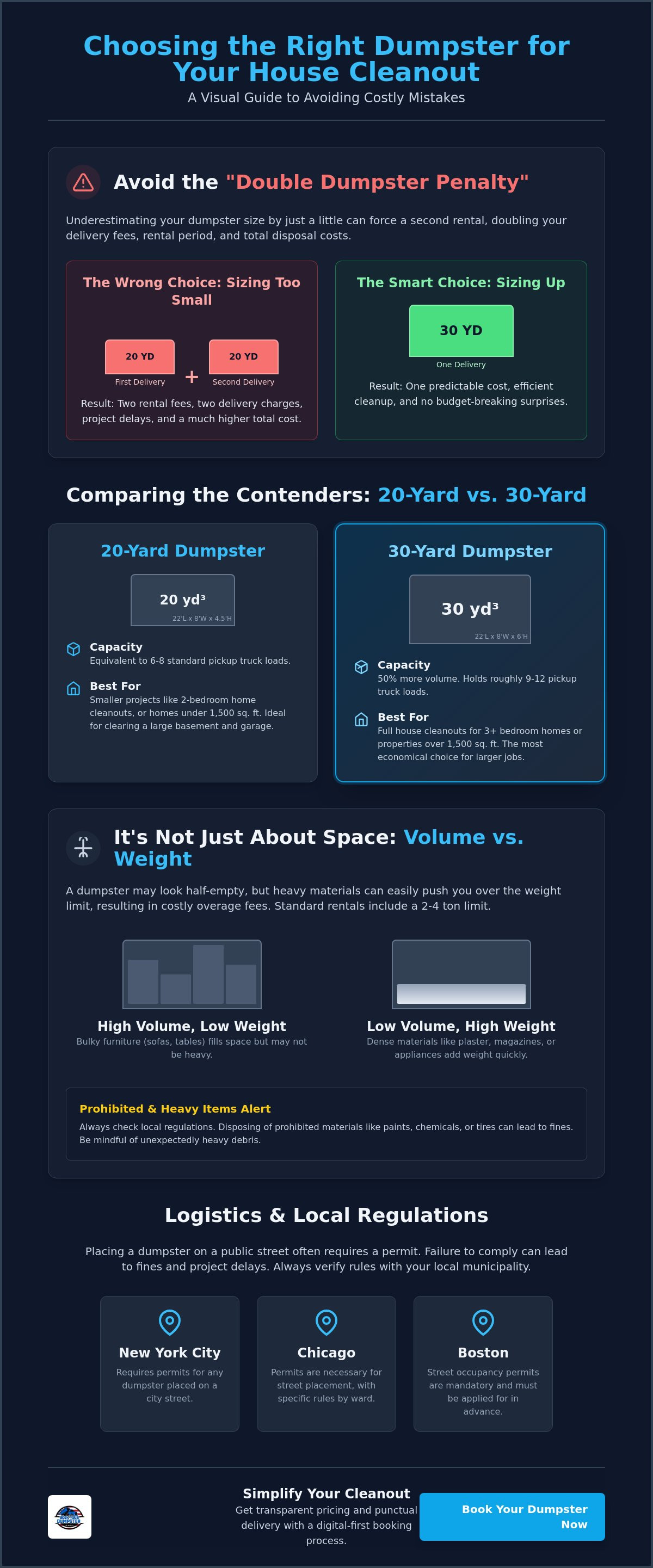
A full house cleanout is a massive undertaking that goes far beyond standard decluttering. It involves the total removal of heavy furniture, old appliances, and years of accumulated household junk from every room, including the attic and garage. Selecting the correct dumpster size for a full house cleanout is the most important logistical decision you will make. If you choose a container that is too small, you face the "Double Dumpster Penalty." This happens when a project requires a second dumpster because the first one reached capacity before the house was empty. You don't just pay for the extra volume; you pay for a second delivery fee, a second rental period, and a second pickup, effectively doubling your disposal budget.
Success requires understanding the difference between air space and actual volume. Bulky items like sofas, dining tables, and refrigerators do not pack tightly. They create significant gaps of empty air within the container. Unless you plan to dismantle every piece of furniture with a chainsaw, you must account for this lost space. Researching various roll-off dumpster sizes allows you to visualize how these awkward items will fit. Matching the container to your home's square footage is a reliable starting point. A 1,500-square-foot home typically requires a different capacity than a 3,000-square-foot estate, especially when basement and garage storage are included in the scope.
The Risk of Underestimating Your Debris
Underestimating your waste creates a logistical bottleneck that can stall your entire project. Imagine your driveway blocked by a maxed-out dumpster while three rooms of junk remain inside the house. You cannot simply pile debris higher than the rim. Overfilled containers are major safety hazards during transport. Drivers will refuse to pick up a dumpster if the load is not level with the top. Overage fees are the specific costs you incur for exceeding the weight or volume limits defined in your rental agreement. Avoid these penalties by sizing up early in the process.
Balancing Cost and Efficiency
There is a clear price gap between a 20-yard and a 30-yard rental, but the larger unit is often the more economical choice for a dumpster size for a full house cleanout. While a 30-yard dumpster offers 50 percent more capacity, it does not cost 50 percent more than a 20-yard unit. However, physical footprint matters. A 30-yard container is longer and may not fit on short or narrow suburban driveways without obstructing the sidewalk. To ensure you select a size that fits both your junk and your property, Book Your Dumpster USA provides professional sizing advice to keep your project moving efficiently.
Comparing the Contenders: 20-Yard vs. 30-Yard Roll-Off Dumpsters
Selecting the correct dumpster size for a full house cleanout requires a choice between three primary contenders: the 20-yard, 30-yard, and 40-yard containers. Most residential projects fall into the 20 to 30-yard range. These units provide the necessary balance of volume for furniture and weight capacity for general household debris. While volume is the most visible factor, you must also account for tonnage. Standard residential units typically include a weight limit between 2 and 4 tons. If you exceed this limit, you will face overage fees regardless of how much physical space remains in the container.
Don't fall into the common weight limit trap. A dumpster might look half-empty, but heavy items like old plaster, stacks of magazines, or large appliances can quickly push you over your weight allowance. Proper loading is essential for safety and cost control. You should also verify Local Regulations for Hazardous Waste before you start tossing items. Disposing of prohibited materials like paints or chemicals adds significant weight and can trigger immediate fines from the disposal facility.
The 20-Yard Dumpster: Capacity and Best Uses
The 20-yard dumpster is the "Goldilocks" size for small to mid-sized homes. It typically measures 22 feet long, 8 feet wide, and 4.5 feet high. This size occupies roughly the same footprint as a standard parking space, making it easy to place in most suburban driveways. To visualize its capacity, think of it as equivalent to 6 to 8 pickup truck loads. It's the ideal choice for 2-bedroom apartments, small ranch houses, or projects focused on decluttering a large basement and garage. If your house is under 1,500 square feet and lacks heavy estate furniture, this is your most efficient option.
The 30-Yard Dumpster: The Estate Cleanout Workhorse
The 30-yard dumpster is the industry standard for full house cleanouts involving 3 to 4 bedrooms. It shares the same 22-foot length and 8-foot width as the 20-yard model but stands 6 feet high. Those extra 1.5 feet of wall height are critical for accommodating tall furniture pieces and large appliances without them sticking out over the top. This unit holds approximately 9 to 12 pickup truck loads of debris. Use this size for homes over 2,500 square feet or estate cleanouts where every room is fully furnished. It provides the breathing room necessary to avoid the double dumpster penalty mentioned earlier.
For hoarding situations or major structural renovations that include tearing out walls and flooring, you may need to step up to a 40-yard unit. This is the largest dumpster size for a full house cleanout and is designed for maximum volume. Before you commit, view our available dumpster sizes to ensure the container dimensions match your available driveway space. Choosing the right unit on the first try keeps your project on schedule and your budget intact.
Room-by-Room Debris Estimation: A Practical Volume Guide
Stop relying on trash bag counts to estimate your project. Most guides fail because they don't account for bulky furniture. A systematic item-by-item inventory is the only way to accurately determine the dumpster size for a full house cleanout. Different materials pack with varying efficiency. Soft goods like mattresses and cushions compress under weight. Wood furniture and metal appliances are rigid and create "dead space." Use the "Tetrising" technique to maximize every inch. Load flat items like table tops and plywood against the walls. Place heavy appliances at the bottom. Fill the gaps with smaller bags of junk. Proper loading can save up to 20% of your total volume. For smaller, room-specific tasks, read our 10 yard dumpster rentals guide for more focused projects.
Estimating the "Big Three": Kitchen, Living Room, and Master Bedroom
The kitchen is your highest density area. A standard refrigerator and stove occupy nearly 3 cubic yards combined. If you remove cabinetry, expect another 4 to 5 yards of bulk. The living room is about high volume but low density. A large sectional sofa consumes up to 6 cubic yards of air space. Entertainment centers are notorious for creating air pockets unless you break them down. In the master bedroom, mattresses are the primary concern. A king-sized set consumes 3 cubic yards instantly. Add dressers and bed frames, and a single bedroom can easily fill 8 cubic yards of your container.
The "Hidden" Debris: Attics, Basements, and Garages
Attics, basements, and garages are the "weight traps" of any cleanout. These spaces often contain 50% of the home's total debris weight despite appearing less cluttered. Boxed junk is incredibly dense. It doesn't compress and adds up quickly on the scale. Garages also house heavy debris like power tools, old tires, and workshop scraps. Many of these items have specific disposal restrictions. Always identify these items early. Their weight and volume are the deciding factors when selecting the right dumpster size for a full house cleanout. Check local guidelines before loading heavy tools or chemicals to avoid project delays.
Logistics and Local Regulations: Permits and Placement in Major Cities
Securing the right dumpster size for a full house cleanout is only half the battle. You must also ensure the delivery truck has the physical space to drop and retrieve the container. Most roll-off trucks require at least 60 feet of straight-line clearance to safely maneuver and tilt the hoist into position. If your driveway is blocked by low-hanging branches or power lines, the driver may be forced to abort the delivery. This results in a dry run fee and stalls your project. Additionally, you must strictly adhere to prohibited items lists. Never place chemicals, car batteries, or electronics into a residential dumpster. These materials require specialized handling. Disposing of them improperly will result in immediate rejection at the landfill or heavy environmental fines. It's your responsibility to ensure the load is safe and compliant before the truck arrives for pickup.
City-Specific Placement Rules
Regulations vary significantly by metro area. In New York City and Queens, placing a dumpster on a public street requires a DOT permit. These permits typically cost between $45 and $150 depending on the duration and specific location. Narrow residential streets in these boroughs often make driveway placement impossible. This makes the permit process a mandatory first step. In Chicago, you must navigate the choice between alleyway placement and street parking permits. Street permits in Illinois generally range from $50 to $100. In Illinois and Massachusetts, the distinction between private property and public right-of-way is strictly enforced. If any part of the dumpster touches a sidewalk, you are legally required to have a permit. Massachusetts cities like Boston and Worcester often require a specific dumpster license from the local health department. You must verify these requirements at least five business days before your project begins to avoid legal delays.
Scheduling and Punctuality
Punctuality is the backbone of a successful cleanout. If you have hired labor waiting to move furniture, a late delivery wastes money. Book your container at least 48 to 72 hours in advance to guarantee your preferred delivery window. This lead time is especially critical during peak spring and summer months when demand for the ideal dumpster size for a full house cleanout is highest. Reliable delivery ensures that your crew stays productive from the moment they arrive. Don't wait until the morning of your project to start the rental process. For a deeper look at the logistics of delivery and pickup, consult our roll off dumpster rental guide. Our system is designed to remove these logistical hurdles so you can focus on the work itself. Check permit requirements and book your dumpster online to secure your delivery date today.
Simplifying Your Cleanout with Book Your Dumpster USA
Securing the correct dumpster size for a full house cleanout requires a partner that understands the entire waste landscape. Book Your Dumpster USA brings professional-grade logistics to the residential market, offering a streamlined booking system for 10, 20, 30, and 40-yard containers. We don't just serve homeowners; our operations cover the full spectrum of the industry, from private curbside trash pickup to specialized front load commercial waste pickup for local businesses and commercial entities. This broad expertise ensures that we handle the specific regulatory hurdles of New York, New Jersey, Illinois, and Massachusetts with ease. We maintain a strict commitment to pricing integrity, providing flat-rate quotes that protect your budget from the hidden fees and opaque surcharges common in the disposal industry. Whether you are managing a single-family estate or a commercial property, our system is built for speed and reliability.
Modern Waste Management for Homeowners and Commercial Entities
Our digital-first platform removes the friction from waste management. You can book a roll-off container from your phone in under two minutes, whether you're at a residential site or managing a commercial facility. While residential users benefit from our sizing tools to find the perfect dumpster size for a full house cleanout, businesses rely on our competence for high-frequency waste needs. We act as a reliable partner who understands the urgency of a cleanout project. Our customer support is available to resolve complex logistical questions, ensuring that every container is placed safely and picked up on schedule. For massive estate projects that exceed standard capacities, we provide the same high-velocity service and logical step-by-step cadence that our commercial clients expect daily.
Ready to Clear the Clutter?
Before you hit the booking button, run through your final site checklist. Confirm that your driveway is clear of obstructions and that you've identified all materials that require special handling. If you are in a high-traffic area like San Francisco or Boston, verify that your street permits are in place to avoid project delays. Once your site is prepared, select your container size and schedule your delivery through our simple interface. We provide the control and transparency you need to move from a state of clutter to a state of resolution without the logistical headache. Book your residential dumpster size today and experience a modern, reliable approach to waste disposal that keeps your project moving forward.
Take Control of Your Home Cleanout
Successful debris management depends on accurate volume estimation and proactive logistics. You now understand how to avoid the double dumpster penalty by choosing a container that accounts for furniture bulk and weight limits. Remember to secure your city permits early to keep your project compliant. Selecting the right dumpster size for a full house cleanout turns a chaotic project into an organized, one-step process.
Book Your Dumpster USA provides transparent flat-rate pricing across New York, New Jersey, Illinois, Massachusetts, and San Francisco. Our digital platform allows you to complete your rental in under two minutes. Rent the perfect dumpster for your house cleanout today. You have the plan and the tools to finish the job right. Start today and reclaim your home from the clutter.
Frequently Asked Questions
What is the most common dumpster size for a 3-bedroom house cleanout?
The 30-yard dumpster is the industry standard for a 3-bedroom house. It provides the six-foot wall height needed for large furniture and appliances. This capacity prevents the container from overflowing before the project is complete. It's the safest bet for most estate cleanouts where every room is fully furnished. Most residential users find this size offers the best balance of volume and physical footprint.
Can I fit a king-sized mattress in a 20-yard dumpster?
Yes, a king-sized mattress fits in a 20-yard container. Place it flat or against the side wall to maximize remaining space. A king mattress set occupies about 3 cubic yards of volume. If you have multiple mattresses, consider a 30-yard unit instead. This prevents the bulky items from sticking out over the top rim of the dumpster. Proper placement is key to keeping the load level for safe transport.
How do I know if I need a permit for my dumpster in New York City?
You need a DOT permit if the container sits on any public property in NYC. This includes the street, sidewalk, or any public right-of-way. Placement on a private driveway does not require a permit. Check with your local precinct or the DOT website at least five days before delivery. We can help you navigate these local requirements during the booking process to ensure you stay compliant with city regulations.
What happens if the dumpster is too heavy for the truck to pick up?
The driver will leave the container on-site if it exceeds the truck's safe lifting capacity. You'll have to remove heavy items until the load meets legal weight limits. This results in a dry run fee and stalls your project until the weight is corrected. Always distribute heavy debris like old books or files evenly across the bottom of the container. Avoid concentrated piles of dense materials to ensure a successful pickup.
Is a 10-yard dumpster big enough for a full house cleanout?
A 10-yard unit is almost never the right dumpster size for a full house cleanout. Reserve this size for small debris like a single bathroom remodel or a shed cleanout. Most residential cleanouts require a 20 or 30-yard unit to avoid multiple delivery fees. Choosing a container that is too small usually doubles your total project cost. It's more efficient to have extra space than to pay for a second delivery.
What items are strictly prohibited in a residential roll-off dumpster?
Never put hazardous materials, wet paint, car batteries, or tires in the unit. Electronics and appliances with Freon are also restricted in most areas. These items cause safety issues at landfills and trigger immediate environmental fines. Contact your local sanitation department for specific drop-off locations for these items. Keeping your load clean ensures a smooth pickup and disposal process without unexpected surcharges.
How much space does a 30-yard dumpster actually take up in my driveway?
A 30-yard dumpster requires a footprint of 22 feet by 8 feet. Ensure your driveway is long enough to accommodate this without blocking the sidewalk. The delivery truck also needs 23 feet of vertical clearance to lift and drop the container. Confirm your drop-off site is clear of low-hanging branches or wires before the truck arrives on the scheduled day. Clear the area of all vehicles and obstacles to prevent delivery delays.
Should I choose a dumpster rental or a junk removal service for a house cleanout?
Choose a rental if you want to work at your own pace and save on labor costs. Junk removal is a premium service where you pay for the crew's labor. For a dumpster size for a full house cleanout, the rental is usually the more pragmatic financial choice. It allows you to sort through items carefully rather than rushing to meet a crew's schedule. You maintain total control over what stays and what goes.


