
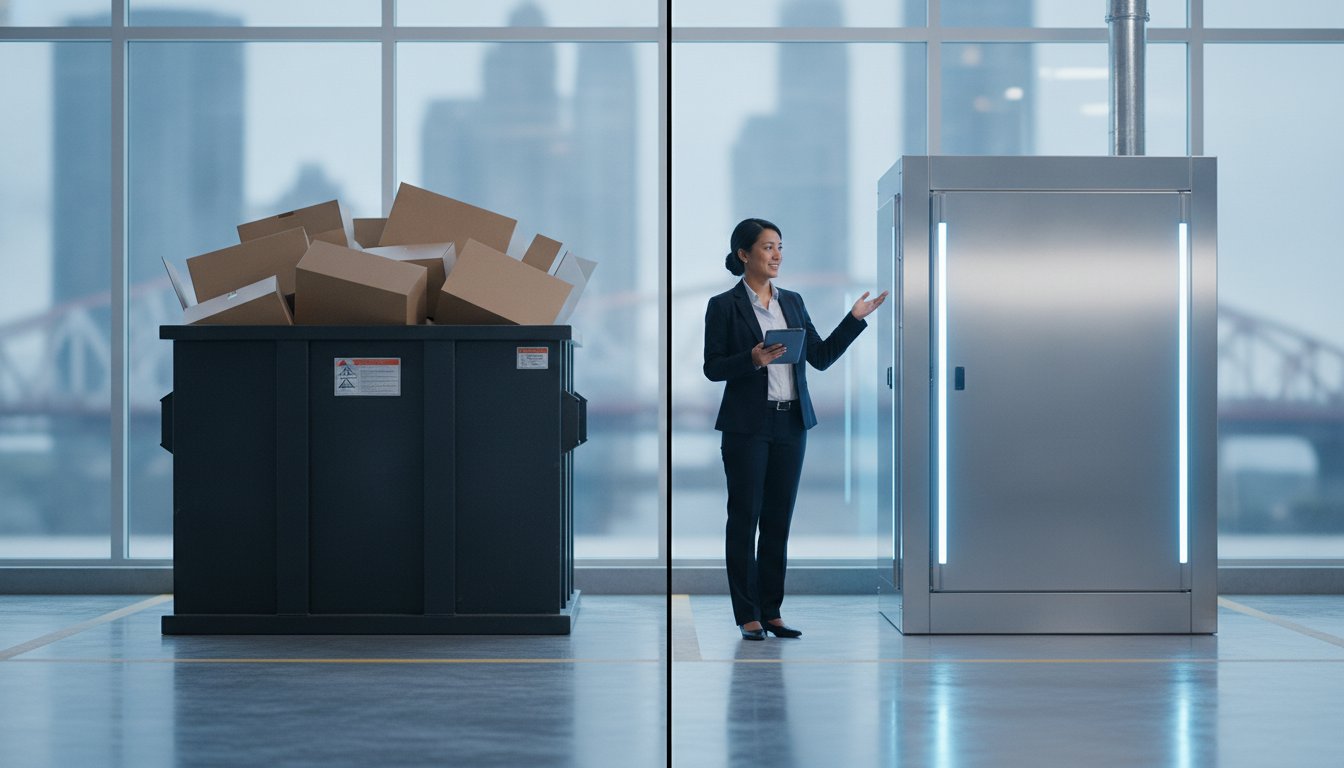
If you think waste management is about the size of your container, you're likely paying too much for air. The real secret to efficiency isn't the volume of the bin; it's the density of the haul. Selecting the right dumpster and compactor service is the difference between a streamlined operation and a loading dock that drains your budget. You know the frustration of watching hauling fees spike while loose waste takes up valuable square footage on-site. It's a common headache, but it isn't a necessary cost of doing business.
Stop overpaying for frequent pickups and start optimizing your disposal strategy. This guide helps you master the differences between open containers and compaction units so you can lower your monthly waste bills and secure your site against unauthorized dumping. We'll examine the specific cost-saving benefits of each system, analyze the security advantages of closed containers, and provide a clear roadmap for scaling your waste management as your business grows. Move past the logistical stress and turn your waste disposal into a high-functioning tool for your facility.
Key Takeaways
- Learn the fundamental differences between a standard dumpster and compactor service to determine which system handles your specific waste stream most efficiently.
- Understand how roll-off dumpsters offer the flexibility needed for dynamic construction projects and heavy residential renovations.
- Identify high-volume ROI opportunities where mechanical compression can reduce your waste volume by up to 75 percent, slashing your hauling frequency.
- Evaluate your site constraints and material density using a decision matrix to choose between a large roll-off footprint or a space-saving vertical compactor.
- Optimize your operational budget by selecting a scalable disposal plan that eliminates unnecessary hauling fees and unauthorized dumping.
Defining Dumpster and Compactor Service: Which Fits Your Stream?
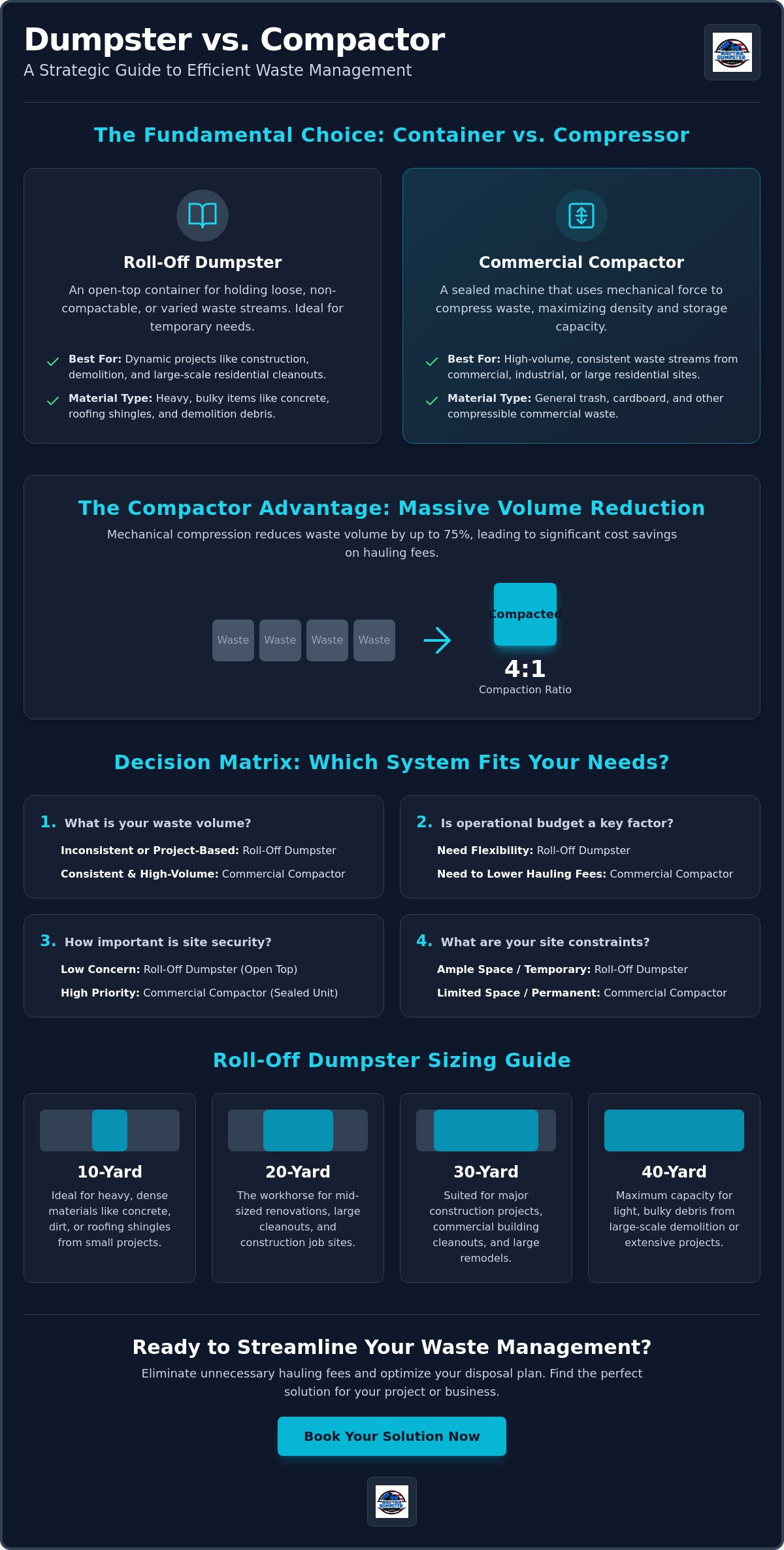
Selecting the right dumpster and compactor service is a tactical decision that dictates your operational overhead. Standard dumpster services rely on open-top or front-load containers to hold loose debris. They're effective for general trash but lack the density-driven efficiency of mechanical systems. Compactor services utilize heavy-duty machinery to compress waste, often achieving a volume reduction of 4:1. This choice isn't just about the bin; it's about how often a truck visits your site. In 2026, waste regulations in Illinois and New York have made volume management a priority. Businesses now face intensified pressure to provide data-driven ESG reports, making the choice of equipment a matter of compliance as much as cost.
Consider your site's physical appearance and security. Open dumpsters are prone to unauthorized dumping. This adds weight to your bill that isn't yours. They also take up significant space and can look unorganized. A compactor offers a sealed environment that improves site aesthetics and prevents scavengers from accessing your waste. Since 60 percent of waste entering landfills is commercial, optimizing your density is the fastest way to stabilize monthly waste costs while meeting modern sustainability targets. Choose your equipment based on the density of your waste stream, not just the physical footprint of the container.
The Role of Roll-Off Dumpsters
Roll-off containers are the primary choice for construction, demolition, and seasonal residential cleanouts. They offer a flexible, temporary solution for high-velocity projects where waste accumulates quickly. You can select from 10, 20, 30, or 40-yard capacities based on your project scale. For heavy materials like concrete or roofing shingles, the 10-yard or 20-yard options are standard to stay within weight limits. Larger 30 and 40-yard bins handle lighter, bulkier debris. These containers allow for easy placement and rapid removal once filled, keeping your job site clear and your project on schedule.
The Mechanics of Compactor Systems
Compactor systems use a heavy-duty mechanical ram to compress waste into a reinforced container. This waste compaction process reduces the physical volume of your trash, meaning you fit more into every haul. Fewer "truck rolls" result in lower carbon emissions and reduced site traffic. These units are best for high-volume commercial environments, industrial plants, or large multi-family residential complexes. If your business generates consistent, high-volume waste, a compactor provides a scalable solution that grows with your operations while keeping hauling fees predictable.
Roll-Off Dumpster Services: The Flexible Solution for Dynamic Projects
Roll-off containers provide the necessary flexibility for high-impact projects that don't have a fixed waste volume. While permanent compaction units are excellent for steady commercial streams, dynamic construction sites and residential renovations require the mobility of a roll-off. This is where a comprehensive dumpster and compactor service becomes a strategic asset. You can swap out bins as project phases shift from heavy demolition to lighter finishing work. Contractors managing multiple job sites in New Jersey or Massachusetts rely on this adaptability to keep their loading docks clear and their crews moving. For those planning a large-scale project, the EPA guide for commercial buildings offers a solid framework for assessing waste before you even order your first bin.
Large-scale construction sites often face a hybrid challenge. You might need the massive volume capacity of a 40-yard roll-off for initial demolition, but as you move into the fit-out phase, a temporary compactor might save you more on hauling fees. This balanced approach is a hallmark of a sophisticated dumpster and compactor service. It allows you to scale your waste capacity up or down without being locked into a rigid system that no longer fits your site's needs. If you're ready to organize your next phase, you can view available inventory and book online to secure your delivery date.
Choosing the Right Size for Efficiency
- 10-Yard Dumpsters: Use these for heavy, high-density materials. They're the standard for concrete, dirt, or small bathroom remodels where weight is the primary concern.
- 20 and 30-Yard Dumpsters: These are the workhorses of the industry. Select them for whole-home cleanouts, roofing projects, or general construction debris.
- 40-Yard Dumpsters: Designed for commercial demolition and massive amounts of light, bulky debris like wood, siding, or cardboard.
Logistics and Placement Strategy
Logistics can make or break your site efficiency. Always identify stable, level, and accessible ground before the truck arrives. A fully loaded roll-off is incredibly heavy; soft soil or weak asphalt will crack under the pressure. In urban centers like Queens, street placement requires strict adherence to local permit requirements. Don't risk a fine by skipping the paperwork. Ensure there's at least 60 feet of linear space and 25 feet of overhead clearance for the delivery and pickup process. If the truck can't maneuver, you'll face dry-run fees that eat into your profit margins.
Commercial Compactor Services: Maximizing ROI for High-Volume Sites
For high-volume facilities, a permanent dumpster and compactor service is an investment in site control and financial predictability. Open-top containers often hide costs that don't appear on a standard quote. You pay for the physical space that uncrushed air takes up in every bin. You also pay the tipping fees when unauthorized users dump heavy debris into your open containers overnight. Compactors eliminate these budget leaks by securing your waste in a locked, high-density environment. Retail centers, hospitals, and industrial warehouses use these systems to convert a messy logistical hurdle into a streamlined, cost-effective process.
Site security is a primary driver for compaction. Closed systems prevent scavengers from accessing sensitive documents or discarded products. They also stop pests and windblown litter, which keeps your loading docks cleaner and safer for staff. In 2026, where ESG reporting is standard, the ability to track exact waste weights through compacted hauls provides the data you need for compliance. It's a professional solution that removes the stress of managing overflowing bins and the associated fines from local municipalities.
Stationary vs. Self-Contained Compactors
- Stationary Units: These are bolted to the ground and are best for dry waste streams like cardboard, paper, and plastic. Only the receiving container is hauled away for emptying.
- Self-Contained Units: These are fully sealed systems designed for "wet" waste. They're essential for hospitals or food service providers because they manage liquid runoff and odors.
- Vertical Compactors: If your facility is in a tight urban corridor like Boston or San Francisco, vertical units offer a space-saving alternative. They provide high-density compaction within a footprint as small as 15 feet.
The Financial Logic of Compaction
Calculate your break-even point by comparing your current hauling frequency against the monthly cost of equipment. If you're currently scheduling four pickups a week for loose trash, a compactor can often reduce that to one. This 75 percent reduction in truck traffic directly impacts your bottom line. Labor savings are equally significant. Employees don't have to spend hours breaking down boxes or wrestling with jammed bin lids. They simply load the machine and let the mechanical ram do the work. Over time, the reduction in fuel surcharges and environmental fees makes compaction the most scalable choice for growing businesses. If you're ready to transition, schedule a consultation for commercial waste pickup to find the right unit for your site.
The Decision Matrix: Volume, Cost, and Site Constraints
Choosing between a dumpster and compactor service depends on more than just your total trash weight. You must evaluate the physical composition of your waste stream. If your bins are mostly filled with "air," such as uncrushed cardboard boxes, plastic film, or light packaging, you're paying for empty space every time the truck rolls. Conversely, if your waste consists of high-density construction debris like concrete or roofing, mechanical compaction isn't just unnecessary; it's often impossible. Density dictates your equipment, but frequency dictates your budget. Analyze your hauling logs from the last 90 days. If you're scheduling a pickup more than twice a week for loose trash, the math almost always favors a compactor. The equipment costs are quickly offset by the reduction in per-haul fees.
Site footprint is the final decider. Measure your loading dock or parking area with precision. A standard 40-yard roll-off requires approximately 40 feet of linear space for the container itself, plus another 20 to 30 feet of "swing room" for the truck to maneuver. If you don't have that kind of acreage, a vertical compactor is your best alternative. These units fit into a 15-foot spot, making them ideal for tight urban corridors. This is the "New York Factor." In cities with narrow alleys and strict municipal waste schedules, space is your most expensive asset. Don't waste it on oversized bins that your site can't actually support. If you need to verify your site's capacity, book a 10 to 40-yard dumpster online and consult with our logistics team during the scheduling process.
Material-Specific Equipment Choices
Heavy masonry debris like brick, stone, or asphalt should never go in a compactor. The hydraulic ram is designed to crush compressible materials, not solid rock. Putting heavy aggregates in a compaction unit will lead to equipment failure and expensive repair bills. For these materials, stick to 10-yard or 20-yard roll-off dumpsters. If your stream is dominated by high-volume recyclables, consider a dedicated cardboard baler. This separates your cardboard from mixed municipal solid waste (MSW), potentially turning a disposal cost into a recycling credit. Retail environments with a mix of food waste and packaging should prioritize self-contained compactors to prevent leaks and odors.
Urban Logistical Challenges
Managing waste in high-density areas requires a firm grasp of local ordinances. You'll face noise restrictions and time-of-day hauling limits in residential-adjacent zones. In cities like Chicago or Boston, truck access is often restricted to specific hours to avoid traffic congestion. Navigating these hurdles requires a partner who understands the local landscape. For a detailed breakdown of regional regulations, see our Guide to Dumpster Rental in New York and Massachusetts. Always ensure your loading area is clear of parked cars and low-hanging wires before your scheduled pickup to avoid dry-run fees and service delays.
Streamlining Your Waste Management with Book Your Dumpster USA
Transitioning from a cluttered job site to an efficient, high-density operation requires a partner who handles the logistics for you. At Book Your Dumpster USA, we've modernized a traditional industrial sector through digital convenience and straightforward honesty. Our dumpster and compactor service provides the infrastructure needed for any project scale, from localized residential cleanups in Illinois to multi-state industrial operations across New York and New Jersey. We remove the logistical stress of waste management so you can focus on your core business. You get direct, no-nonsense pricing that respects your project budget and a reliable schedule that keeps your facility running smoothly.
Every facility has unique requirements based on material density and site footprint. Don't guess which equipment you need. We provide professional consultations to determine if your site is ready for a permanent compaction unit or if a high-capacity roll-off strategy is more cost-effective. By analyzing your hauling frequency and waste composition, we help you eliminate the "air" in your bins and the unnecessary fees on your monthly bill. Trust our expertise to turn your waste disposal into a high-functioning tool for your business.
Our Comprehensive Waste Solutions
We provide a full range of equipment to handle any waste stream. Select from our inventory of 10, 20, 30, and 40-yard dumpsters to match your specific project volume. For residential users or small businesses, our 10-yard and 20-yard options are perfect for heavy debris and tight spaces. If you're managing a large-scale commercial demolition, our 40-yard units provide the massive capacity required for bulky materials. We also offer front-load commercial waste pickup and private curbside trash pickup for ongoing, long-term needs. We frequently partner with contractors to provide reliable construction debris removal, ensuring that loading docks stay clear across multiple phases of development.
Getting Started with Your Service
Use our streamlined online booking system to secure your equipment and schedule a delivery date in minutes. The process is designed to reduce friction, guiding you through selection and scheduling with total transparency. If you're looking for a permanent commercial solution, your first site assessment will evaluate truck access, overhead clearance, and power requirements for compaction units. We identify the logistical hurdles before the equipment arrives to prevent dry-run fees and installation delays. Ready to clear the clutter? Book your dumpster now and experience a more efficient way to manage your waste.
Optimize Your Site Efficiency for 2026
Waste management isn't just about hauling trash; it's about mastering density and site logistics. You've learned that the right dumpster and compactor service choice depends on your material type, volume, and physical space constraints. Whether you're managing high-velocity construction debris with roll-off containers or stabilizing commercial costs with a permanent compaction unit, the goal remains the same. You need to lower your overhead and clear the clutter to maintain a professional workspace.
Don't let inefficient waste cycles drain your budget or compromise your site security. We serve major hubs including NY, NJ, IL, MA, and SF with a full range of 10, 20, 30, and 40-yard containers. Our streamlined online booking system removes the friction from your planning process, giving you immediate control over your disposal needs. It's a pragmatic solution for a messy problem that requires a direct, reliable approach from a partner you can trust.
Order Your Roll-Off Dumpster Online Today to secure your delivery and streamline your operations. Take charge of your loading dock and turn your waste strategy into a competitive advantage. Your project deserves a reliable partner that values your time and your bottom line.
Frequently Asked Questions
Is a compactor cheaper than a dumpster service for my business?
A compactor is often cheaper if your facility generates enough waste to require more than two pickups per week. By compressing trash at a 4:1 ratio, you significantly reduce the number of expensive "truck rolls" to your site. This makes a dedicated dumpster and compactor service a smart financial move for high-volume retail or industrial sites. You'll pay for the equipment, but you'll save much more on hauling fees over time.
What is the smallest dumpster size available for residential projects?
The 10-yard dumpster is the smallest unit we sell for residential and cleanout projects. It's the standard choice for heavy, high-density materials like dirt, concrete, or roofing shingles. Homeowners also use it for small bathroom or kitchen renovations where driveway space is limited. This size ensures you stay within weight limits while clearing your project debris efficiently. It fits easily in a standard driveway without blocking your personal vehicles.
Can I use a compactor for construction and demolition (C&D) debris?
You should never use a compactor for construction and demolition debris. The mechanical ram is designed to crush soft materials like cardboard, plastic, and general municipal trash. Solid materials like brick, stone, or heavy timber can jam the system or cause permanent structural damage to the hydraulic unit. For these heavy-duty projects, always select a roll-off dumpster to ensure your site stays compliant and your equipment remains fully functional.
How much space do I need for a 40-yard roll-off dumpster delivery?
A 40-yard roll-off requires approximately 60 feet of linear space for a safe delivery and pickup. While the bin itself is about 22 feet long, the truck needs significant extra room to maneuver and drop the container. You also need 25 feet of overhead clearance to avoid power lines or tree limbs during the hoist process. Always ensure the drop zone is level and clear of parked cars before the driver arrives.
Does Book Your Dumpster USA offer service in Queens and San Francisco?
Yes, we provide comprehensive waste services in both Queens and San Francisco. These cities present unique logistical challenges, including narrow streets and strict time-of-day hauling restrictions. Our team is familiar with local permit requirements and urban navigation, ensuring your delivery happens on schedule. Whether you need a temporary roll-off or a long-term dumpster and compactor service, we have the local expertise to manage your high-density waste stream.
What happens if I put prohibited materials in my dumpster or compactor?
Placing prohibited materials in your container leads to immediate contamination fees or a refusal of service. Hazardous waste, liquid chemicals, tires, and electronic waste are strictly forbidden in standard bins. These items require specialized handling at dedicated facilities and cannot be mixed with general trash. Always review our prohibited items list before you start loading. This prevents project delays and keeps your total waste management costs predictable and transparent.
How often are commercial compactors typically serviced or emptied?
Service frequency depends on your waste volume, but most commercial compactors are emptied every 14 to 30 days. Because the waste is compressed, you can hold much more material than a standard open-top bin. Many modern units include sensors that notify us when the container reaches 80 percent capacity. This ensures you only pay for hauls when they're truly necessary, maximizing your operational efficiency and reducing unnecessary truck traffic at your facility.
Do I need a permit to place a dumpster on a city street in New Jersey?
You will likely need a permit if the dumpster sits on a public street or sidewalk in New Jersey. Each municipality has its own rules regarding duration and safety markings like reflective cones. If you place the container entirely on private property, such as your driveway, a permit is usually not required. Always contact your local town hall or police department to verify the specific requirements for your neighborhood before delivery.


