
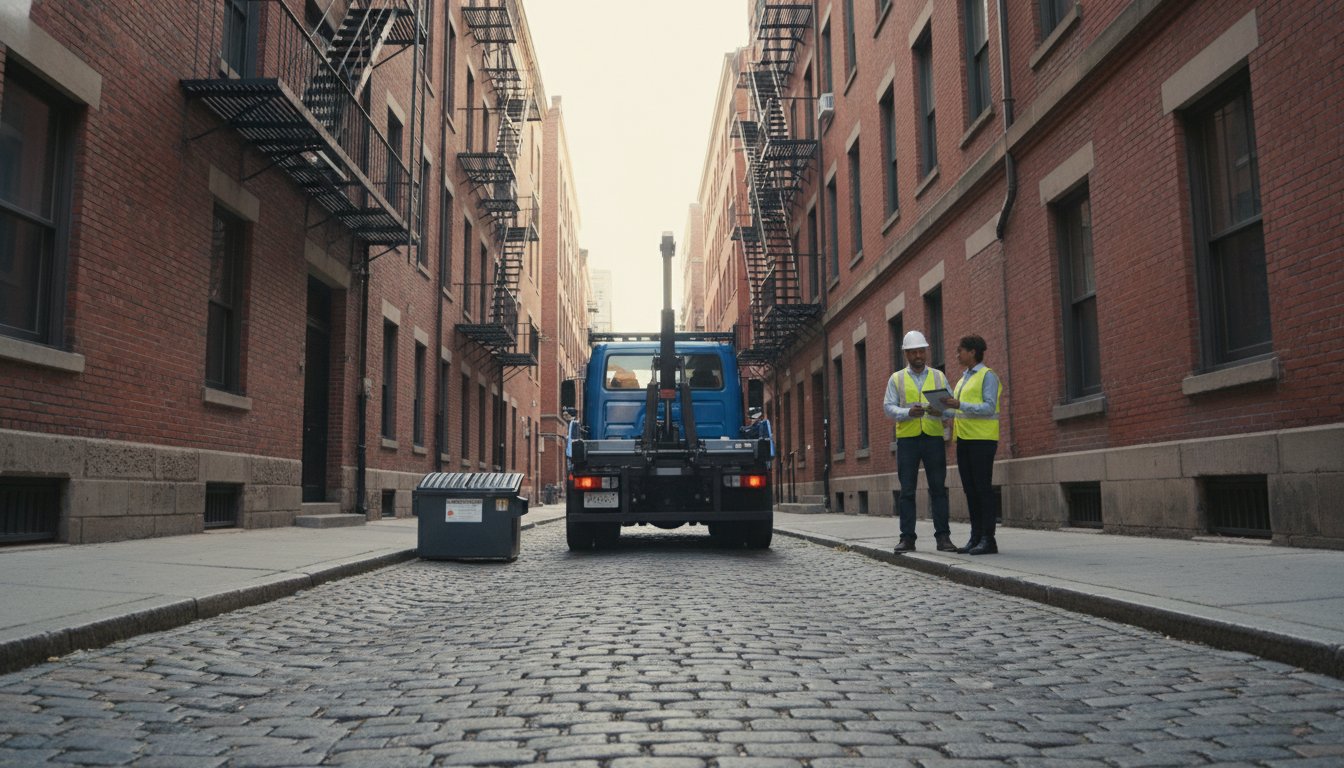
A narrow alleyway isn't a dealbreaker for your project, but it is a high-precision logistical maneuver that requires expert planning. You're likely worried about a multi-ton truck scraping your siding or a neighbor calling code enforcement over a blocked right-of-way. These are valid concerns that can turn a simple cleanup into a legal headache. Successfully securing a dumpster rental for alleyway placement depends on your ability to navigate local permit laws and physical clearance requirements with total accuracy.
We believe waste removal should be the easiest part of your job. This guide teaches you exactly how to manage the legal and physical hurdles of placing a roll-off container in tight urban spaces. You'll gain the confidence to measure your site for truck accessibility and understand the specific permit needs for your city. We'll preview the essential steps to avoid property damage and neighbor disputes, ensuring your project stays on schedule and compliant. From selecting the right container size to final pickup, we provide the roadmap for a frictionless experience.
Key Takeaways
- Compare Hook and Lift versus Cable delivery systems to see which truck type can safely navigate your specific alley dimensions.
- Learn to distinguish between public Right-of-Way permits and private property placement to avoid unexpected municipal fines.
- Discover why the 10-yard dumpster footprint is the most reliable choice for maintaining clearance in tight urban corridors.
- Follow a precise site-prep checklist to ensure your dumpster rental for alleyway placement doesn't result in property damage or failed deliveries.
- Use professional measurement techniques to verify truck access at the narrowest points of your entry and exit route.
The Logistics of Dumpster Rental for Alleyway Placement
Alleyway placement involves the precise positioning of a heavy roll-off container within a narrow secondary thoroughfare. This strategy is a necessity for urban renovations in high-density cities like New York and Chicago, where street parking is restricted and private driveways are non-existent. When you plan a dumpster rental for alleyway placement, you aren't just ordering a box; you're coordinating a high-stakes delivery that requires specific hardware and careful site preparation.
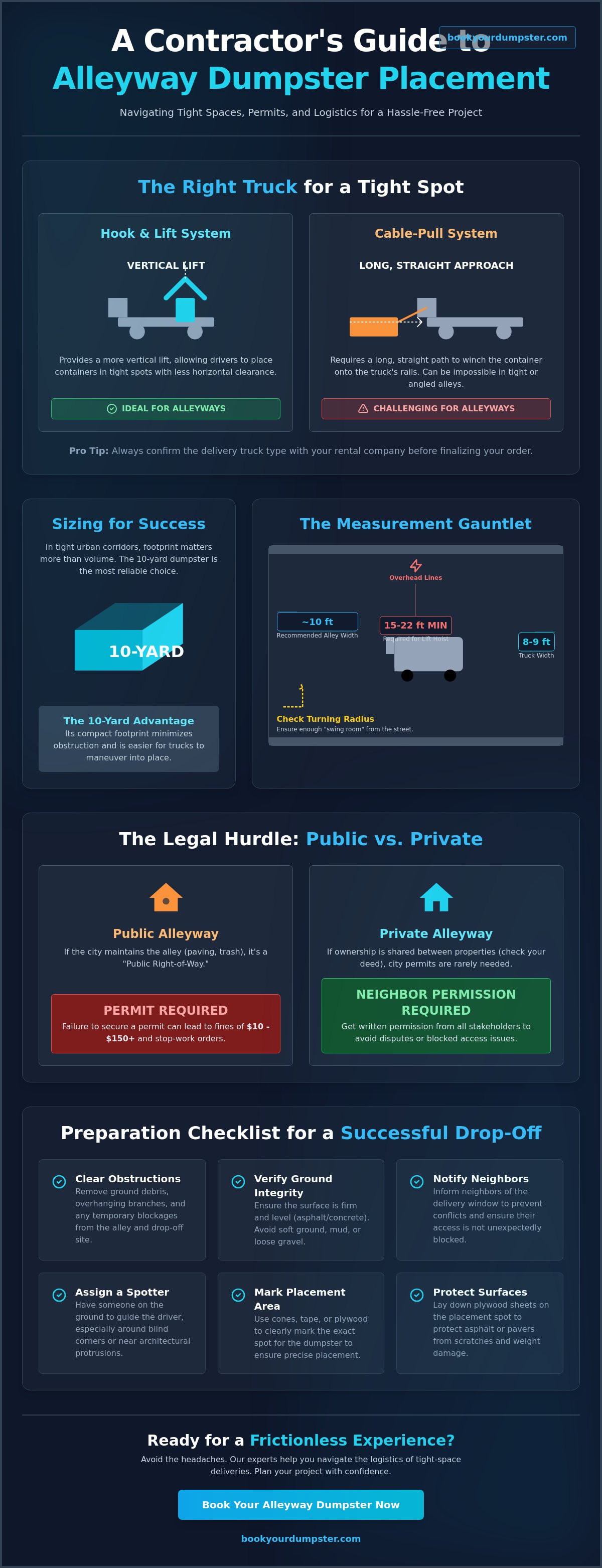
The delivery method determines whether the truck can physically drop the unit in a confined space. Cable-style trucks are common, but they require a long, straight approach to pull the roll-off dumpster onto the rails. In contrast, Hook and Lift systems provide a more vertical lift. This allows the driver to drop the container in tighter spots with less horizontal clearance. Confirm the equipment type before you finalize your order to ensure it matches your site's physical constraints.
Ground integrity is a critical logistical factor. The alley surface must be firm and level to support the combined weight of the truck and the loaded container. Avoid soft mud or loose debris that could cause the vehicle to sink. If the ground is uneven, the truck's stabilizers might fail to engage properly, creating a safety risk. Prepare the site by clearing all obstructions and verifying that the asphalt or concrete can handle the pressure of a multi-ton load.
Understanding Truck Dimensions and Turning Radius
A standard roll-off truck is roughly 8 to 9 feet wide. While this fits most alleys, the real challenge lies in the approach. The truck needs significant swing room to turn from a standard street into a narrow entrance. If the street is also narrow or lined with parked cars, the turn might be impossible. Vertical space is equally critical. The hoist needs 15 to 22 feet of overhead clearance to tilt the bed and slide the container off. Measure from the ground to the lowest hanging obstacle to ensure the driver has the room to operate the lift safely.
Physical Obstructions to Watch For
Overhead hazards are the primary cause of failed deliveries in urban corridors. Identify low-hanging power lines, internet cables, and tree branches before the truck arrives. On the ground, look for architectural protrusions like narrow eaves, gutters, and fire escapes. These can easily be clipped by the top of the container or the truck's mirrors. If the delivery route involves blind corners or tight bends, assign a spotter to guide the driver. This prevents property damage and ensures the container is placed exactly where you need it without obstructing neighbor access.
Navigating Permits and Local Regulations for Alley Placement
You must determine your permit status before the truck arrives. In most jurisdictions, you need a permit for a dumpster rental for alleyway placement whenever the container sits on city-owned property. Many homeowners and contractors mistake secondary thoroughfares for private property. If the city maintains the pavement, manages the drainage, or handles municipal trash pickup in that corridor, it's a public right-of-way. Placing a roll-off container there without authorization leads to immediate fines and the potential removal of the unit at your expense.
Regulations vary significantly across the Northeast and Midwest. In New York, the Department of Transportation requires specific permits for any street or sidewalk obstruction. Chicago has strict "Public Way Use" requirements for its extensive alley network. New Jersey municipalities often delegate these decisions to local police or public works departments. Following Construction Waste Management Best Practices helps ensure your project remains compliant with these layered urban regulations. To avoid delays, verify your local requirements through our online portal before scheduling.
Public vs. Private Alleyways
Identifying the ownership of your alley is the first step in the planning process. Check your property survey or deed for mentions of a private easement. If the alley is a private thoroughfare shared only by a few neighbors, city permits are rarely required. However, you still need written permission from all stakeholders who share access to avoid legal disputes or blocked entries. If the alley is public, you are occupying "Right-of-Way" space. Failure to permit this space can cost between $10 and $150 depending on the city's fee schedule. Beyond the cost, an unpermitted dumpster in a public alley can trigger a "stop work" order for your entire renovation project.
The Permit Application Process
Apply for a temporary occupancy permit at least 3 to 5 business days before your scheduled drop-off. Most major metro areas offer online applications through their Department of Transportation or Public Works portals. You'll need to provide the exact dimensions of the container and the planned duration of the placement. Once the city approves the request, print the permit and secure it to the side of the dumpster or a nearby visible structure. This visibility prevents unnecessary site visits from code enforcement officers and proves you have the legal right to occupy the space. Ensure the permit covers the entire duration of your dumpster rental for alleyway placement to avoid late-project citations.
Choosing the Right Dumpster Size for Narrow Spaces
Size selection isn't just about volume; it's about the physical geometry of your site. In a tight urban corridor, the wrong dimensions lead to a blocked thoroughfare or a failed delivery. When choosing a dumpster rental for alleyway placement, you must balance your debris needs with the reality of your alley's width and length. A container that's too long will prevent neighbors from exiting their garages, while one that's too wide will simply not fit between the brickwork of older city buildings. Precision measurement is the only way to avoid these logistical failures.
Low-profile designs are particularly beneficial in these cramped environments. They feature shorter side walls, which make manual loading over the side much easier when you don't have the room to open the rear swinging door. Following EPA guidelines for construction debris ensures you maximize this limited volume through efficient packing and sorting of recyclables. This approach reduces the total number of hauls needed, which is a major advantage when dealing with difficult access points.
The 10-Yard Dumpster: Compact and Efficient
The 10-yard dumpster is the gold standard for alleyway projects. These units typically measure 12 feet long by 8 feet wide. This compact footprint allows the container to fit within a single parking spot or a narrow lane without completely cutting off traffic. It's the ideal choice for residential bathroom remodels, basement cleanouts, or small deck removals where space is at a premium. Because it's shorter, the delivery truck requires less straight-line clearance to drop the unit, making it much easier to maneuver into tight spots than larger alternatives.
The 20-Yard Option: When You Need More Volume
Sometimes a 10-yard unit isn't enough for larger urban construction projects. The 20-yard option offers double the capacity but requires a significantly larger operational area. These containers are usually 22 feet long. That extra 10 feet of length drastically increases the truck's turning radius and the total straight-line clearance needed for the drop. Before committing to this size, consult our Roll Off Dumpster Guide to compare volumes and footprint requirements.
If your project involves heavy materials like brick or dirt, be mindful of weight limits to protect the alley surface. Narrow corridors often have thinner asphalt or older concrete that can crack under extreme pressure. A 10-yard unit filled with heavy masonry can exceed the weight-bearing capacity of residential alleys. Distribute the load evenly and avoid overfilling to prevent surface damage. If the alley surface looks fragile, consider placing plywood boards down before the dumpster rental for alleyway placement arrives to help distribute the weight of the container.
Preparation Checklist for a Successful Alley Drop-off
Preparation is the difference between a seamless delivery and a costly dry-run fee. Once you've selected your container size, you must physically secure the site. Start by measuring the width of the alley at its narrowest point, including architectural protrusions like window units or eaves. A dumpster rental for alleyway placement requires a clear path for the truck and the unit itself. Clear away all loose debris, mobile trash bins, and parked cars from the drop-off zone. If the driver arrives and finds the path blocked, they'll have to skip the delivery, delaying your project and potentially triggering a trip charge.
Protect the alley surface from the immense weight of the loaded container. Even a 10-yard dumpster can cause asphalt cracking or leave indentations on older concrete when filled with heavy materials. Use 3/4-inch plywood sheets or professional-grade street pads to create a barrier between the dumpster's steel rollers and the ground. This simple step distributes the weight and prevents property damage that could lead to costly repairs or municipal citations. To ensure a smooth delivery, schedule your rental after you have confirmed the site is fully prepped.
The 'Neighbor Diplomacy' Strategy
Successful alleyway placement depends on the cooperation of those around you. Notify your neighbors at least 48 hours before the truck arrives. This prevents complaints and ensures they don't accidentally block the alley with their own vehicles on delivery day. If the alley is the only exit for a neighbor's garage, propose a shared-use window where the dumpster is placed to allow them enough room to pass. Handle shared easements professionally by showing your permit and explaining the project timeline. Clear communication reduces the likelihood of neighbor disputes and keeps the work environment productive.
Marking the Drop-off Zone
Don't leave the exact placement to guesswork. Use traffic cones or heavy-duty chalk to mark the four corners of where the dumpster should sit. This gives the driver a clear target and ensures the unit is positioned for maximum efficiency. Maintain at least 3 feet of walk-around space on at least one side of the container if possible. This room is essential for loading debris safely and accessing the rear door. Finally, verify that your marked zone doesn't block fire hydrants, utility meters, or manhole covers. Obstructing these items is a violation of city code and can result in an immediate tow-away order.
Expert Alleyway Placement with Book Your Dumpster USA
Book Your Dumpster USA understands that urban projects don't always have the luxury of a wide driveway or an open parking lot. Our drivers specialize in the high-precision maneuvers required for a successful dumpster rental for alleyway placement. We navigate the tightest corridors in New York, New Jersey, and Illinois with professional control. You don't have to worry about property damage or blocked access when you work with experts who do this every day. We train our team to handle the specific equipment maneuvers required to drop a container exactly where you marked it, even when space is measured in inches.
Our commitment to pricing integrity sets us apart from national brokers. Many companies hide "difficulty fees" for narrow street deliveries in the fine print of their contracts. We believe in transparent utility. The price you see during our digital checkout process is the final cost for your service. This honesty builds the immediate trust you need for a project that's already messy and labor-intensive. We focus on reliability and the removal of logistical stress so you can focus on the job at hand. Our streamlined online booking system is designed for speed, helping you secure equipment quickly when you're working with time-sensitive city permits.
Why Experience Matters in Tight Spaces
National brokers often lack the local insight needed for complex urban drops. They might dispatch a driver who isn't equipped for a narrow alleyway or who doesn't understand the swing room required for a successful turn. We use local knowledge and advanced digital tools to review your site before the truck leaves the yard. Our team frequently reviews Google Maps imagery to verify clearance and approach angles. This proactive approach ensures we meet all New York and Massachusetts regulations without compromising safety. Trust a partner who understands the specific architectural challenges of your neighborhood and the legal requirements of your city.
Book Your Alleyway Dumpster Today
Don't let permit deadlines or space constraints stall your cleanup. Our streamlined online platform makes it easy to secure the right equipment for your specific location. We offer a full range of sizes, including our 10, 20, 30, and 40 yard dumpsters, to accommodate any urban renovation or commercial project. If you need a front load commercial waste pickup or private curbside trash pickup, we provide those reliable solutions too. Select your container, choose your delivery date, and let our team handle the logistics. Rent your dumpster now at bookyourdumpster.com to ensure your project stays on track. We move you quickly from a state of clutter to a state of resolution with minimal cognitive load.
Execute Your Alleyway Delivery with Precision
Successful waste removal in tight spaces depends on three critical factors: accurate site measurements, verified permits, and proactive neighbor communication. You now have the technical knowledge to identify overhead hazards and determine if your alley is a public right-of-way. Following these logistical steps prevents property damage and eliminates the risk of municipal fines or project delays. A dumpster rental for alleyway placement doesn't have to be a source of stress when you prioritize preparation and choose the right equipment size for the physical footprint of your site. By marking your drop-off zone and protecting the surface with plywood, you ensure a professional result that respects both your property and your community.
Stop worrying about narrow clearances and logistical hurdles. We provide expert urban drivers who specialize in tight-access drops and maintain total pricing integrity with no hidden fees. With a versatile inventory ranging from 10 to 40 yard dumpsters, we have the specific tool required for your residential renovation or commercial cleanout. Secure your alleyway dumpster rental today with Book Your Dumpster USA and clear your debris with total confidence. Your project is ready to move forward.
Frequently Asked Questions
Do I need a permit to place a dumpster in a residential alley?
Yes, you typically need a permit if the alley is a public right-of-way. Most municipalities classify alleys as city property, even if they sit directly behind your home. If the container is placed entirely on your private property adjacent to the alley, a permit is usually not required. Check with your local public works department to verify the boundary lines before delivery.
What is the minimum width required for a dumpster truck to enter an alley?
A minimum width of 10 feet is generally required for a roll-off truck to pass safely. Most trucks are approximately 8 to 9 feet wide, leaving very little room for error. You must ensure the entire path is clear of permanent obstructions like gas meters, low fences, or building corners. Measure the narrowest point of the alley to confirm the truck can fit.
Can a dumpster be placed on an unpaved or dirt alley?
Yes, but you must use ground protection to prevent the unit from sinking. Soft soil or loose gravel can't support the weight of a loaded container or the delivery truck. Place heavy-duty plywood or street pads down to create a stable surface. This protects the ground from deep ruts and ensures the truck doesn't get stuck during the pickup process.
How much vertical clearance does a roll-off truck need for delivery?
You need at least 22 feet of vertical clearance for the hoist to operate correctly. This height is necessary because the truck must tilt its bed to slide the container onto the ground. Scan the area for low-hanging power lines, internet cables, and tree limbs. Identifying these hazards is a vital step when planning a dumpster rental for alleyway placement.
What happens if a neighbor's car is blocking the alley on delivery day?
The driver will be unable to complete the delivery, and you'll likely be charged a dry-run fee. We don't have the legal authority to tow vehicles or enter private property to move obstructions. Coordinate with your neighbors 48 hours in advance to ensure the thoroughfare remains clear. A blocked alley prevents the truck from maneuvering and delays your entire project schedule.
How do I know if my alley is public or private?
Review your property deed or a local plat map to determine ownership. Public alleys are maintained by the city and often feature municipal services like trash collection or street lighting. Private alleys are usually shared easements owned and maintained by the adjacent property owners. If you're still unsure, contact your local building department or tax assessor's office for a definitive answer.
Are there extra fees for 'difficult' alleyway placements?
We maintain strict pricing integrity and don't charge hidden fees for narrow or difficult placements. However, you're responsible for ensuring the site is accessible and permitted. If a driver can't complete a drop-off because of obstructions or missing paperwork, a dry-run fee applies. Proper preparation ensures your dumpster rental for alleyway placement stays within your original budget.
Can I put a 40-yard dumpster in a standard city alley?
A 40-yard dumpster is usually too large for a standard residential alley. These units are 22 feet long and require significant straight-line clearance for the truck to pull away after the drop. In most urban corridors, a 10-yard or 20-yard container is the only viable option. Choosing a smaller size ensures the driver can maneuver the truck without hitting buildings or blocking the entire thoroughfare.


