

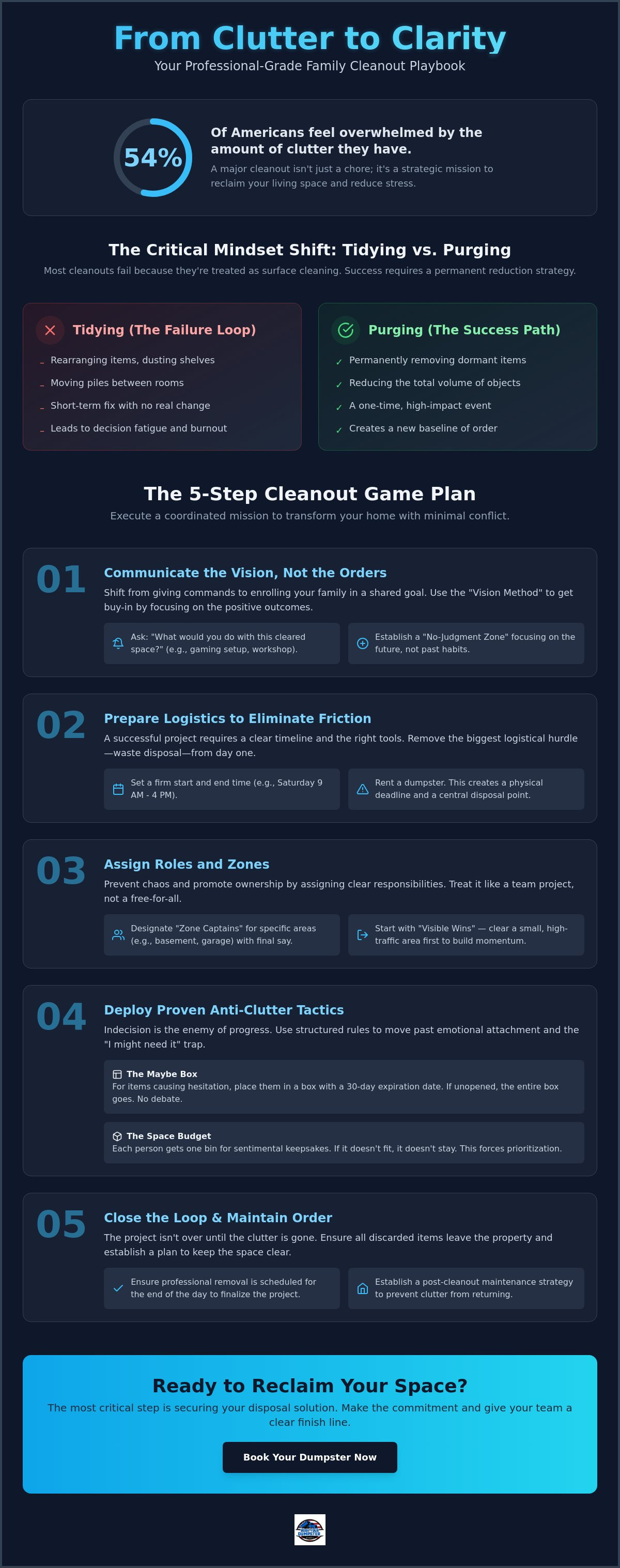
A 2024 survey by the National Association of Professional Organizers found that 54% of Americans feel overwhelmed by the amount of clutter they have. If you're part of that group, you likely feel like the only person in your household who cares about the mounting piles of junk. It's draining to manage the logistics of a home when others cling to items they might need someday. Getting your family on board with a major cleanout is often the hardest part of the process, but it's also the most critical step for long-term success.
You can transform family resistance into a coordinated team effort with the right approach. This guide provides a pragmatic plan to move from a state of clutter to a state of resolution. You'll learn how to assign ownership of specific zones, set a strict weekend timeline, and remove the emotional friction that stalls progress. We'll show you how to streamline the entire project so your home becomes a functional space again with minimal conflict. Stop managing the mess alone and start executing a professional-grade cleanup strategy today.
Key Takeaways
- Learn how to use the "Vision Method" to shift from giving orders to enrolling your family in a shared goal.
- Select the right professional waste solution to remove logistical friction and keep the project moving.
- Master the art of getting your family on board with a major cleanout by assigning "Zone Captains" with clear authority.
- Identify "Visible Wins" early in the weekend to build momentum and prove the project's value.
- Establish a post-cleanout maintenance strategy to ensure your newly reclaimed space remains clutter-free.
Why Major Cleanouts Stall (and How to Reset the Narrative)
A major cleanout is not a standard weekend chore; it is a project involving structural change to your living environment. Most projects fail because they are treated as surface cleaning rather than a logistical mission. You aren't just rearranging items or dusting shelves. You are permanently reducing the volume of objects that occupy your home. Getting your family on board with a major cleanout requires a mental shift from "tidying up" to "executing a plan." Without this shift, the project remains a series of small, disconnected tasks that never reach a conclusion.
Clutter blindness often prevents family members from seeing the true scale of the problem. Over time, stacks of boxes in the basement or broken gear in the garage become part of the background. When you finally attempt to address these areas, decision fatigue acts as a bottleneck. Making hundreds of individual choices about what to keep, sell, or toss is mentally exhausting for everyone involved. Without a visible finish line, like a set date for professional removal, the project will likely stall as energy fades. You need a clear, physical goal to keep morale high throughout the day.
The Difference Between Tidying and Purging
Surface cleaning fails because it doesn't address deep-seated clutter issues. Moving piles from one room to another is not a solution; it is just relocation. To achieve real results, you must apply the principles of professional organizing, which focus on the permanent removal of dormant items. These are the objects in your attic or crawlspace that haven't been touched in years. Setting the expectation that this is a one-time, high-impact event helps everyone prepare for the intensity of the work. You are purging the home to create a new baseline of order.
Identifying Your Family’s Resistance Points
Resistance usually comes from sentimental attachment or the "I might need it" trap. You must counter these emotional arguments with direct logic. If an item has not been used or needed for 12 consecutive months, it no longer serves a purpose as a household utility item. Identifying these resistance points early allows you to move past them quickly, making the process of getting your family on board with a major cleanout far more efficient. For a reliable finish line, visit Book Your Dumpster USA to schedule the physical removal of your unwanted items. This ensures that once a decision is made, the item leaves your home forever, preventing any second-guessing or re-sorting later.
Communicating the Mission Without the Conflict
Success depends on how you frame the project. Stop issuing orders. Start enrolling your family in the shared benefit of a functional home. Getting your family on board with a major cleanout is easier when they see a personal win in the result. Use the Vision Method to create this buy-in. Ask each person what they would do with a cleared room. A teenager might want space for a gaming setup in the basement. A spouse might envision a functional workshop in the garage. When the goal is a hobby space rather than just "less junk," participation increases.
Establish a No-Judgment Zone early. Conflict often arises when one person criticizes another's past habits or "hoarding" tendencies. Avoid looking backward. Focus entirely on the future state of the house. To prevent the project from becoming an endless chore, set a firm start and end time. Scheduling your container delivery for a specific Saturday creates a physical deadline that stops the "we will do it eventually" syndrome. Once the date is set, reserve your equipment to make the commitment official.
The Family Meeting: Keeping it Short and Direct
Hold a brief planning session before the cleanout day. Limit this meeting to 15 minutes. Long discussions lead to pre-project burnout. Use this time to focus on the "Why." Explain that more room for hobbies and less daily stress are the primary goals. Clearly state the operational hours. If the cleanout runs from 9:00 AM to 4:00 PM, stick to it. Knowing there is a definitive end point helps family members maintain their energy and focus.
Dealing with "Keepers" and "Maybes"
Indecision is the enemy of progress. Use the Maybe Box strategy for items that cause hesitation. If a family member can't decide, put the item in a box and label it with a 30-day expiration date. If no one opens it within a month, the entire box goes to disposal without further debate. This keeps the momentum high during the actual cleanout.
Manage sentimental items with a Space Budget. Every person gets one specific bin for keepsakes. If the item doesn't fit in the bin, it doesn't stay in the house. This forces a priority check without stopping the flow of the project. This system respects personal attachments while maintaining the integrity of the cleanout mission. You aren't just getting your family on board with a major cleanout; you're providing them with the tools to make fast, logical decisions.
Preparing the Logistics for a Stress-Free Cleanout
Logistics are the backbone of any successful home project. If you lack a clear disposal plan, your cleanout will likely end with piles of trash sitting in your hallway for weeks. This creates more stress and resentment. Getting your family on board with a major cleanout is significantly easier when you provide a professional waste solution. Having a dumpster on the driveway signals that the project is serious and the removal is permanent. It sets a physical boundary between what stays in the house and what leaves forever.
Choose the right tool for the job to avoid logistical bottlenecks. A 10 yard dumpster works best for heavy debris or single-room cleanouts like a kitchen or bathroom. For a whole-house purge involving furniture and years of accumulated junk, a 20 yard dumpster is the industry standard. This ensures you have enough capacity to finish the project in one go without waiting for multiple pickups. In high-density areas like New York or San Francisco, check your local permit requirements before delivery. Many cities require a street permit if the container cannot fit on private property.
The "Out of Sight, Out of Mind" principle is vital for maintaining family morale. When junk leaves the house and enters a container, it stops being a mental burden. It also prevents the "re-sorting" trap where family members pull items back out of bags. Once an item is in the dumpster, the decision is final. This reduces the cognitive load on everyone and keeps the momentum moving toward the finish line.
The Dumpster Advantage: Making Progress Permanent
A roll-off dumpster acts as the "Mission Hub" for your weekend. It provides a central, high-capacity destination for everything being discarded. Consult our Roll Off Dumpster Rental Guide to understand how these containers streamline the process. Unlike standard trash cans, a dumpster handles bulky items that your regular service won't touch. This permanence is a psychological win for everyone involved. It turns a messy chore into an efficient operation.
Gathering Your Supplies in Advance
Preparation prevents mid-project delays. Buy heavy-duty contractor bags, thick markers, packing tape, and work gloves for every family member. Set up a clear Sorting Station with three zones: Keep, Donate, and Dump. Before the delivery arrives, ensure your driveway is clear of vehicles and low-hanging branches. This allows for a smooth 10 Yard Dumpster drop-off. Having these logistics settled allows you to focus entirely on getting your family on board with a major cleanout and executing the work without distractions.
The Cleanout Game Plan: Roles, Zones, and Rewards
Execution requires a tactical shift from general cleanup to a structured operation. Getting your family on board with a major cleanout is most effective when you assign "Zone Captains" to lead specific areas of the home. This gives children and spouses a sense of authority over their workspace. When someone is in charge of the garage or the playroom, they are more likely to stay focused on the objective rather than waiting for instructions.
Use the "Visible Win" strategy to maintain high spirits. Start with the room that provides the most immediate relief, such as the kitchen or main entryway. Seeing a clear floor early in the day proves the plan works. Implement "Power Hours" to keep the pace consistent. Work for 50 minutes of high-intensity sorting, followed by a mandatory 10-minute break. This rhythm prevents the mental burnout that usually ends projects prematurely. Visit Book Your Dumpster USA to secure the equipment needed to support this high-velocity workflow.
Before the day ends, execute a "Final Walkthrough" protocol. Inspect every zone to ensure no lingering piles remain in corners or hallways. If an item isn't in its permanent home or the container, it's still a problem. This final check ensures the project reaches a definitive conclusion and prevents clutter from migrating back into the living space.
Assigning Missions Based on Strengths
Match tasks to natural abilities to maximize efficiency. Designate a "Heavy Lifter" for bulky furniture, a "Decision Maker" for the final call on "Maybe" items, and an "Organizer" to manage the sorting station. Use a "Runner" to take debris directly to the dumpster. This keeps the work flowing without forcing the decision-makers to leave their zones. Even young children can act as runners for safe, lightweight items, keeping them involved without causing delays.
Maintaining Momentum with Rewards
The psychological impact of seeing a half-full dumpster by noon is a powerful motivator. It provides visual evidence of progress that internal piles cannot match. Celebrate reaching milestone zones with small, immediate rewards like a favorite snack or a brief music break. Once the final load is secured and the container is ready for pickup, establish a "Post-Dumpster Pizza" tradition. Celebrating the newly empty space reinforces the success of the mission and makes the effort feel worthwhile for everyone involved.
Closing the Loop: Professional Disposal and Reclaiming Your Home
The final haul-away is the most satisfying moment of any home project. When the container leaves your driveway, the physical and mental weight of the clutter goes with it. This is the definitive end of the mission. Professional debris removal is both safer and faster than attempting multiple trips to a local dump in a personal vehicle. You avoid the risk of damaging your car or wasting hours in line at a transfer station. Getting your family on board with a major cleanout is a significant achievement, but the success is only permanent once the waste is off your property.
Book Your Dumpster USA simplifies this final step across NJ, NY, IL, and MA. We manage the logistics so you can focus on enjoying your reclaimed space. By opting for a professional service, you ensure that the momentum you built over the weekend isn't lost to a "cleanout hangover" caused by lingering piles of trash. A single, coordinated removal is the most efficient way to close the loop on a large-scale project. It provides the finality your family needs to move forward.
The Satisfaction of a Clean Slate
A successful major cleanout does more than clear a room; it improves family mental health by reducing daily environmental stress. Now that the floor is visible, plan the new use for your reclaimed space immediately. Whether it's a home gym, a workshop, or a playroom, assigning a function to the room prevents it from becoming a "junk magnet" again. Encourage your family to adopt the "One In, One Out" rule. For every new item brought into the house, one old item must be discarded or donated. This simple maintenance habit ensures that getting your family on board with a major cleanout remains a one-time event rather than a recurring necessity.
Why Reliable Service Matters
Punctuality is a core promise of our service. A dumpster that sits on your driveway for days after it is full creates unnecessary friction. We prioritize timely pickups to ensure your project concludes exactly when you intended. Our transparent, flat-rate pricing model eliminates the hidden fees and weight surcharges often found in traditional junk removal services. You know your costs upfront, which allows for better project budgeting. Don't let the momentum fade. Schedule your cleanout dumpster today and finalize your home's transformation with a partner you can trust.
Reclaim Your Space and Execute Your Mission
Transforming your home requires more than just good intentions; it requires a professional-grade strategy. Transitioning from chaos to a project management mindset ensures every family member understands their role. By combining clear communication with professional logistics, you remove the emotional hurdles that usually stall home purges. Getting your family on board with a major cleanout becomes a repeatable success when you treat the project as a coordinated operation rather than a series of endless chores.
We provide the tools to make your transformation permanent. Serving NY, NJ, IL, MA, and SF, we offer pragmatic 10 to 40-yard options with direct, transparent pricing and no hidden fluff. You can trust our punctual service to support your timeline and keep your team focused on the finish line. Book your residential cleanout dumpster online in seconds to secure your delivery date. Take control of your living environment today and enjoy the lasting clarity of a functional, clutter-free home.
Frequently Asked Questions
How do I handle a spouse who is a "hoarder" during a cleanout?
Focus on functionality rather than psychology when dealing with extreme clutter. Establish clear boundaries for shared living spaces while allowing them a private, designated zone for their collections. If the behavior is extreme, consult a professional organizer specializing in chronic disorganization before attempting a massive purge. Getting your family on board with a major cleanout requires patience; however, the safety and utility of common areas must remain the priority.
Is a 10 yard dumpster enough for a three-bedroom house cleanout?
No, a 10 yard dumpster is typically insufficient for a whole-house cleanout of that size. It's better suited for small bathroom renovations or heavy debris like dirt and concrete. For a standard three-bedroom house purge, a 20 yard or 30 yard dumpster provides the necessary volume for furniture, boxes, and general household junk. Choosing a larger size upfront prevents the need for a second rental and keeps your project on schedule.
Do I need a permit to put a dumpster on the street in Queens or Chicago?
Yes, you generally need a permit for street placement in both Queens and Chicago. In New York City, a DOT permit is required if the container occupies a public right-of-way. In Chicago, you must obtain a permit from the Department of Transportation for any container placed on the street. Check your local municipal website for current application fees and processing times to ensure your delivery isn't delayed by city regulations.
What items are strictly prohibited from being put in a residential dumpster?
Prohibited items include hazardous materials like wet paint, chemicals, batteries, and tires. Electronics, appliances containing Freon, and medical waste are also banned due to federal and local environmental regulations. Improper disposal of these items can result in significant fines. Always check with your service provider for a specific list of restricted items before you start loading the container to avoid overage fees or a rejected pickup.
How can I involve young children in a cleanout without it being dangerous?
Assign them to a safe sorting station away from heavy lifting and the dumpster itself. Let them categorize soft goods like old clothing or plush toys into donation bins. This keeps them engaged in the process of getting your family on board with a major cleanout while ensuring they remain in a controlled, hazard-free environment. Use the sorting station as a teaching tool for organization and the value of donating unused items.
What is the most efficient room to start a whole-house cleanout in?
Start in the garage or a large staging area. Clearing this space first provides a necessary command center for sorting items from other rooms. It also allows you to stage donation piles and trash bags efficiently before they go into the dumpster. This prevents bottlenecks in hallways and living areas, allowing the rest of the cleanout to proceed with a logical flow and less physical obstruction.
How much time should I realistically allot for a major family cleanout?
Allot at least 48 hours for a comprehensive project. A weekend schedule allows for one full day of intense sorting and one day for final removal and deep cleaning. Trying to rush a whole-house purge into a single afternoon often leads to decision fatigue and incomplete results. Set a firm start and end time for each day to maintain energy levels and ensure the project concludes on time.
What should I do with items that are too good to throw away but no one wants?
Schedule a pickup from a local charity or use a listing on a community digital marketplace. If items don't move within your designated cleanout window, you must treat them as waste. The goal is reclaiming space, not storing unwanted goods for an indefinite period. Be decisive; if an item has no recipient by the time the dumpster is ready to leave, it belongs in the container.


