
You’ve just received a $100 overage fee because someone tossed heavy debris into a bin that was already at its weight limit. It’s a frustrating, avoidable drain on your project’s bottom line that stems from a single breakdown in site management. Managing a busy job site is difficult enough without having to play trash police every afternoon. You expect your crew to focus on the build, yet ignoring the waste pile leads to safety hazards, prohibited item delays, and expensive fines. Learning how to communicate dumpster rules to a work crew is the only way to stop these logistical leaks before they happen.
Mastering these protocols ensures your team follows waste sorting rules every time, protecting you from contaminated load fees and OSHA violations. This guide provides the professional strategies you need to enforce disposal standards and keep your workflow moving. We will cover how to integrate waste rules into daily huddles, the best ways to use site signage, and how to build a culture of accountability that keeps your site clean and your budget on track. It is time to turn waste management from a constant headache into a streamlined part of your daily operations.
Key Takeaways
- Prevent expensive overage fees and load rejections by integrating waste protocols into your daily site management.
- Master how to communicate dumpster rules to a work crew through targeted morning toolbox talks and high-visibility signage.
- Identify the "No-Fly List" of prohibited items to ensure every load meets landfill standards and avoids costly dig-out charges.
- Designate a Waste Captain to perform quick daily checks, creating accountability that protects your project bottom line.
- Streamline your workflow with transparent pricing and the right container size to eliminate logistical friction.
Why Dumpster Compliance is a Critical Project Management Task
Managing a construction site requires precision. Every minute wasted on logistics is a dollar lost from your profit margin. Most managers focus on high-level materials and labor, but waste management is a critical pillar of project success. When you fail to establish clear rules, the dumpster becomes a liability rather than a tool. Communication breakdowns lead to "dig-out" charges where haulers refuse to touch a bin until prohibited items are removed. This forces your crew to stop their skilled work to sort through trash, doubling your labor costs for a single task. Understanding how to communicate dumpster rules to a work crew is the only way to prevent these site-wide disruptions.
The Financial Impact of "Dumpster Negligence"
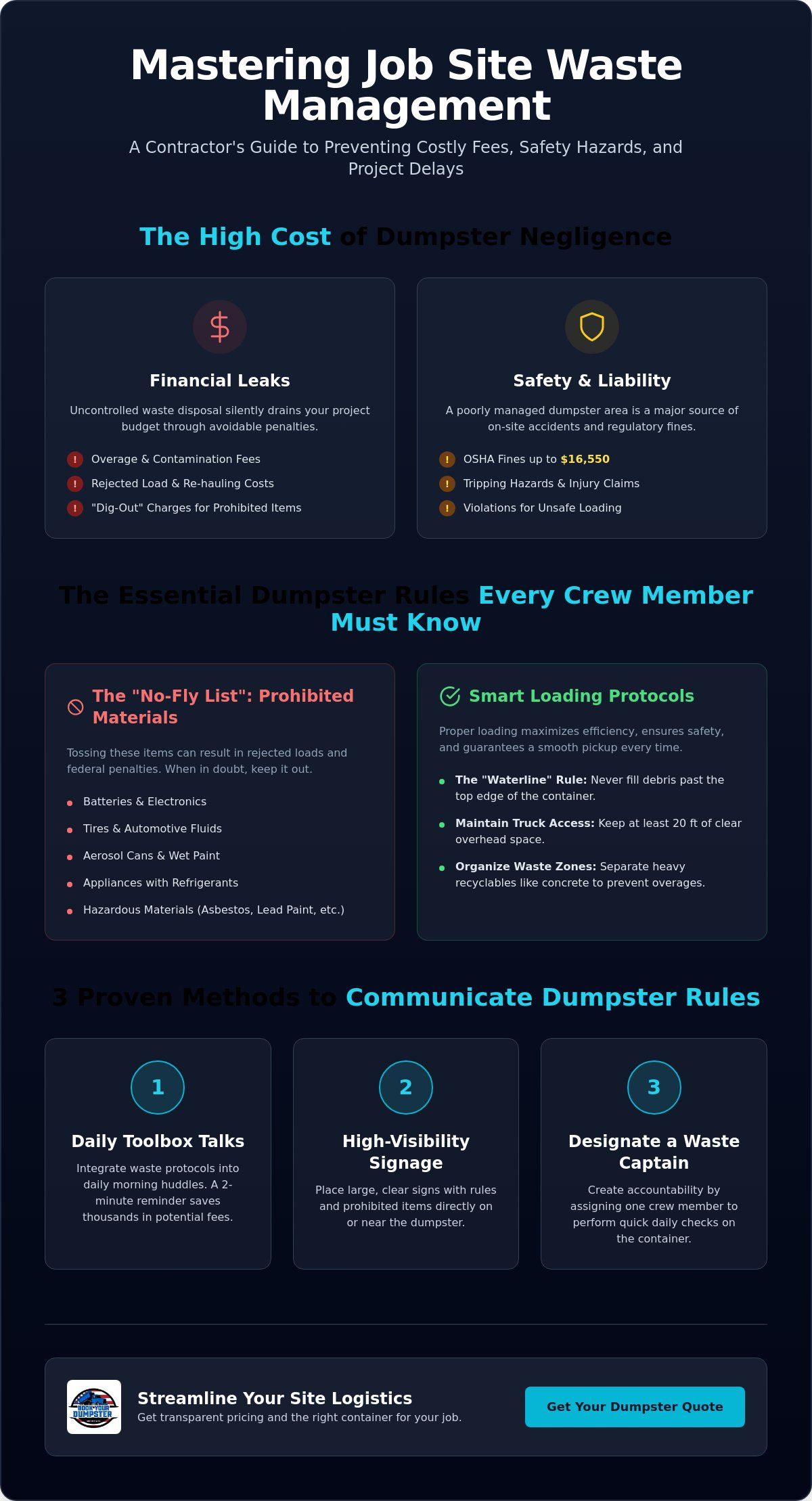
Contamination fees are the silent killers of a project budget. A single tire or a half-empty can of paint can trigger a fee that wipes out your daily savings. Landfills operate on strict intake requirements based on standard waste management principles. If your crew tosses hazardous materials into a standard roll-off, the entire load might be rejected at the scale. You then pay for the haul, the return trip, and the labor to reload a new container. Overfilling is another common drain on your resources. Loading debris past the top rail makes the bin unsafe for transport. Drivers will leave the bin on-site if it's overfilled, causing delays that ripple through your entire project schedule. Proactive training protects your profit margins from these preventable hits.
Safety and Liability on the Job Site
Safety isn't just a compliance checkbox; it's a legal and financial requirement. Poorly managed waste zones create tripping hazards that lead to expensive workers' compensation claims. OSHA inspectors in 2026 are focusing on high-risk activities and site cleanliness, with penalties for serious violations reaching approximately $16,550. A dumpster overflowing with jagged metal or heavy concrete isn't just a mess; it's a violation waiting to happen. You must maintain a clean perimeter to ensure your team stays productive and safe.
Protect your site by enforcing these logistical standards:
- Enforce the "waterline" rule: Never allow debris to stack higher than the top edge of the container to prevent falling hazards.
- Maintain truck access: Keep at least 20 feet of clear overhead space and a wide path for the roll-off truck to operate.
- Organize waste zones: Use clear markers to separate recyclable concrete from general debris to avoid weight overages.
When you prioritize these protocols, you reduce the risk of accidents and ensure the driver can swap your bin quickly. Efficiency starts with an organized site. Learning how to communicate dumpster rules to a work crew ensures that everyone from the foreman to the day laborer understands their role in maintaining a safe, profitable environment.
The Essential Dumpster Rules Every Crew Member Must Know
Rules are not suggestions. They are operational requirements that keep your site moving. When every crew member understands the boundaries, you eliminate the friction of rejected loads and safety audits. Knowing how to communicate dumpster rules to a work crew starts with defining the "No-Fly List" and standardizing how debris enters the container. Clear boundaries prevent the "I didn't know" excuse that leads to project delays and unexpected expenses.
Identifying Prohibited Materials
Your crew must recognize that a roll-off is not a catch-all for every piece of site waste. Hazardous materials like asbestos, lead-based paint, and certain chemicals are strictly regulated under the Resource Conservation and Recovery Act (RCRA). Tossing these into a standard bin can result in massive federal penalties. In New York City, for example, residential buildings with 1-9 units face fines up to $200 for third and subsequent offenses regarding improper containerization.
Common prohibited items include:
- Batteries and electronics
- Tires and automotive fluids
- Aerosol cans and wet paint
- Appliances containing refrigerants
Following OSHA regulations for waste disposal ensures your team stays compliant with safety standards while avoiding local enforcement headaches. Ensure your crew knows that "when in doubt, keep it out" is the standard operating procedure for any mystery materials found during demolition.
Loading Strategies for Maximum Efficiency
How you load the bin is just as important as what you put in it. Efficient loading prevents overage fees and ensures the hauler can safely transport the load. Use the "flat-load" method by breaking down bulky items and laying them horizontally to eliminate air pockets. This maximizes every cubic yard of space you paid for. Always place heavy materials like concrete or brick at the bottom of the bin. This maintains a low center of gravity and prevents the container from becoming unbalanced during pickup.
Enforce the waterline rule by ensuring debris never extends above the top rail of the container to prevent spillover during transport. Finally, maintain placement integrity. Keep the area around the dumpster clear of equipment, vehicles, and loose materials. If a driver cannot access the bin due to blocked paths, you will face a "dry run" fee. To ensure you have the right equipment for your specific debris type, choose the correct container size before your next project phase begins.
4 Proven Methods to Communicate Rules to Your Work Crew
Communication is the bridge between a messy site and a profitable one. You can't assume your crew knows the weight limits or the prohibited items list by instinct. Establishing how to communicate dumpster rules to a work crew requires a mix of verbal, visual, and digital touchpoints. If you only mention the rules once during the project kickoff, you're setting yourself up for failure. Use these four methods to keep waste protocols at the forefront of every worker's mind.
Conducting Effective Toolbox Talks
Toolbox talks are the best time to reinforce site standards. Keep these sessions brief; two minutes of focused waste safety before the shift starts is enough. Don't just talk from the trailer. Walk the crew to the container and provide a physical demonstration of the fill line. Use this time to address specific debris coming out that day. If you're doing a bathroom tear-out, ask the crew if they need a 10-yard dumpster for heavy tile or if the current bin is sufficient. Mastering how to communicate dumpster rules to a work crew through these feedback loops prevents overfilling before it starts.
Visual Cues and Site Signage
Visual reminders act as the silent supervisor on your site. Place "No Prohibited Items" stickers directly on the dumpster exterior at eye level. This makes it impossible for a worker to claim ignorance when tossing a battery or paint can. Use color-coded bins if you're separating scrap metal from general construction debris. High-visibility signage is only effective if everyone can read it. Ensure all signs are translated into the primary languages spoken by your crew. Clear, bilingual posters that mirror OSHA regulations for waste disposal reduce the risk of accidental non-compliance and keep the site running smoothly.
Set the standard before the first hammer swings by including waste management expectations in your initial subcontractor onboarding paperwork. Make it clear that "dig-out" charges or contamination fees caused by their team will be back-charged to their contract. When subcontractors know there's a financial consequence for negligence, they manage their own crews more effectively. This creates a chain of accountability that protects your bottom line.
Leverage group messaging apps for real-time site updates. If a bin is reaching the 75% mark, snap a photo and send it to the group thread with a reminder to stop loading by noon. Digital records also provide a paper trail if you need to verify that rules were communicated. Consistent digital touchpoints ensure that even workers who miss a morning huddle stay informed about the current waste status. These short, direct messages reduce confusion and keep the workflow moving without unnecessary delays.
Enforcement and On-Site Waste Quality Control
Enforcement turns your verbal instructions into site-wide habits. Without a system to verify compliance, even the best toolbox talks lose their impact over time. Knowing how to communicate dumpster rules to a work crew includes setting up a clear hierarchy of accountability. Assign a "Waste Captain" to perform a five-minute inspection at the end of every shift. This individual ensures no prohibited items entered the bin and that the load remains below the waterline. Catching a stray battery or an overfilled corner today saves you from a rejected pickup tomorrow. This small time investment prevents the labor-intensive task of unloading a container to find a single hidden hazard.
Implement a "First Offense" correction policy that prioritizes education over immediate punishment. If you find a violation, bring the responsible party to the bin. Show them the specific issue and explain the financial consequence, such as the potential for a $100 overage fee or a $5,000 civil penalty for hazardous waste. This direct feedback loop reinforces your standards without creating a hostile environment. It ensures that the crew understands the "why" behind the rules, making them more likely to self-correct in the future.
The Role of the Site Supervisor
Site supervisors must lead by example. If you bypass your own waste protocols, your crew will naturally do the same. Empower your team to speak up when they witness unauthorized dumping or improper sorting by subcontractors. Make waste quality control a standard part of your final site walk-through every afternoon. This consistency proves that you take disposal rules as seriously as structural integrity. When the supervisor treats the dumpster area as a professional zone, the crew follows suit.
Handling Non-Compliance
Discrepancies often arise from "midnight dumping," where external parties use your bin after hours. If you discover unauthorized items that your crew didn't place, document the scene immediately. Use your phone to take photos of the site conditions before every scheduled roll-off dumpster rental pickup. These photos serve as undeniable evidence if you need to resolve disputes with subcontractors or hauling services regarding overage fees. Clear documentation protects your budget from being penalized for the actions of others.
Review your construction debris removal logs monthly to identify recurring issues. Look for patterns like consistent weight overages or frequent hazardous waste discoveries. Patterns in the data help you adjust your communication strategy for specific teams or project phases. If you find hazardous materials, isolate the area and follow proper remediation steps without halting your entire production line. Maintaining control over your waste stream protects your project timeline and your reputation. Ready to optimize your site? Schedule your next roll-off container today and put these enforcement strategies into practice.
Simplify Your Site Logistics with Book Your Dumpster USA
Implementing a communication strategy is only half the battle. Once you master how to communicate dumpster rules to a work crew, you need a waste management partner that matches your professional standards. Book Your Dumpster USA provides the logistical backbone for your site. We offer streamlined online booking for 10, 20, 30, and 40-yard roll-off containers. This variety ensures you never pay for more space than you need or struggle with a bin that is too small for your debris. Our transparent pricing model removes the stress of hidden fees. You get clear, upfront costs that keep your project on budget and your profit margins intact.
Reliability is our primary promise. We provide dependable delivery and pickup services across New York, New Jersey, and Illinois. When you schedule a swap, you need it to happen on time to keep your crew productive. A late pickup leads to site clutter and safety hazards, undermining the very rules you worked hard to establish. Our team understands the urgency of construction timelines. We focus on punctuality so your foremen can focus on the build, not the bin.
Flexible Solutions for Every Project Scale
Every site has unique demands. A residential clean-up might only require a 10 or 20-yard dumpster, while large-scale renovations often necessitate a 40-yard container to handle bulky demolition waste. Choosing the wrong size leads to overfilling and "waterline" violations. Our experts help you evaluate your specific crew needs to ensure you have the right capacity from day one. We also provide dedicated support for commercial property managers in Queens and San Francisco. Whether you are managing a high-rise project or a local storefront renovation, we provide the scale and speed required for urban site management.
Get Started with Your Next Rental
Our digital-first system is built for the modern foreman. You don't have time for long phone calls or opaque billing cycles. You can manage your entire waste workflow through our intuitive online platform. This simplicity reduces the administrative load on your site supervisors and ensures that logistical data is always at your fingertips. If you have questions about regional regulations, such as the specific container requirements in New York City or permit processing in Austin, our local support teams provide direct answers.
Stop letting waste management be a source of project friction. Combine your internal communication protocols with a reliable hauling partner to create a safer, more efficient work environment. Take control of your site logistics right now. Book your next roll-off dumpster today and experience a service designed for the demands of professional contractors.
Master Your Site Waste Management
Effective site leadership requires more than just structural expertise; it demands total control over your project's logistics. By establishing a dedicated Waste Captain and integrating disposal protocols into your daily toolbox talks, you eliminate the confusion that leads to costly overage fees. Consistency is the key to maintaining a safe and compliant environment. When you prioritize how to communicate dumpster rules to a work crew, you protect your bottom line and ensure your team stays focused on the build rather than sorting through debris.
Success starts with having the right tools for the job. We provide 10 to 40-yard sizes available to fit any project scale, from residential clean-ups to major commercial renovations. Our digital-first platform allows for online booking in under 2 minutes, giving you more time to manage your site. Serving NY, NJ, IL, and MA, we are the reliable partner you need for predictable waste removal. Rent your next construction dumpster with Book Your Dumpster USA and take the stress out of site cleanup. Keep your site moving and your budget secure with a partner that values punctuality and transparency as much as you do.
Frequently Asked Questions
What happens if my crew accidentally puts a prohibited item in the dumpster?
You must remove the item before the scheduled pickup to avoid contamination fees or a total load rejection. Landfills use strict sensors and manual inspections to catch hazardous materials like batteries or chemicals. If a hauler discovers these items, they will leave the bin on-site and charge a "dry run" fee. Establishing a clear protocol for how to communicate dumpster rules to a work crew ensures that these mistakes are caught during the daily Waste Captain check rather than at the landfill gate.
How much weight can a standard 20-yard construction dumpster hold?
A standard 20-yard dumpster typically has a weight limit of 2 to 3 tons, though this depends on your specific rental agreement. Exceeding this limit triggers overage fees that generally range from $40 to $100 per extra ton. For dense materials like dirt or brick, you must monitor the volume closely. Loading a 20-yard bin to the top with heavy debris will almost certainly exceed legal transport weights and lead to significant surcharges.
Can I put concrete and general trash in the same dumpster?
You can mix them, but it is not the most efficient strategy for your budget. Concrete and asphalt have a recycling recovery rate of over 95% when kept in a dedicated "clean" load. Mixing them with general trash sends the entire load to a landfill, where you will pay higher tipping fees. Separating these materials helps meet local diversion mandates, such as those requiring a 65% diversion rate for construction debris in many urban jurisdictions.
Is a permit required for placing a dumpster on a job site in New York?
A permit is required if the container occupies any portion of the public right-of-way, including streets or sidewalks. In New York City, residential buildings with 1-9 units are also subject to the NYC Bin mandate for trash set out. Failure to follow specific containerization rules can result in fines of $50 for a first offense, $100 for a second, and $200 for subsequent violations. Always verify your specific street-side requirements with the local Department of Transportation before delivery.
What is the "waterline" rule for dumpster loading?
The waterline rule dictates that no debris can extend above the top rail of the container. This is a safety requirement that allows the driver to secure a transport tarp over the load. If items are poking out or piled high, they become projectiles on the highway. Drivers are legally obligated to refuse any load that is not flush with the top of the bin, which results in a wasted trip fee and labor costs for your crew to level the load.
How do I prevent people from dumping their own trash in our site dumpster at night?
Use lockable lids or a fenced perimeter to secure the waste zone after hours. In 2026, OSHA inspectors and insurance adjusters are increasingly relying on digital documentation for site management. Take a timestamped photo of the bin at the end of every shift. This digital record provides proof that your crew followed the rules, protecting you from being held liable for prohibited items or weight overages caused by external "midnight dumpers."
Can my crew move the dumpster with their own equipment if it is in the way?
Do not attempt to move a roll-off container using a forklift, backhoe, or other site machinery. These bins are designed to be moved only by the hydraulic systems on a specialized truck. Dragging a bin can damage the container's rollers and the pavement beneath it. If the bin is blocking a critical path, call for a professional relocation. Moving it yourself will result in damage charges that far exceed the cost of a standard swap or reset.
What are the most common OSHA violations related to dumpsters?
Common violations include improper disposal of hazardous materials and failing to maintain clear access around the waste area. In 2026, OSHA is also placing a heavy emphasis on silica exposure and heat illness prevention. Keeping your waste organized and dampening down dusty debris within the bin helps mitigate these risks. Mastering how to communicate dumpster rules to a work crew ensures your site remains clean, reducing the likelihood of a serious violation and the associated $16,550 penalty.


