

A construction waste management plan isn't just a compliance box to check. It's a strategic logistics document that proves your project's operational efficiency. You already know that complex LEED requirements and shifting local regulations, like New York City's Int 0899-2026, can make estimating waste volumes feel like guesswork. It's frustrating to worry that high overhead costs or a disorganized disposal strategy might cost you the contract. When you are writing a waste management plan for a construction bid, you need accuracy and professionalism to stand out in a crowded market.
This guide will help you master the art of drafting a professional plan that satisfies strict contract requirements while lowering your project overhead. We'll show you how to calculate volumes for materials like concrete and wood, which account for the bulk of debris weight. You'll learn to navigate 2026 environmental mandates and secure accurate dumpster estimates to keep your bid competitive. By the end of this article, you'll have a professional-grade plan ready for submission and a clear path to compliance with the latest local regulations.
Key Takeaways
- Understand why a logistical roadmap is now mandatory for commercial bids under 2026 environmental standards.
- Learn how to categorize waste streams and use blueprints to estimate debris tonnage when writing a waste management plan for a construction bid.
- Balance your project budget by analyzing the cost-benefit of different dumpster sizes for specific construction phases.
- Identify the essential roles and communication strategies needed to ensure subcontractor compliance throughout the project.
- Finalize your bid with confidence using transparent pricing and digital booking tools designed for multi-phase waste removal.
Why a Construction Waste Management Plan is Critical for Bids in 2026
A Construction Waste Management Plan (CWMP) is your project's logistical roadmap. It outlines how you'll handle every ton of debris from the moment it hits the floor until it leaves the site. In 2026, this document has transitioned from a best practice to a strict requirement for most commercial projects. When you are writing a waste management plan for a construction bid, you're doing more than listing dumpster sizes. You're demonstrating that you have full control over your site's operational flow and environmental footprint. Decision-makers look for this level of detail to ensure the project doesn't stall due to poor debris management or regulatory fines.
Don't view the CWMP as a hurdle. View it as a tool to prevent mid-project cost overruns. Without a clear strategy, you risk paying for emergency hauls or facing penalties for contaminated loads. A professional plan identifies these risks early and provides a clear solution. It shows the client that you've already solved the logistical challenges of the job before you even break ground.
Meeting LEED and Local Regulatory Standards
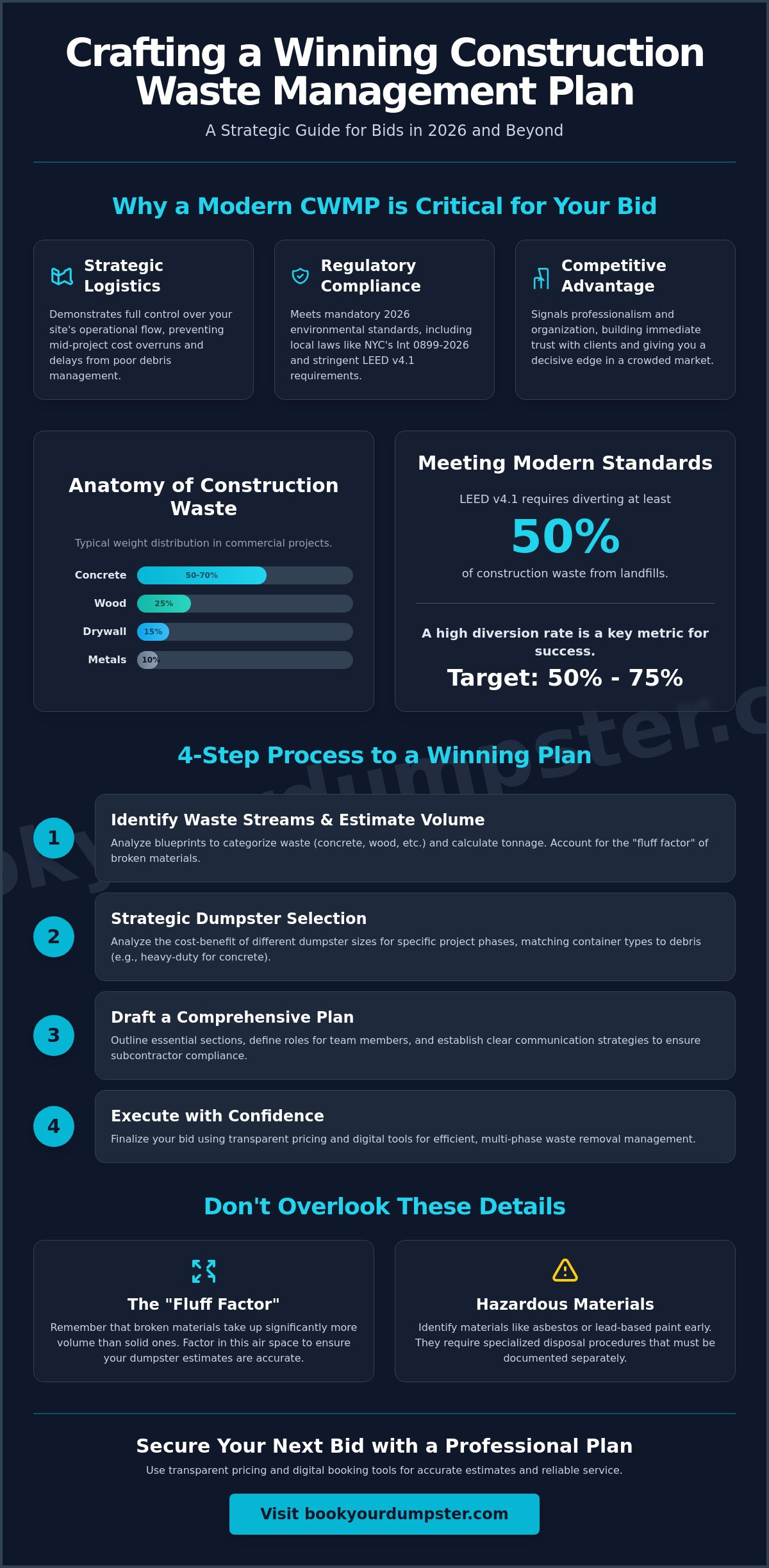
Modern contracts prioritize sustainability and compliance. LEED v4.1 requires projects to divert at least 50% of total construction and demolition waste from landfills to earn certification points. Beyond national standards, local laws are tightening across the country. For example, New York City's Int 0899-2026 proposal mandates a disposal plan for nearly all building alterations. Massachusetts has similar strict bans on disposing of recyclable materials like metal and clean wood. Your diversion rate, the percentage of waste recycled versus landfilled, is now a key metric in your bid's success. High diversion rates prove your commitment to local environmental mandates and can be the deciding factor in winning a contract.
The Competitive Advantage of Professional Logistics
A detailed plan signals that you are an organized contractor who values site safety. Congested sites are dangerous and slow. By scheduling specific dumpster rotations and designating sorting areas, you keep the workspace clear for other trades. This reduces the risk of accidents and avoids the heavy fines associated with improper waste storage. It also protects your profit margins. When you're ready to secure the containers needed for your strategy, Book Your Dumpster provides the transparent pricing you need for an accurate bid. A professional plan builds immediate trust that you can handle the complexities of a large-scale project without logistical stress.
Step 1: Identifying Waste Streams and Estimating Volume
Analyze your project blueprints to determine the exact types and quantities of materials you'll be handling. When writing a waste management plan for a construction bid, precision is your best defense against unexpected costs. You must categorize waste into distinct streams: wood, drywall, concrete, and metals. Concrete typically dominates these projects, accounting for 50% to 70% of total C&D waste by weight. Wood usually follows at 25%, while drywall and metals make up about 15% and 10% respectively. Use these benchmarks to create a baseline for your disposal needs.
Don't forget the fluff factor. This is the volume increase that occurs when solid materials are broken up and tossed into a container. A ton of solid concrete takes up far less space than a ton of broken slabs. Factor in this air space to ensure your dumpster estimates remain accurate throughout the project lifecycle. Identify any hazardous materials early. Lead based paint or asbestos require specialized disposal procedures that must be documented separately from standard debris. Stating a target diversion rate of 50% to 75% in your proposal shows the client you're committed to meeting high level Construction Waste Management Plan requirements.
Common Debris Types in Commercial Projects
Demolition phases generate heavy masonry and concrete waste. These materials require reinforced containers and strict weight monitoring to avoid tipping fee surprises. During finishing stages, focus on high volume, low weight items like cardboard packaging and plastic wrap. You also need a plan for mixed municipal solid waste generated by daily crew operations. If you're unsure which container fits your specific material mix, check the dumpster dimensions and weight limits to match your volume needs.
Calculation Tools and Industry Benchmarks
Use EPA standard volume to weight conversion factors to turn your square footage estimates into tonnage. Compare these numbers against similar past projects in your portfolio to verify accuracy. Be aware of regional disposal limits. Cities like Chicago or San Francisco have specific mandates that may affect how you sort and transport debris. Documenting these local nuances in your bid proves you've done the homework required to keep the project on schedule and under budget. This level of detail separates a professional contractor from the competition.
Strategic Dumpster Selection: Balancing Cost and Site Efficiency
Your bid's profitability hinges on container logistics. When writing a waste management plan for a construction bid, you must match container capacity to the project's physical footprint. Evaluate the site map to determine the maximum size allowed by local access roads and staging areas. A miscalculation here leads to blocked subcontractor access or costly 'dry run' fees from hauling delays. Consult the EPA Construction Waste Management Guidance to align your equipment selection with federal performance requirements and LEED standards. Proving you have a plan for equipment placement builds immediate trust with the project owner.
Analyze the cost-benefit of different container sizes for each project phase. Heavy materials like concrete, dirt, or brick require specialized handling and strict weight management. Overloading a large container with dense debris triggers safety risks and expensive overweight penalties. Instead, use multiple smaller units or schedule frequent 'switch-outs' to keep the site moving. This strategic approach ensures you aren't paying for empty air space in a large bin or paying for extra hauls for a container that's too small. Decide early whether your site can accommodate two containers for sorting or if a single-stream rotation is more efficient for the space provided.
Matching Container Sizes to Project Phases
Select the right tool for the job to maintain a clean and safe workspace. A 30 yard dumpster serves as the workhorse for demolition phases, handling bulky debris without requiring constant hauls. For heavy masonry, cleanout work, or dirt removal, use a 10 yard dumpster to stay within legal weight limits for transport. In tight urban environments like Queens or San Francisco, smaller footprints are often mandatory. Plan your staging area carefully to allow for rapid rotations without disrupting the surrounding traffic or violating site safety protocols. Organized debris management prevents the clutter that leads to crew downtime.
Reducing Transportation Costs in the Bid
Lower your bid price by minimizing transportation overhead and fuel surcharges. Utilizing a 40 yard dumpster for light, high-volume materials like wood and packaging reduces the total number of hauls significantly. Coordinate your pickup schedules to ensure containers are only pulled when they are truly full. This prevents unnecessary fees and keeps your project budget predictable. Always designate a placement zone that allows the driver clear access while keeping the path open for your crew and subcontractors. Efficient placement is the key to maintaining a high-velocity work environment and avoiding the 'messy site' reputation that can sink future bids.
Drafting the Plan: Essential Sections for Your Proposal
When you're writing a waste management plan for a construction bid, your document must be exhaustive yet easy to follow. Start by designating a Waste Management Coordinator. This individual is the point of contact for all debris logistics, ensuring that subcontractors and crew members adhere to the sorting rules you've established. A coordinator prevents the confusion that leads to contaminated loads and expensive landfill penalties. Your plan should also detail the exact documentation process you'll use. Providing the owner with a clear system for tracking weight tickets and disposal manifests proves your commitment to transparency and regulatory compliance.
Your proposal needs to list the specific recycling and disposal facilities you intend to use. Don't just promise to recycle; name the local partners who will handle your debris. This level of detail builds immediate trust and shows you've already secured the necessary supply chain for the project's waste. If you're ready to lock in your logistics now, you can schedule your project dumpsters online to ensure your bid reflects current market availability and pricing.
The Waste Diversion Strategy
Choose between a 'Source Separation' or 'Commingled' approach based on your site's footprint. Source separation involves using multiple bins for wood, metal, and concrete, which often results in higher diversion rates and lower tipping fees. Commingled collection uses a single container that is sorted at a secondary facility. In states like Illinois, New Jersey, or Massachusetts, local mandates often dictate which materials must be diverted from landfills. Target 100% diversion for high-value materials like scrap metal and clean wood to maximize your bid's sustainability score. Mentioning New York City's Int 0899-2026 requirements specifically shows you're prepared for the latest 2026 legal standards.
On-Site Logistics and Safety
Include a site map that clearly defines designated areas for dumpster placement. Proper placement ensures that waste removal doesn't interfere with active construction zones or block emergency access. Establish strict safety protocols for loading to prevent overfilled containers, which are a major hazard during transport. Use the following checklist to maintain site standards:
- Mark sorting stations with high-visibility signage in multiple languages.
- Implement daily site sweeps to prevent wind-blown debris from leaving the permit area.
- Verify that all containers are covered or secured at the end of each shift.
- Train all subcontractors on the specific diversion goals of the project.
An organized site is a safe site. By documenting these logistics, you signal to the project owner that you are a high-functioning contractor who manages every detail with precision.
Executing Your Bid Strategy with Book Your Dumpster USA
Your bid is only as strong as your ability to execute it. When you are writing a waste management plan for a construction bid, you need more than just rough estimates. You need a partner that provides transparent pricing to protect your project margins from the start. Book Your Dumpster USA removes the logistical stress by offering clear, upfront costs. This allows you to finalize your bid numbers without fear of hidden surcharges or fluctuating fees. By integrating our reliable pricing into your proposal, you present a budget that is both competitive and realistic.
We operate across New York, New Jersey, Illinois, and Massachusetts. We understand the specific regional demands and disposal requirements in these busy markets. We don't just drop off containers; we act as a high-functioning tool in your project management kit. Our digital-first approach means you spend less time on the phone and more time managing your crew. We help you move from a state of clutter to a state of resolution with minimal cognitive load. This level of professional support is what separates a winning bid from one that is overlooked due to logistical gaps.
Reliable Service for Commercial Contractors
Project schedules are tight and unforgiving. A delayed haul or a missing container can halt an entire crew and blow your labor budget in a single afternoon. We prioritize punctuality and direct communication to keep your site moving at high velocity. Whether your project requires 20 yard dumpsters for mid-sized renovations or large 40-yard units for major demolition phases, we have the inventory to support your scale. We also provide customized billing options that match your project's specific accounting needs. This makes tracking your project's waste expenses straightforward, transparent, and ready for owner audits.
Next Steps: Finalize Your Waste Plan Today
Take a final look at your plan draft before submission. Cross-reference your diversion targets, material streams, and container sizes against the final RFP requirements. Ensure every section of your plan is backed by accurate logistical data and a clear chain of command. Once your strategy is set, you must lock in your debris removal costs to ensure your bid remains profitable. Use our streamlined online system to get a quick quote and verify equipment availability for your project dates. Book Your Dumpster today and secure the reliable equipment you need to submit a winning, professional-grade bid with confidence.
Secure Your Next Project with a Precise Waste Strategy
Mastering the process of writing a waste management plan for a construction bid is the key to proving your operational maturity. You've learned how to identify waste streams accurately and select the right container sizes to maximize site efficiency. By designating a coordinator and detailing your documentation process, you remove the logistical stress that often sinks a proposal. These steps ensure your project remains compliant with 2026 regulations while protecting your profit margins.
Don't let waste logistics be an afterthought in your next submission. We provide professional logistics support and a full range of 10 to 40 yard containers to help you execute every phase of your plan. Whether you're bidding on work in New York, New Jersey, or Illinois, we're ready to act as your dependable partner. Take the guesswork out of your overhead costs today. Get a commercial quote for your next bid and lock in the transparent pricing you need to win. You have the tools to build a superior plan. Now, secure the equipment to back it up.
Frequently Asked Questions
What are the most common waste streams in commercial construction?
Concrete, wood, drywall, and metals dominate most commercial sites. Concrete typically makes up 50% to 70% of debris weight, while wood accounts for about 25%. Metals and drywall comprise the remaining portion. Identifying these specific streams is a critical step when you are writing a waste management plan for a construction bid. It allows you to target high-value recyclables and reduce total landfill volume.
How do I calculate the volume of waste for a construction bid?
Use project blueprints to estimate the total weight of materials and apply standard conversion factors to determine cubic yardage. You must factor in the fluff factor, which is the extra space debris occupies once it is broken up and tossed into a container. Comparing these figures against similar past projects helps verify your math. Accurate volume estimates prevent underestimating your dumpster needs and protect your bid's profit margins.
Is source separation more expensive than commingled waste disposal?
Source separation often costs less because it significantly reduces landfill tipping fees. While it requires more on-site space for multiple containers, the savings from recycling clean wood, metal, and concrete usually offset the extra labor. Commingled disposal is faster for tight sites but carries higher processing fees. Evaluate your site's footprint to decide which method keeps your bid price competitive.
What is a waste diversion rate and how do I improve it?
The diversion rate is the percentage of total project waste that you recycle or reuse instead of sending to a landfill. Improve this rate by training your crew on strict sorting protocols and choosing disposal facilities with high recovery certifications. LEED v4.1 standards often require at least a 50% diversion rate. Setting a higher target in your proposal shows the project owner that you prioritize environmental compliance and efficiency.
Do I need a permit for a roll-off dumpster on a construction site?
Permits are usually only required if the dumpster is placed on public property like a street or sidewalk. If the container stays within the boundaries of your private job site, a local permit is typically unnecessary. Always check the specific municipal codes in your project's city. Requirements for safety reflectors, placement duration, and street protection vary and can impact your logistical costs.
How can a waste management plan help me win more construction bids?
A professional plan signals to the project owner that you are an organized and low-risk contractor. It proves you have a strategy to meet 2026 environmental mandates and manage site safety effectively. When you're writing a waste management plan for a construction bid, you're demonstrating that you've already solved the logistical challenges of the project. This level of detail builds immediate trust and sets you apart from disorganized competitors.
What happens if my waste volume exceeds the bid estimate?
Exceeding your estimate leads to unplanned hauling fees and higher tipping charges. To avoid this, include a small contingency buffer in your initial waste volume calculations. If you notice debris accumulating faster than expected, adjust your dumpster rotation schedule immediately. Maintaining a clear documentation trail through waste manifests ensures you can explain volume changes to the project owner with full transparency.


