
Office waste collection is a two-tier logistics problem: managing the daily stream and preparing for the inevitable project-based overflow. You likely feel the pressure of missed pickups in tight urban corridors or the frustration of hidden fees that inflate your monthly overhead. It's difficult to stay ahead of shifting mandates like New York's lidded bin requirements or the strict e-waste and textile bans in Massachusetts. Managing these moving parts shouldn't take up your entire work week.
You need a waste strategy that works as hard as your business does. Use this guide to master the logistics of professional waste management, from choosing the right container size to ensuring total regional compliance. We'll show you how to establish a predictable pickup schedule and navigate the specific regulations in NY, IL, and MA. You will learn how to streamline your operations by securing front load commercial waste pickup for daily refuse or using easy online booking for one-off projects. We'll break down the steps to eliminate logistical stress and ensure your facility remains compliant, clean, and within budget.
Key Takeaways
- Establish a systematic approach to office waste collection to improve tenant satisfaction and maintain high facility productivity.
- Differentiate between municipal solid waste and specialized streams like e-waste to ensure you're compliant with evolving disposal laws.
- Match your container to your project by choosing front-load dumpsters for daily trash or roll-off units for temporary cleanouts.
- Master regional compliance rules in New York, Illinois, and Massachusetts to prevent service delays and costly municipal penalties.
- Simplify your logistics using digital-first booking tools that provide clear pricing without hidden administrative surcharges.
Scaling Office Waste Collection for Modern Business Needs
Modern office waste collection is a systematic approach to business sanitation. It's no longer just about emptying trash cans; it's a critical logistical layer that keeps your facility functional. Treat waste management as a core utility rather than an afterthought. Efficient systems directly impact tenant satisfaction and employee productivity. A cluttered, overflowing bin area creates a poor impression and can lead to pest issues or safety hazards. By 2026, the standard for office environments has shifted from basic disposal to comprehensive material management. This change is driven by stricter regulations and a need for higher pickup frequencies in high-density urban zones.
The regulatory environment is also evolving rapidly. In New York City, the Commercial Waste Zones program requires all businesses to have a contract with an authorized hauler by May 31, 2026. Meanwhile, Massachusetts continues to enforce strict bans on disposing of textiles, mattresses, and organic waste in landfills. For a deeper look at the logistical layers involved, consult this comprehensive guide to waste management which outlines the core principles of collection and transport. Implementing a professional strategy ensures you avoid the steep fines associated with these local mandates.
The Shift Toward Zero-Waste Office Environments
Modern offices are moving toward a circular model to control costs. This often involves replacing individual desk bins with centralized waste stations. Centralization encourages employees to sort materials correctly and reduces the amount of plastic liners used daily. Use data from your hauling reports to track diversion rates. This transparency helps you identify which departments generate the most refuse and where you can optimize your recycling streams to save on disposal fees. It's a pragmatic way to turn a messy necessity into a streamlined operational win.
Why Professional Collection Trumps DIY Disposal
Don't let employees handle waste runs to local facilities. Employee-led disposal carries significant liability risks and hides the true cost of labor and vehicle maintenance. Professional front load commercial waste pickup provides a level of reliability and punctuality that DIY methods can't match. You need a predictable schedule to prevent overflow in tight urban corridors. Outsourcing these logistics to experts allows your team to focus on their primary roles while ensuring your business remains compliant with all local health and safety codes. Reliability is the foundation of a clean workspace. Audit your waste streams today and select a service level that matches your actual output.
Identifying Office Waste Streams: Beyond Paper and Plastic
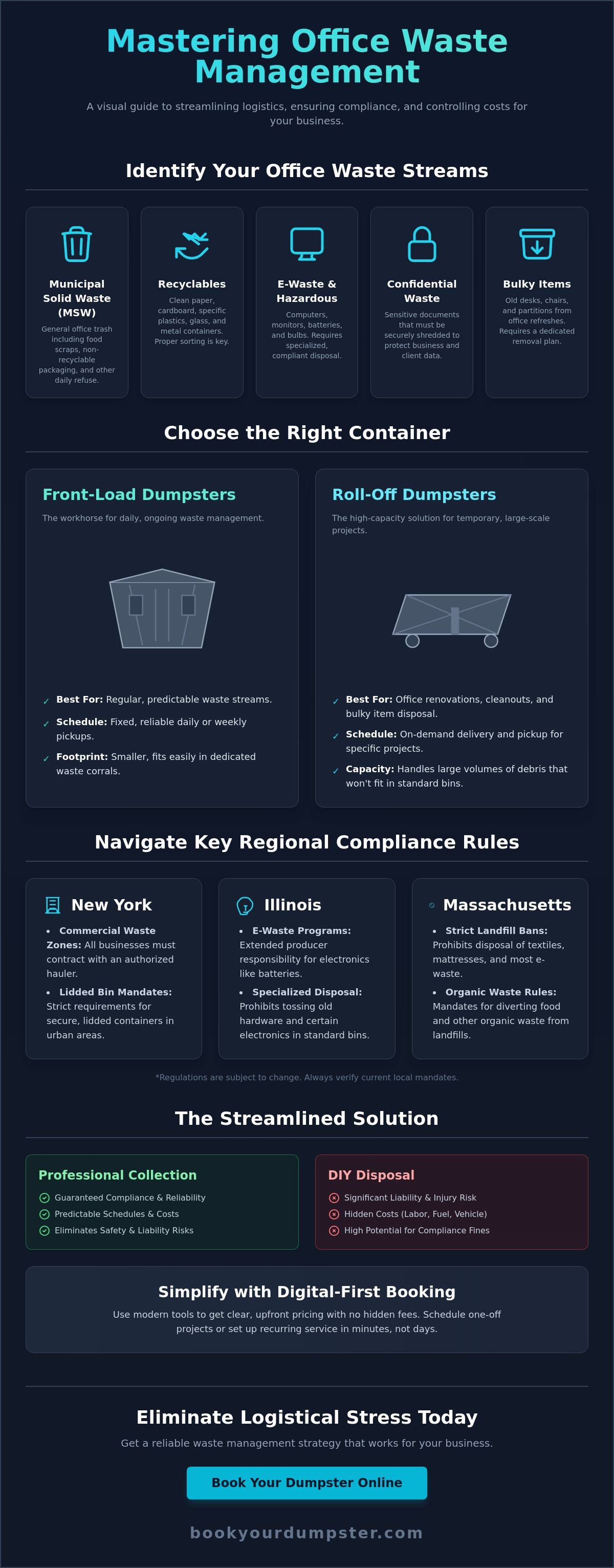
Effective office waste collection requires a granular understanding of your building's output. You can't treat every bag of trash the same way. Categorize your materials into Municipal Solid Waste (MSW) and recyclables immediately. Standard MSW includes food scraps and non-recyclable packaging. Recyclables focus on clean paper, cardboard, and specific plastics. For a structured approach to waste reduction, refer to the EPA guide for commercial buildings. This resource helps facility managers identify diversion opportunities that lower total disposal volume and streamline logistics.
Managing e-waste is a significant hurdle for modern offices. Computers, monitors, and peripherals contain heavy metals that require specialized handling. In Massachusetts, disposing of most electronic devices in landfills is strictly prohibited. You must also account for confidential waste. Securely shred sensitive documents before they enter the general waste stream. This protects your business and ensures you don't violate privacy regulations. Bulky items like old desks, ergonomic chairs, and partition walls require a different strategy. These items won't fit in your standard daily bins and need a dedicated removal plan during office refreshes.
E-Waste and Hazardous Material Protocols
Dispose of lithium batteries and mercury-containing bulbs according to strict state protocols. In Illinois, an extended producer responsibility program for batteries is now in effect. This requires sellers and distributors to manage recycling programs. Never toss old hardware into standard bins. Secure your data first, then arrange for compliant disposal of these materials. This prevents environmental contamination and protects your company from legal liability and data breaches.
Managing Seasonal and Project-Based Debris
Standard bins often fail during office renovations or end-of-lease cleanouts. Heavy furniture and partition walls quickly overwhelm front-load containers designed for daily refuse. If you are planning tenant improvements, integrate construction debris removal into your project timeline. This ensures that heavy materials don't block your daily operations or create safety hazards. For larger refreshes or "spring cleaning" events, you might need a temporary roll-off container to handle the sudden surge in volume. Book a temporary dumpster to keep your workspace clear and professional during transition periods.
Choosing the Right Container: Front-Load vs. Roll-Off Dumpsters
Choosing a container requires balancing your daily volume with physical space. Most offices rely on front-load dumpsters for their routine office waste collection. These bins range from 2 to 8 cubic yards and stay on-site indefinitely. They handle small-volume, daily trash like food waste and packaging. However, project-based needs like furniture removal or floor renovations require roll-off dumpsters. A 10 yard dumpster rental is often the best choice for these cleanouts. It fits into tighter spots while providing enough capacity for heavy debris that would overwhelm a standard bin.
Space is a major factor in cities like New York or Queens. Narrow alleys and busy streets limit where you can place a container. Measure your loading zone before ordering any equipment. Front-load trucks need overhead clearance to lift bins, while roll-off trucks require linear space to drop the container. For detailed advice on optimizing your building's setup, consult the EPA Guide to Commercial Waste. This resource helps you understand how container selection impacts your overall waste footprint and disposal efficiency. Comparing weight limits and disposal fees early prevents unexpected budget spikes.
When to Opt for a Permanent Commercial Bin
Select a permanent bin based on your weekly trash volume. Small offices usually thrive with a 2-yard or 4-yard bin picked up once or twice a week. Larger facilities might need an 8-yard bin with daily service. There is always a trade-off between container size and pickup frequency. Smaller bins save space but require more frequent visits, which can increase costs. Secure your bins with locks. This prevents third parties from using your container for illegal dumping, which can lead to overage fees and material contamination.
Strategic Use of Roll-Offs for Office Projects
Roll-off containers are essential for temporary projects. Use a 10-yard dumpster for minor office renovations or carpet replacements. These units are compact and easy to place. If you are decommissioning an entire floor, scale up to a 20-yard or 30-yard container. These larger sizes handle bulky desks and partition walls efficiently. Load the dumpster evenly. Place heavy items at the bottom and keep the debris level with the top of the bin. This prevents safety hazards during transport and helps you avoid weight-related overage charges. Match the container to the task to keep your office waste collection costs predictable.
Local Compliance and Best Practices for Urban Offices
Navigating urban office waste collection requires staying ahead of aggressive municipal deadlines. In New York City, the transition to Commercial Waste Zones is a primary concern. If your business is in Lower Manhattan, you must have a contract with an authorized hauler by May 31, 2026. Failure to comply leads to significant fines. Additionally, all NYC businesses setting waste on the curb must use bins with secure lids to reduce pests and improve street cleanliness. Urban compliance isn't just a suggestion; it's a legal requirement that impacts your bottom line.
Permit requirements are equally strict in cities like Boston. If you plan to place a dumpster on a public street for a cleanout, you must secure a permit from the city first. In Illinois, the Chicago Recycling Ordinance mandates that commercial buildings provide recycling services for tenants. Effective January 1, 2026, Illinois also requires sellers and distributors to have a battery recycling program in place. These localized rules mean your waste strategy must be as specific as your zip code. Preparing for health and safety inspections involves more than just hiding trash. Inspectors look for proper containerization and clear access to loading docks. Ensure your waste storage area is clean and that your containers aren't leaking.
City-Specific Waste Regulations
New York and Queens businesses must manage tight pickup windows and sidewalk placement rules. Use lidded bins to avoid citations. In Chicago, ensure your hauler provides the necessary reports to prove compliance with the city's recycling ordinance. Massachusetts facility managers should audit their organic waste. If you generate more than one-half ton of organic material per week, you must divert it from the landfill through composting or conversion. Mattresses and textiles are also banned from Massachusetts landfills, requiring specialized recycling haulers.
Designing an Internal Waste Flow
Efficiency starts inside the office. Use clear signage and color-coded bins to reduce recycling contamination. Train your staff to distinguish between food waste and standard office supplies. This reduces the volume of your general refuse and can lower your costs since many zones offer discounts for source-separated organics. Ensure your loading dock is clear of obstructions so collection vehicles can enter and exit quickly. This punctuality keeps your operations on schedule and prevents missed pickups in high-traffic areas. Streamline your compliance by choosing a partner that understands these local nuances. Order front load commercial waste pickup to ensure your business meets every municipal standard without the logistical headache.
Streamline Your Business with Book Your Dumpster USA
Managing office waste collection shouldn't be a source of constant frustration. Most businesses struggle with opaque contracts and unpredictable schedules that lead to overflow. We solve these logistical bottlenecks through a digital-first booking experience. This platform allows you to secure the exact equipment you need without long phone calls or manual paperwork. Whether you need a permanent solution for daily refuse or a temporary unit for a renovation, the process is straightforward and fast.
Transparency is the cornerstone of our service. You can view current dumpster rental prices online to ensure your budget remains intact. We eliminate hidden administrative fees and surcharges that often surprise facility managers at the end of the month. Our local expertise across New York, New Jersey, Illinois, and Massachusetts ensures that we understand the specific street-level challenges of your area. We provide flexible scheduling to accommodate both your routine collection needs and sudden emergency cleanouts. This level of control allows you to maintain a professional environment regardless of the project scale. Reliable office waste collection is now just a few clicks away.
The Book Your Dumpster Advantage
Choose a partner that respects the urgency of your business timelines. Our pragmatic approach focuses on reliability and punctuality. We maintain a fleet of 10, 20, 30, and 40-yard dumpsters to handle everything from minor office refreshes to full-floor decommissioning projects. Local experts manage every placement to ensure containers are positioned safely and legally. You'll receive direct communication throughout the process, removing the guesswork from your waste management strategy. We act as a high-functioning tool for your business, not just another vendor.
Getting Started Today
Securing your first commercial container is a simple, step-by-step process. First, visit our website and select your service area. Next, choose the container size that matches your current volume. If you're unsure which unit fits your project, consult our roll off dumpster rental guide for a detailed assessment of capacities and weight limits. Once you select your container, pick your delivery date and complete the booking online. This modern approach to an industrial sector ensures you move from clutter to resolution with minimal cognitive load. Don't let waste logistics slow down your operations. Book Your Office Dumpster Now and regain control of your facility today.
Master Your Office Logistics Today
Efficient office waste collection is the backbone of a professional workspace. You now have the tools to navigate complex urban regulations and choose the right container for your specific needs. Balancing routine front load commercial waste pickup with project-based roll-off containers ensures your facility remains clean and compliant. By identifying your unique waste streams early, you avoid the logistical bottlenecks that often disrupt business operations. It's time to replace confusion with a predictable, transparent disposal strategy.
Since 2018, we've provided dependable service across New York, New Jersey, Illinois, and Massachusetts. We offer transparent flat-rate pricing and a full fleet of 10, 20, 30, and 40-yard options to handle any office scale. Our digital-first platform removes the stress of traditional waste contracts, giving you immediate control over your scheduling and budget. Secure your office waste container today at BookYourDumpster.com. Take the final step toward a clutter-free environment and ensure your business stays ahead of municipal mandates.
Frequently Asked Questions
How often should an office have its waste collected?
Schedule your collection based on your weekly volume and local health codes. Most urban offices require at least once-per-week service to maintain sanitation. High-volume facilities or those with large breakrooms often need three to five pickups per week to prevent odors and pest issues. Audit your trash output to determine if a larger bin or higher frequency is the most cost-effective solution for your building.
Can we put old office furniture in a standard commercial dumpster?
No, you cannot place bulky office furniture in standard front-load bins. These containers are designed for bagged office waste and small debris. Desks, chairs, and cabinets take up too much space and can damage the truck's lifting mechanism. Rent a 10-yard or 20-yard roll-off dumpster for furniture disposal during office refreshes to ensure safe and compliant removal.
What are the rules for electronics recycling in a business setting?
Businesses must follow strict state-level bans on landfilling electronics. In Massachusetts, computers, monitors, and printers are prohibited from general waste streams. Illinois requires sellers and distributors to manage battery recycling programs. You must arrange for specialized e-waste disposal or data destruction services to remain compliant with environmental laws and protect your sensitive business information from potential data breaches.
Do I need a permit to rent a dumpster for an office cleanout in New York?
Yes, you need a permit if the dumpster occupies a public street or sidewalk. New York City requires a DOT permit for any container placed in public space. If you can place the dumpster on private property, such as an internal loading dock or private lot, you typically don't need a municipal permit. Check your local zone requirements before scheduling your delivery to avoid fines.
What is the difference between MSW and C&D waste for offices?
Municipal Solid Waste (MSW) consists of daily office trash like paper, food scraps, and packaging. Construction and Demolition (C&D) waste includes heavy materials like drywall, carpet, and wood from renovations. These streams are processed differently at disposal facilities. Accurate sorting is essential for your office waste collection strategy to avoid contamination fees and ensure compliance with local disposal mandates in cities like Boston or Chicago.
How can our office reduce its monthly waste collection costs?
Conduct a waste audit to identify recyclables and organics. Many cities, including New York, require haulers to offer discounts for source-separated recycling. By moving paper, cardboard, and food waste out of your general refuse bin, you can often reduce the size of your MSW container or decrease pickup frequency. This directly lowers your monthly overhead and improves your facility's overall diversion rates.
What happens if our dumpster exceeds the weight limit?
Exceeding the weight limit results in overage charges and safety risks. Trucks have maximum lifting capacities; overloaded bins can damage equipment or violate road weight laws. If your container is too heavy, the driver may be unable to pick it up until you remove excess material. Monitor your disposal habits and choose a larger roll-off size for heavy debris projects to keep your office waste collection costs predictable.
Are there specific bins for confidential document disposal?
Standard office waste containers are not secure for un-shredded confidential documents. You should implement a policy where all sensitive papers are shredded before being placed in a recycling bin. While we provide the large-scale containers for final removal, internal security remains your responsibility. Using locked consoles for sensitive materials prevents data breaches and ensures you meet industry privacy standards before the final collection occurs.


