Your roofing shingle disposal dumpster is a weight limit waiting to be exceeded, not just a box to fill. Most homeowners and contractors focus on the physical dimensions of the container, but asphalt shingles are deceptively heavy. You might expect a 20-yard bin to handle any residential tear-off, yet weight capacity is the real bottleneck. It's frustrating to see a half-empty dumpster hauled away only to receive a bill for surprise overage fees because the load was too dense.
We understand that logistical stress can ruin a project's budget. This guide helps you master the logistics of roofing waste by showing you how to calculate shingle weight and select the right dumpster size with total accuracy. You'll learn exactly how many "squares" fit into our 10, 20, or 30-yard options without triggering extra costs. We also provide clear steps to protect your driveway from damage and ensure a smooth delivery and pickup. Use this data to avoid hidden fees and keep your 2026 renovation on track.
Key Takeaways
- Understand the critical difference between volume and weight to prevent costly overage fees on heavy asphalt debris.
- Use the "Squares x Layers" formula to accurately size your roofing shingle disposal dumpster for any residential project.
- Identify the specific capacity limits of 10-yard and 20-yard containers to ensure safe hauling and regulatory compliance.
- Prepare your site with driveway protection and verify local permit requirements for specific zones in Illinois, Massachusetts, and New Jersey.
- Utilize streamlined booking tools to coordinate reliable delivery and pickup that matches your roofing crew's timeline.
Understanding Roofing Shingle Weight and Disposal Challenges
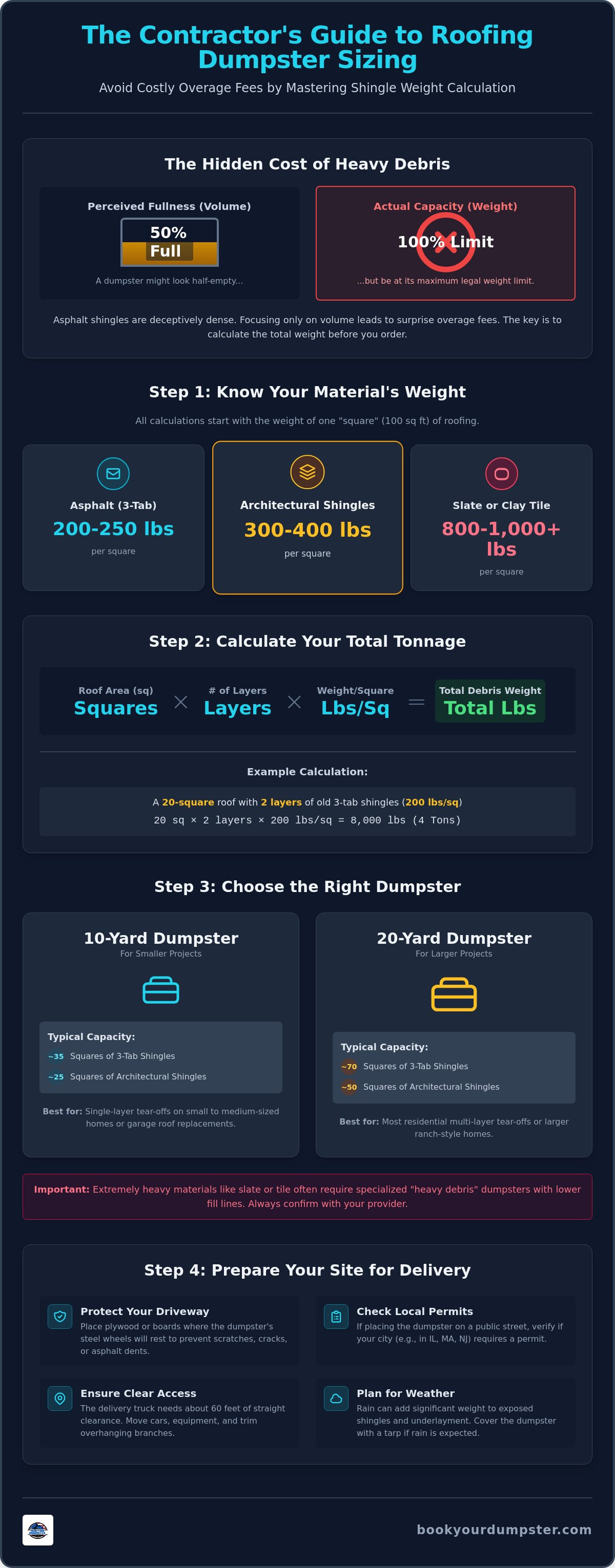
Roofing debris falls into the "heavy debris" category for a reason. Unlike household junk or furniture, shingles consist of dense materials like stone granules and asphalt. When you order a roofing shingle disposal dumpster, you aren't just paying for the physical space inside the metal box. You're paying for the hauling capacity of a heavy-duty truck. Most people overestimate how much volume they need and underestimate the sheer weight of the pile. A container might look half-empty but still exceed its weight limit.
Weight varies significantly by material. Standard asphalt shingles are common, but their density is significant. Understanding asphalt shingle composition helps explain this; the combination of fiberglass and mineral granules creates a product designed to withstand decades of weather. Cedar shakes are lighter but bulkier. Slate is the heaviest, often requiring specialized hauling solutions. Always check for multiple layers. A "double tear-off" means you're disposing of twice the weight, even if the roof area remains the same.
Defining the Roofing Square
Roofers measure projects in "squares." One square equals 100 square feet of roof surface. Typically, three bundles of shingles make up one square. Don't estimate your dumpster needs based on the floor plan of your home. A 2,000-square-foot house often has 25 to 30 squares of roofing once you account for pitch, overhangs, and garage space. Use the total number of squares to determine your tonnage. Standard 3-tab shingles weigh between 150 and 200 pounds per square. Architectural shingles are thicker and weigh between 200 and 300 pounds per square.
The Problem with Overweight Loads
Overweight loads create serious risks. Roll-off trucks have strict legal weight limits to operate safely on residential streets. If a container is too heavy, the hydraulic system may fail to lift it; the truck's braking distance also becomes dangerous. Most waste companies charge overage fees for every ton exceeding the rental agreement's limit. In some cases, a driver will refuse to pick up a container until you remove the excess weight. Properly loading your roofing shingle disposal dumpster ensures you stay within these legal boundaries and avoid project delays. Visit BookYourDumpster.com to view weight limits for your specific area.
Calculating the Right Dumpster Size for Your Roofing Project
Sizing your roofing shingle disposal dumpster requires math, not guesswork. Most project delays happen because a container reaches its weight limit before it is physically full. You must calculate the total tonnage based on the number of squares and the number of layers being removed. A single square of standard asphalt shingles typically weighs between 150 and 200 pounds, serving as the baseline for all disposal calculations. Use this figure to determine if a 10-yard or 20-yard container fits your specific needs.
Material type changes the equation quickly. Architectural shingles are 20 to 30 percent heavier than standard 3-tab options because of their multi-layered design. While 3-tab shingles are lighter, architectural shingles often reach 200 to 300 pounds per square. You also need to account for the weight of underlayment, flashing, and thousands of nails. These components add bulk and weight that can push a borderline estimate over the limit. If your project involves asphalt shingle recycling, keep the load clean of other construction debris to qualify for different disposal rates.
Material Weight Breakdown
- Asphalt shingles (3-tab): Expect a range of 200 to 250 pounds per square for older, standard materials.
- Architectural shingles: These dense materials weigh approximately 300 to 400 pounds per square.
- Slate or Clay Tile: These are extremely heavy, ranging from 800 to 1,000+ pounds per square, and require specialized heavy-debris dumpsters.
Estimating Total Tonnage
Consider a 20-square roof with two layers of asphalt shingles. If you are removing 3-tab shingles, that is 40 squares of material total. At 200 pounds per square, you are looking at 8,000 pounds, or 4 tons of waste. This does not include the weight of the underlayment or the dumpster itself. Always round up your final weight estimate by at least 10 percent to provide a safety margin for unexpected debris or heavier-than-average materials.
Weather also plays a factor in your final bill. If it rains during your project, the shingles and felt paper will absorb moisture. This significantly increases the total weight of the load. Plan your project during a dry window or cover the container with a tarp to keep the weight predictable. Once you have your tonnage estimate, select a dumpster size that offers enough capacity to handle the peak weight of your specific roof material.
Selecting Your Container: 10-Yard vs. 20-Yard Roofing Dumpsters
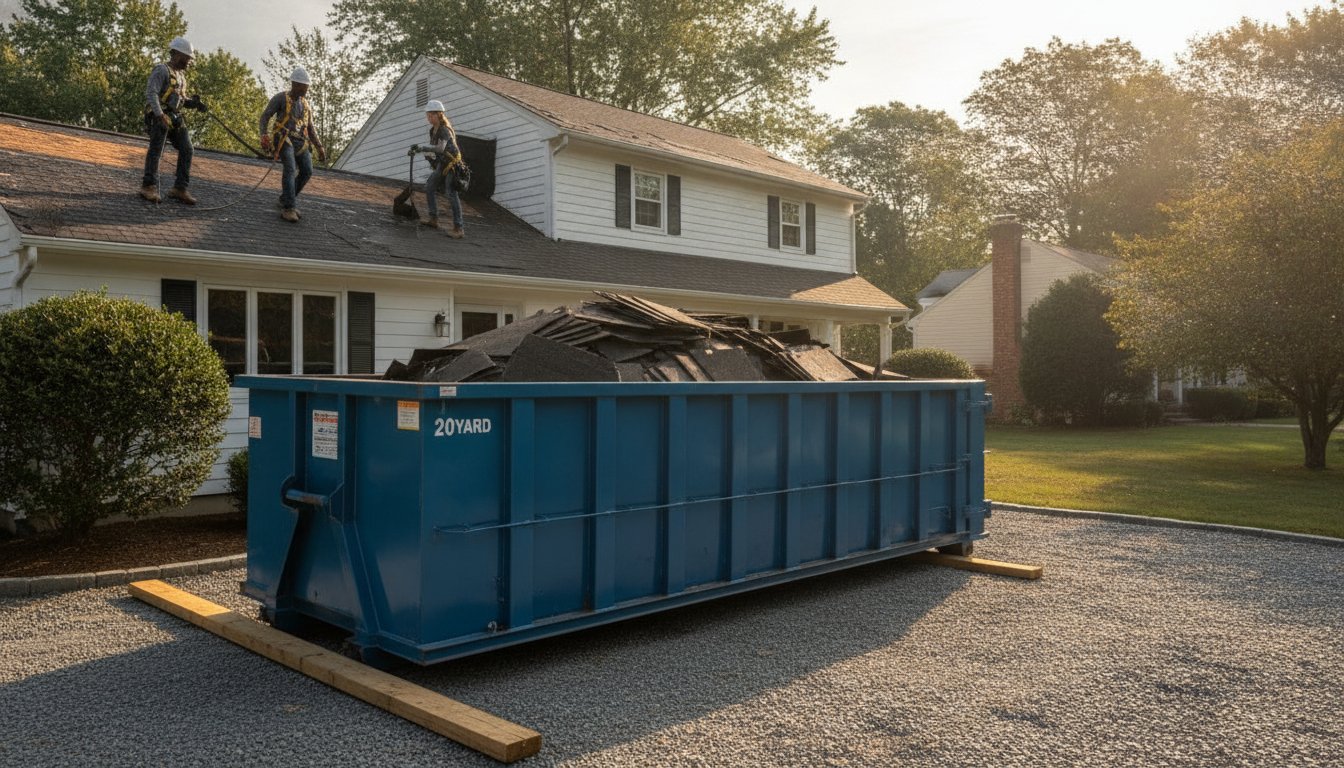
Choosing a roofing shingle disposal dumpster is a decision based on weight limits rather than just visual space. You cannot simply pick the largest box available and expect a truck to haul it away. Most 30-yard and 40-yard containers are strictly prohibited for heavy roofing debris because the weight of a full load would exceed the legal limit for residential roads. A 40-yard dumpster filled with asphalt shingles could weigh over 10 tons, which is double the safe lifting capacity of many roll-off trucks. Stick to 10-yard or 20-yard models to ensure your project remains street-legal and your waste is removed on schedule.
The Case for the 10-Yard Dumpster
The 10-yard dumpster is the "gold standard" for standard residential roof repairs. It comfortably holds between 10 and 25 squares of single-layer asphalt shingles without hitting dangerous weight thresholds. Its compact footprint is its biggest advantage. If you are working in tight suburban driveways or narrow city streets in areas like Queens and Brooklyn, a 10-yard unit is often your only viable option. Choosing this size minimizes the risk of property damage while maximizing the available space on your project site. These units also feature lower side walls. This makes it significantly easier for your crew to toss heavy bundles into the bin, reducing labor fatigue and speeding up the tear-off phase of the job.
When to Upgrade to a 20-Yard or 30-Yard
Upgrade to a 20-yard container for larger residential projects or multi-family units exceeding 30 squares of material. This size is also useful for "mixed loads" where you are disposing of shingles alongside bulky items like rotted plywood, old aluminum gutters, or insulation. However, you must still respect the weight limit. Even a 20-yard unit should rarely be filled to the top with shingles alone. For large-scale commercial roofing, the best strategy is often to order multiple 10-yard or 20-yard units. Scheduling a "swap" ensures that you always have a fresh container ready for debris without ever overloading a single truck. Visit BookYourDumpster.com to coordinate a delivery schedule that keeps your crew moving without the risk of overweight penalties.
Preparing for Delivery: Driveway Protection and Local Logistics
A roofing shingle disposal dumpster exerts immense pressure on your property. While standard household waste is light, five tons of asphalt shingles concentrated on four small steel wheels can easily crack concrete or leave permanent ruts in asphalt. You must prepare the landing zone before the roll-off truck arrives. Clear the area of vehicles, equipment, and debris to ensure the driver has a straight path. Most trucks require at least 60 feet of linear space and 23 feet of vertical clearance to safely extend their hydraulic lift and drop the container.
Driveway Protection Checklist
- Distribute the weight: Place 4x8 sheets of plywood or heavy 2x10 lumber where the dumpster wheels will rest. This prevents the steel from scarring your driveway surface.
- Avoid utilities: Never place a heavy roofing load over septic tanks, sprinkler heads, or thin decorative pavers. Identify underground lines that cannot withstand high-pressure loads.
- Check overhead: Scan for low-hanging power lines or tree branches. The truck’s lift system reaches significant heights during delivery; any obstruction can cause property damage or safety hazards.
Local Regulations and Street Placement
Logistics vary by state and municipality. In Illinois, Massachusetts, and New Jersey, residential projects often have strict time limits for how long a dumpster can remain on-site. If your driveway is too small or inaccessible, you may need to place the unit on a public street. Cities like Chicago, San Francisco, and boroughs like Queens require a "Right of Way" or street permit before delivery. These permits often come with specific signage requirements and daily fees. Failure to secure these documents can result in immediate fines or the removal of your container mid-project.
Don't handle the bureaucracy alone. At Book Your Dumpster USA, we act as your partner for local permit guidance, helping you navigate the specific requirements of your neighborhood. Communicating clearly with your roofing contractor is also vital. Ensure they understand the loading limits discussed in previous sections to keep the weight balanced. A centered load prevents the container from tipping or shifting during pickup. Schedule your roofing dumpster delivery today to secure your preferred drop-off window and protect your property from the start.
Book Your Dumpster USA: Pragmatic Roofing Disposal Solutions
Our streamlined online booking system provides immediate roofing support for projects of any scale. We eliminate the logistical friction that usually accompanies waste management. When you order a roofing shingle disposal dumpster, you receive clear documentation regarding weight limits and disposal protocols. Book Your Dumpster USA offers 10, 20, 30, and 40-yard containers to handle everything from minor repairs to complete commercial tear-offs. Every rental comes with a commitment to punctuality and pricing integrity. You don't have to wait for a callback or navigate complex phone menus to secure your equipment.
Expert support is available for both residential and commercial roofing projects across our service areas. We understand that roofing is a high-stakes trade where timing is everything. Our team ensures that your container arrives exactly when needed and is hauled away as soon as the job is done. We maintain a high-functioning toolset that keeps your project moving toward completion without the burden of logistical clutter. Our digital-first approach means you have access to your rental details and scheduling options at any time; this provides total control over your project's waste stream.
Why Contractors Choose Book Your Dumpster USA
Reliable timing is non-negotiable for roofing professionals. We prioritize punctuality to prevent crew downtime on critical tear-off days. If a crew stands around waiting for a container, your project loses money. We provide direct communication regarding weight limits for heavy materials like asphalt and slate. Our platform also allows for easy management of multiple jobsites. This level of control ensures that waste removal never becomes the bottleneck in your construction timeline. We act as a dependable partner who understands the urgency of a professional jobsite and the need for unmistakable instructions and transparent billing.
Getting Started with Your Rental
Select your dumpster size and secure your delivery date in under five minutes. Start by entering your project location to see available inventory. Once you choose a 10-yard or 20-yard unit for your shingles, confirm your drop-off window. Prepare your site as discussed in previous sections by clearing obstructions and placing protective boards. Our drivers handle the rest. We provide a high-velocity service that moves you from a state of clutter to a state of resolution without the headache of hidden fees. Rent your roofing dumpster now to keep your 2026 project on schedule. Using our service is synonymous with reliability, ensuring your renovation stays on track from the first shingle to the final pickup.
Streamline Your Roofing Waste Management
Managing a roof replacement is a complex operation. Waste disposal shouldn't be the part that slows you down. You now have the math to calculate shingle weight accurately and select the right container based on your project's specific square count. Remember that a 10-yard container is often the most efficient choice for heavy asphalt debris. Proper site preparation protects your property from the extreme pressure of several tons. By prioritizing weight limits over visual volume, you eliminate the risk of surprise fees and logistical delays.
We provide specialized 10-yard heavy debris containers designed specifically for roofing tear-offs. Our team serves key regions including NY, NJ, IL, MA, and SF with transparent flat-rate pricing models that respect your project's bottom line. Take control of your jobsite logistics immediately. Book Your Roofing Dumpster Online Now to ensure your roofing shingle disposal dumpster remains an asset rather than a liability. Your next successful renovation starts with a reliable, no-nonsense disposal partner.
Frequently Asked Questions
How much does a 10-yard dumpster hold in roofing squares?
A 10-yard dumpster typically holds 10 to 25 squares of single-layer asphalt shingles. This capacity is determined by weight rather than physical volume. If you are disposing of heavier architectural shingles, stay toward the lower end of that range to avoid exceeding the truck's lifting capacity. Always verify your total square count before finalizing your rental to ensure the container can be safely hauled away.
Can I put other roofing materials like flashing and wood in the same dumpster?
You can include flashing, underlayment, and small amounts of wood in your roofing shingle disposal dumpster. However, adding these materials often classifies the container as a mixed load rather than a clean shingle load. If you plan to utilize a recycling program, you must keep the shingles separate from metal and wood debris. Mixed loads may be subject to different disposal rates at the facility.
Will a roofing dumpster damage my driveway?
Heavy roofing loads can damage driveways without proper site preparation. The concentrated weight of several tons on steel wheels can crack concrete or leave permanent ruts in asphalt. Protect your property by placing 4x8 plywood sheets or heavy 2x10 boards under the wheels before the truck arrives. Ensure the drop-off zone is level and clear of underground utility lines or septic tanks that cannot support the weight.
How many layers of shingles can I fit in a 20-yard dumpster?
A 20-yard dumpster generally accommodates up to 30 squares of double-layered shingles. If your project involves a single-layer tear-off, this size can handle up to 40 squares. Never fill a 20-yard container to the top with shingles alone. The material is so dense that the truck will reach its legal weight limit long before the bin appears full. Monitor your loading carefully to avoid overweight penalties.
What is the "clean shingle" recycling discount, and do you offer it?
A "clean shingle" load consists only of asphalt shingles, nails, and felt paper. Many facilities offer lower tipping fees for these loads because they are processed into asphalt for road paving. We provide the logistics and guidance needed to coordinate clean loads with local recycling centers. Avoid adding gutters, wood, or general construction trash to the roofing shingle disposal dumpster if you want to qualify for these specific rates.
What happens if my roofing dumpster is overweight?
Overweight containers incur additional fees for every ton that exceeds the agreed-upon weight limit. If the load is dangerously heavy, the driver may refuse to pick up the container until you remove the excess material. This results in costly project delays and extra labor. Use the math formulas provided in this guide to estimate your tonnage accurately and stay within the legal hauling capacity of the roll-off truck.
Do I need a permit for a roofing dumpster in New Jersey or New York?
Permits are required if you place the container on a public street or right-of-way in New Jersey or New York. Cities like Newark and New York City have strict ordinances regarding street placement and safety markings. If the dumpster stays entirely on your private driveway, a permit is usually unnecessary. Check with your local municipal building department to verify the specific requirements for your neighborhood before scheduling your delivery.
How long can I keep the dumpster for my roofing project?
Standard rental periods typically range from 7 to 14 days for residential roofing projects. This window provides ample time for a crew to complete the tear-off and new installation even with minor weather delays. If your project is finished early, call for an immediate pickup to clear your property. If you anticipate a longer project timeline, contact us before your scheduled pickup date to discuss extending the rental period.