A single missed permit or an undersized dumpster can turn a 48-hour REO turnaround into a week of expensive municipal fines and missed listing deadlines. Securing a reliable dumpster rental for foreclosure cleanouts is the most critical logistical decision you'll make before the first bag of debris hits the curb. You already know that every day a property sits full of a former occupant's junk is a day it isn't making money. Dealing with unexpected hazardous waste or strict city regulations in dense areas like Queens or San Francisco adds layers of stress you simply don't need.
This guide provides a professional-grade checklist to help you empty any property in one go while keeping your waste management costs predictable. We'll show you exactly how to streamline your debris removal process and meet tight deadlines without logistical delays. You will learn how to select the right container size, manage municipal permit requirements, and handle prohibited materials to ensure your property is ready for the market immediately.
Key Takeaways
- Learn how to audit interior debris and yard waste to establish a synchronized timeline for your cleanup crew and equipment delivery.
- Discover how to select the optimal container size, ensuring your dumpster rental for foreclosure cleanouts handles the full volume of 2-3 bedroom homes in a single haul.
- Master the permit requirements for street placement in states like New York and Illinois to avoid costly municipal fines.
- Use professional loading strategies to maximize cubic yardage and fit bulky furniture more efficiently into your rental.
- Find out how to use a digital-first booking system to secure equipment immediately and maintain your REO listing schedule.
Essential Planning for Foreclosure and REO Property Cleanouts
Successful property preservation starts with a clear inventory of what's left behind. Foreclosure cleanouts aren't standard residential junk removals; they often involve years of accumulation or sudden abandonment. Securing a dumpster rental for foreclosure cleanouts early in the process ensures you don't stall when the crew arrives. Every hour a property sits full of debris is an hour it stays off the market. Start by identifying the three main zones: the interior living spaces, the exterior yard waste, and any structural elements that need removal, such as damaged drywall or rotted flooring.
Assess the property's distress level immediately. Real estate owned (REO) properties often present unique challenges like refrigerators full of spoiled food or abandoned electronics. These items require specific disposal protocols to avoid environmental fines. You must also verify property access. Narrow residential streets or low-hanging overhead wires can block a large roll-off truck. If the driveway is too narrow, you'll need to coordinate a street placement permit well in advance.
The REO Pre-Cleanout Assessment
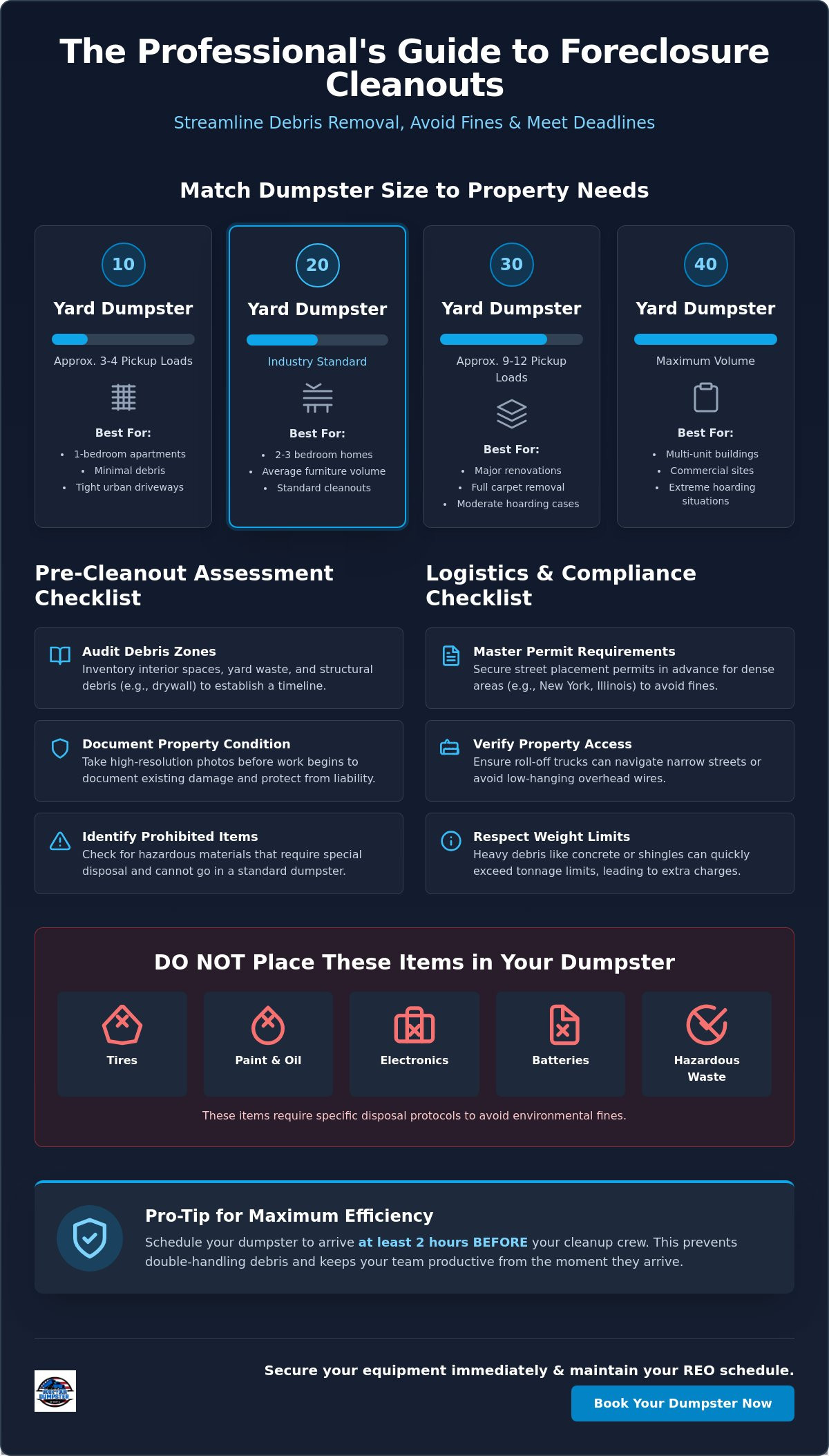
Take high-resolution photos of the property before any heavy lifting begins. This documents existing structural damage and protects you from liability if a contractor claims a wall was damaged during the haul. Check for hazardous materials like old paint cans, motor oil, or tires. Standard containers cannot accept these items. Match your equipment to the volume of the mess. Use a 10 Yard Dumpster for small apartments or a 40 Yard Dumpster for severe hoarding situations where the house is packed to the ceiling.
Coordinating with Contractors and Cleaners
Dumpster Sizing Checklist: Matching Volume to Property Size
Selecting the wrong container size stalls your timeline and inflates your budget. A professional dumpster rental for foreclosure cleanouts requires precise volume estimation to ensure you don't pay for empty space or end up needing a second haul. Use this comparison to match your property type to the correct capacity. Choosing the right bin allows your crew to work continuously without waiting for a swap.
- 10-Yard Dumpster: Best for 1-bedroom apartments or properties with minimal debris. It's the compact choice for tight urban driveways or small-scale junk removal.
- 20-Yard Dumpster: The industry standard for 2-3 bedroom homes. It handles average furniture volume and basic cleanouts without reaching capacity too early.
- 30-Yard Dumpster: Necessary for major renovations, full carpet removal, or moderate hoarding cases. It offers the extra height needed for bulky items.
- 40-Yard Dumpster: Reserved for multi-unit buildings, commercial sites, or extreme hoarding situations where volume is the primary concern.
Adhering to official property preservation guidelines ensures the home remains marketable and safe. Selecting the correct dumpster size is the first step in meeting these professional standards during the cleanout phase.
Calculating Your Debris Volume
Don't guess on volume; use the pickup truck metric. A 10-yard container holds roughly 3 to 4 level pickup truck loads. If you're clearing out a house with 12 loads of junk, you need at least a 30-yard bin. Factor in "air space" caused by bulky items like sofas, mattresses, and old appliances. These items don't pack tightly, so they often consume more volume than their weight suggests. For smaller REO tasks, you can learn more about the 10 yard dumpster rental to see if it fits your specific scope.
Weight Limit Considerations for REO Debris
Weight limits are just as important as volume. Foreclosure sites often require tearing out damaged shingles or old concrete walkways. These heavy materials can quickly exceed the tonnage limit of even the largest bins. Check if your provider offers transparent pricing versus weight-based overages to keep your budget predictable. Weight limits directly impact your total cleanout costs, especially when dealing with structural debris or wet materials. If you're ready to secure your site, you can view available sizes online to match your project needs.
The Logistics Checklist: Permits, Placement, and Local Compliance
Logistics determine whether your project stays on schedule or hits a wall of city fines. You must decide immediately if the container will sit on private property or the public right-of-way. Driveway placement is usually the most efficient choice, but it requires enough space for the truck to maneuver. If the property lacks a driveway, you'll need to use the street. When arranging a dumpster rental for foreclosure cleanouts, the placement site dictates your permit needs. If the property is in a high-density area like Queens or San Francisco, city-specific rules are non-negotiable and often require several days of lead time for approval.
Site preparation is a safety requirement. Ensure you have 15 to 20 feet of vertical clearance at the drop-off point. Roll-off trucks lift their beds high to slide the container into place. Low-hanging power lines, cable wires, or tree branches will stop a delivery immediately. Clear the area of all parked cars and low-hanging obstructions before the driver arrives. This prevents failed delivery fees and keeps your crew on task.
Urban Placement Strategies
Busy streets in Chicago or Boston require "No Parking" signs to reserve space for the equipment. Without these signs, local traffic will block your drop-off zone, causing delays. Always use plywood under the rollers if you're placing the bin on a residential driveway. This prevents the heavy steel from cracking the concrete or scarring the asphalt under the weight of the debris. Check the dumpster rental guide for New York and Illinois for specific 2026 regional rules regarding street placement and duration limits.
Local Regulation and Compliance
Respect municipal quiet hours to avoid neighbor complaints and police intervention. Most residential zones prohibit heavy machinery operation before 7:00 AM or after 7:00 PM. If you're managing a multi-family foreclosure, you must understand the difference between residential and commercial waste regulations to stay compliant with local hauling laws. Be aware of landfill bans that vary by state. For example, many regions now prohibit mattresses, tires, or e-waste in general debris bins. Mixing these items into your dumpster rental for foreclosure cleanouts leads to rejection at the transfer station and significant overage charges. Confirm these details during the booking process to keep your budget predictable.
Efficient Loading and Debris Management Strategies
Loading your container strategically is the only way to get the full value out of your dumpster rental for foreclosure cleanouts. Randomly tossing items into the bin creates large air pockets that waste expensive space. Start by loading large, flat items like plywood, old doors, or flattened cardboard first. This creates a solid base at the bottom of the bin. It allows you to stack smaller debris on top, filling the gaps and maximizing every cubic yard of capacity.
Break down everything. Use a sledgehammer to dismantle furniture, cabinets, and bed frames. If you leave a dresser intact, you're paying to haul away the air inside the drawers. Flatten all boxes and stack them tightly against the sides. You must also distribute the weight evenly across the entire floor of the dumpster. If the truck is imbalanced, the driver cannot safely lift the container during pickup. This leads to costly delays and potential dry-run fees.
Respect the "Max Fill" line. Hauling companies face heavy fines for transporting loads that exceed the height of the container walls. If your debris sticks out above the top, the driver will leave it behind. You'll have to manually remove the excess before they return for a second pickup attempt. If you find yourself nearing the limit with more work to do, schedule a swap-out immediately to keep your crew moving.
The "Accepted Items" Checklist
Knowing what goes in the bin prevents rejection at the scale. Most foreclosure projects involve a mix of household items and building materials. Standard containers accept:
- Household Goods: Furniture, clothing, toys, and general household trash.
- Building Materials: Drywall, flooring, siding, and wooden studs.
- Appliances: Stoves and washers are usually fine, but refrigerators require a certificate proving the Freon was professionally removed.
Managing Prohibited Items
Identify hazardous waste before it enters the container. Batteries, wet paint, motor oils, and flammable liquids are strictly prohibited. These items pose fire risks and environmental hazards at the landfill. You must also check for state-specific rules regarding tires and mattresses. Many regions require these to be handled separately from general waste to avoid heavy surcharge fees. Review our guide on safe construction waste disposal for non-standard items that might require special handling. Organizing these materials into a separate pile on-site keeps your primary dumpster clean and compliant.
Securing Your Foreclosure Cleanout Dumpster with Book Your Dumpster USA
Managing the debris from a distressed property requires a partner that values your timeline as much as you do. Our streamlined online system makes securing a dumpster rental for foreclosure cleanouts a matter of clicks rather than phone tag. You can't afford to wait for a callback when a cleanup crew is on the clock. By choosing a digital-first provider, you eliminate the friction of traditional waste management and get back to the work of property restoration. We provide the high-functioning tools you need to move from a state of clutter to a state of resolution with minimal cognitive load.
Transparency is the foundation of our service. We provide 10, 20, 30, and 40-yard containers with clear capacity guidelines to match any REO project scope. Whether you're clearing a single-family home or a multi-unit complex, you'll receive a flat-rate quote that protects your budget from hidden surcharges. Our pricing integrity and punctuality remain our primary commitments to every client throughout 2026. You get the bin you need, exactly when you need it, with no surprises on the final invoice.
Why REO Professionals Choose Us
We understand the specific pressures of high-volume real estate markets like New Jersey, Illinois, and San Francisco. Property managers and investors rely on us because we handle the logistical heavy lifting of waste removal. We don't just drop off a box; we provide a professional-grade solution that integrates into your professional workflow. Our team supports the unique needs of property preservation specialists who require reliable equipment and unmistakable communication to meet strict bank or municipal deadlines. We act as a dependable, no-nonsense expert so you can focus on the listing.
Ready to Clear the Property?
Don't let trash stand between you and a successful listing. You can select your city and container size through our website in under three minutes. Check our online portal for same or next business day delivery availability in your specific zip code to ensure your project never stalls. Once the container is full, our system makes scheduling a pickup just as fast. Take control of your property timeline by using a service designed for speed and simplicity. Book Your Foreclosure Cleanout Dumpster Now and clear your site today.
Accelerate Your Property Turnaround
Successful REO management depends on logistical precision. By matching your container size to the property volume and securing placement permits early, you avoid the delays that stall listing deadlines. Efficient loading further ensures you maximize every cubic yard of your dumpster rental for foreclosure cleanouts, keeping your waste management costs predictable and your site safe. You now have the professional checklist needed to move from a state of clutter to a state of resolution with minimal friction.
We've modernized the process with a streamlined online booking system designed specifically for the urgency of real estate investors. Serving major markets across New York, New Jersey, Illinois, Massachusetts, and San Francisco, we provide 10 to 40-yard containers tailored to any scale of distress. You can rely on our punctuality and pricing integrity to keep your project on schedule. Start Your Foreclosure Cleanout with Book Your Dumpster USA today to secure your equipment. You have the plan; now use the right tool to finish the job and get your property back on the market.
Frequently Asked Questions
What is the best dumpster size for a 3-bedroom foreclosure cleanout?
A 20-Yard Dumpster is the standard choice for a typical 3-bedroom foreclosure cleanout. This size accommodates the average volume of furniture and household debris found in mid-sized properties. If the house has a basement or garage full of heavy items, consider a 30-Yard Dumpster instead. It provides the extra volume needed to avoid a second haul and keeps your cleanup on a tight schedule.
Do I need a permit to rent a dumpster for an REO property in New York?
You need a permit if the container sits on a public street or sidewalk in New York. Municipal rules in high-density areas are strict and often require a permit from the Department of Transportation. If the dumpster is placed entirely on a private driveway, a city permit is usually not required. Always verify local neighborhood or HOA rules before scheduling your dumpster rental for foreclosure cleanouts to prevent unexpected fines.
Can I put appliances like refrigerators and stoves in a foreclosure dumpster?
Stoves and dishwashers are generally accepted, but refrigerators and air conditioners require special handling. You must have a certified technician remove the Freon and tag the unit before it can go into the container. Most transfer stations will reject a load if they find untagged cooling appliances. Check with your provider during the booking process to ensure you meet local disposal regulations for bulk metal items.
How long can I keep the dumpster on-site for a foreclosure project?
Standard rental periods typically range from 7 to 14 days for foreclosure projects. This timeframe allows your crew enough time to clear out the interior and manage any exterior yard waste. If the property requires extensive structural tear-outs, you can often extend your rental for a daily fee. Schedule your pickup as soon as the project is complete to clear the driveway for prospective buyers or contractors.
What happens if the dumpster is over the weight limit for an REO cleanout?
Exceeding the weight limit results in overage fees that are billed per ton. These costs can disrupt an REO budget, especially when hauling heavy materials like wet drywall or roofing shingles. The truck may also be unable to lift the container safely if it is significantly overloaded. Distribute the weight evenly and monitor the Max Fill line to ensure a smooth pickup without additional financial penalties.
Are there items I am strictly prohibited from putting in the dumpster?
You are strictly prohibited from disposing of hazardous materials like wet paint, motor oil, car batteries, and asbestos. Flammable liquids and pressurized tanks also pose significant safety risks and are not allowed in standard bins. Mixing these items into a dumpster rental for foreclosure cleanouts leads to immediate rejection at the landfill. Arrange for a separate hazardous waste pickup to handle these materials legally and safely.
Do you offer same-day delivery for urgent foreclosure cleanouts?
Same-day delivery is subject to local inventory and driver availability in your specific city. While we strive for maximum speed, booking 24 to 48 hours in advance is the most reliable way to guarantee your equipment arrives on time. Use our online portal to check real-time availability for your zip code. Prompt scheduling ensures your labor crew isn't standing around waiting for a place to put the debris.
How much clearance does the truck need to drop off a roll-off container?
The delivery truck needs approximately 15 to 20 feet of vertical clearance and 10 to 12 feet of width to operate safely. Low-hanging power lines, tree branches, or narrow alleyways will prevent a successful drop-off. Ensure the path to the placement site is clear of parked cars and overhead obstructions. Providing adequate space allows the driver to position the roll-off container precisely where your crew needs it most.


