

Clicking "I agree" on your rental contract without reading it is the fastest way to turn a standard cleanup into a financial headache. You expect a straightforward service, but the fine print often hides the real cost of a mistake. Most renters worry about surprise overage fees or damage to their driveway, and these concerns are valid when the rules aren't clear. Understanding dumpster rental terms and conditions is the only way to ensure your project stays on budget and on schedule.
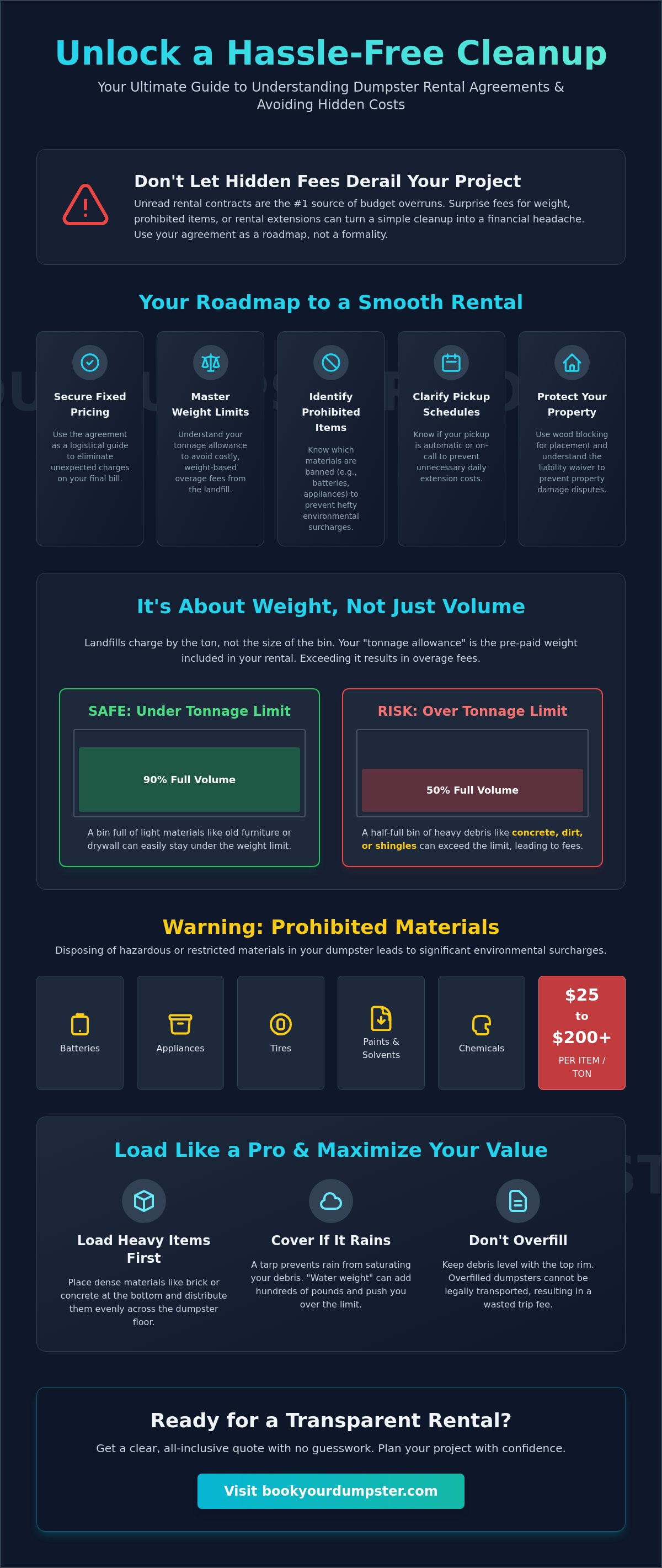
We know you want the waste gone with zero logistical stress. This guide removes the guesswork by outlining exactly how weight limits and rental windows impact your final invoice. You'll learn which materials are strictly prohibited to avoid surcharges that can range from $25 to $200 per item or ton. Read on to master the details of your agreement, from liability clauses to placement regulations. Use this information to manage your 10, 20, 30, or 40 yard dumpster with the confidence of a professional contractor.
Key Takeaways
- Use the rental agreement as a logistical roadmap to secure fixed pricing and eliminate unexpected line items on your final bill.
- Master the relationship between bin size and tonnage allowance by understanding dumpster rental terms and conditions regarding weight-based overage fees.
- Identify restricted materials like batteries and appliances early to prevent environmental surcharges and project delays.
- Distinguish between automatic and call-for-pickup schedules to ensure your rental doesn't incur unnecessary daily extension costs.
- Protect your property by using wood blocking for placement and verifying your responsibility under standard liability waivers.
Why Your Rental Agreement is the Secret to a Fixed-Price Project
Think of your rental agreement as a logistical shield. It isn't just a legal hurdle to clear before delivery. It's a Service Level Agreement (SLA) that defines exactly what you're paying for and what the provider will deliver. Understanding dumpster rental terms and conditions allows you to lock in a price and hold the provider accountable. Without this clarity, projects often suffer from price variance. This happens when expectations for weight, time, or debris type don't align with the actual service provided. When both parties follow the same roadmap, surprise costs disappear.
By May 2026, waste management has become more complex. Rising fuel costs and stricter environmental mandates have forced disposal facilities to tighten their rules. If you don't know the specifics of your contract, you're leaving your budget exposed to these external pressures. Treat the agreement as your project checklist. It tells you how to prep your site and how to manage your debris to keep costs flat. A professional agreement removes the stress of the unknown, turning a messy job into a controlled process.
Breaking Down the Core Components of an Agreement
Service dates are the first pillar of your contract. You must distinguish between the delivery window and the actual rental duration. If your project runs over, you need to know the daily extension rate immediately. Equipment specifications are equally vital. Once the bin hits the ground, you're responsible for its condition and access. Payment terms should be transparent. Ensure you know how and when your card is charged for overages. Most disputes arise from a lack of clarity here, so verify these details before you sign.
The Role of Transparency in Modern Waste Logistics
Digital booking platforms like Book Your Dumpster USA have modernized how terms are communicated. They replace dense legal blocks with clear, actionable instructions. However, even "all-inclusive" quotes have conditional clauses. These usually involve weight limits or specific local landfill regulations that impact disposal costs. Standard Roll-off dumpsters are the industry workhorses, but their utility depends on your adherence to the contract. Understanding dumpster rental terms and conditions ensures that your 10, 20, 30, or 40 yard dumpster arrives and departs without an unexpected impact on your bottom line. Always confirm how local municipal rules might override standard company policies to avoid permit-related fines.
Decoding Weight Limits and Tonnage Allowances
Tonnage allowance is the pre-paid weight included in your base rental price. It's the most critical number in your contract. While the bin size tells you the volume, the tonnage limit tells you the mass. Landfills don't charge by the bin; they charge by the ton. This is why providers must pass overage fees to you if you exceed the limit. Understanding dumpster rental terms and conditions means recognizing that a half-full bin of concrete can easily outweigh a brimming bin of old furniture. Accuracy here is the only way to keep your final invoice predictable.
Estimate your debris before you start loading. Asphalt shingles are notoriously heavy, weighing roughly 2,000 to 4,000 pounds for a standard residential roof replacement. Concrete and dirt are even denser. If you ignore these limits, you risk more than just fees. An overfilled dumpster is a safety hazard. DOT regulations are strict about weight limits for transport. If debris is piled above the rim, the driver cannot safely tarp the load. They will leave the bin on-site, and you'll face a trip fee for the failed pickup attempt.
How Tonnage is Tracked and Billed
Certified scale house tickets determine your final weight. Every truck stops at a scale before and after dumping. This provides a transparent, verifiable record of your debris weight. Note that a 10 yard dumpster and a 40 yard dumpster have different weight-to-volume ratios. Small bins are often rated for heavier materials like masonry. Large bins are built for high-volume, lower-weight items. Pro-rated overage charges are standard. This means you only pay for the specific amount you go over the limit, rather than a flat-fee penalty.
Strategies to Stay Under Your Weight Limit
Protect your budget with these loading strategies. Load heavy items like brick or dirt first and keep them level. Cover your bin with a tarp if rain is in the forecast. Saturated debris can add significant "water weight" to your total, potentially pushing you over your limit. Monitor your volume closely. If you hit your weight limit before the bin is full, stop loading immediately.
Reviewing the EPA regulations for C&D debris helps clarify why certain materials are billed differently. If you anticipate a heavy project, choosing a higher tonnage allowance upfront is always cheaper than paying overage fees later. Understanding dumpster rental terms and conditions ensures you select the right capacity for your specific debris type, from household cleanouts to professional construction sites.
Prohibited Materials and Environmental Compliance
The legal line between hazardous waste and non-hazardous debris is sharp. Crossing it triggers immediate financial and legal consequences. Standard roll-off bins are designed for inert materials, not volatile substances. Understanding dumpster rental terms and conditions requires you to accept full environmental liability for every item placed in the bin. If hazardous materials are discovered at the disposal facility, the remediation fees are billed directly back to you. This is why you must vet every load before the driver arrives.
Local mandates in cities like New York or San Francisco have added layers of complexity to waste removal. These regions often require the strict separation of organic waste from construction debris. Mixing these streams can result in heavy municipal fines. Always verify your local ordinances before loading your 10, 20, 30, or 40 yard dumpster. Compliance isn't just about following rules; it's about protecting your project's bottom line from avoidable environmental surcharges.
The 'Big No-Go' List for 2026
Chemicals and liquids top the list of banned items. Never toss wet paint, motor oil, pesticides, or industrial cleaners into your bin. These substances leak and contaminate entire loads. Special handling items like tires and mattresses also carry restrictions. Most facilities charge flat fees ranging from $25 to $75 per item because they require separate processing. For contractors, the rules are even stricter. You must identify Banned construction materials such as asbestos-containing insulation or lead-based paint debris before loading begins. If you're unsure about a specific material, call and ask before you throw it in.
What Happens if Prohibited Items are Found?
Drivers perform a visual inspection before hauling. If they see a prohibited item, they'll initiate a "Return to Sender" policy. This means the bin stays on your property, and you'll pay a trip fee for the failed pickup. If the item is buried and discovered at the landfill, the consequences escalate. You'll face landfill rejection fees and the high cost of manual sorting or hazardous waste remediation. Don't take the risk. Use local municipal programs for electronics, batteries, and appliances containing Freon. These items are commonly "hidden" prohibited goods that trigger automatic surcharges. Keep your project clean and your invoice predictable by sticking to the accepted materials list.
Rental Periods, Extensions, and Pickup Logistics
Time management is just as critical as weight management for any cleanup project. Most standard rental periods range from 7 to 14 days. However, you must verify the exact duration listed in your specific quote. Understanding dumpster rental terms and conditions ensures you don't accidentally enter an extension period without realizing it. If your project hits a snag, communicate the delay early. Extension fees are typically billed on a daily basis. Knowing this rate upfront helps you adjust your budget immediately.
The biggest cause of unexpected charges is confusion over the pickup method. Some providers use automatic pickup, where the truck arrives exactly when the rental period ends. Others require a call-for-pickup. If you assume the provider is coming but they're waiting for your call, you'll pay for every extra day the bin sits on your property. Conversely, if you aren't ready for an automatic pickup, you'll face a "Dry Run" fee. This happens when the driver arrives but cannot access the bin due to parked cars, locked gates, or low-hanging wires. Clear the path before the scheduled time to keep your project moving.
Scheduling Your Delivery and Removal
Same-day service is a major logistical feat that depends on local inventory and driver routes. To ensure availability, book your delivery at least 48 hours in advance. Clear access is mandatory for a successful drop-off. Ensure there's enough room for the truck to maneuver and that no overhead obstructions exist. You can manage these details and track your timeline through the Book Your Dumpster USA portal. This digital tool provides real-time scheduling to eliminate the friction of traditional phone bookings. Schedule your next delivery online to lock in your preferred dates.
Managing Long-Term Commercial Projects
Construction sites in New Jersey or Massachusetts often require recurring "swap-out" terms for multi-unit roll-off deployments. For these long-term projects, understanding dumpster rental terms and conditions regarding volume discounts is essential. Sometimes, paying for a larger 40 yard dumpster is more cost-effective than frequent swap-outs of a 20 yard bin. Contractors should negotiate specific terms for multi-unit deployments to ensure pricing integrity across the entire project lifecycle. Always confirm if your site requires a specific permit for long-term street placement, as these regulations vary significantly by municipality.
Site Requirements, Liability, and Local Permits
Property damage waivers are a standard part of any waste management contract. They state that the service provider isn't liable for damage to the placement area, such as cracked asphalt or ruts in a lawn. While this sounds restrictive, you can take active steps to protect your property. Laying down two sheets of 3/4-inch plywood creates a "buffer zone" for the dumpster's steel wheels. You can also use specialized "street pads" to distribute the weight of a heavy 30 or 40 yard dumpster more evenly. Understanding dumpster rental terms and conditions means acknowledging that site preparation is your primary responsibility to prevent costly driveway repairs.
Local permit laws vary wildly depending on your geography. In high-density areas like Queens, New York, parking a bin on the street requires a "Right-of-Way" permit and strict adherence to traffic safety codes. If you're working in suburban Illinois, the rules might be more relaxed, but a village-level permit is often still necessary. Neglecting these local nuances can lead to immediate fines or the forced removal of your bin. Always check your municipal website for the latest 2026 regulations regarding dumpster placement on public property.
Permit Requirements and Street Placement
In most major metros, you only need a permit if the dumpster sits on a public street or sidewalk. If the bin stays on your private driveway, you're usually in the clear. However, the responsibility for obtaining this permit typically falls on the homeowner or the hiring contractor, not the hauling company. Ensure your bin complies with local safety laws by using reflective tape or orange traffic barricades if required by your city's department of transportation. This keeps your site visible to motorists and reduces your liability for accidents.
Final Checklist Before Your Dumpster Arrives
Preparation doesn't end with the paperwork. Use this checklist to ensure a seamless delivery:
- Level the ground: Ensure the placement spot is flat to prevent the bin from shifting as it's loaded.
- Clear the path: Remove parked cars and check for low-hanging tree limbs or power lines.
- Note the details: Use the booking notes to give the driver specific instructions about gate codes or preferred orientation.
- Verify the terms: Do a final review of your rights and responsibilities regarding weight and prohibited items.
Finalizing your agreement with a clear head ensures your project starts on the right foot. When you have a firm grasp on the logistics, the entire waste removal process becomes a background task rather than a source of stress. Ready to start? Rent a roll-off dumpster today with transparent terms and professional support for your next cleanup or construction project.
Execute Your Project with Total Pricing Integrity
Master your next cleanup by prioritizing clarity over speed. You've learned that your rental agreement is a logistical roadmap. It protects you from surprise overages and ensures your site is ready for a 10, 20, 30, or 40 yard bin. Understanding dumpster rental terms and conditions is the final step in turning a complex waste removal task into a predictable, managed process. By respecting weight limits and local permit laws, you keep your final invoice exactly where it started.
We provide the local expertise needed to navigate specific regulations across NY, NJ, IL, and MA. Our streamlined online booking system is built on upfront pricing integrity; you'll never have to guess about the final cost. Eliminate the stress of the unknown and focus on finishing your renovation or cleanout. Book Your Dumpster with Transparent Terms Now. You're ready to clear the clutter with total confidence.
Frequently Asked Questions
What is an overage fee and how is it calculated?
An overage fee is a charge applied when the weight of your debris exceeds the tonnage allowance specified in your contract. Landfills weigh the truck before and after disposal to determine the exact weight of your load. If you exceed your limit, the provider passes that cost to you. Understanding dumpster rental terms and conditions regarding weight is the best way to keep your final bill at the quoted price.
Do I need to be home when the dumpster is delivered or picked up?
You don't need to be present for delivery or pickup as long as the placement area is completely accessible. Ensure the driver has a clear path and that no vehicles or locked gates block the spot. Provide specific instructions in your booking notes to guide the driver. This ensures a seamless drop-off or removal without requiring you to pause your workday or project schedule.
Can I put a mattress or tires in my rented dumpster?
Mattresses and tires are often restricted and typically carry a flat surcharge per item if they're accepted at all. These items require separate processing at the disposal facility and cannot be mixed with standard construction debris. Always check your specific agreement before loading these items. Placing them at the bottom of the bin won't hide them and will result in automatic fees upon disposal.
What happens if I need to keep the dumpster longer than the agreed period?
Contact your provider immediately to request an extension if your project timeline changes. You'll be billed a daily rate for every day the bin remains on-site beyond the initial rental period. Understanding dumpster rental terms and conditions helps you budget for these project delays. Early communication prevents the provider from attempting a pickup while you're still using the equipment, saving you from unnecessary trip fees.
Who is responsible for damage to my driveway during delivery?
The renter is responsible for any damage to the placement area as outlined in the property damage waiver. Roll-off trucks and loaded bins are extremely heavy and can cause cracks or ruts. Protect your driveway by placing plywood or wooden planks under the bin's wheels. This simple step distributes the weight and minimizes the risk of structural damage to your pavement or landscaping during the project.
Do I need a permit if the dumpster is placed on my own driveway?
A permit is generally not required if the dumpster is placed entirely on private property like your driveway. Permits are typically mandatory only when the bin occupies a public street, sidewalk, or right-of-way. Check with your local municipality to verify specific neighborhood rules or HOA regulations. These local ordinances can override general policies and lead to fines if you ignore the specific requirements for your city.
What is a 'dry run' fee and how can I avoid it?
A dry run fee is a penalty charged when a driver can't deliver or pick up a bin due to obstructions. Common causes include parked cars, low-hanging wires, or debris blocking the bin's path. Avoid this cost by inspecting the site 30 minutes before your scheduled window. Ensure the path is clear to allow the truck to maneuver without delay or the need for a second trip.
Can I fill the dumpster all the way to the top rim?
You can fill the bin up to the top rim, often called the water level, but never above it. Drivers must be able to securely tarp the load for safe transport on public roads. If debris is piled higher than the sides, the driver will refuse the pickup for safety reasons. This results in a trip fee and requires you to level the load before a second pickup attempt.


