

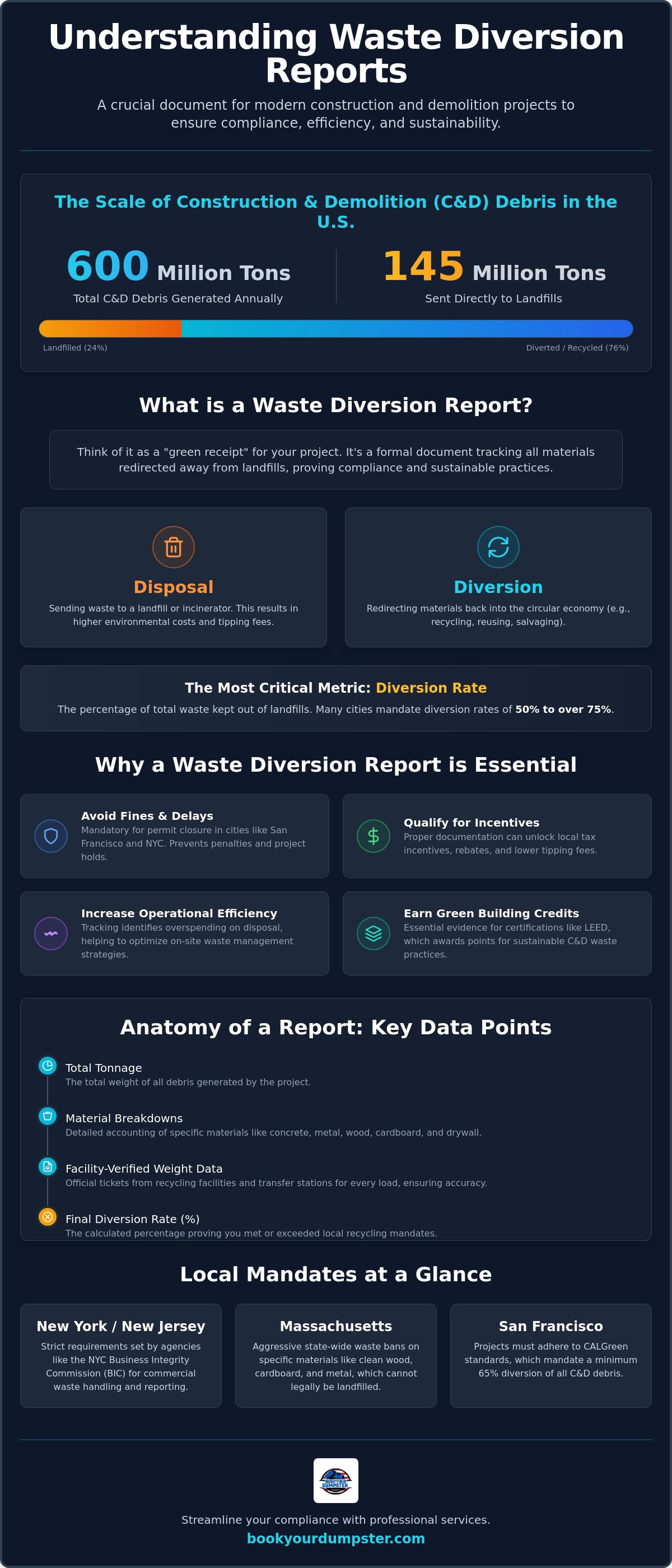
In 2018, the U.S. generated 600 million tons of construction and demolition debris, with nearly 145 million tons heading straight to landfills. Whether you're a homeowner tackling a major kitchen gut in Queens or a contractor managing a multi-unit build in San Francisco, local waste regulations are tightening. You've likely heard the term mentioned during the permitting process, but you might still wonder what is a waste diversion report and why I need one to keep your project on track. Managing a site is stressful enough without the threat of municipal fines or permit delays hanging over your head.
We understand that data collection feels like a distraction from the real work. This guide simplifies the process, showing you how these reports ensure regulatory compliance and boost your sustainability metrics. We'll look at specific mandates in New York and Massachusetts and show you how to streamline your tracking from the first dumpster delivery. Learn how to turn your project's waste into a documented asset that proves your competence to both city inspectors and future clients.
Key Takeaways
- Define the core document and its essential role in modern construction and demolition management.
- Discover why understanding what is a waste diversion report and why I need one is the key to avoiding municipal penalties and project delays.
- Learn to track essential metrics like total tonnage and material breakdowns to qualify for local tax incentives and rebates.
- Simplify your compliance by coordinating with haulers to secure facility-verified weight data for every load leaving your site.
- Optimize site organization with the right roll-off container size to ensure accurate material separation and easier reporting.
Defining the Waste Diversion Report
A waste diversion report is a formal document that tracks the exact volume of materials redirected away from landfills during a project. Think of it as a "green receipt" for your construction or demolition work. It provides a line-by-line accounting of everything you recycled, salvaged, or reused compared to what was disposed of as trash. In high-regulation zones like Queens or San Francisco, this isn't a suggestion; it's a legal requirement. If you are asking what is a waste diversion report and why I need one, start by viewing it as your primary shield against municipal fines and permit delays. It transforms messy waste data into a clean, professional asset for your business.
The Difference Between Disposal and Diversion
Understanding the report requires a clear distinction between disposal and Landfill diversion. Disposal means sending waste to a landfill or incineration facility, which often carries higher long-term environmental costs and tipping fees. Diversion is the act of redirecting materials back into the circular economy. This includes crushing concrete for road base, mulching untreated wood for landscaping, or smelting scrap metal for new manufacturing. The most critical number in your documentation is the "Diversion Rate," which represents the portion of total waste successfully kept out of landfills. Your report proves you hit the specific targets mandated by your local building department, which can range from 50% to over 75% depending on the specific city ordinances.
Who Typically Requires These Reports?
Several entities will demand this documentation throughout the project lifecycle. Municipal building departments, like the NYC Department of Buildings or the San Francisco Department of the Environment, often require a final diversion report to close out demolition permits. Green building certification bodies like LEED or GRESB use these reports to award points for sustainable practices. Even commercial clients with corporate social responsibility goals need this data to prove their projects aren't harming the environment. It is your evidence of professional competence and regulatory compliance that protects your project from being held up in the final stages of inspection.
To get this right, you need accurate data from the first day on the job. Using professional services like Book Your Dumpster USA ensures you have the right equipment on-site to keep materials separated. When your hauler provides facility-verified weights, your report becomes an airtight record of your project's impact. Don't treat this as a last-minute chore. Understanding what is a waste diversion report and why I need one gives you a competitive edge. Treat it as a tool for professional project management that protects your bottom line and ensures your site remains organized from start to finish.
Why Your Project Needs a Waste Diversion Report
Project managers often view paperwork as a hurdle. However, understanding what is a waste diversion report and why I need one is the difference between a profitable job and a legal nightmare. In cities like San Francisco or Boston, these reports are mandatory for permit closure. Without them, you risk heavy fines and blocked projects. Beyond simple compliance, these documents act as financial tools. In San Francisco, projects must adhere to CALGreen standards, which require a minimum 65% diversion of C&D debris. Failure to provide a verified report means losing your standing with city inspectors. It's a high-stakes environment where proof is the only currency.
Operational efficiency is another major driver. Landfill tipping fees continue to rise across the Northeast and Midwest. By tracking your diversion, you identify exactly where you are overspending on trash disposal. Recycling concrete or metal is often significantly cheaper than sending it to a landfill. A detailed report shows you the weight of every load, allowing you to adjust your site strategy in real-time. If you want to keep your site organized and compliant, you can schedule a roll-off dumpster with Book Your Dumpster USA. This transparency also makes you more attractive to developers who prioritize sustainability in their bidding process.
Local Mandates in NY, NJ, and MA
Regulations vary by region. In New York City, the Business Integrity Commission (BIC) sets strict requirements for how commercial waste is handled and reported. Massachusetts has implemented aggressive waste bans on materials like cardboard, clean wood, and metal; these items cannot legally enter a landfill. In Chicago, large-scale demolition projects must follow specific recycling ordinances to maintain their standing with the city. Your diversion report is the only way to prove you haven't violated these regional bans.
LEED Certification and Green Building Credits
If you are aiming for LEED v4 or v4.1 certification, your diversion report is your most important piece of evidence. The Construction Waste Management credit requires rigorous documentation of all diverted materials. You must use Qualified Facilities to ensure your diversion score is accurate and verifiable. These reports track every ton of waste by material type, ensuring you earn the maximum points available for your project. High-percentage recycling rates aren't just good for the planet; they are essential for winning green-certified bids in a competitive market. This documentation is exactly why you should understand what is a waste diversion report and why I need one before your next project breaks ground.
Anatomy of a Report: Key Metrics and Data Points
Building a compliant report requires precise data entry from the moment your first container arrives. If you've been asking what is a waste diversion report and why I need one, the answer lies in the specific data points inspectors use to verify your project's impact. A professional report is an audit trail that provides a line-by-line accounting of your site's output. You must track every ton of material to ensure your final math meets local mandates. Most reports focus on four primary metrics to determine your project's success.
- Total Weight Generated: The sum of all materials leaving the site, measured in tons.
- Material Breakdown: Specific weights for concrete, wood, metal, drywall, and organic debris.
- Destination Facilities: A list of every recycling center or landfill used, including their permit numbers.
- Final Diversion Percentage: Calculated by dividing your total diverted weight by the total generated weight and multiplying by 100.
Accuracy is non-negotiable. If your math doesn't add up or your destination facilities aren't verified, your permit could remain open indefinitely. This level of detail protects your business by proving you followed the waste management plan submitted during the initial permitting phase.
The Importance of Weight Tickets
Every roll-off dumpster pickup must have a corresponding weight ticket. These tickets are the only evidence your report has. When you review a scale ticket, look for three specific numbers: Gross, Tare, and Net weight. The Gross weight is the truck plus your debris. The Tare weight is the empty truck. The Net weight is the actual tonnage of your waste. Missing even one ticket can tank your entire diversion rate. Always keep a digital backup of these receipts. Unverified facilities or handwritten notes won't pass a municipal audit. Ensure your hauler uses certified scales to avoid discrepancies that lead to fines.
Categorizing Waste Streams Correctly
You must distinguish between source-separated and commingled recycling. Source-separated materials, like a load of pure scrap metal, are easy to track and often result in 100% diversion for that specific load. Commingled or mixed C&D loads are more complex. These go to mixed-load facilities that sort the debris for you. In these cases, you must use the facility's certified "facility-wide diversion rate" for your report. For example, if a facility has a 65% certified rate, you can only claim 65% of that load's weight as diverted. Don't forget to include salvaged materials. Reclaimed brick or timber reused on-site counts toward your diversion goal and should be documented with estimated weights and photos. For reliable equipment that helps keep these streams organized, rent a dumpster from Book Your Dumpster USA to ensure your material separation is handled correctly from the start.
How to Track and Document Waste Diversion Effectively
Effective tracking starts before the first load leaves your site. While you now understand what is a waste diversion report and why I need one for legal protection, you must implement a framework to produce it without slowing down your crew. Set a clear baseline by defining your diversion goals during the pre-construction phase. This proactive approach ensures your team knows the target percentage from day one. Coordinate closely with your hauler to ensure they provide facility-verified weight data for every load. Without these verified receipts, your final report won't hold up during a municipal audit.
On-site organization is the backbone of accurate reporting. Use separate 10 or 20-yard dumpsters from Book Your Dumpster USA for high-value recyclables like scrap metal or clean concrete. Mixing these with general debris lowers your diversion rate and increases your disposal costs. Don't wait for the project to end to check your progress. Perform ongoing auditing by reviewing your weight tickets monthly. This allows you to catch errors or contamination issues early, preventing a last-minute scramble to meet compliance numbers at the end of the job.
Best Practices for On-Site Waste Management
Success depends on clear communication across the job site. Install bold signage on every container to prevent cross-contamination from subcontractors or new hires. Train your crew members to distinguish between "clean" debris, like untreated wood, and "dirty" debris that must go to a landfill. For bulky, recyclable materials like large timber or roofing shingles, utilize 30 or 40-yard containers. These larger sizes keep the site organized and reduce the frequency of hauls, which simplifies your data collection. A clean site is a compliant site.
Digital vs. Manual Tracking
Relying on paper tickets in a busy construction environment is a major risk. Mud, rain, and lost folders can destroy your audit trail and lead to failed inspections. Digital waste management platforms streamline the reporting process by centralizing all weight data in one accessible location. Most jurisdictions, including New York and Massachusetts, require you to store this documentation for a 3-5 year audit window. Digital storage ensures you can produce these records instantly if a building department questions your project's history. Switch to digital tracking to remove logistical stress and protect your professional reputation.
Ready to simplify your project compliance? Order your next dumpster now from Book Your Dumpster USA and get the reliable service your project demands.
Streamlining Compliance with Book Your Dumpster USA
High-compliance markets like NY, NJ, IL, and MA leave no room for error. Managing a site in these zones requires a partner who understands the logistical weight of your reporting obligations. If you've moved past the stage of wondering what is a waste diversion report and why I need one, you need a service that provides verified data. Book Your Dumpster USA offers professional roll-off services designed specifically to support these strict environments. Our transparent logistics simplify the collection of disposal data. You receive the verified weight tickets and facility information necessary to close out your permits. We maintain a commitment to pricing integrity and punctuality, ensuring your commercial project remains profitable and on schedule. Our fleet provides reliable delivery of 10, 20, 30, and 40-yard dumpsters to keep your work area organized and your waste streams separated.
The Right Size for Better Diversion
Diversion strategy depends heavily on equipment selection. Use 10-yard dumpsters for heavy, single-stream materials like concrete, dirt, or brick. These smaller bins allow you to isolate heavy recyclables, which simplifies your tonnage tracking and often results in 100% diversion for those specific loads. For large-scale demolition debris, 40-yard containers provide the capacity needed to keep your site clear of bulky waste. Selecting the correct dumpster size also helps reduce transport emissions by minimizing the total number of hauls required. Proper sizing is a direct way to boost your sustainability metrics while lowering logistical stress on your crew. Strategic placement of these containers ensures that workers don't have to travel far to dispose of materials, which reduces the chance of cross-contamination in your recycling bins.
Ready to Start Your Next Project?
Efficiency is the core of our service. Our online booking system allows busy project managers to schedule deliveries in seconds, removing the need for long phone calls or manual paperwork. We offer direct access to support for commercial waste needs in Queens, San Francisco, and other high-regulation cities. When you understand what is a waste diversion report and why I need one, the next step is securing a hauler that delivers verified data alongside every bin. We act as a high-functioning tool for your project, providing the reliability you need to win more bids through green certification. Don't let paperwork stall your progress or lead to municipal penalties. Book Your Dumpster Online Today to secure your project logistics and ensure your next diversion report is airtight.
Take Control of Your Project Compliance
Successful projects require more than just quality builds. They demand rigorous documentation and a total commitment to local waste mandates. Prioritize accurate weight tickets and strict site organization to protect your business from costly municipal fines. These habits also position you as a leader in sustainable construction; a major advantage in any competitive market. Understanding what is a waste diversion report and why I need one is the first step toward a successful, compliant build.
Stop letting logistical clutter jeopardize your permits. We serve high-regulation markets across NY, NJ, IL, MA, and SF with a versatile inventory of 10, 20, 30, and 40-yard roll-off dumpsters. Use our streamlined online booking system to take command of your site logistics and secure the data integrity your project demands. Simplify your project logistics with Book Your Dumpster and ensure every ton is accounted for. Finish your project with confidence knowing your waste management is handled by experts who value your time and bottom line.
Frequently Asked Questions
Is a waste diversion report mandatory for residential renovations?
Requirement depends on your local building code and the scale of your project. Many cities now mandate these reports for residential work exceeding a specific square footage or dollar value. Check with your municipal building department to see if your permit requires a documented Construction and Demolition (C&D) plan before you begin work.
How is the diversion rate calculated for mixed-waste dumpsters?
You calculate this using the destination facility's certified diversion percentage. If you send a two-ton load to a facility with a 65% certified recovery rate, you record 1.3 tons as diverted and 0.7 tons as disposed. Always request the facility's current certification average to ensure your math stands up to a municipal audit.
What happens if my project fails to meet the required diversion percentage?
Failure to meet mandates usually results in heavy fines or the loss of your compliance deposit. In jurisdictions like Los Angeles County, you must hit specific targets to receive a refund of your upfront payment. Understanding what is a waste diversion report and why I need one is the best way to protect your project's budget from these avoidable penalties.
Can I include salvaged items in my waste diversion report?
Yes, salvaged materials are a highly effective way to boost your diversion rate. Document any reclaimed brick, timber, or architectural fixtures that you reuse on-site or donate to a non-profit. Include estimated weights and photographs in your report to prove these materials were redirected from the landfill into the circular economy.
How long do I need to keep my weight tickets for auditing?
Most jurisdictions require you to maintain these records for three to five years after project completion. Building departments often perform retrospective audits to verify the data submitted during the permit close-out process. Store digital copies of every ticket to ensure they remain legible and accessible for the duration of the required window.
Do all recycling facilities provide the data needed for these reports?
Not all facilities are equipped to provide the verified data required for legal compliance. You must use permitted facilities that offer third-party certified diversion rates to ensure your report is valid. Confirm your hauler uses these authorized sites before you schedule your first dumpster delivery to avoid unverified data gaps.
How does a waste diversion report help with LEED certification?
This report provides the primary evidence needed for the Construction Waste Management credit. It offers a detailed breakdown of all material streams, proving you met the diversion thresholds required for LEED v4 or v4.1. Without this line-by-line accounting, you cannot earn the points necessary for high-level green building certification.
What are the most common materials diverted in construction projects?
Concrete, scrap metal, and asphalt are the most frequently diverted materials because they are heavy and easily recycled. Clean wood and cardboard also contribute significantly to diversion totals when kept free of contamination. Focus on separating these high-value materials on-site to maximize your diversion percentage and reduce your overall disposal costs.


