
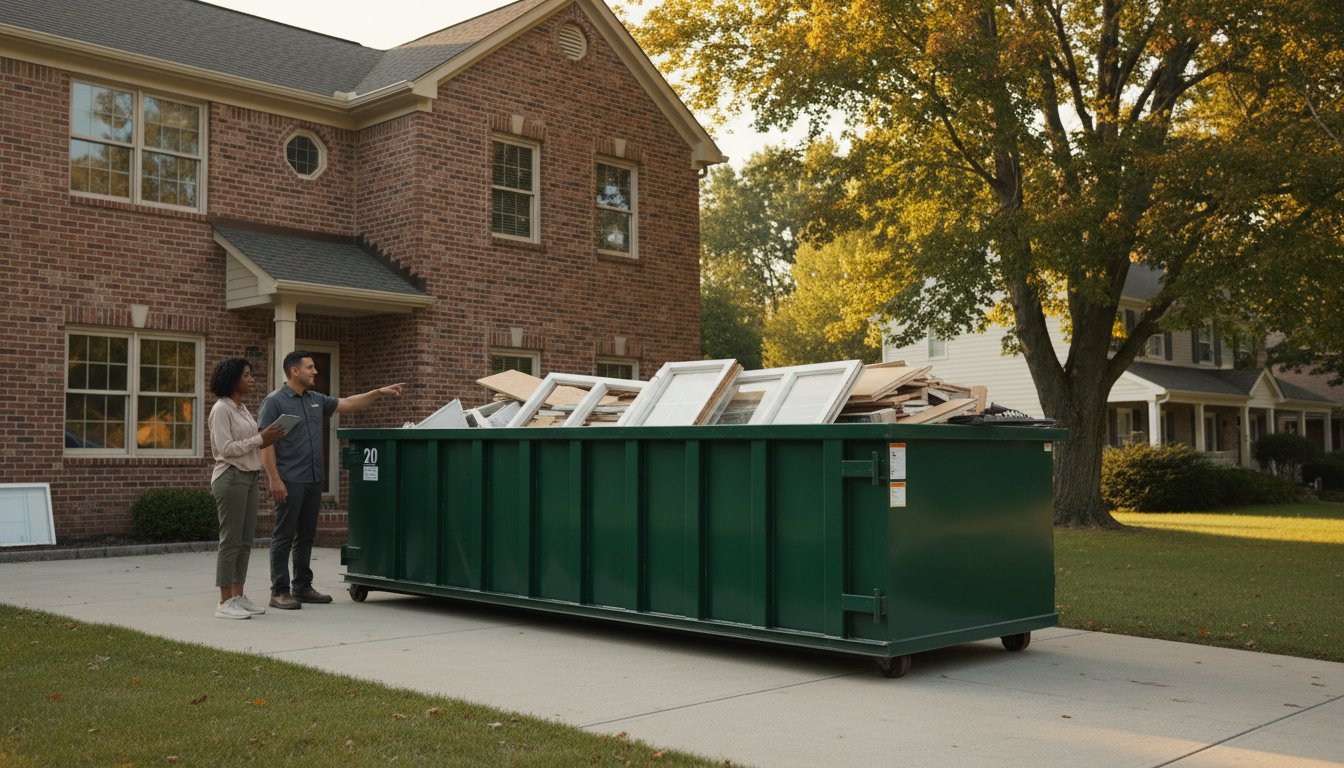
Ordering the wrong dumpster size is the fastest way to blow your renovation budget before the first wall even comes down. You want to clear the debris without swallowing your entire driveway or worrying if the 20 yard dumpster dimensions will fit your specific site. It's frustrating to juggle debris volume while navigating the complex permit laws in NYC and Chicago. We know you need reliability and a plan that keeps your project on schedule.
This guide provides the exact measurements, typically 22 feet long, 8 feet wide, and 4.5 feet high, to ensure your site is ready for a seamless delivery. Master the details of this "Goldilocks" size, which holds about 110 to 130 trash bags, while staying within the 2 to 4-ton weight limits common in New York, Illinois, and Massachusetts. We'll break down the local permit requirements and 2026 pricing trends so you can Book Your Dumpster with total confidence and zero hidden fees.
Key Takeaways
- Measure your site beyond the container's edge to ensure enough room for the delivery truck and hoist operations.
- Confirm if the 20 yard dumpster dimensions provide the right capacity for your specific debris volume without the need for a second bin.
- Identify the specific weight limits and "heavy fill" restrictions for your region to avoid unexpected disposal surcharges.
- Determine when your project requires a local permit for public right-of-way placement in cities like Boston, Chicago, or NYC.
- Streamline your logistics by learning how to book your dumpster with transparent, local pricing tailored to your state.
Understanding 20-Yard Dumpster Dimensions and Capacity
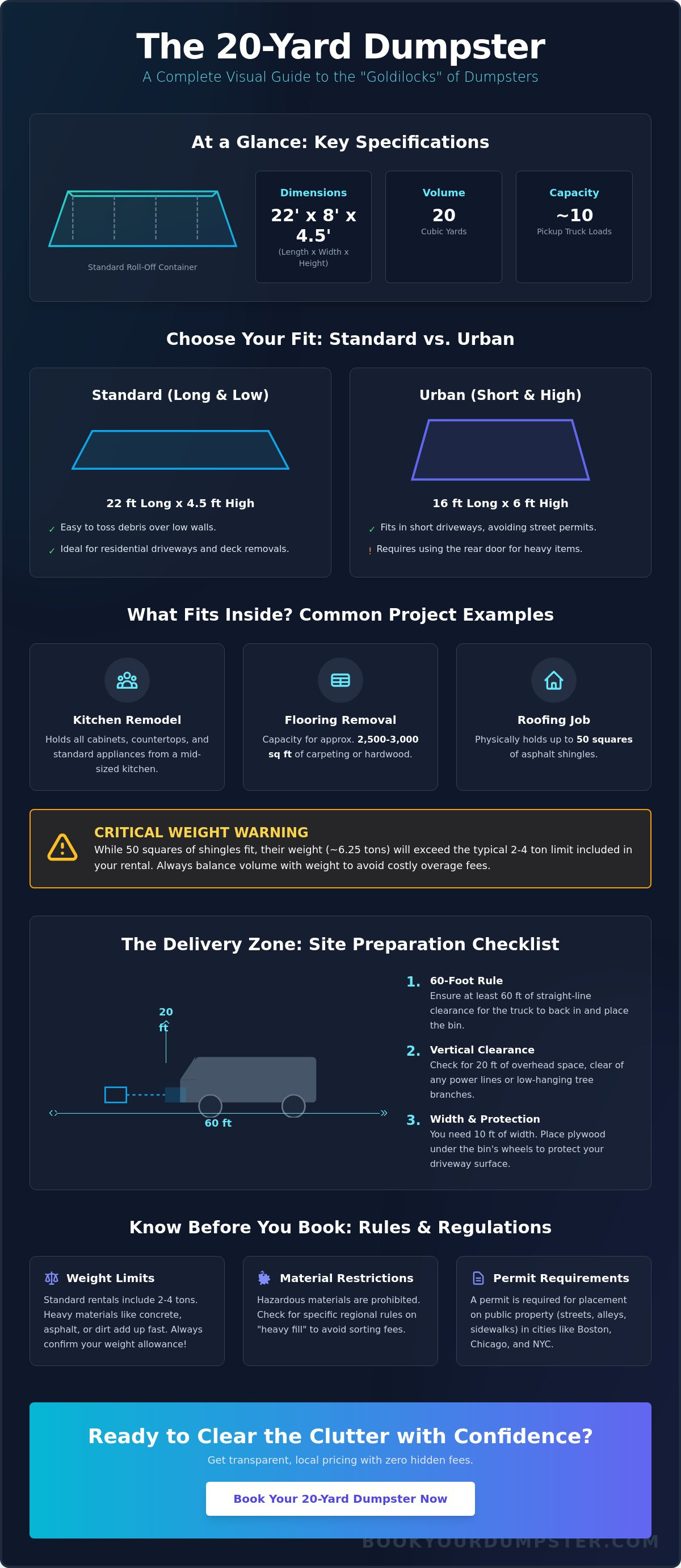
A 20-yard dumpster is the industry standard for medium-scale debris removal. It offers the ideal capacity for projects that are too large for a 10-yard bin but don't require the massive footprint of a 30-yard commercial container. One cubic yard is a volume measurement of 3 feet by 3 feet by 3 feet. A 20-yard unit holds exactly 20 of these cubes. Roll-off dumpsters in this size category typically utilize external 20 yard dumpster dimensions of 22 feet long, 8 feet wide, and 4.5 feet high. This size is equivalent to roughly 10 standard pickup truck beds or 120 to 150 large 33-gallon trash bags.
Standard vs. Low-Profile 20-Yard Containers
Not all 20-yard containers share the same shape. The standard design is 22 feet long and 4.5 feet high. This long and low profile is a favorite for residential DIYers because the low walls allow you to toss debris over the side without straining. It works perfectly for deck removals or clearing out a bulky basement. You don't have to lift heavy boards high into the air to get them into the bin.
In contrast, some suppliers provide a short and high version. These bins are often 16 feet long but stand 6 feet high. This variation is vital for urban projects in Chicago or Boston where driveway length is limited. A 16-foot footprint allows the container to sit entirely on private property, often avoiding the need for a city street permit. The trade-off is the higher wall height. This requires you to use the rear swing door to walk heavy items into the bin rather than lifting them over the side.
Visualizing Your Debris: What Actually Fits?
Knowing the volume is one thing, but seeing it in your mind is another. For a mid-sized kitchen remodel, a 20-yard dumpster accommodates all cabinets, countertops, and standard appliances like stoves or dishwashers. If you're stripping out old flooring, this bin holds approximately 2,500 to 3,000 square feet of carpeting or hardwood. It's the "Goldilocks" size for a full-room gutting project.
Roofing contractors frequently choose this size for residential jobs. A 20-yard bin can physically hold up to 50 squares of asphalt shingles. A square is a roofing term for 100 square feet of material. While the volume fits, you must watch the weight. 50 squares of shingles weigh about 12,500 pounds, or 6.25 tons. Since many 20-yard rentals in areas like Massachusetts or Long Island include a 3 to 4-ton limit, loading it to the brim with shingles will result in overage fees. Always balance the physical volume with the weight of the materials you're discarding.
Space Requirements: Will a 20-Yard Dumpster Fit Your Site?
Don't mistake the footprint for the delivery zone. While the 20 yard dumpster dimensions are roughly 22 feet by 8 feet, the truck dropping it off requires significantly more room. Think of it as a landing strip rather than a parking spot. You need at least 60 feet of straight-line clearance to allow the roll-off truck to back in, tilt the hoist, and slide the container into place. If your driveway is only 30 feet long, the bin will end up blocking the sidewalk or overhanging the street.
Vertical clearance is equally critical. The hoist mechanism on a standard roll-off truck reaches a height of 20 feet during the drop-off process. Check for low-hanging tree branches or power lines before the driver arrives. If the truck can't safely lift the rail, they'll have to abort the delivery. You also need about 10 feet of width. This provides enough space for the container itself and the stabilizer legs the truck uses to remain level during the operation.
Protect your property before the truck pulls up. In Massachusetts and New York, winter freeze-thaw cycles make asphalt brittle. A fully loaded 20-yard bin can weigh over 10 tons. Place large wooden planks or sheets of plywood where the dumpster's steel wheels will rest. This distributes the weight and prevents the bin from sinking into your driveway or cracking the concrete.
Delivery Logistics in Narrow Urban Environments
Urban projects present unique challenges. In Chicago, many deliveries happen in 16-foot wide public alleys. Drivers need precision to drop a bin without clipping a neighbor's fence. In Boston, historic brownstones often sit on narrow, one-way streets where a driveway is non-existent. NYC is even tighter. Because driveways are rare in the five boroughs, you'll likely place the bin on the street. Ensure you understand New York C&D debris regulations to ensure your street-side waste meets local standards for construction and demolition materials.
Clearance Checklist for Homeowners
Run through this list before you schedule your delivery to avoid dry-run fees:
- The 60-Foot Rule: Measure a clear, straight path from the final resting spot of the bin outward to the street.
- Overhead Obstructions: Look up. Ensure no wires or branches sit lower than 20 feet.
- Turning Radius: If the truck must turn a sharp corner to reach your driveway, it needs extra width to swing the trailer.
- Gate Width: If the bin goes behind a fence, ensure the opening is at least 10 feet wide.
Confirming these details ahead of time ensures a hassle-free experience. If you're unsure about your specific 20 yard dumpster dimensions or site layout, our team can help you evaluate the space over the phone.
Weight Limits and Material Restrictions for 20-Yard Bins
While the 20 yard dumpster dimensions provide significant volume, the weight limit is the actual ceiling for your project. Most standard rentals include a weight allowance between 3 and 4 tons, which is 6,000 to 8,000 pounds. Your rental cost is directly tied to this tonnage. It acts as a prepaid disposal fee for the weight of your debris. If the landfill scale shows you've exceeded this limit, you'll be responsible for overage fees on the back end.
Avoid the "Heavy Fill" trap. Never load a 20-yard bin with dense materials like concrete, brick, asphalt, or dirt. These materials weigh roughly 2,000 pounds per cubic yard. Filling a 20-yard bin even halfway with dirt would exceed the legal road weight limits and the truck's lifting capacity. For these projects, choose 10 yard dumpster rentals. They're specifically designed to handle the massive weight of heavy debris while remaining safe for transport.
Prohibited items are non-negotiable. Do not toss hazardous waste, liquid paints, chemicals, or tires into the container. In many Massachusetts municipalities, mattresses are now banned from standard landfills and require separate recycling. Loading these items can result in the driver refusing the pickup or the landfill charging a high contamination fee.
Estimating Your Debris Weight
Density matters more than volume. Household junk like old toys and clothes is mostly air and won't likely hit your 4-ton limit. Construction debris is different. Drywall, roofing shingles, and pressure-treated wood are heavy. If you're working in Illinois or New York, remember that rain is your enemy. Saturated debris weighs significantly more than dry material. Use a tarp to cover the bin during storms to prevent the weight of the water from triggering an overage fee. These fees typically range from $70 to $185 per ton depending on your specific 2026 local landfill rates.
Regional Material Bans (NY, IL, MA)
Local laws dictate what stays out of the bin. In Massachusetts, the Department of Environmental Protection enforces strict bans on "Easy-to-Recycle" items. This includes cardboard, glass, and electronics. New York has specific oversight for C&D debris to ensure recyclable metals are diverted from the waste stream. In Illinois, landscape waste like grass clippings and branches must be handled separately from your standard renovation debris. Check with your local provider to ensure your load is compliant before the truck arrives.
Local Regulations: Permits in New York, Illinois, and Massachusetts
Placement determines your paperwork. If your site allows the 20 yard dumpster dimensions to sit entirely on your private driveway, you generally don't need a permit. However, moving the container to a street, sidewalk, or alley triggers municipal oversight in New York, Illinois, and Massachusetts. We handle these logistical hurdles to ensure your project stays on track and compliant with local laws.
In New York City, the Department of Transportation (DOT) requires a permit for any container placed on a public street or sidewalk. Your carting company or general contractor is responsible for obtaining this permit, not the homeowner. A standard Commercial Refuse Container permit in NYC is valid for up to five consecutive days. For longer renovations, a Construction Debris Container permit covers 30 to 90 days. On Long Island, requirements vary by town, so always confirm your local village code before the truck arrives.
Chicago requires a permit for any dumpster placed on a public street, alley, or parkway. The city offers 3-day and 30-day permits to accommodate different project scales. If you can fit the bin on your private property, you'll save on these municipal fees. In Massachusetts, cities like Boston require a Street Occupancy Permit from the Public Works Department. As of May 2026, these permits cost between $50 and $150. Neglecting this step in Boston can lead to fines of $50 per day for residential projects, reaching a maximum of $1,000.
How to Apply for a Street Permit
Plan ahead to avoid delivery delays. Apply for your permit at least 5 business days before your scheduled delivery date. Most municipalities require the hauling company to provide a certificate of insurance listing the city as "Additionally Insured." This protects the city from liability while the container occupies public space. Costs vary significantly by zip code, but expect to pay more in high-density urban centers where street space is at a premium.
HOA and Local Neighborhood Rules
Even if you have the space for the 20 yard dumpster dimensions on your driveway, your Homeowners Association (HOA) might have a say. Many HOAs limit the number of days a bin can remain visible. If you're placing the bin on a public street, "save" the parking spot using traffic cones 24 hours in advance. This ensures the driver has the 60 feet of linear clearance needed to drop the load safely. For a full breakdown of how permits and location impact your total budget, see our 2026 guide to dumpster rental prices.
Ready to get started? Book your dumpster today and let our regional experts manage the permitting details for your specific location.
Booking Your 20-Yard Dumpster with Book Your Dumpster USA
Transparency is the foundation of our service. While other companies hide fees behind vague quotes, we provide "No-Surprise" pricing upfront. We calculate your costs based on the specific 20 yard dumpster dimensions you need and the local disposal rates in your zip code. As of May 2026, Book Your Dumpster USA lists a 20-yard rental in Massachusetts for $725, which includes delivery and pickup. This ensures you pay for exactly what you use. Our regional expertise across NY, IL, and MA means we understand the logistical nuances that local haulers often miss.
Speed is essential for any construction project. We offer same-day and next-day delivery options to keep your crew moving. Waiting for a bin costs you money in labor and lost time. We eliminate that friction by maintaining a robust fleet of roll-off trucks ready for immediate dispatch. Book your 20-yard dumpster online today to secure your delivery window and lock in your rate.
The Online Booking Process
Our digital-first approach respects your time. Select your size from our inventory. The 20-yard model is our most popular mid-sized option because it balances capacity with a manageable footprint. Choose your dates using our flexible scheduling tool. Whether you're a weekend warrior tackling a basement or a long-term pro managing a multi-phase build, we adapt to your timeline. Finish with our secure checkout for instant confirmation. You'll receive a clear summary of your rental period, weight allowance, and delivery instructions immediately.
Customer Support and Reliability
Reliability is our standard. Our local drivers know your neighborhood's tight corners and traffic patterns. This local knowledge guarantees on-time delivery, even in challenging urban environments. When your bin is full, just call or click to schedule a hassle-free pickup. We handle the disposal so you can focus on the next stage of your project. For contractors managing larger sites, check our Construction Debris Removal guide for advanced logistics and multi-bin strategies. We modernize the waste industry by combining straightforward honesty with digital convenience. You have waste, we have the container, and the booking happens now.
Take Control of Your Project Logistics
You now have the technical blueprint to manage your debris removal without the stress of site delays or unexpected fines. Understanding the 20 yard dumpster dimensions and the 60-foot linear clearance required ensures your delivery goes smoothly in tight urban markets like NYC or Chicago. Remember to balance your debris volume with the 3 to 4-ton weight limits common in the Northeast and secure your municipal permits at least five business days in advance. These simple steps prevent the logistical headaches that often stall medium-scale renovations.
Book Your Dumpster USA has served New York, Illinois, and Massachusetts since 2018. We maintain an A+ rated local service by providing transparent pricing with no hidden fees and on-time delivery guarantees. Our regional experts are ready to help you navigate specific city requirements so you can stay focused on the job at hand. Don't let waste pile up and slow you down. Take command of your job site today.
Book Your 20-Yard Dumpster Now and experience the most reliable waste management solution in the industry. Let's get your project finished on schedule.
Frequently Asked Questions
How much weight can a 20-yard dumpster hold?
A 20-yard dumpster holds between 2 and 4 tons of material. This equals 4,000 to 8,000 pounds. While the 20 yard dumpster dimensions provide ample volume, heavy items like roofing shingles or drywall reach this weight limit quickly. If you're disposing of concrete or dirt, you must use a smaller 10-yard bin to avoid exceeding legal road weight limits and truck lifting capacities.
Will a 20-yard dumpster damage my driveway?
Yes, the weight of a loaded bin can crack asphalt or concrete if you don't take precautions. A fully loaded 20-yard container can weigh over 10 tons. Protect your property by placing 2x4 wooden planks or sheets of plywood on the delivery spot. This simple step distributes the pressure and prevents the steel wheels from sinking into your driveway during summer heat or winter thaws.
Do I need a permit for a 20-yard dumpster in Chicago?
You only need a permit in Chicago if the dumpster sits on a public street, alley, or sidewalk. No permit is required for placement on private property like your driveway. If you must use the public way, you'll need to secure a 3-day or 30-day permit from the city. Always confirm placement with your driver before delivery to avoid costly municipal fines and project delays.
What is the height of a 20-yard dumpster?
The standard height is 4.5 feet. This low profile makes it easy to toss debris over the sides without straining. However, you need 20 feet of vertical clearance for the truck's hoist to operate safely. Check for low tree branches or power lines before the truck arrives. Knowing the 20 yard dumpster dimensions helps you prepare a safe delivery zone without any overhead obstructions.
Can I put a mattress in a 20-yard dumpster in Massachusetts?
You cannot put mattresses in a dumpster in Massachusetts due to strict Department of Environmental Protection (DEP) recycling mandates. As of 2022, mattresses and box springs are banned from landfills and must be sent to specialized recycling facilities. If you include them, the hauler may refuse the load or pass along high contamination fees. Check with local recyclers for separate mattress disposal options in your town.
How many tons are included in a 20-yard dumpster rental?
Most rental agreements include 3 to 4 tons of disposal weight in the base price. This covers the majority of residential cleanouts and medium renovations. If your load exceeds this limit, you'll pay an overage fee for every additional ton. These fees typically range from $70 to $185 per ton depending on the specific landfill rates in your region. Always track your debris weight to stay within your budget.
Is a 20-yard dumpster big enough for a whole house cleanout?
This size is ideal for a 1,500 to 2,500 square foot home cleanout. It holds about 6 to 8 pickup truck loads or up to 130 large trash bags. If you're gutting an entire house or clearing out a large estate with heavy furniture, you might need a 30-yard bin. For standard basement, attic, or garage purges, the 20-yard size is the most efficient choice for most homeowners.
What happens if I overfill my 20-yard dumpster?
Overfilling creates a major safety hazard for the driver and other motorists. Debris must be level with the top of the bin. If items stick out over the rim, the driver will refuse to pick up the load until you remove the excess material. You'll also face a dry-run fee for the failed pickup attempt. Always distribute weight evenly and keep the load below the top rail for a safe haul.


