
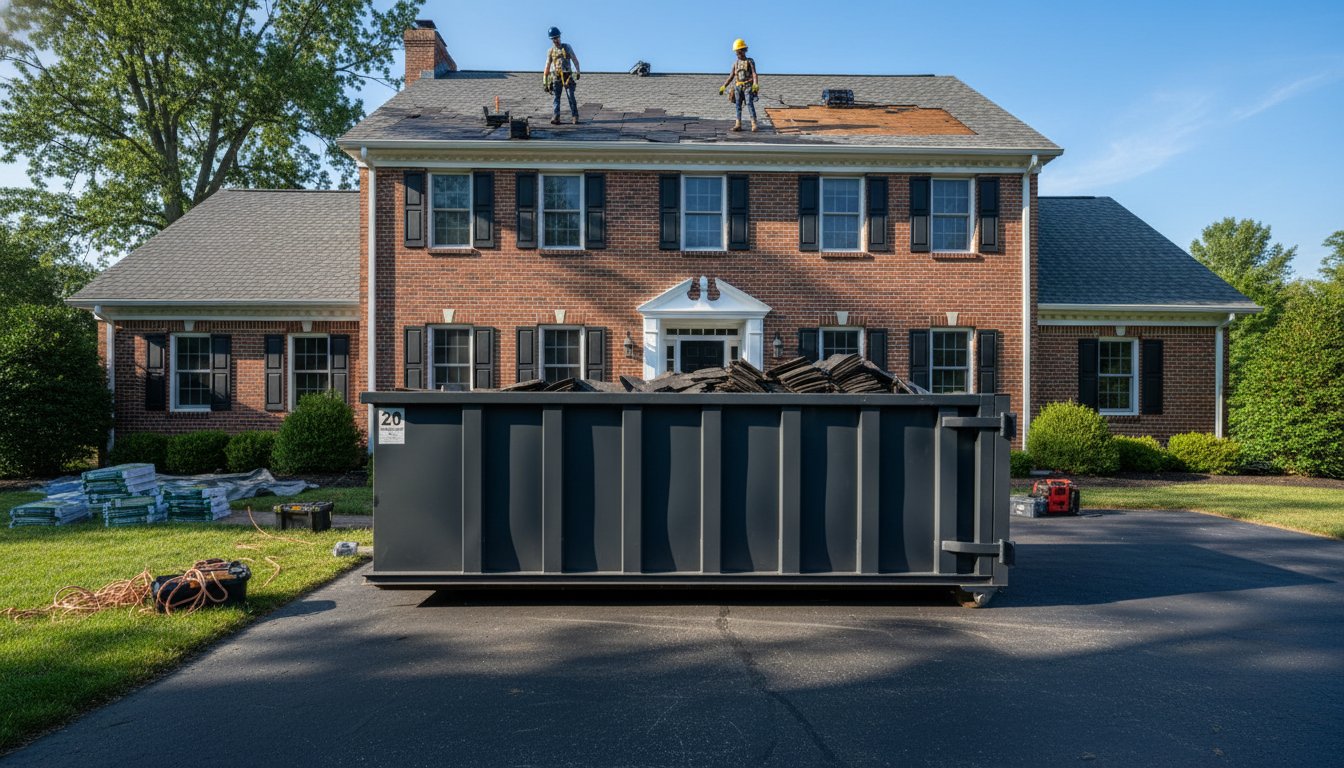
The largest dumpster available is often the most expensive mistake you can make on a roofing job. While a 30-yard bin offers more space, it is the quickest way to exceed weight limits and trigger a $200 per ton overage fee. A 20 yard dumpster for roofing shingles is the industrial standard because it maximizes volume without hitting the dead weight limits that plague larger containers. You need a reliable rental that arrives on time and respects your budget, especially when architectural shingles weigh up to 300 pounds per square.
You want to finish your tear-off without the disposal cost doubling due to weight limits or complex permit rules in cities like Chicago or NYC. This guide explains exactly how many roofing squares fit into a 20-yard container and how to manage disposal in New York, Illinois, and Massachusetts. We will break down the shingle-to-dumpster math and state-specific regulations so you can book your dumpster with total confidence. Learn how to avoid hidden fees, handle state-specific waste requirements, and ensure your project stays compliant from start to finish.
Key Takeaways
- Understand why the 20-yard container is the industry standard for weight management and why larger bins often lead to expensive overage fees.
- Learn the precise math to calculate how many squares of 3-tab or architectural shingles will fit in a 20 yard dumpster for roofing shingles.
- Determine if your specific tear-off project requires a full-size 20-yard rental or if a 10-yard bin is sufficient for smaller garage repairs.
- Discover essential loading techniques to protect your property and ensure a safe, balanced pickup by the roll-off driver.
- Navigate the specific waste regulations and permit requirements for roofing debris across New York, Illinois, and Massachusetts.
Why the 20 Yard Dumpster is the Standard for Roofing Projects
A standard 20 yard dumpster for roofing shingles typically measures 22 feet long, 8 feet wide, and 4.5 feet high. These dimensions serve a specific purpose in the waste industry. While larger 30-yard or 40-yard containers exist, they are rarely used for roofing tear-offs. Asphalt shingles are "heavy debris." They consist of dense layers of asphalt, fiberglass, and ceramic granules. A single square (100 square feet) of 3-tab shingles weighs between 150 and 200 pounds, while architectural shingles range from 200 to 300 pounds per square. Most Roll-off dumpsters are restricted by the hydraulic lift capacity of the delivery truck. If you fill a larger bin with shingles, the truck might not be able to pull it onto the bed, leaving you with a container that is impossible to remove without manual unloading.
Contractors in Chicago and homeowners in New York rely on the 20-yard size because it balances volume with transportability. In dense urban areas like NYC, street permits are often required for dumpster placement. A 20-yard bin fits within a standard parking space, making it easier to secure local approval. It provides enough room for a full residential roof replacement without the risk of the container becoming an immovable anchor on your property. Stick to this size to keep your project moving and your site clean.
Understanding Weight vs. Volume in Roofing
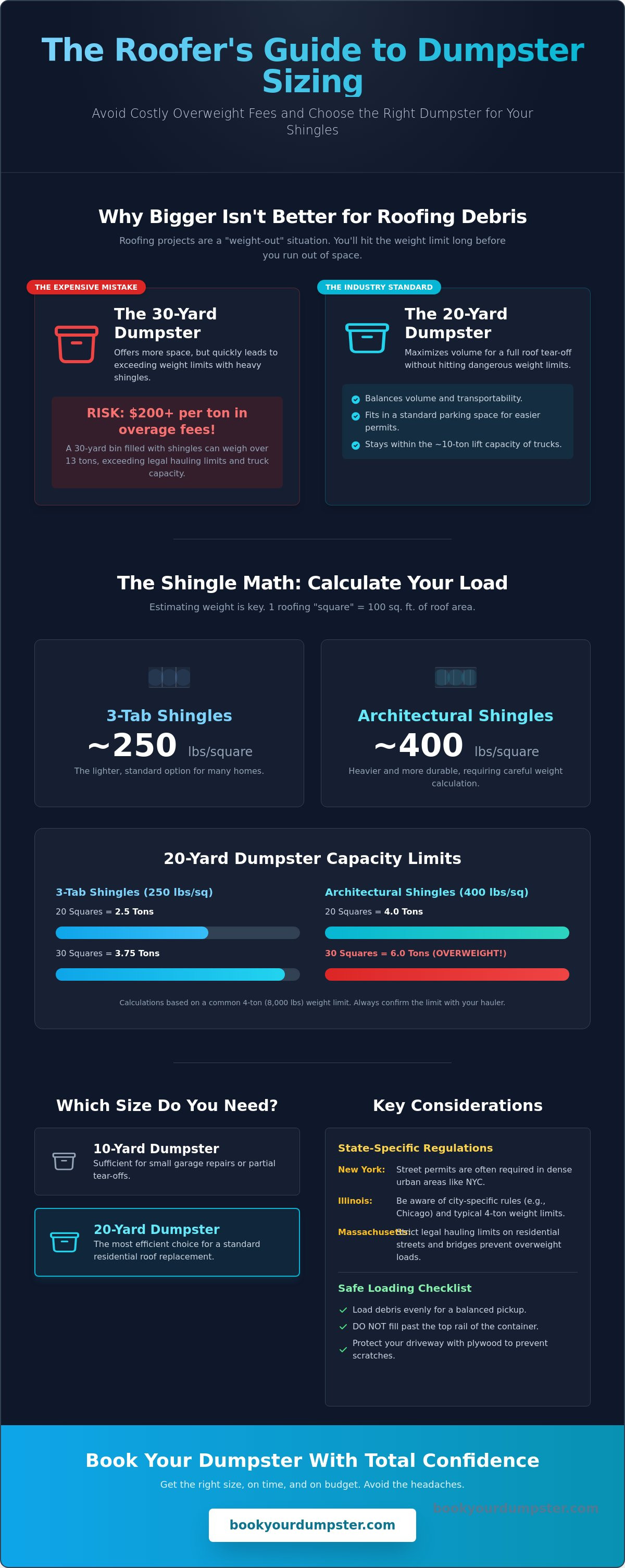
Roofing projects create a "weight-out" situation. In a typical house cleanout, you run out of physical space long before you hit the weight limit. With shingles, you will hit the weight limit while the dumpster still looks half empty. A 30-yard bin filled with architectural shingles could weigh over 13 tons. This weight exceeds the legal hauling limits for residential streets and bridges in Massachusetts and Illinois. If a hauler attempts to transport an overweight load, they face heavy fines, which they will pass directly to you. Choosing a 20-yard bin prevents these legal and financial headaches. It ensures the load stays within the 10-ton maximum capacity of most heavy-duty roll-off trucks.
20 Yard Dumpster Capacity for Shingles
Use a reliable rule of thumb for your calculations: one cubic yard of dumpster space holds 2 to 3 roofing squares. A 20 yard dumpster for roofing shingles safely accommodates 25 to 30 squares of debris. This includes the shingles, felt paper, and nails. If you are unsure how this compares to other container types, review our resource on roll off dumpster rental for a deeper dive into size comparisons. For a standard 2,500-square-foot home in suburban Illinois or Massachusetts, a 20-yard bin is the most efficient choice. It handles the entire tear-off in one trip, saving you from the cost of multiple deliveries. Schedule your delivery early to ensure the bin is on-site before the first shingle hits the ground.
Calculating Your Shingle Load: How Much Fits?
Estimating the weight of a tear-off is the difference between a smooth job and a massive overage fee. One square of roofing covers 100 square feet. Standard 3-tab shingles weigh between 230 and 250 pounds per square. If you upgrade to architectural shingles, the weight jumps to 350 or 400 pounds per square. This material is dense. It doesn't just take up space; it exerts massive pressure on the container and the truck's hydraulics. You must also account for secondary debris. Felt paper, flashing, and cedar shakes add bulk. Even the thousands of nails used in a typical install contribute to the final tonnage. Adhering to EPA waste regulations is essential when disposing of these materials to ensure environmental compliance and proper debris management.
Shingle Weight Chart for 20 Yard Bins
A 20 yard dumpster for roofing shingles has a weight limit that varies by region. For example, a 20-yard rental in the Lower Hudson Valley of New York often comes with a 2.25-ton limit, while a similar bin in Barrington, Illinois, includes 4 tons. Use these estimates to stay within your limit:
- 3-Tab Shingles (250 lbs/sq): 20 squares = 2.5 tons; 30 squares = 3.75 tons.
- Architectural Shingles (400 lbs/sq): 20 squares = 4 tons; 30 squares = 6 tons.
- Slate or Tile: These materials are extremely heavy and often require specialized "low-boy" containers rather than a standard 20-yard bin.
Always include a 10% safety buffer in your math. It's better to have extra space than to pay $85 per ton for an overweight load in Illinois or up to $200 per ton in other regions. In 2023, approximately 318,800 residential roofs were recycled into asphalt pavement, so check if your local facility accepts "clean" shingle loads for a lower rate.
The Multi-Layer Factor
Check your roof's edge before you order. If you see multiple layers of shingles, you are doubling or tripling the weight of your debris. A 20 yard dumpster for roofing shingles might handle a 30-square roof with a single layer, but it will only hold about 10 squares if there are three layers. Overfilling a container is a safety hazard. In New York and Illinois, trucks face strict roadside inspections. If the load is over the legal limit, the driver cannot pick it up. You'll be stuck paying a dry-run fee and manually removing shingles until the weight is legal. If you aren't sure about your roof's layer count, check our local availability before booking your delivery to ensure you have the right capacity for the job.
20 Yard vs. 10 Yard Dumpsters: Which to Choose?
Selecting the right container size determines your project's pace. A 10-yard bin might seem like a budget-friendly choice, but it often fails on standard residential tear-offs. For minor repairs or small outbuildings, a 10 yard dumpster rental is a logical choice. However, for a full home roof replacement, the 20 yard dumpster for roofing shingles is almost always the superior investment. It provides the necessary volume to handle a standard tear-off in a single trip, preventing the logistical nightmare of a mid-project swap.
When the 10-Yard is Sufficient
Small-scale projects are the primary use case for 10-yard containers. If you are stripping a shed, a single-car garage, or performing a partial repair under 10 squares, this size works well. It is particularly useful in dense urban areas like Boston or New York City where driveway space is a luxury. A 10-yard bin has a smaller footprint, making it easier to place in tight alleys or narrow residential lots. While the initial price is lower, the risk of needing a "swap" service is high. If your debris exceeds the weight limit, you will pay for a second haul. This doubles your delivery costs and creates downtime for your crew. While the truck is at the landfill, shingles often pile up on the lawn, which can damage the grass and landscape.
Why the 20-Yard Wins for Most Roofs
The average residential roof in the United States spans between 1,700 and 2,000 square feet. This translates to 17 to 20 squares of debris. A 10-yard bin cannot physically contain this volume once the shingles are torn off and mixed with air. A 20 yard dumpster for roofing shingles provides the necessary headroom for the shingles plus underlayment, flashing, and damaged plywood. Loading efficiency is another major factor. Most 20-yard bins feature side walls around 4.5 feet high. This height allows roofing crews to toss bundles over the side with minimal effort. Taller 30-yard bins often require workers to lift heavy, abrasive debris over their heads. This increases the risk of injury and slows down the job. Following OSHA's guidelines on waste material disposal ensures your site stays safe and compliant during this process. Ton-for-ton, the 20-yard container offers the best value. It eliminates the need for multiple swaps and keeps your labor costs down by streamlining the disposal process. Choose your size based on your total square count to avoid logistical delays. If you are ready to start, book your dumpster today to lock in your delivery date.
How to Load and Manage Your Roofing Dumpster
Loading your container correctly is just as important as choosing the right size. For a 20 yard dumpster for roofing shingles, start with a solid foundation. Place the dumpster on a flat, level surface. In Illinois and Massachusetts, winter conditions make driveways brittle or slick. Always lay down 2x4 boards or thick plywood before the truck arrives. This prevents the heavy steel rollers from cracking your asphalt or concrete under the pressure of several tons of debris.
Follow these steps for an efficient load:
- Use the swing door: Open the rear door and walk the first 50% of your debris directly into the bin. This saves your crew from lifting heavy bundles over the 4.5-foot walls.
- Distribute weight evenly: Stack shingle bundles from front to back. If the weight is concentrated at the front, the truck's hoist may struggle to lift the container, leading to a failed pickup.
- Maintain a level load: Keep all debris below the top rim. In New York and Massachusetts, haulers must tarp every load. If shingles poke out above the top, the driver cannot legally transport the bin.
- Manage the shingle slide: Shingles are slippery. As you pile them up, they tend to slide toward the door. Secure the door tightly before the bin gets too full to avoid spillages.
Local Permitting and Placement Rules
State and city regulations vary significantly. In Chicago, if you can't fit the bin on your private property, you must obtain a "Right of Way" permit from the city to place it on the street. New York City follows similar strict protocols, requiring a NYC DOT permit for any public street placement. Failure to display a valid permit results in immediate fines and the potential removal of the container at your expense.
Massachusetts presents a unique challenge due to the MassDEP waste ban on certain materials. Asphalt shingles are often classified as restricted waste that must be diverted to specific recovery facilities rather than standard landfills. Ensure your rental provider is aware of these local mandates to avoid compliance issues. For more site safety and management strategies, read our guide on construction debris removal. If you're ready to secure a container that meets all local standards, book your 20-yard dumpster now to stay on schedule.
Safety and Property Protection
Protecting your driveway is a non-negotiable step. Heavy roofing debris causes "spiderweb" cracks in older pavement. Use street pads or heavy-duty plywood to distribute the weight of the 20 yard dumpster for roofing shingles. This is especially critical in the Lower Hudson Valley and suburban Chicago where extreme temperature swings weaken driveway surfaces. Keep a clear perimeter around the bin to prevent accidents during the tear-off process. A clean site is a safe site, and proper loading is the first step toward a successful project resolution.
Book Your 20 Yard Roofing Dumpster in NY, IL, and MA
Book Your Dumpster USA provides the logistical support you need for a successful tear-off. We understand the specific demands of roofing projects in New York, Illinois, and Massachusetts. A 20 yard dumpster for roofing shingles is the most requested size for our contractor partners and residential DIYers alike. We focus on reliability and transparency so you can focus on the roof. Our fleet is ready to deploy to your site with the punctuality required to keep your crew working. There is no reason to let waste management become a bottleneck for your project.
Transparent Pricing in Your Region
We eliminate the guesswork from waste management with a verbal handshake of integrity. Our flat-rate pricing for shingles in Chicago, Boston, and the Lower Hudson Valley includes the delivery, pickup, and a predetermined weight allowance. You won't face the hidden surcharges common in the industry. For current rates and detailed breakdowns by state, consult our guide on dumpster rental prices. As of April 2026, roofing-specific 20-yard rentals typically range from $400 to $700 depending on the specific tonnage limit. If you exceed the limit, we clearly state the per-ton overage fee upfront. In Barrington, Illinois, this fee is approximately $85 per ton, while other regions may reach $200. We provide the facts before you book so your budget stays intact.
Compliance and Regional Expertise
We handle the regional compliance details so you don't have to. This includes managing the MassDEP waste bans in Massachusetts, which require asphalt shingles to be diverted to recovery facilities. Our team knows the local landscape. We ensure C&D debris reaches permitted facilities in New York and provide the necessary documentation for contractor bids in Illinois. By choosing a partner who understands these regional nuances, you avoid the risk of legal fines or rejected loads at the landfill. In 2023, the equivalent of 318,800 residential roofs were recycled into asphalt pavement, and we prioritize these circular economy initiatives whenever local infrastructure allows.
Ready to Start Your Roofing Project?
Efficiency is our priority. Our online booking system allows you to schedule your 20 yard dumpster for roofing shingles in under five minutes. Choose your size, select your delivery date, and provide your drop-off instructions. We offer same-day or next-day delivery across our service areas to prevent project delays. Whether you're a commercial roofer in Chicagoland or a homeowner in Central Massachusetts, we have your roofing waste under control. Our drivers are professional, our bins are clean, and our pricing is honest. Book your dumpster today and experience a hassle-free rental process from start to finish.
Get Your Roofing Project Moving Today
Successful roofing disposal comes down to two factors: accurate weight estimation and reliable container delivery. You now have the math to calculate your load and the strategies to protect your property during the tear-off. By choosing a 20 yard dumpster for roofing shingles, you avoid the "weight-out" risks of larger bins and the high costs of multiple swaps. Loading the bin correctly ensures compliance with road laws in New York and Massachusetts while keeping your site safe and your crew efficient.
Serving New York, Illinois, and Massachusetts since 2018, Book Your Dumpster USA provides the professional support needed for high-velocity construction projects. We eliminate the stress of hidden fees by offering transparent, flat-rate pricing. Our fleet ensures on-time delivery so your roofing crews never have to wait for a container. Don't let waste management slow down your progress or inflate your budget with unexpected overage charges. We handle the logistics so you can focus on the craftsmanship.
Book your 20-yard roofing dumpster online now to secure your project date. We have your waste management under control so you can focus on the finish line. Your clean job site is just a few clicks away.
Frequently Asked Questions
How many squares of shingles fit in a 20-yard dumpster?
A 20 yard dumpster for roofing shingles typically holds 25 to 30 squares of standard 3-tab shingles. If your project involves heavier architectural shingles, the capacity decreases to approximately 20 squares to stay within weight limits. Always account for the number of layers on the roof before ordering. A double-layer roof effectively halves the square footage a single bin can accommodate.
Can I put other roofing materials like flashing and gutters in the same dumpster?
Yes, you can include flashing, gutters, and underlayment in the same container. These materials are standard construction debris and are accepted at most facilities in Illinois and New York. Flatten gutters and long metal pieces to prevent "air pockets" from wasting space. If you have a large volume of metal, consider separate recycling to potentially reduce your total disposal costs.
Do I need a permit for a 20-yard dumpster in Chicago or New York City?
You must obtain a permit if the dumpster is placed on a public street or sidewalk in Chicago or New York City. Chicago requires a "Right of Way" permit, while the NYC DOT handles street permits in New York. If the container stays entirely on your private driveway, a permit is generally not required. Check your local municipal website to avoid fines that often exceed $100 per day.
What happens if my roofing dumpster is overweight?
An overweight dumpster triggers additional per-ton fees and may lead to a failed pickup. If the load exceeds legal hauling limits, the driver will leave the bin on-site, and you will pay a dry-run fee. You must then manually remove debris until the weight is legal. Overage fees range from $40 to $200 per ton depending on the specific regulations in your county or state.
Are asphalt shingles recyclable in Massachusetts or New York?
Asphalt shingles are recyclable at specialized C&D recovery facilities in both Massachusetts and New York. The MassDEP has specific waste bans that encourage the diversion of shingles from landfills to recycling centers. While less than 10% of shingles are recycled nationwide, using a 20 yard dumpster for roofing shingles for "clean" loads makes recycling easier. Check with your provider for local recycling-only bin options.
How long can I keep the 20-yard dumpster on my job site?
Standard rental periods typically range from 5 to 10 days. In Horseheads, New York, a 7-day rental is the standard, while some Massachusetts providers offer shorter 72-hour windows. You can usually extend your rental for a daily fee of $25 to $50. Schedule your pickup through our online portal as soon as your crew finishes the tear-off to avoid unnecessary daily charges.
Will a 20-yard dumpster damage my driveway?
Heavy roll-off containers can crack asphalt or concrete if they are not supported correctly. Prevent damage by placing 3/4-inch plywood or 2x4 boards under the dumpster's steel wheels before delivery. This is a critical step in Illinois and Massachusetts where seasonal temperature swings make pavement more brittle. Protecting the surface ensures your property remains in good condition after the debris is hauled away.
Can I mix shingles with regular household trash in the same bin?
Do not mix household trash with roofing shingles. Disposal facilities charge different rates for construction debris versus municipal solid waste. Mixing these materials often results in the entire load being reclassified at a higher price point. Keep your shingles separate to ensure transparent pricing and compliance with state waste regulations. Book a separate smaller bin if you have significant amounts of household junk to discard.


