

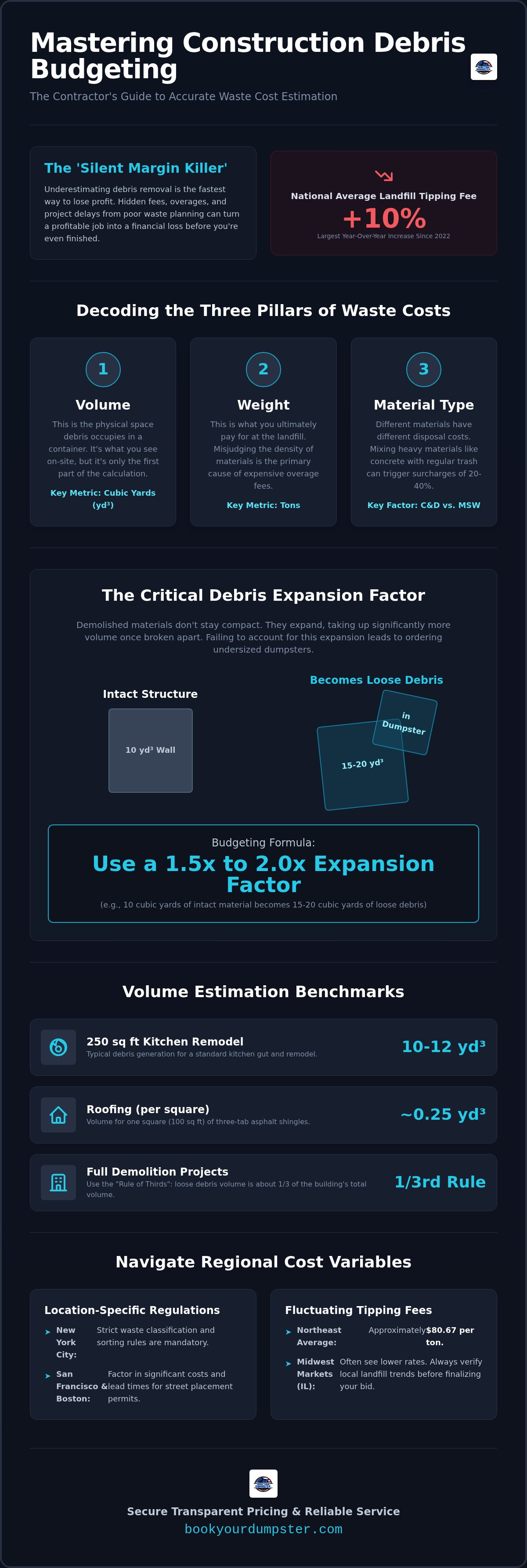
The national average landfill tipping fee recently jumped by 10 percent, marking the largest year-over-year increase since 2022. This spike means that mastering how to budget for debris removal in a construction bid is now the difference between a profitable project and a financial loss. You've likely felt the sting of hidden fees or underestimated the crushing weight of concrete debris during a final haul. It's a common pain point that eats away at your margins before the job is even finished.
We understand that managing waste logistics is a pragmatic, labor-intensive part of the business that demands precision. This guide provides the exact formulas and logistical insights you need to price debris removal accurately every time. You'll learn how to navigate regional permit costs and shifting regulations in high-demand areas like San Francisco or New York. We'll also help you determine whether a 10-yard or 40-yard dumpster is the most cost-effective choice for your specific project scale. Stop guessing at your waste costs and start bidding with total confidence.
Key Takeaways
- Learn to differentiate between volume and weight to avoid the "silent margin killer" of heavy material overage fees.
- Discover the step-by-step formula for how to budget for debris removal in a construction bid using the 1.5x to 2.0x Debris Expansion Factor.
- Compare the logistical flexibility of on-site roll-off containers against the high labor costs associated with full-service hauling crews.
- Leverage transparent online booking systems to secure firm, all-in quotes that safeguard your project's bottom line.
- Understand why material classification is critical for meeting regional recycling ordinances and avoiding expensive landfill surcharges.
Why Debris Removal Budgeting is the 'Silent Margin Killer' in Construction Bids
Underestimating waste is the fastest way to bleed profit on a job site. A simple $500 miscalculation in tipping fees can quickly snowball into thousands of dollars in overage charges and lost labor hours. Many contractors rely on a "flat percentage" to estimate waste costs, but this approach is dangerous. It fails to account for the massive density differences in demolition waste composition across different project types. A roofing tear-off or a masonry remodel generates weight that far exceeds standard drywall or framing debris. If you want to protect your bottom line, you must master how to budget for debris removal in a construction bid using material-specific data rather than broad estimates.
Unmanaged waste also kills project velocity. When debris piles up, your crew spends more time navigating obstacles and less time performing billable work. A cluttered site is a slow site, and a slow site is an expensive one. Beyond labor efficiency, poor waste management introduces significant safety and insurance risks. Tripping hazards and fire load increases can lead to avoidable claims that erase your remaining margins. Secure a reliable dumpster partner to keep the site clear and the project moving on schedule.
Regional Regulatory Impacts in NY, MA, and IL
Regulations vary wildly by geography. In New York City, strict waste classification rules require meticulous sorting and specific disposal paths. If you're bidding in San Francisco or Boston, factor in the cost and lead time for street-placement permits. These costs are often overlooked in the initial bid but are non-negotiable for compliance. Tipping fees also fluctuate by region. While the Northeast averages approximately $80.67 per ton, Illinois and other Midwest markets often see lower rates. Always verify local landfill trends before finalizing your numbers.
The True Cost of Project Delays
Calculate the cost of labor downtime. If your crew stops working because the bins are full and the site is blocked, you're paying for zero productivity. This downtime is a direct result of poor logistical planning. Scheduling consistent roll-off swaps ensures your team stays focused on construction. Think of a reliable dumpster partner like Book Your Dumpster USA as a bid-protection strategy. By securing transparent pricing and firm delivery schedules, you remove the logistical variables that threaten your project's profitability. Don't let waste be the reason you finish a project in the red.
Decoding the Three Pillars of Construction Waste Costs
Accurate bidding requires you to look beyond the physical space a dumpster occupies. You must calculate costs based on three distinct pillars: volume, weight, and material type. When learning how to budget for debris removal in a construction bid, remember that volume is what you see on the site, but weight is what you pay for at the scale. Misjudging this relationship leads to overage fees that quickly erode your project's profitability.
The expansion factor is a critical variable. Materials don't stay compact once they're demolished. For instance, ten yards of an intact interior wall can easily expand into 15 yards of loose debris once it's in the container. To master these conversions, consult FEMA's Debris Estimating Field Guide for reliable density and volume ratios. Precise volume estimation prevents you from ordering a 20-yard dumpster when a 40-yard unit is actually required for the load.
Material classification also dictates your final bill. Construction and Demolition (C&D) waste is handled differently than Municipal Solid Waste (MSW). Avoid the common surcharge trap of mixing materials. Landfills often charge 20 to 40 percent more for loads containing concrete or masonry mixed with standard trash. Keep these streams separate to maintain your budget integrity. If you need a specific container for heavy materials, you can view available dumpster sizes to match your project's specific waste stream.
Estimating Volume by Project Type
For a typical 250-square-foot kitchen remodel, expect to generate approximately 10 to 12 cubic yards of debris. When bidding roofing jobs, remember that one square of three-tab shingles typically equates to about 0.25 cubic yards of waste. For full demolition projects, use the "Rule of Thirds." This method suggests that the loose debris volume will be roughly one-third of the total building volume. These benchmarks help you determine if you need a 10-yard starter bin or a larger commercial container.
Understanding Tipping Fees and Weight Limits
The tipping fee is the cost charged by a disposal facility to unload waste, usually calculated per ton. As of August 2026, the national average landfill tipping fee has reached $62.28 per ton. This represents a significant 10 percent increase from the previous year. Regional variations are sharp; the Northeast currently sees averages around $80.67 per ton. To avoid overweight penalties, know your limits before you load. A weight limit is the pre-negotiated tonnage included in a rental price. Understanding these limits is a cornerstone of how to budget for debris removal in a construction bid without facing back-end surprises.
Roll-Off Dumpsters vs. Full-Service Hauling: Which Fits Your Bid?
Choosing the right removal method is a logistical decision that directly impacts your labor budget. When you analyze how to budget for debris removal in a construction bid, you must weigh the upfront cost of a rental against the hidden labor expenses of a hauling crew. Full-service haulers charge for both disposal and the time their team spends on your site. For larger commercial bids, this labor premium often makes hauling significantly more expensive than managing the waste yourself with a roll-off container.
Flexibility is the primary advantage of a roll-off. Having a bin on-site for the duration of the project allows your crew to load debris as it's generated. This prevents waste from piling up and eliminates the need for "double handling" where workers move debris once to a pile and again to a truck. In tight urban environments like Queens or Boston, space is at a premium. Mastering how to budget for debris removal in a construction bid in these areas requires choosing smaller, more manageable containers like a 10-yard dumpster. These units provide the necessary capacity without blocking critical site access or incurring excessive street permit fees.
The Cost-Efficiency of Self-Managed Dumpsters
Using a roll-off dumpster removes the "wait time" fees common with hauling services. You aren't paying an external crew to sit in traffic or wait for your team to finish a specific demolition phase. Self-managed bins also allow for real-time waste sorting. By separating high-density materials like concrete from general trash on-site, you can avoid the 20 to 40 percent surcharges associated with mixed loads. For contractors who need reliable scheduling and transparent roll-off pricing, Book Your Dumpster USA offers a streamlined booking system that fits perfectly into a professional bidding workflow.
When to Outsource to a Hauling Service
There are specific scenarios where outsourcing makes sense. If a site is too narrow for a roll-off truck to navigate, a smaller hauling vehicle might be your only option. Outsourcing is also useful for ultra-fast, one-day cleanouts where you need the debris gone immediately and don't have the internal labor to spare. However, always compare the overhead of professional hauling against the cost-efficiency of a 20-yard or 30-yard dumpster. In most construction scenarios, the ability to control your own waste timeline leads to better project velocity and protected margins.
Step-by-Step Calculation Guide for Construction Bids
Precision in your estimates prevents profit leaks. While automated tools offer quick guesses, understanding how to budget for debris removal in a construction bid requires manual verification of the math. Follow this five-step process to ensure your waste management line item is bulletproof.
- Step 1: Inventory the materials. Identify exactly what you're tearing out. Density dictates your disposal costs more than physical dimensions. A pile of lumber takes up space, but a single pallet of concrete debris can trigger heavy-load surcharges.
- Step 2: Apply the Debris Expansion Factor. Solid materials take up significantly more room once they are broken apart. Most construction debris requires a multiplier of 1.5x to 2.0x to account for this change in density.
- Step 3: Select the optimal container size. Match your calculated volume to the right bin. Use a 10-yard dumpster for small bathroom guts and scale up to 40-yard units for major commercial demolition.
- Step 4: Factor in local logistical overhead. Don't ignore the administrative costs. Permit fees and site preparation time are essential parts of the budget.
- Step 5: Add a 10 percent Contingency Waste buffer. Demolition often reveals hidden layers of flooring or wall materials. This buffer protects you from paying for an extra haul out of your own pocket.
The 'Weight-to-Waste' Formula for Contractors
Converting square footage into tonnage is a critical skill. For drywall, 1,000 square feet of half-inch board weighs approximately 1.6 tons. Concrete is far denser; a single cubic yard of solid concrete weighs roughly 2 tons. The expansion factor is the increase in volume once materials are demolished and loosely packed. Always calculate your weight based on these raw material densities before selecting your container to avoid exceeding the tonnage limits discussed in previous sections.
Accounting for Permits and Logistics
Logistical costs vary by city. In high-regulation zones like San Francisco, Chicago, and New York, street-placement permits can cost hundreds of dollars and require days of lead time. Check with local departments like the NYC DOT or Chicago CDOT for current 2026 rates. Additionally, budget for "dry run" fees. These occur if a driver cannot drop or pick up a dumpster due to site obstructions or poor planning. See our Guide to Construction Debris Removal for more on site prep and avoiding these unnecessary charges.
Ready to finalize your numbers? Use our online system to get an instant quote for your next bid and lock in transparent pricing today.
Streamlining Your Bid with Predictable Dumpster Rental Solutions
Your bid is only as strong as its most volatile line item. For many contractors, that variable is waste management. Transitioning from the raw math of how to budget for debris removal in a construction bid to actual project execution requires a partner that provides pricing integrity. Use online booking tools to get instant, all-in quotes that you can plug directly into your bid documents. This transparency removes the risk of back-end profit loss caused by unexpected surcharges or hidden fees that surface after the job begins.
Scaling your waste strategy is simple when you have access to a full range of container sizes. A 10-yard dumpster is the perfect starter for bathroom or kitchen remodels where space is limited. As your projects grow into major commercial developments, scale up to 40-yard containers to handle massive debris volumes efficiently. Building a long-term partnership with a reliable provider ensures priority deliveries and the flexible scheduling needed to maintain project velocity. When you know exactly what your disposal costs will be, you can bid more aggressively without sacrificing your margins.
Why Contractors Choose Book Your Dumpster USA
Reliability is the foundation of a successful construction project. We provide 10, 20, 30, and 40-yard roll-off dumpsters across high-regulation markets like Queens, San Francisco, and Chicago. Our team understands the specific permit requirements and disposal rules of these high-traffic areas. For a deep dive into container dimensions and weight capacities, check out our Roll-Off Dumpster Rental Guide. We simplify the logistical mess so you can focus on the build.
Final Checklist Before Submitting Your Bid
Review your numbers one last time before hitting send. A small oversight in waste logistics can derail your entire schedule. Follow these final steps to protect your project profitability and ensure you know exactly how to budget for debris removal in a construction bid without surprises.
- Verify weight limits. Ensure the tonnage included in your quote matches your estimated material density.
- Audit site access. Confirm that the drop-off location is clear of overhead wires, low branches, or parked vehicles.
- Check permit lead times. Contact local city offices to ensure your permit will be active before the first bin arrives.
- Account for regional trends. Remember that tipping fees in the Northeast average $80.67 per ton, while other regions may be lower.
Eliminate the stress of waste logistics today. Visit Book Your Dumpster USA to get an instant quote and secure a dependable partner for your next project.
Secure Your Project Margins with Accurate Planning
Mastering the math behind volume expansion and weight density ensures your bids stay competitive and profitable. By factoring in regional permit costs and selecting the right container size from the start, you eliminate the logistical friction that slows down a job site. Learning how to budget for debris removal in a construction bid is a vital skill for any professional contractor looking to protect their bottom line. Use the data-driven approach outlined in this guide to stop guessing and start bidding with total accuracy.
Reliability is non-negotiable in waste management. We offer 10 to 40-yard containers with transparent pricing for professional contractors across New York, New Jersey, Illinois, Massachusetts, and San Francisco. Stop letting hidden fees eat into your profits. Get an instant quote for your construction bid at Book Your Dumpster USA today. Take control of your waste logistics and keep your projects moving forward on schedule. Your next successful build starts with a clear site and a solid budget.
Frequently Asked Questions
How much waste does a standard kitchen remodel generate for a bid?
A standard 250-square-foot kitchen remodel typically generates 10 to 12 cubic yards of debris. This volume fits well in a 10-yard dumpster if the materials are broken down efficiently. For larger kitchens with extensive cabinetry or heavy tile floors, scale up to a 20-yard container to avoid overflow. Always account for the expansion factor of demolished cabinets and countertops when finalizing your estimate.
What is a tipping fee and why does it vary by city?
A tipping fee is the disposal cost charged by a landfill or transfer station to unload waste, usually measured per ton. These fees vary by city because of local landfill capacity and state-mandated recycling ordinances. For example, the Northeast averages approximately $80.67 per ton, while the South Central region remains much lower at around $44.87. Always verify local rates in your specific project area to ensure your bid reflects current 2026 pricing.
Do I need a permit for a dumpster in New York or San Francisco?
You must obtain a permit if you plan to place a dumpster on a public street or sidewalk in New York or San Francisco. New York requires a permit from the NYC DOT, while San Francisco permits are managed through the Department of Public Works. Fees and lead times change frequently, so verify the requirements at least one week before your scheduled delivery to avoid fines or site delays.
How do I calculate the weight of construction debris for a 20-yard dumpster?
Calculate your weight by multiplying the estimated cubic yardage by the density of your specific materials. Mixed construction and demolition waste often weighs about 500 to 1,000 pounds per cubic yard. Knowing these ratios is a core component of how to budget for debris removal in a construction bid. This calculation helps you choose a container with a weight limit that accommodates your load without triggering expensive overage penalties.
Can I mix different types of construction waste in one dumpster?
You can mix general construction debris, but mixing heavy materials like concrete, brick, or dirt with lighter trash often triggers a surcharge. Landfills frequently charge 20 to 40 percent more for mixed heavy loads because of the specialized processing required. Keep your heavy materials in a dedicated 10-yard or 20-yard dumpster. This separation lowers your total disposal cost and simplifies the hauling process for your crew.
What happens if my construction bid underestimates the debris volume?
Underestimating debris volume forces you to order additional hauls or pay for "dry run" fees if a bin is overloaded. These unplanned costs directly reduce your project profit and can cause significant scheduling delays. Protect your margins by adding a 10 percent "Contingency Waste" buffer to every estimate. This buffer accounts for unforeseen demolition layers, such as hidden subflooring, that often appear once the job starts.
Is it cheaper to rent a 10-yard dumpster twice or a 20-yard dumpster once?
It is almost always cheaper to rent a 20-yard dumpster once rather than a 10-yard dumpster twice. Ordering a single larger bin eliminates the second delivery fee and prevents labor downtime while waiting for a container swap. A 20-yard container offers double the capacity for a price that is typically much less than two separate rentals. Always choose the larger size if you have the physical space on your site.
How do I account for hazardous materials in a construction bid?
Hazardous materials require specialized disposal services and cannot be placed in a standard roll-off container. Budget an additional $150 to $300 for items like asbestos, lead-based paint, or chemicals. Identifying these materials during the site walk-through is critical when you determine how to budget for debris removal in a construction bid. Failure to separate hazardous waste can lead to significant environmental fines and the rejection of your entire load at the landfill.


