Your business shouldn't stop running because a dumpster didn't show up or a compliance deadline passed you by. In high-stakes markets like New York, Illinois, and Massachusetts, business waste removal is no longer just a utility; it's a regulatory hurdle that can drain your bottom line if managed poorly. Between the New York City Commercial Waste Zone rollouts starting in May 2026 and strict organics mandates across the Northeast, the margin for error is shrinking.
You've likely dealt with the frustration of opaque invoices and missed pickups that leave trash piling up at your loading dock. It's an unnecessary headache for any manager trying to stay focused on growth. We understand that you need reliability and pricing integrity, not a complex contract that's impossible to decipher. You deserve a service that acts as a high-functioning tool rather than another logistical burden.
This guide provides a pragmatic roadmap to streamline your operations and ensure total compliance with local laws. We'll show you how to select the right 10 to 40 yard dumpsters for your projects and set up front load or curbside services that actually show up on time. You'll gain a clear strategy for managing your waste stream with zero logistical stress.
Key Takeaways
- Navigate the 2026 mandatory waste diversion laws and city-specific commercial waste zones to ensure your business stays compliant and avoids fines.
- Identify whether your operation requires recurring front load service or project-specific roll-off dumpsters ranging from 10 to 40 yards.
- Streamline your business waste removal by matching pickup frequency and container capacity to the specific volume of your industry.
- Master the local permit requirements and logistics necessary for placing equipment in high-traffic hubs like NYC and Boston.
- Eliminate hidden surcharges and operational delays by using digital booking tools designed for pricing integrity and reliability.
The Fundamentals of Business Waste Removal in 2026
Effective The Fundamentals of Business Waste Removal involves the systematic collection and disposal of refuse generated by commercial entities. In 2026, this process is no longer just a basic utility. It's a high-stakes logistics challenge. Major shifts in legislation across New York, Illinois, and Massachusetts have transformed waste management into a strict compliance exercise. For example, the New York City Commercial Waste Zone program is currently hitting full implementation in Lower Manhattan and Midtown South. This requires businesses to transition to authorized haulers within narrow sign-up windows.
Waste management is an operational necessity that directly impacts your safety protocols and public image. You must distinguish between two primary service paths to maintain efficiency. Permanent business waste removal, such as front load commercial waste pickup or private curbside services, handles your daily refuse. Temporary roll-off rentals are designed for one-time projects, renovations, or heavy debris management. Choosing the wrong path leads to service gaps and unnecessary costs.
Why Professional Disposal Matters for Your Bottom Line
Ignoring local regulations is expensive. New York City's lidded bin requirement and the 2026 expansion of organics mandates mean that businesses generating significant food waste must divert it or face heavy fines. Professional disposal ensures you stay on the right side of these laws. Proper container sizing is also vital for your budget. Don't pay for "air" by renting a bin that's too large for your actual output. Visit bookyourdumpster.com to evaluate which service matches your volume. A well-managed waste plan also improves curb appeal, preventing pest issues and maintaining a professional environment for your customers.
Commercial vs. Industrial Waste: Knowing the Difference
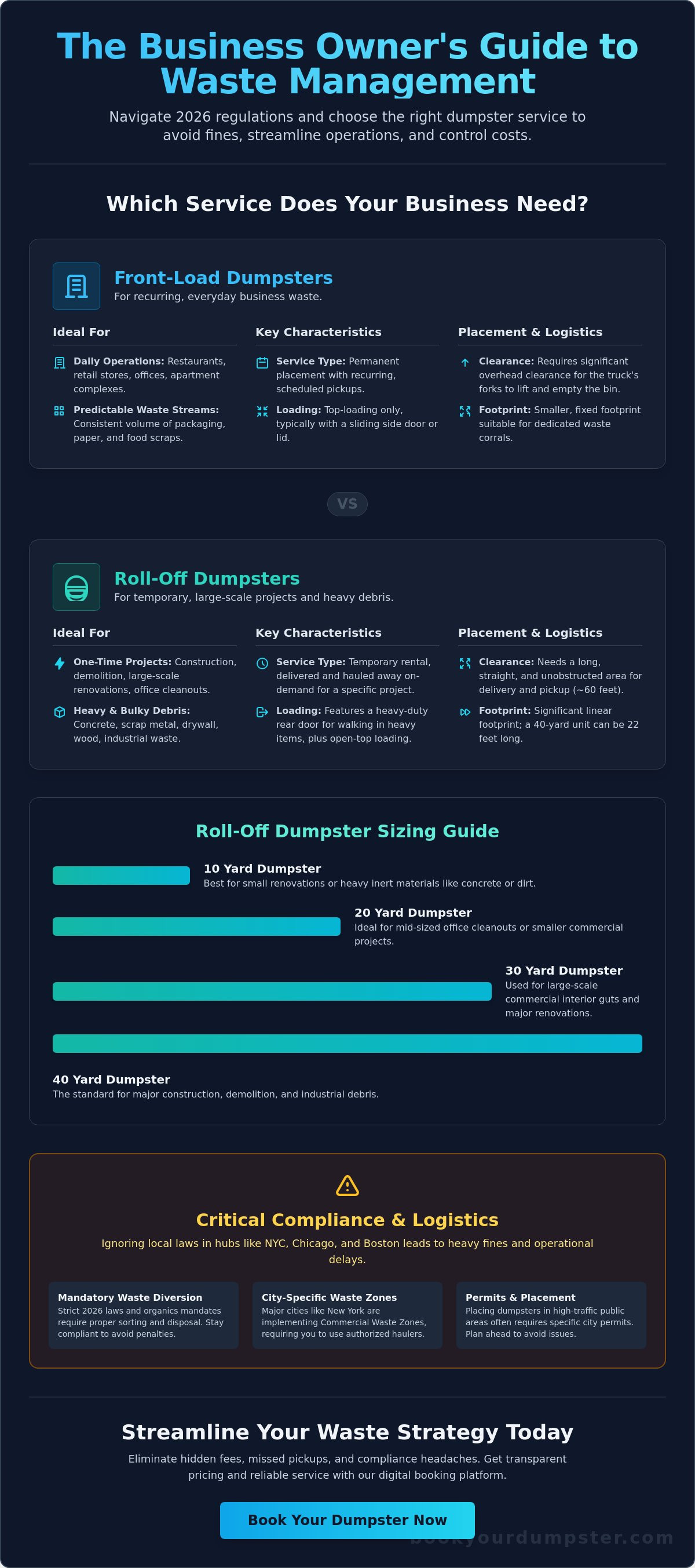
You must match your debris to the correct vessel. Commercial waste typically includes retail packaging, office paper, and general food service refuse. These materials are best handled through regular front load commercial waste pickup. Industrial and construction waste is different. It consists of heavy, bulky materials like concrete, drywall, and scrap metal. These require high-capacity roll-off units. We offer several sizes to handle these heavy loads:
- 10 Yard Dumpster: Best for small renovations or heavy inert materials.
- 20 Yard Dumpster: Ideal for mid-sized office cleanouts.
- 30 Yard Dumpster: Used for large-scale commercial interior guts.
- 40 Yard Dumpster: The standard for major construction and industrial debris.
Identify your primary waste stream before booking. If you're clearing out a warehouse in Chicago or a retail space in Boston, the weight of your material determines whether you need a permanent bin or a temporary roll-off solution. Select your service based on utility and compliance to keep your operation moving without friction.
Choosing Between Front-Load Services and Roll-Off Dumpsters
Selecting the right equipment is the first step toward Optimizing Your Commercial Waste Strategy. You must decide if your business needs a permanent fixture or a temporary solution. Front-load containers are the workhorses of daily business waste removal. They sit in a fixed location and receive regular service. Roll-off dumpsters, however, are heavy-duty tools for specific projects. They are delivered, filled, and hauled away once the job is finished. Understanding the footprint and loading mechanism of each is vital for site safety.
Front-load bins are usually smaller and require overhead clearance for the truck's forks to lift the container over the cab. Roll-off dumpsters require a significant linear footprint. A 40-yard unit can be 22 feet long and needs at least 60 feet of clear space for the truck to safely drop or winched the bin. While front-load bins are strictly top-loading, roll-off dumpsters feature a heavy-duty rear door. This allows you to walk heavy debris directly into the unit instead of lifting it over the side walls.
When to Use Front-Load Commercial Pickup
Choose front-load service if you manage a restaurant, retail store, or office building with a predictable waste stream. This service provides stability. You can schedule pickups on a daily, bi-weekly, or weekly basis depending on your volume. These containers come with secure, locked lids. This is a critical feature for preventing illegal dumping and keeping pests out of your refuse. It ensures your loading dock stays clean and compliant with local health codes. If your daily trash production is steady, this is your most cost-effective path.
When a Roll-Off Dumpster is the Better Tool
Opt for a roll-off dumpster when your waste output is tied to a specific timeline rather than daily operations. This is the standard for construction sites, warehouse cleanouts, and major renovations. For smaller commercial renovations or tight urban spaces, the 10-yard dumpster is often the most efficient choice. Roll-off services are "on-call" by nature. You fill the bin at your own pace and notify the hauler when it's ready for removal. We offer 10, 20, 30, and 40-yard dumpsters to match the scale of any project. You can view container dimensions and availability to find the best fit for your job site today.
Tailoring Waste Solutions to Your Specific Industry Needs
A law firm in Boston has different requirements than a demolition crew in Chicago. Effective business waste removal starts with identifying the specific density and volume of your output. Professional services and offices typically produce high volumes of paper and confidential materials, requiring secure front load containers and reliable recycling schedules. Conversely, the hospitality sector deals with heavy organic waste and packaging. You must scale your service to match these demands, especially during seasonal peaks like the holiday retail rush or the summer construction window.
Waste Management for Contractors and Construction
Punctuality is the most important factor on a job site. If a bin is full and a swap is delayed, your crew stops working. Large-scale sites require 30 and 40-yard containers to handle heavy debris like lumber, metal, and masonry. For detailed technical advice on managing these materials, read our Ultimate Guide to Construction Debris Removal. We prioritize timely roll-off swaps so your project stays on schedule and your site remains clear of safety hazards.
Retail and Restaurant Waste Efficiency
Food service operators face the strictest regulations, particularly regarding organic waste diversion. Navigating Local Compliance is essential for restaurants in New York and Massachusetts, where organics mandates are now in full effect. Beyond daily front load pickup, many retail managers find themselves needing temporary solutions for store remodels or inventory purges. A 10 or 20-yard roll-off dumpster is the ideal tool for these short-term spikes. Keep your containers well-maintained and positioned away from customer-facing areas to preserve your brand's curb appeal.
If your business experiences seasonal fluctuations, don't stay locked into a rigid schedule that no longer fits. You can adjust your pickup frequency or add temporary roll-off capacity for business waste removal by visiting bookyourdumpster.com. This flexibility prevents you from paying for empty bins during slow months or dealing with overflows during your busiest weeks. Manage your waste as a variable resource rather than a fixed burden.
Navigating Local Compliance and Logistics in Major Hubs
NYC's Commercial Waste Zones (CWZ) are fundamentally changing how Manhattan and Queens handle refuse. By the end of 2026, every business must transition to a zone-specific authorized hauler. This isn't just about picking a provider; it's about adhering to rigid sign-up windows. If you miss your window, you risk service interruptions and heavy fines from the Business Integrity Commission. Beyond New York, cities like Boston require specific "Right-of-Way" permits if a dumpster occupies public street space. Managing these logistics is a critical part of business waste removal that many owners overlook until a citation arrives.
Understanding City-Specific Regulations
The NYC "Clear Alleys Program" and similar initiatives in other hubs aim to reduce sidewalk clutter by mandating specific set-out times and container types. In Massachusetts, the 2026 landscape includes strict automated collection systems and expanded organics bans for businesses generating over one ton of food waste per week. Illinois is seeing a similar shift toward franchise agreements that dictate specific haul rates through 2027. For a deeper look at these state-level requirements, consult the 2026 guide for NY, IL, and MA. Staying compliant means knowing your local "Right-of-Way" rules. In Boston, placing a 10 or 20-yard dumpster on the street without a permit can result in immediate removal of the unit at your expense.
Logistics: Overcoming Urban Delivery Challenges
Delivering a 40-yard dumpster to a tight alley in Queens or a construction site in Chicago requires precision. You must account for overhead clearance, usually 14 to 22 feet depending on the truck, and a turning radius that can exceed 60 feet. Before your delivery, use this checklist to prepare your site:
- Clear all parked vehicles and debris from the drop-off path.
- Check for low-hanging wires, tree branches, or building overhangs.
- Ensure the surface is level and capable of supporting the weight of a loaded bin.
- Confirm that the delivery window doesn't conflict with local noise ordinances or peak traffic hours.
We specialize in managing these tight urban placements to ensure your project doesn't stall. Don't let a narrow street stop your progress. Schedule your urban dumpster delivery today and let us handle the logistical heavy lifting.
Optimizing Your Commercial Waste Strategy with Book Your Dumpster USA
Managing a commercial site is complex enough without fighting your waste provider for transparency. Traditional business waste removal often involves endless phone calls and "Request a Quote" forms that simply lead to more sales pitches. Book Your Dumpster USA removes this friction. We provide a high-functioning tool designed for managers who value their time and require immediate resolution. Whether you operate a retail chain in New Jersey or a construction firm in Chicago, our local delivery network ensures your equipment arrives when promised. We act as your pragmatic partner, removing logistical stress so you can focus on your core operations.
The Digital-First Advantage for Busy Managers
Stop wasting hours on the phone. Our platform allows you to secure a 20 or 30-yard dumpster in under five minutes. This speed is essential for fast-moving construction projects where a delayed bin means a stalled crew. You can view real-time availability and select the exact container size your project requires without leaving your desk. This level of digital control is what modernizes a traditional industrial sector. Take charge of your site logistics and Book Your Dumpster today to experience a streamlined, resolution-focused workflow.
Reliability and Pricing Integrity
We treat every transaction as a verbal handshake. You'll never see hidden "environmental fees" or "fuel surcharges" on your invoice. The price you see during the booking process is the price you pay. This pricing integrity is a core promise of our service, distinguishing us from the opaque communication structures found elsewhere in the industry. We understand that your budget relies on predictability. By offering a full range of sizes, including 10, 20, 30, and 40-yard dumpsters, we ensure you never overpay for capacity you don't use.
Our track record for punctuality in major commercial hubs like New York and Boston is built on a foundation of competence. We don't attempt to be a lifestyle brand. We position ourselves as a dependable, no-nonsense expert in business waste removal. Rely on our local expertise to handle the narrow alleys of Queens or the strict compliance laws of Illinois and Massachusetts. We move you quickly through the decision-making process with unmistakable instructions and immediate value. Select your service, schedule your delivery, and return your focus to growing your business. We'll handle the rest with the efficiency your operation demands.
Secure Your Operational Efficiency Today
Managing commercial refuse doesn't have to be a logistical burden. By understanding the 2026 compliance landscape in hubs like New York and Boston, you can avoid costly fines and operational delays. Selecting the correct equipment, whether it's a permanent front-load bin or a project-based roll-off dumpster, ensures you only pay for the capacity you actually need. Efficient business waste removal is a tool for growth, not just a line item on your budget.
We provide the local expertise and transparent pricing necessary to keep your site running smoothly across NY, NJ, IL, MA, and SF. There are no hidden logistical fees or surprise surcharges here; just a verbal handshake backed by digital convenience. You can choose from our 10 to 40 yard containers and finalize your schedule in minutes. Stop letting waste management clutter your schedule and start focusing on your next project.
Simplify your business waste management and book your dumpster online now. Take control of your site logistics with a partner who values your time as much as you do.
Frequently Asked Questions
How do I determine the right dumpster size for my business renovation?
Match the dumpster size to the square footage and material density of your project. A 10 yard dumpster works for small office updates or heavy debris like tile. Move up to a 20 or 30 yard unit for carpet removal and drywall. Use a 40 yard dumpster for major structural guts. Always choose one size larger than you think you need to avoid overfilling fees and logistical delays.
Are there items that businesses are prohibited from putting in commercial dumpsters?
You cannot dispose of hazardous materials, liquids, or electronics in standard commercial containers. Prohibited items include paints, oils, batteries, tires, and fluorescent bulbs. Many states also ban appliances containing freon. If you're unsure about a specific material, check with your local sanitation department before loading the bin. This prevents safety hazards and keeps your business compliant with environmental regulations.
Do I need a permit for a temporary roll-off dumpster at my business location?
Permit requirements depend entirely on where the dumpster is placed. If the container sits on your private property or in your business's parking lot, you usually don't need a permit. However, placing a dumpster on a public street or sidewalk in cities like Boston or Chicago requires a Right of Way permit. Contact your local public works department to secure the necessary paperwork before your scheduled delivery date.
What is the difference between a front-load and a roll-off dumpster service?
Front load service is a permanent solution for daily business waste removal, while roll-off service is for temporary projects. Front load bins are smaller, top loading containers serviced by trucks with front facing forks. Roll-off dumpsters are large, open top units delivered by specialized trucks. They feature a rear door for walking in heavy debris and are hauled away once your specific cleanup or renovation is complete.
How often should a retail business schedule waste pickups?
Schedule your pickup frequency based on your weekly volume and the types of materials you produce. High volume retail operations often require daily front load service to prevent overflow and maintain curb appeal. Smaller boutiques may only need weekly or bi-weekly pickups. Monitor your bin levels for two weeks to determine the most efficient schedule. This avoids paying for empty pickups or dealing with unsightly trash piles.
Can I rent a dumpster for a one-time commercial cleanout in New York or Chicago?
Yes, you can rent a temporary roll-off dumpster for one-time cleanouts in any of our service areas. We provide 10, 20, 30, and 40 yard units specifically for these short term needs. This is the most efficient way to clear out old inventory, office furniture, or warehouse clutter. Simply book your unit online, fill it at your pace, and notify us when it's ready for removal.
What happens if my dumpster is overloaded or contains hazardous materials?
Overloaded dumpsters cannot be safely transported and will remain on-site until you remove the excess material. Filling the bin above the Max Fill line creates a road hazard. If hazardous materials are found, the load may be rejected at the disposal facility. You will be responsible for removing the prohibited items and may face additional fees for the failed haul or the required decontamination of the unit.
How does Book Your Dumpster USA handle billing for commercial accounts?
We prioritize transparency and simplicity in our business waste removal billing. You receive upfront pricing at the time of booking with no hidden environmental fees or fuel surcharges. Billing is processed digitally, providing clear documentation for your records. This approach ensures you know exactly what you're paying for before the service begins. It removes the stress of opaque invoices and ensures total pricing integrity for your business.


