

Is your current waste contract designed to keep your facility clean or just to drain your monthly budget with hidden surcharges? Managing a business is difficult enough without worrying about trash overflow or missed pickups that violate local codes. Finding a reliable commercial front load dumpster service shouldn't feel like a logistical nightmare. You deserve transparent pricing and a schedule that actually matches your daily volume without the fine-print headaches. Stop guessing about your waste needs and start managing them with precision.
Waste management is a utility, not a hobby. You need it to work quietly in the background so you can focus on your actual operations. Select the ideal bin size and pickup frequency to eliminate wasted space and unnecessary fees. This guide breaks down critical 2026 updates, such as the New York organic waste diversion expansion for businesses generating one ton of waste and the Illinois Large Event Facilities Act. Use these strategies to maintain a compliant, clean premises while significantly driving down your monthly overhead.
Key Takeaways
- Differentiate between permanent front-load service and temporary roll-off rentals to select the most efficient waste solution for your specific business operations.
- Optimize your monthly budget by matching bin sizes from 2 to 8 cubic yards with a pickup schedule tailored to your actual waste volume.
- Identify how to secure a commercial front load dumpster service that offers transparent pricing and digital management to eliminate hidden fees and missed pickups.
- Navigate 2026 local regulations in metros like New York and Chicago, including new organic waste diversion thresholds and annual recycling reporting requirements.
- Reduce logistical stress by transitioning from project-based roll-offs to permanent service using streamlined, digital-first scheduling tools.
What is Commercial Front Load Dumpster Service?
A commercial front load dumpster service provides the permanent infrastructure for your company's daily trash disposal. Unlike temporary solutions, this service involves a fixed-schedule pickup where specialized trucks use hydraulic forks to lift bins over the front of the vehicle. You've likely seen these bins behind grocery stores or tucked into alleyways. They typically feature slanted tops for easy access or flat tops for higher volume capacity. Understanding these mechanics is a small part of a comprehensive guide to waste management, but it's the most critical part for your bottom line. These bins stay on your property indefinitely, providing a reliable point of disposal for employees and staff.
The design of the front-load system emphasizes efficiency and space conservation. Because the truck approaches the bin from the front, these containers fit perfectly in tight enclosures or narrow loading docks. Slanted-top bins are generally lower in height, making them easier for staff to toss bags into. Flat-top bins offer slightly more internal volume for the same footprint. Choosing the right design prevents trash from piling up outside the container, keeping your premises clean and compliant with local health department standards.
Front Load vs. Roll-Off: Which Does Your Business Need?
Determine your needs based on volume consistency. If you're finishing a renovation and have cleared out construction debris removal tasks, you no longer need a massive roll-off bin. Transition to a front-load model for your ongoing operations. Use roll-off containers for one-time, high-volume projects. Switch to a commercial front load dumpster service when your waste generation becomes predictable. This shift saves space and reduces the high cost of per-haul project pricing. Roll-offs are dropped and hauled away when full; front-load bins are emptied on-site and remain in place, ensuring you're never without a disposal option.
Common Industries Served
Retailers and office managers prioritize cardboard recycling and compact bin designs to save parking space. Restaurants require a different approach. They need leak-proof bins and frequent pickups to manage organic waste and prevent odors. In high-density metros like Queens or San Francisco, property managers use these services to keep residential complexes compliant with local sanitation codes. Match your bin type to your specific industry output to avoid overage charges or health code violations. Predictable waste streams allow for precise scheduling, which is the fastest way to lower your monthly utility costs.
Choosing the Right Front Load Dumpster Size
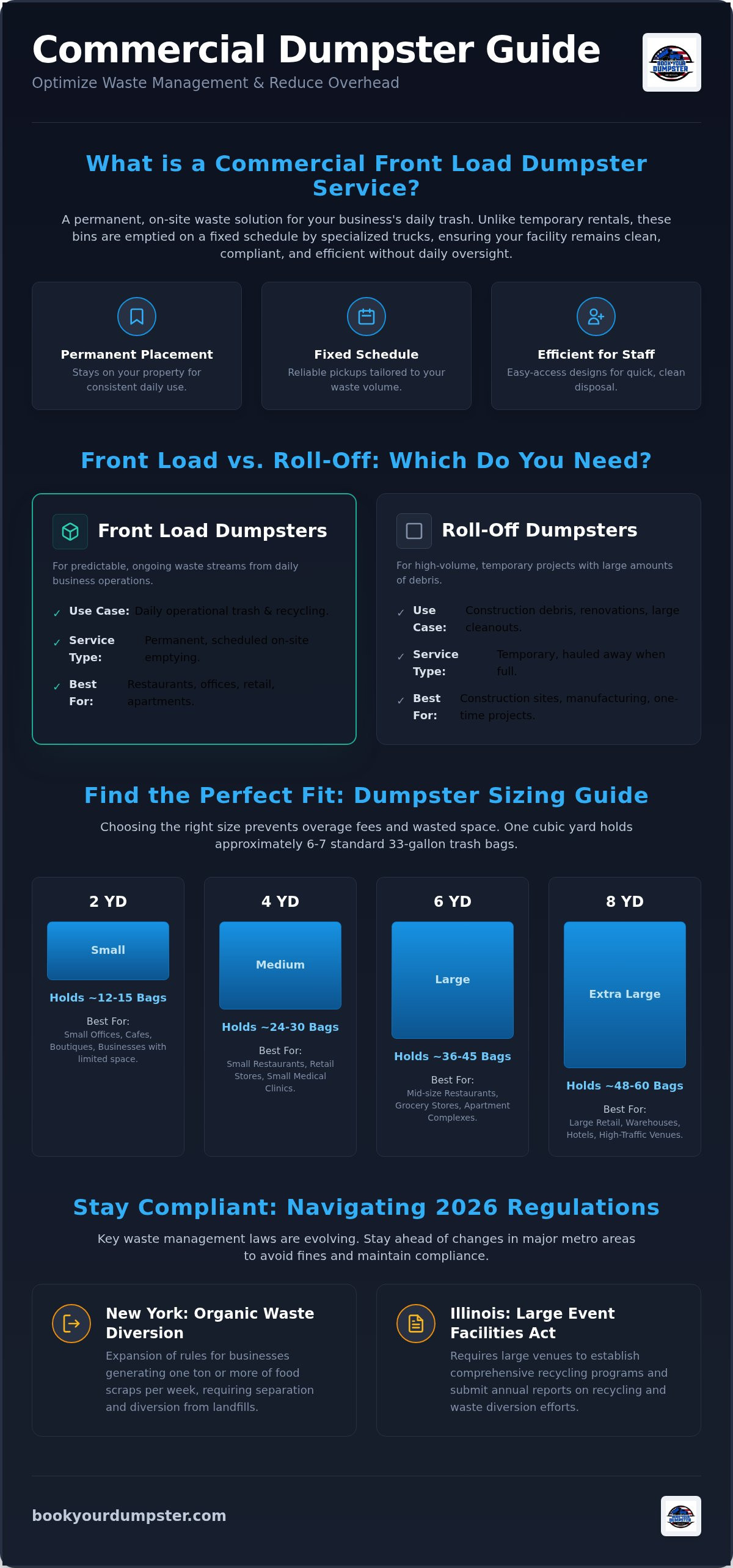
Selecting the wrong bin size leads to two expensive problems: paying for empty space or dealing with costly overage fees from overflow. A commercial front load dumpster service relies on matching your weekly output to the physical volume of the container. Standard bins range from 2 to 8 cubic yards. To visualize this, consider a standard 33-gallon trash bag. One cubic yard holds roughly six to seven of these bags. If your staff tosses out two bags a day, a 2-yard bin emptied weekly is your baseline. Precise sizing keeps your monthly bills predictable and your enclosure clean.
Weight limits also dictate your choice. While front-load trucks are powerful, they have lifting capacities designed for standard municipal solid waste. If your business generates heavy materials like wet food waste or dense paper stacks, you must account for these weight thresholds to avoid mechanical failures or safety violations under federal waste regulations. Always ensure your designated pickup area has at least 14 feet of overhead clearance and a clear path for the truck's hydraulic forks. This prevents property damage and ensures the driver can complete the service without delay.
Small Bins: 2-Yard and 4-Yard Options
Small offices, boutiques, and cafes with limited alley space should start here. A 2-yard bin accommodates about 12 to 15 large trash bags, while a 4-yard bin handles roughly 24 to 30 bags. These sizes offer a compact footprint that fits easily into standard enclosures. They're the most cost-effective entry point for businesses that prioritize a clean exterior without a massive equipment footprint. If you have tight quarters, check available dimensions before you finalize your layout to ensure the truck has enough room to maneuver.
Large Bins: 6-Yard and 8-Yard Options
High-traffic environments like grocery stores, mid-sized apartment complexes, and busy restaurants require 6-yard or 8-yard models. A 6-yard bin holds approximately 36 to 40 bags, and the 8-yard behemoth manages 48 to 50 bags. These larger containers handle bulky items like broken pallets or large cardboard boxes much better than smaller alternatives. Choosing a larger bin often reduces the need for daily pickups, which can lower your overall monthly bill by consolidating service days. Monitor your volume for two weeks; if your 4-yard bin is overflowing by Wednesday, it's time to scale up. Selecting a commercial front load dumpster service that fits your specific volume prevents the logistical stress of missed pickups and overflowing trash.
Factors Influencing Commercial Waste Pickup Costs
Monthly bills for a commercial front load dumpster service are rarely static. They fluctuate based on how you balance bin volume against the speed of collection. The national average monthly cost sits between $175 and $178, but your actual invoice depends on four specific variables: bin size, pickup frequency, location, and waste type. Businesses often overpay because they select a bin that is too small, forcing them into a high-frequency pickup schedule. Every time a truck stops at your facility, you pay for the transit and labor. Consolidating your waste into a larger bin with fewer stops is almost always the more pragmatic financial move.
Geography plays a massive role in your bottom line. Disposal costs vary significantly by region. For instance, waste management in the Midwest is generally the most affordable, while West Coast markets see the highest rates due to stricter environmental mandates and higher landfill tipping fees. You can find a detailed breakdown of dumpster rental prices in high-density areas to see how your local market compares. Beyond regional baselines, signing a longer-term agreement, such as a three-year contract, can typically reduce your monthly service cost by $15 to $30 compared to a standard one-year term.
Beware of ancillary fees that can double your expected costs. Overage fees are the most common trap; exceeding your weight limit often results in charges ranging from $40 to $100 per extra ton. In cities like Boston, landfill fees can reach $120 per ton, making heavy loads a liability. Other "hidden" costs include gate fees for locked enclosures or contamination fees for putting recyclables in the trash bin. Demand a flat-rate pricing model to ensure transparency and prevent these logistical surprises from inflating your overhead.
Optimizing Your Pickup Schedule
Stop paying to haul air. If your bin is only half-full on pickup day, you're wasting money. Monitor your waste levels for two weeks. If you consistently have extra space, reduce your frequency. Conversely, if you're constantly dealing with overflow, upgrade your bin size rather than adding another pickup day. Adjust your schedule seasonally if your business sees peak months. A retail store might need three pickups a week in December but only one in July. Stay agile to keep your costs aligned with your actual needs.
Recycling and Diverting Waste to Save Money
Diverting cardboard and organic waste isn't just about sustainability; it's a cost-saving strategy. Cardboard takes up massive amounts of volume in a standard bin. By using a separate recycling service, you reduce the volume in your primary commercial front load dumpster service, allowing for a smaller bin or fewer pickups. In cities like San Francisco, local zero-waste initiatives make sorting mandatory. Proper sorting prevents contamination penalties and keeps you compliant with 2026 regulations. Efficient waste management starts with keeping the right materials in the right containers.
Navigating Local Regulations: NY, NJ, IL, MA, and SF
Operating a business in high-density metros requires more than just picking a bin size. You must navigate a complex web of "Commercial Waste Zones" and municipal mandates. In New York City, for example, the shift toward zoned collection means your choice of provider is often dictated by your specific neighborhood. This system aims to reduce truck traffic but requires business owners to be highly diligent about contract terms and service windows. Before you secure a commercial front load dumpster service, verify which haulers are authorized to operate in your zone to avoid heavy administrative fines.
Placement is the next hurdle. If your facility lacks a private loading dock or alleyway, you may need a public right-of-way permit. In Chicago and Boston, placing a bin on a sidewalk or public street requires an active permit from the Department of Transportation. Failure to display these permits leads to immediate impoundment of your bin. Additionally, most cities now enforce strict enclosure ordinances. Your bin must be kept in a secured, screened corral to prevent illegal dumping and maintain community aesthetics. Secure your enclosure with a heavy-duty lock and ensure your driver has a key or code to prevent missed pickups.
Metropolitan Placement Challenges
Space is a premium in Queens and San Francisco. If you operate out of a parking garage, you must account for vertical clearance. Most front-load trucks require at least 14 feet of overhead space to tip the bin safely. In tight alleyways, drivers need a wide turning radius to align their forks with the bin sleeves. Winter weather adds another layer of logistical stress in New Jersey and Massachusetts. Local ordinances often require businesses to clear snow and ice from the path of the dumpster by 7:00 AM on service days. If the truck cannot safely reach the bin, you will likely be charged for a "dry run" without receiving a pickup.
Compliance and Sustainability Standards
2026 marks a major shift in waste diversion requirements. In New York, businesses generating one ton or more of organic waste per week must now divert that waste from landfills if they are within 25 miles of an organics recycler. Illinois has enacted the Large Event Facilities Act, requiring venues with a capacity over 3,500 people to divert all back-of-house recyclables. Chicago business owners must also remember that private haulers are required to report tonnage annually by February 28. Stay ahead of these deadlines by performing a waste audit every six months. Audit your output to ensure you aren't tossing hazardous materials or e-waste, which can trigger fines reaching thousands of dollars per occurrence. To ensure your facility stays compliant with these evolving local and 2026 federal standards, schedule your service with a provider who understands your city's specific requirements.
Streamlining Your Waste Management with Book Your Dumpster USA
Managing a business requires your full attention. You shouldn't waste time chasing down a hauler or deciphering a bill full of cryptic surcharges. Book Your Dumpster USA provides a commercial front load dumpster service built on pricing integrity and digital efficiency. We remove the logistical stress associated with traditional waste contracts. Our approach is direct. We offer reliable, permanent solutions for businesses in New York, New Jersey, Illinois, Massachusetts, and San Francisco. Stop dealing with corporate fluff and start working with a partner that respects your time and your budget.
Our digital-first booking system streamlines your entire waste management process from start to finish. You can manage your account, check pickup schedules, and adjust service levels through a single, intuitive interface. This modern approach bridges the gap between temporary dumpster rental for renovation projects and the permanent service your daily operations require. If you've recently finished a store build-out using our roll-off bins, transitioning to recurring front-load collection is a seamless process. We maintain the same level of transparency and reliability across all our service lines, ensuring your facility remains clean as you scale your operations.
The Book Your Dumpster USA Advantage
We prioritize your bottom line by eliminating the common pain points of the waste industry. Our system is designed for speed and clarity. You get a high-functioning tool that works in the background of your business.
- Transparent pricing with no hidden logistics surcharges.
- Punctual pickups that respect your specific business operating hours.
- Expert guidance on sizing; we don't upsell you on more than you need.
- Digital account management for real-time scheduling updates.
How to Get Started with Commercial Service
Setting up your account is a straightforward process designed to reduce friction. We don't believe in long-winded consultations or complex jargon. Follow these steps to resolve your waste management challenges immediately:
- Step 1: Contact us for a waste stream evaluation. We'll help you determine your actual volume and identify diversion opportunities to lower your monthly costs.
- Step 2: Select your bin size and frequency based on our data-driven recommendations. We match the equipment to your specific output.
- Step 3: Schedule your delivery and first pickup here.
Take control of your facility's waste today. By choosing a commercial front load dumpster service that prioritizes honesty and speed, you can return your focus to your customers. We handle the mess; you handle the business. It's a simple, reliable partnership built for the modern business owner.
Take Control of Your Business Waste Operations
Effective waste management shouldn't be a source of constant logistical stress. You've learned how to match bin sizes with precise pickup frequencies to eliminate wasted spend. You also know how to navigate 2026 compliance standards across key metros like New York and Chicago. Now it's time to put these strategies into action. Choosing a reliable commercial front load dumpster service ensures your premises stay clean without the burden of hidden fees or missed pickups. A clean facility isn't just about aesthetics; it's about avoiding the heavy fines associated with new diversion mandates.
Book Your Dumpster USA provides the tools you need for streamlined management across NY, NJ, IL, MA, and SF. We focus on pricing integrity and punctuality so you can focus on your actual business goals. Use our digital-first online management tools to monitor your service and keep your overhead low. Don't settle for opaque contracts or unresponsive haulers that leave your bins overflowing. We bridge the gap between temporary project needs and permanent operational success with straightforward honesty.
Request a Commercial Waste Quote from Book Your Dumpster USA and experience a no-nonsense approach to waste disposal. We're ready to help you optimize your facility today.
Frequently Asked Questions
What is the difference between a front load and a rear load dumpster?
Front load bins feature side sleeves designed for a truck's hydraulic forks to lift the container overhead. This design is the standard for permanent business locations because it allows the truck to approach from the front in tight enclosures. Rear load dumpsters use a winch and cable system to tip the bin into the back of the vehicle. Rear load is typically reserved for narrow alleys where a truck cannot pull forward into the bin.
How often should my business have its dumpster picked up?
Base your pickup frequency on your weekly waste volume and local health codes. Most small offices or retail shops start with a once-per-week schedule. Restaurants and grocery stores often require daily collection to manage organic waste and prevent odors. Monitor your bin for two weeks to see if you have consistent overflow. Adjust your schedule immediately if you find the bin is full before your next service day.
Do I need a permit for a commercial dumpster on my own property?
You generally don't need a permit if the bin stays entirely on your private property. However, you must still comply with local zoning laws regarding enclosure construction and screening. If any part of the bin or the truck's access path touches a public sidewalk or street, you must secure a right-of-way permit. Check with your local Department of Transportation in cities like Chicago or Boston for specific permit requirements.
What items are prohibited in a commercial front load dumpster?
Keep hazardous materials, electronics, tires, and heavy construction debris out of your bin. Prohibited items include batteries, paints, chemicals, and any appliances containing refrigerants. Adding these materials to your commercial front load dumpster service will result in immediate contamination fees or a refusal of service. Use a specialized roll-off container for large renovation projects or hazardous waste disposal to ensure you stay compliant with 2026 regulations.
Can I share a commercial dumpster with a neighboring business to save costs?
Sharing a bin is possible but requires a formal agreement and approval from your hauler. One business must act as the primary account holder responsible for compliance and billing. This strategy works well for small boutiques with low waste volume, but it requires strict monitoring. If your neighbor disposes of prohibited items or exceeds the weight limit, you'll be held responsible for the resulting overage fees or contamination charges.
How much space does a front load truck need for pickup?
Ensure your site provides 14 feet of vertical clearance and a clear path at least 20 feet wide for the truck. Front-load vehicles need significant room to align their forks with the bin sleeves and lift the container over the cab. If your enclosure has a low ceiling or narrow entrance, the driver cannot safely perform the pickup. Measure your designated area and clear all overhead obstructions before your first delivery.
What happens if my dumpster is blocked on pickup day?
If a vehicle or obstacle blocks access, the driver will document a "dry run" and move to the next stop on the route. You'll still be charged for the attempted stop because the commercial front load dumpster service operates on a tight, high-velocity schedule. Clear all parked cars, delivery pallets, and snow by 7:00 AM on your service days. Maintaining a clear path is the only way to ensure your trash is collected on time.
How do I prevent illegal dumping in my commercial bin?
Install a heavy-duty lock on your bin and keep your enclosure doors closed at all times. Unauthorized dumping increases your waste volume and leads to expensive overage charges. Consider installing motion-sensor lighting or security cameras near the disposal area to deter outsiders. Provide your driver with a key or gate code so they can access the bin without compromising the security of your enclosure during off-hours.


