Is your current waste management strategy a hidden drain on your company's bottom line? Many facility managers treat trash as an afterthought until they face city fines for overflowing bins or notice pests near customer entrances. Managing a commercial front load dumpster service shouldn't be a source of constant logistical stress. You likely want a solution that works quietly in the background without the unpredictability of fluctuating bills or sanitation failures.
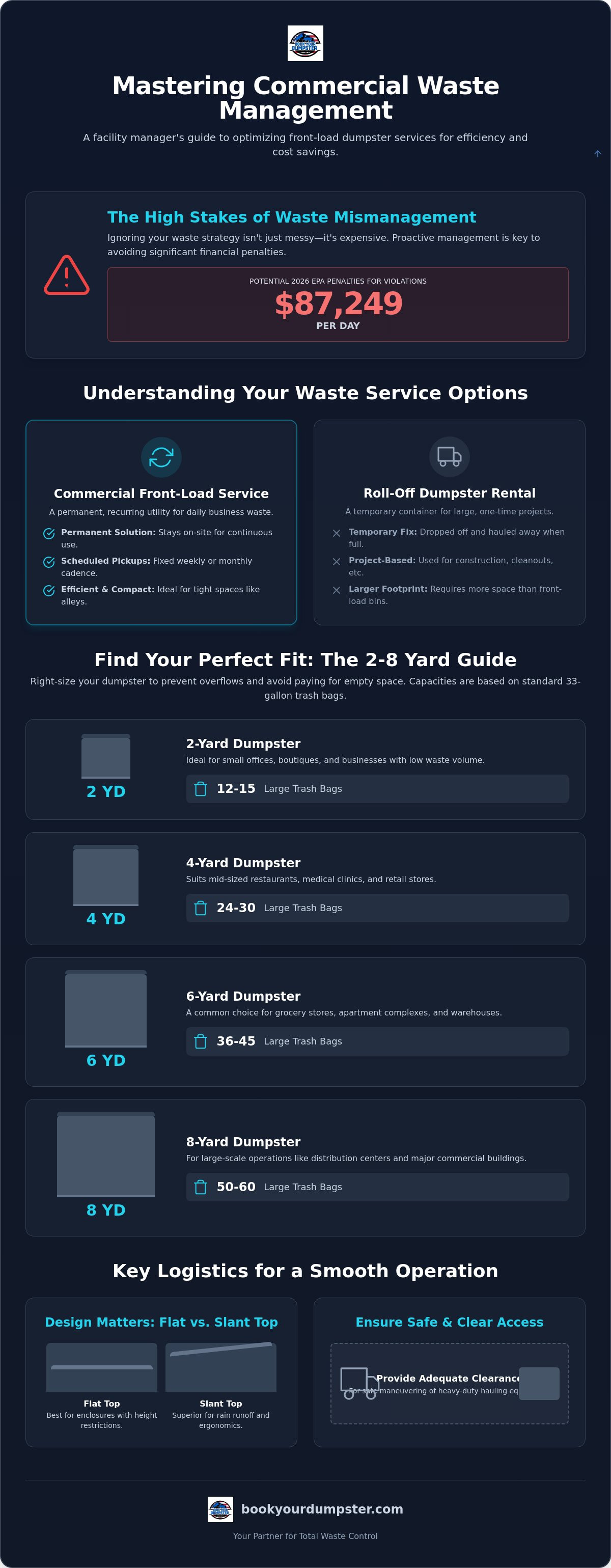
It's time to transition from reactive cleanup to proactive efficiency. With 2026 EPA penalties for waste violations reaching up to $87,249 per day, the stakes for your facility have never been higher. This guide helps you master the logistics of recurring waste removal to reduce overhead and improve site sanitation. We'll preview the exact steps to secure a minimal footprint for waste storage and establish predictable monthly billing. Follow these strategies to transform your waste area into a clean, odor-free zone that supports your broader business goals.
Key Takeaways
- Understand how a commercial front load dumpster service operates as a permanent waste solution, using specialized bin mechanics to keep your site clean and efficient.
- Select the correct bin size, from 2 to 8 cubic yards, by using trash bag equivalents to match your specific waste volume and avoid unnecessary overage fees.
- Optimize your pickup frequency by balancing container capacity with collection schedules to prevent odor issues and minimize your waste storage footprint.
- Ensure site safety and accessibility by designing dumpster enclosures that provide adequate clearance for heavy-duty hauling equipment to maneuver.
- Simplify your transition to professional waste management by leveraging a pragmatic approach that removes logistical stress from your facility operations.
What is Commercial Front Load Dumpster Service?
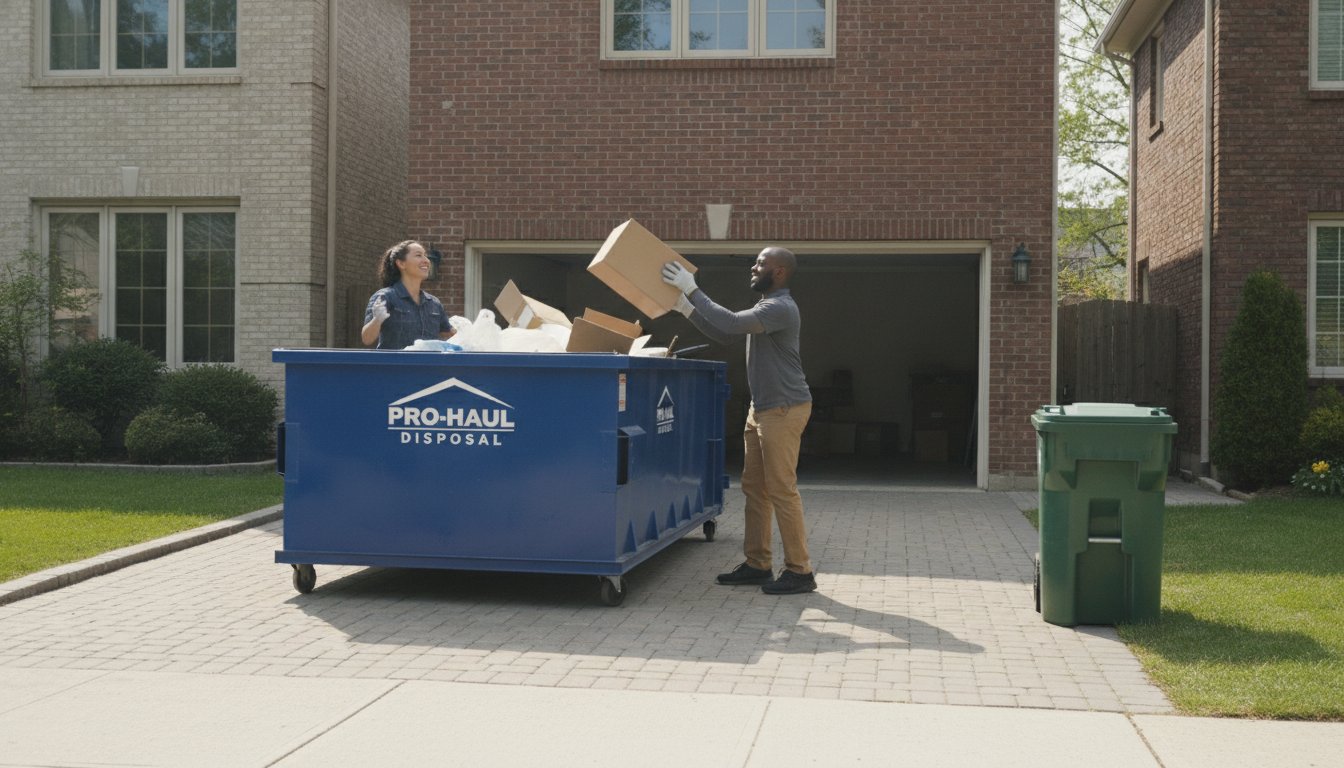
A commercial front load dumpster service acts as a permanent, recurring utility for your daily business operations. It isn't a temporary fix for a weekend cleanup; it's a scheduled logistical system designed to keep your facility running without waste-related interruptions. This service provides a dedicated steel container that stays on your property, with pickups occurring on a fixed weekly or monthly cadence. It creates a predictable rhythm that allows you to focus on your customers rather than your trash pile.
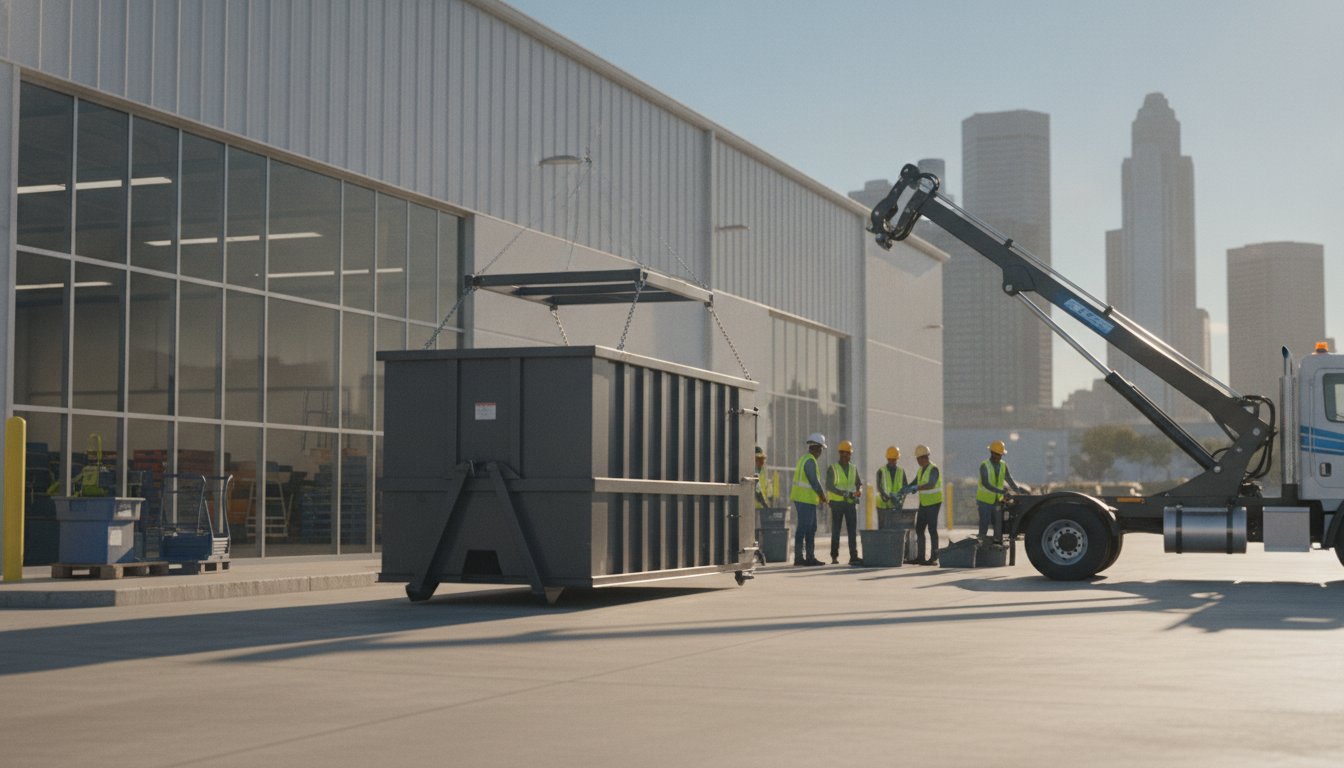
The mechanics of this system are built for speed and urban efficiency. A specialized truck uses front-mounted hydraulic forks to slide into steel-reinforced pockets on the side of the bin. The driver lifts the container over the cab, empties the contents into the truck's hopper, and sets the bin back down. This streamlined waste collection process allows for rapid servicing in tight spaces like alleys or parking lots. Unlike a roll-off dumpster rental, which is dropped off for one-time projects and hauled away when full, front-load bins never leave your site.
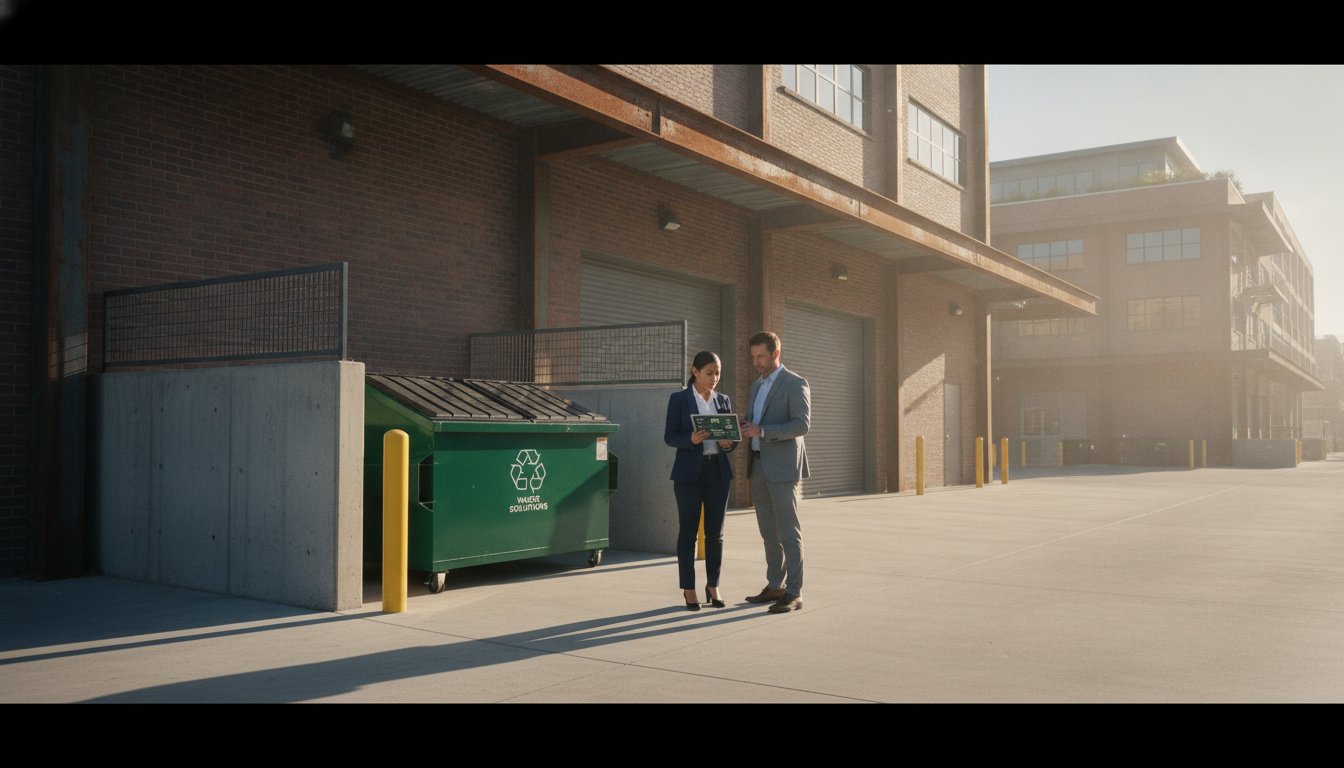
Choosing this service offers several immediate benefits for business owners. These containers have a compact footprint, making them easy to tuck into corners or enclosures. They also feature heavy-duty, leak-proof lids that keep odors in and pests out. Scheduled reliability ensures you never have to guess when your trash will disappear, which is essential for maintaining a professional appearance.
The Business "Waste Heartbeat"
For most retail shops and office complexes, a bin ranging from 2 to 8 cubic yards is the operational standard. Selecting the right size is critical. If your bin is too small, you risk overflowing trash and local health code violations. If it's too large, you're paying for empty air. Right-sizing your service depends entirely on your specific waste velocity. Waste velocity is the rate at which a business fills its allocated volume. Monitoring this pace allows you to adjust your service level before a mess starts to pile up and your overhead increases.
Front-Load vs. Rear-Load Systems
Front-load systems have become the industry standard for commercial parking lots for two main reasons: safety and durability. In a front-load cycle, the driver remains safely in the cab throughout the entire dump process. This reduces the risk of injury and speeds up the collection time significantly. Modern containers also feature steel-reinforced pockets designed to withstand the daily stress of heavy lifting. While rear-load systems require more manual labor and ground-level maneuvering, front-load trucks offer the precision needed for high-traffic business environments.
Choosing the Right Bin Size: 2 to 8 Yard Guide
Selecting the proper container size is the most direct way to control your overhead. A commercial front load dumpster service relies on precise volume management to prevent both overflowing bins and wasted space. If you choose a bin that is too small, you'll face messy overflows and potential city fines. If it's too large, you're paying for unused capacity. You must balance your physical space with your weekly waste output to find the sweet spot for your facility.
To visualize capacity, use the standard 33-gallon trash bag as your metric:
- 2-Yard Bin: Holds approximately 12 to 15 large bags.
- 4-Yard Bin: Holds approximately 24 to 30 large bags.
- 6-Yard Bin: Holds approximately 36 to 45 large bags.
- 8-Yard Bin: Holds approximately 50 to 60 large bags.
Design choice is your next priority. Flat Top dumpsters are standard for enclosures with height restrictions or when bins must be tucked under low overhangs. However, Slant Top models are superior for rain runoff and employee ergonomics. Choosing a Slant Top ensures water doesn't pool on the lid. This prevents rust and keeps the total weight within the safe lifting range for hydraulic forks. If you are unsure which dimensions fit your enclosure, evaluate your site requirements before finalizing your order.
Small Scale: 2 and 4 Yard Dumpsters
These sizes are ideal for banks, small professional offices, and boutiques. They feature a minimal footprint that fits perfectly into tight alleys in urban areas like Queens or Jersey City. Use these bins for low-volume, non-compactable waste such as office paper, mail, and light retail packaging. Their compact nature makes them easy to maneuver into gated enclosures where space is at a premium. They provide enough capacity for a week of standard office waste without dominating your parking area.
Large Scale: 6 and 8 Yard Dumpsters
Large-scale bins are the workhorses of a commercial front load dumpster service for high-volume facilities. They are best suited for warehouses, high-traffic restaurants, and multi-family property management. These facilities generate high-velocity waste that requires significant volume. The Slant Top design is particularly beneficial here. It allows employees to toss heavy bags over the lower front edge with less physical strain. Always monitor your load weight limits. Heavy organic waste from commercial kitchens can quickly exceed the lifting capacity of the truck if the bin is packed too densely. Review the EPA's guide for commercial buildings to better understand how to manage these larger volumes efficiently and sustainably.
Strategic Frequency: Optimizing Your Pickup Schedule
Optimizing your commercial front load dumpster service is a balancing act between total volume and waste velocity. Many facility managers assume a larger bin emptied once a week is the most cost-effective choice. However, the math often favors smaller bins with higher pickup frequency. Consider this: three pickups of a 2-yard bin provide the same 6 yards of total weekly capacity as one pickup of a 6-yard bin. The difference lies in site sanitation. Frequent removals prevent waste from compacting at the bottom, which reduces the risk of heavy-load fees and keeps your enclosure manageable.
Environmental factors also dictate your schedule. In states like New Jersey or Illinois, summer humidity creates an "odor threshold" that can't be ignored. High temperatures accelerate the decomposition of organic matter, making twice-weekly pickups a necessity for restaurants and grocery stores regardless of bin size. Adhering to Federal guidelines for waste storage isn't just about avoiding fines; it's about maintaining a safe, pest-free environment for your employees and customers.
Perform a simple three-step audit this month to see if you're overspending:
- Check the Fill Level: Observe your bin 24 hours before your scheduled pickup. If it's consistently less than 75% full, you're paying for "empty air."
- Inspect the Lids: If lids can't close due to overflow, you're at risk for city fines and pest infestations.
- Review Your Invoices: Look for recurring "overage" or "blocked access" fees. These are signs that your current schedule doesn't match your business's actual waste rhythm.
Reducing Overage Fees and Fines
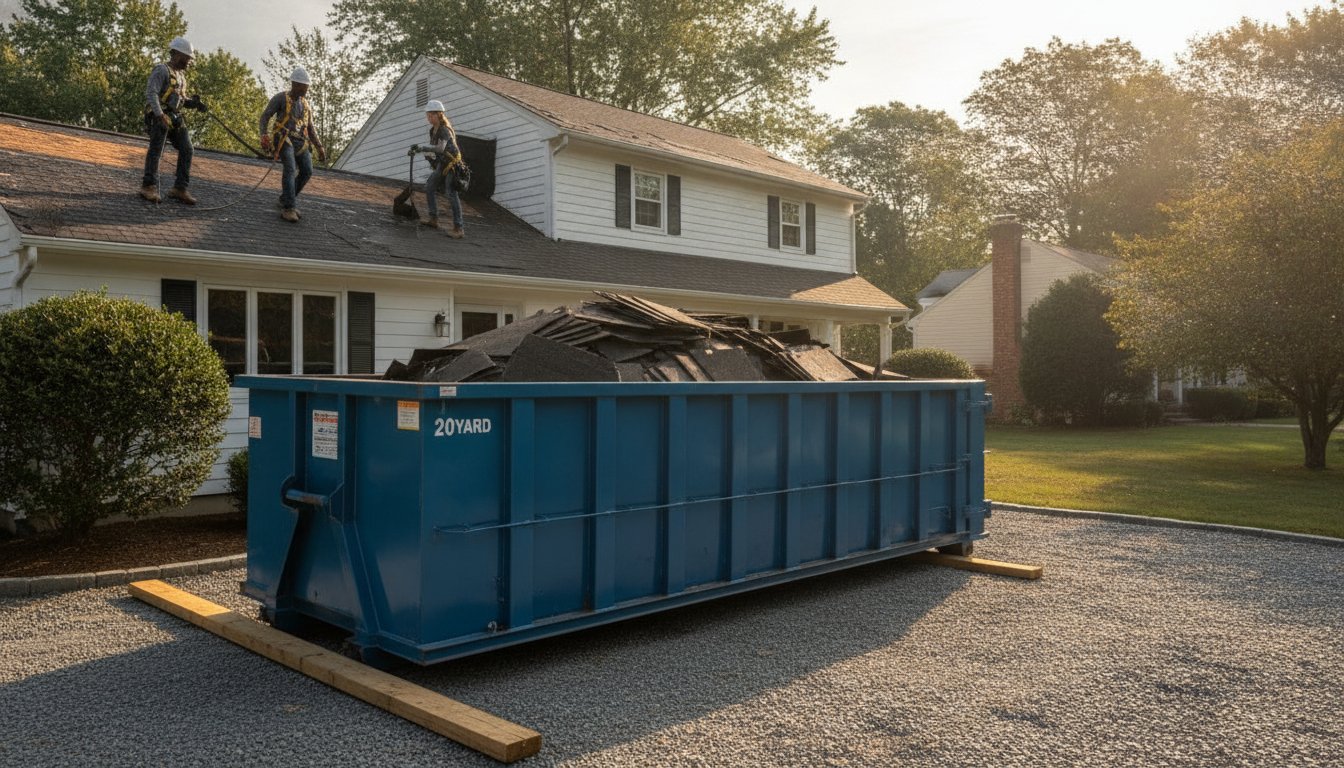
Hidden costs like blocked-access charges or overfilled-bin penalties can inflate your monthly bill by 20% or more. Consistent scheduling prevents the "trash mountain" effect that attracts rodents and triggers health department inspections. If you anticipate a temporary surge in waste, such as a retail holiday rush or a back-of-house cleanout, don't force it into your permanent bin. Use a 10-yard dumpster for short-term overflow to keep your primary service area clean and compliant.
The Logistics of Multi-Site Management
Managing locations across New York and Massachusetts requires a centralized waste strategy. Relying on a single point of contact for billing and service adjustments across multiple states eliminates the administrative burden of tracking disparate hauling contracts. This level of control allows for rapid adjustments when one location sees a spike in activity. Remember that punctuality is non-negotiable in high-traffic commercial zones. A delayed truck can block delivery bays or customer parking, creating a ripple effect of operational delays. If you need to streamline your multi-site operations, centralize your logistics today to ensure consistent service across all your facilities.
Site Logistics: Enclosures, Access, and Safety
The most common failure in a commercial front load dumpster service isn't a missed pickup; it's a site that the truck cannot physically access. A front-load hauler requires a significant amount of maneuvering room to align its forks with the bin's side pockets. You must provide a straight approach of at least 50 to 70 feet. If the driver has to perform complex multi-point turns or risk hitting parked vehicles, they'll likely mark the site as "blocked access," resulting in service delays and additional fees.
When building a "dumpster corral" or enclosure, follow standard dimensions to ensure long-term utility. The gate opening must be at least 12 feet wide to allow for the truck's width and slight angles of approach. However, the most critical oversight is overhead clearance. When the hydraulic forks lift a bin to empty it into the hopper, the total height can reach 25 feet or more. You must inspect your service area for low-hanging power lines, tree limbs, or building eaves that could obstruct this vertical arc. If you're designing a new enclosure or need to troubleshoot a tight location, consult with our logistics experts to ensure your site is fully accessible.
Gate and bolt requirements are equally important for maintaining a professional schedule. Use heavy-duty hinges and functional drop bolts that keep the gates securely open during the dump cycle. Drivers prioritize efficiency and safety. If they have to wrestle with a rusted gate or a complex locking mechanism, it slows down the entire route. Ensure your enclosure hardware is maintained so the driver can complete the service without leaving the cab for extended periods.
Navigating Urban Constraints in Queens and San Francisco
In high-density zones like Queens or San Francisco, sidewalk space is a premium. If your bin must sit on or near a public right-of-way, you must secure the necessary sidewalk permits to avoid municipal citations. For businesses tucked into deep alleys, consider "push-out" service. This logistical adjustment involves moving the bin manually to a designated truck-accessible spot before the scheduled pickup time. Always be mindful of local noise ordinances. Scheduling a 4:00 AM pickup in a residential-adjacent area can lead to expensive noise complaints that disrupt your operations.
Safety and Hygiene Standards
Maintain high hygiene standards to prevent "bridging," which occurs when waste becomes wedged at the bottom of the bin and won't fall out during the dump cycle. Avoid over-compressing bags or tossing in long, rigid materials like lumber. Keep the area around the bin clear of loose debris. This isn't just for aesthetics; it's a fire safety requirement and a deterrent for pests. Finally, use lock bars to prevent unauthorized third-party dumping. Illegal waste can quickly push you over your weight limit, leading to landfill overweight fees that range from $40 to $200 per extra ton.
Partnering with Book Your Dumpster USA for Total Waste Control
Transitioning your facility to a professional commercial front load dumpster service shouldn't be a source of administrative friction. Book Your Dumpster USA simplifies this move by acting as your single point of contact for waste logistics. We focus on removing the stress of recurring pickups through a pragmatic, no-nonsense approach that respects your time and your budget. Whether you operate in the high-traffic corridors of New York and New Jersey or manage facilities in Illinois and Massachusetts, our goal is to provide a service that works quietly and efficiently in the background.
Many businesses find that their waste needs aren't always static. While your daily operations require a permanent front-load bin, facility renovations or back-of-house cleanouts often demand more capacity. This is where our comprehensive support shines. We offer a unique synergy by combining your recurring commercial front load dumpster service with professional construction debris removal for temporary projects. This integrated approach ensures you don't have to juggle multiple vendors or manage conflicting schedules when your site needs change. We handle the heavy lifting so you can keep your focus on your core business.
The Digital-First Logistics Advantage
Facility managers deserve modern tools for traditional industrial services. Our platform offers streamlined online booking and account management that eliminates the need for endless phone tag. We prioritize pricing integrity. You won't find hidden fuel surcharges that fluctuate wildly from month to month. Instead, you get transparent billing and direct access to expert logistics support. This is particularly valuable for complex multi-site operations where consistency across different regions is essential for maintaining a clean bottom line. We provide the data and the dependability required to manage waste budgets across dozens of locations with ease.
Ready to Clean Up Your Operations?
A well-managed waste schedule provides a clear return on investment. By optimizing your bin size and pickup frequency, you reduce overhead and eliminate the risk of city fines. Move your facility from a state of clutter to a state of resolution. Take control of your site sanitation and establish a predictable waste rhythm today. The first step is a professional evaluation of your current needs. Contact Book Your Dumpster USA for a Commercial Service Assessment to secure a quote and streamline your facility operations.
Streamline Your Facility Logistics for 2026
Effective waste management is a competitive advantage that directly impacts your bottom line. You now have the framework to right-size your containers from 2 to 8 yards and optimize pickup frequency to eliminate "empty air" costs. You've also identified how proper site logistics prevent blocked access fees and safety hazards. Implementing these strategies ensures your facility remains clean, compliant, and cost-effective throughout the year. It's about moving from daily clutter to a high-functioning, predictable utility that supports your growth.
Book Your Dumpster USA provides pragmatic, direct waste management for commercial facility managers across New York, New Jersey, Illinois, and Massachusetts. Whether you need a consistent commercial front load dumpster service or supplemental 10 to 40 yard roll-offs for a specific renovation project, we have the tools to resolve your logistical stress. Our digital-first approach ensures pricing integrity and punctuality for every pickup. Stop managing messes and start managing your business with a partner who values your time and operational efficiency.
Get a custom commercial waste quote from Book Your Dumpster USA and take the first step toward a cleaner, more efficient operation today.
Frequently Asked Questions
How much space does a front-load truck need to empty a dumpster?
A front-load truck requires at least 50 to 70 feet of straight-line clearance to safely approach and lift a bin. You must also ensure there is a vertical arc of 25 feet to avoid hitting power lines, tree limbs, or building overhangs during the dump cycle. Without this maneuvering room, drivers cannot align the hydraulic forks, which leads to service delays and "blocked access" charges.
Can I change my pickup frequency if my business grows?
Yes, you can adjust your pickup schedule as your waste velocity changes over time. Many businesses increase their frequency during peak seasons to prevent overflows and manage odors. This flexibility ensures your commercial front load dumpster service remains efficient and cost-effective as your operations evolve. Contact your provider to scale your service up or down based on your actual weekly volume.
What is the difference between a slant-top and a flat-top dumpster?
Slant-top dumpsters feature a sloped lid that prevents rainwater from pooling and allows for easier loading from the front edge. Flat-top models are shorter and designed to fit into enclosures with strict height limitations or under low-hanging structures. Choose the slant-top model for open areas to improve ergonomics for your employees and prevent rust from standing water.
Are there items I am not allowed to put in a commercial front-load bin?
You cannot dispose of hazardous materials, electronics, tires, or lead-acid batteries in a standard commercial bin. Federal regulations strictly prohibit items like motor oil, wet paint, and medical waste from entering the general waste stream. Mixing these prohibited items with your trash can result in significant environmental fines and the refusal of service at the landfill.
Do I need a permit for a commercial dumpster on my own property?
You generally don't need a permit if the dumpster is located entirely on your private property. However, if any part of the bin or the truck's path occupies a public sidewalk or street, you must obtain a municipal right-of-way permit. Check your local city ordinances in areas like Queens or Jersey City to ensure you are compliant with specific regional zoning laws.
What happens if a car is blocking my dumpster on pickup day?
If a vehicle blocks access to your bin, the driver will typically mark the stop as "blocked" and continue their route. You will likely be charged a dry-run fee for the attempted pickup because the truck cannot safely maneuver. To avoid this, ensure the service area is clear of customer or employee vehicles at least 30 minutes before your scheduled pickup window.
How do I prevent people from dumping their trash in my business bin?
Install a lock bar on your container to prevent unauthorized third-party dumping. This steel bar secures the lids and requires a key or combination to open, ensuring only your authorized employees can access the bin. Preventing illegal dumping is critical for staying within your weight limits and avoiding unexpected landfill overage fees that can inflate your monthly bill.
Is front-load service cheaper than roll-off for long-term use?
A commercial front load dumpster service is significantly more affordable for permanent, recurring waste needs than roll-off rentals. Front-load systems are designed for high-efficiency, rapid pickups on a fixed route, which keeps the operational costs low for daily business trash. Roll-off containers are better suited for large-scale, one-time projects like renovations where you need massive volume for a short duration.