
A missed dumpster pickup isn't just a minor inconvenience; it's a logistical bottleneck that can cost your project thousands in labor delays and regulatory fines. In 2026, managing a commercial roll-off dumpster service requires more than just a phone call. It demands precision and transparency. You've likely dealt with the frustration of hidden fees or the stress of a container arriving late while your crew stands idle on a high-stakes job site. You need a waste partner who operates with the same urgency as your own project manager.
We understand that navigating dense urban regulations in places like San Francisco or the new commercial waste zones in Queens feels like a full-time job. This guide simplifies the entire process for you. You'll learn how to select the ideal 10 to 40-yard container to avoid weight overages and how to stay ahead of mandatory containerization laws like NYC's Local Law 1461. We cover everything from EPA compliance to securing permits on tight city streets. Stop guessing at your waste costs and start streamlining your debris removal with a logistics-first approach that keeps your site moving and your budget intact.
Key Takeaways
- Learn how to match your specific project volume with the correct 10, 20, 30, or 40-yard container to eliminate costly overage fees.
- Master the logistics of a commercial roll-off dumpster service by identifying when to use temporary high-capacity bins versus permanent front-load solutions.
- Navigate complex 2026 mandates in major metros like New York and San Francisco to ensure your site stays compliant with local permitting and waste diversion laws.
- Discover industry-specific strategies for construction and retail sites that prioritize OSHA compliance and maintain clear, safe walkways.
- Explore how a digital-first booking system removes scheduling friction, providing the punctuality and pricing transparency required for large-scale project timelines.
Understanding Commercial Roll-Off Dumpster Services vs. Standard Waste Pickup
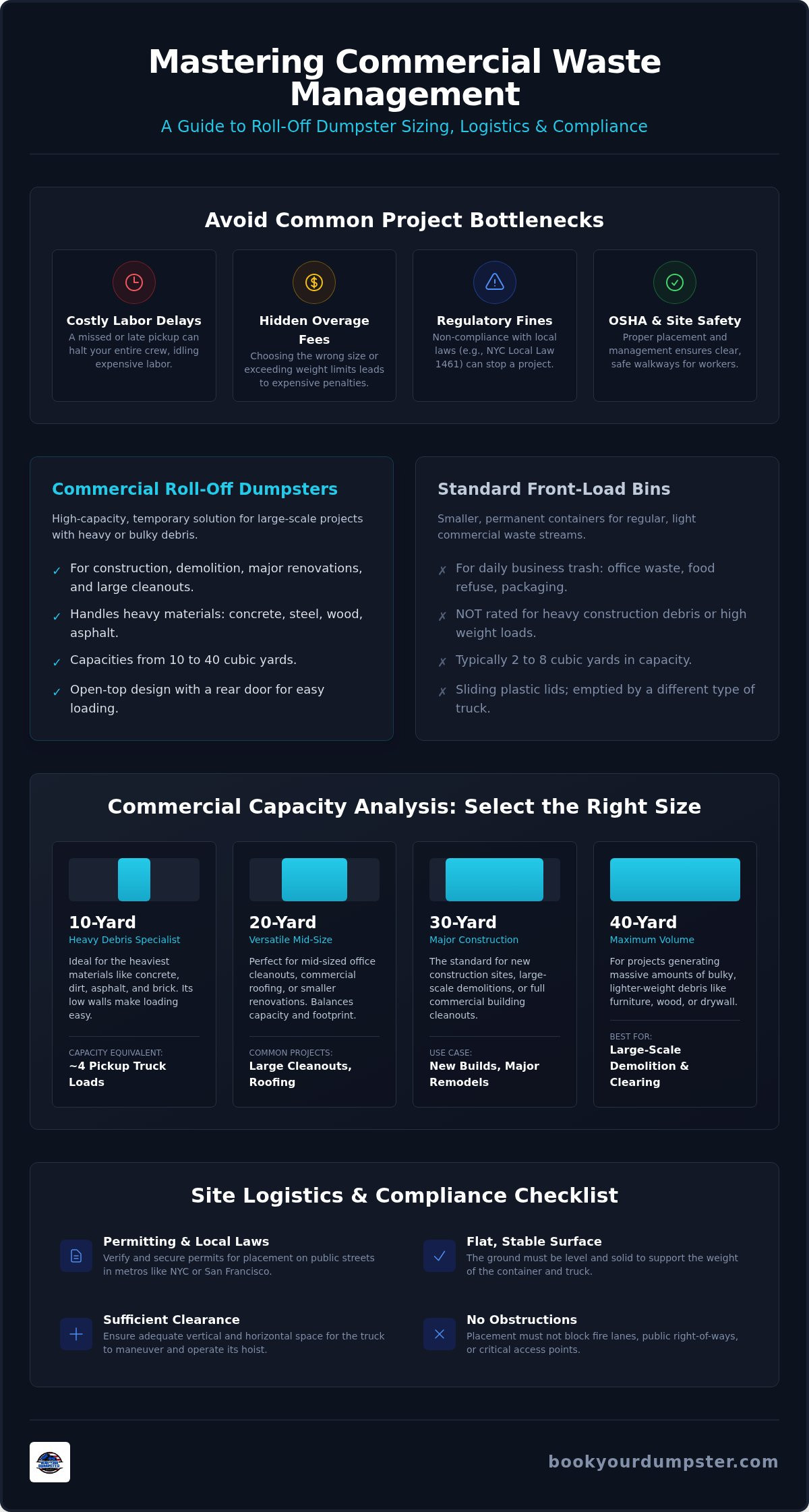
A commercial roll-off dumpster service provides temporary, high-capacity containers designed to handle large-scale debris that standard trash pickup cannot accommodate. Unlike the permanent front-load bins you see behind retail stores or restaurants, these containers are delivered for a specific project duration. They feature an open-top design and a rear swing door, making it easy to load bulky materials. Contractors, developers, and facility managers rely on these services to maintain site safety and manage the heavy outflow of materials during construction or cleanouts.
The technical side of this service is defined by the "roll-off" mechanism. To understand the mechanics, you can research What is a Roll-Off Dumpster? to see how specialized trucks operate. A hydraulic hoist tips the truck bed, allowing the container to roll off onto the ground using a winch and cable system. This process requires significant overhead clearance and a flat, stable surface. You must ensure your site has enough room for the truck to maneuver and a clear path that doesn't obstruct fire lanes or public right-of-ways.
When Your Business Needs a Roll-Off Instead of a Front-Load
Base your decision on waste volume and material type. If your project generates more than 8 cubic yards of debris, standard bins are insufficient. Front-load containers are built for light office refuse and food waste; they aren't rated for the weight of concrete, steel, or heavy timber. For 2026 commercial renovations, roll-offs are the industry standard because they handle massive weight loads without equipment failure. If you're gutting a retail space or clearing a construction site, a 20 or 30-yard roll-off is the right tool for the job.
The Logistics of Commercial Waste Hauling
Effective waste management is a matter of timing and placement. Specialized trucks must navigate tight commercial alleys and busy urban streets in metros like Queens or San Francisco. A commercial roll-off dumpster service is a logistics-heavy waste solution designed for high-volume debris management during finite project timelines. At Book Your Dumpster USA, we prioritize punctuality so your crew isn't standing idle. We use a digital-first scheduling system to place 10, 20, 30, or 40-yard bins exactly where they're needed. Proper placement prevents site congestion and keeps your project moving toward its next milestone.
Commercial Capacity Analysis: Selecting the Right Size for Your Project
Choosing the wrong container size is the fastest way to blow your project budget. If the bin is too small, you'll pay for extra hauls. If it's too large, you're paying for unused space. A professional commercial roll-off dumpster service requires a precise understanding of material density and volume. Before you book, evaluate the physical footprint available on your job site. A 10-yard bin fits easily in a single parking stall; however, a 40-yard container requires a clear path of at least 60 feet for the truck to drop and retrieve the load safely.
Weight limits are the most critical factor in your selection. Heavy debris like concrete, asphalt, or steel must be managed in smaller containers to avoid exceeding the truck's lifting capacity or legal road weight limits. While managing these materials, you must also adhere to Federal Waste Regulations to ensure hazardous components are handled correctly. Overloading a bin doesn't just lead to overage fees; it can stall your entire project if a hauler refuses to pick up an unsafe load. Use a conservative estimate for your debris volume to maintain a buffer for unexpected waste.
The 10 and 20-Yard Advantage for Heavy Debris
Use the 10-yard dumpster for your heaviest materials. It's the industry standard for concrete, dirt, and brick because its low walls make it easy to load with a skid steer. One 10-yard container holds roughly 50 to 60 standard trash bags or the equivalent of four pickup truck loads. For mid-sized office cleanouts or commercial roofing projects, step up to the 20-yard bin. This size offers double the capacity while maintaining a manageable footprint, making it ideal for sites with limited staging areas. You can view container dimensions online to ensure the bin fits your specific loading zone before scheduling delivery.
High-Volume Solutions: 30 and 40-Yard Containers
Deploy 30 and 40-yard containers for large-scale demolition and new construction. These high-volume bins are designed for bulky, light-weight waste like drywall, cardboard, and wooden pallets. A 40-yard dumpster provides the maximum capacity allowed for roll-off transport, holding approximately 12 to 15 pickup truck loads. On high-velocity sites, coordinate with your waste partner for "swap out" services. This ensures that as soon as one bin is full, a fresh one is dropped in its place. This seamless rotation prevents debris from piling up and keeps your crew focused on production rather than waste management.
Industry-Specific Waste Management Strategies
A reliable commercial roll-off dumpster service is not a one-size-fits-all product. Different sectors face unique logistical hurdles, from strict OSHA safety standards on active builds to the aesthetic demands of high-end retail malls. Effective waste management requires a strategy tailored to your specific industry constraints. You must align your container selection and pickup frequency with the pace of your operations to avoid site congestion and safety violations.
Facility managers overseeing corporate relocations often face massive volumes of furniture and office equipment. Coordinate multi-bin deployments to handle different waste streams simultaneously. This ensures that sensitive materials are handled according to EPA waste management regulations while standard refuse is cleared quickly. For projects aiming for green building status, use separate containers for wood, metal, and concrete. This source-separation supports LEED certification by providing clear documentation of your waste diversion efforts.
Contractor and Construction Waste Solutions
On a busy construction site, waste management is a safety priority. Piles of debris create trip hazards and obstruct emergency exits. Use roll-off containers to maintain clear walkways and stay compliant with OSHA site standards. Timing is everything for a productive crew. A full bin that isn't swapped out promptly can stall your entire project. Schedule punctual "swap-outs" to keep your labor moving and prevent debris from accumulating on the ground. For a deeper dive into these logistics, read The Ultimate Guide to Construction Debris Removal in 2026.
Retail and Office Renovation Logistics
Retail projects require surgical precision to minimize business interruption. If you're managing a mall cleanout or store opening, place bins in areas that don't block customer parking or pedestrian traffic. High-volume packaging waste like cardboard and plastic film can quickly overflow smaller bins. Use a 30 or 40-yard container for these light but bulky materials to maximize your space.
Protect your budget from unauthorized public dumping. Secure your bins with locks or place them in well-lit, fenced areas during off-hours. This prevents locals from filling your container with household trash, which often leads to unexpected weight overages. If you're ready to secure a bin for your next project, schedule your delivery online to lock in your timeline and maintain total control over your site logistics.
Navigating Local Regulations and Permitting in Major Metros
Operating a commercial roll-off dumpster service in 2026 requires more than just a truck and a bin. You must navigate a complex web of city-specific mandates that can stall your project if ignored. In high-density areas like Queens or San Francisco, space is a premium commodity. Placing a container on a public street without the correct paperwork leads to immediate stop-work orders and heavy municipal fines. You must secure your permits well before the scheduled delivery date to ensure a seamless drop-off.
Local regulations vary significantly by region. For example, New York City's Local Law 1461 requires all buildings to use secure, rodent-proof trash bins by June 2026. Additionally, the implementation of Local Law 199 has divided the city into 20 commercial waste zones. If your project is in Midtown South or Staten Island, the customer sign-up period begins July 1, 2026, with full implementation required by August 31, 2026. You must contract with an authorized hauler for your specific zone to remain compliant. In Chicago, you'll need to provide proof of at least $1,000,000 in insurance to secure a permit for any dumpster placed in the public way.
Urban Placement: Queens and San Francisco Case Studies
Limited space and sidewalk clearance are your primary hurdles in urban centers. In San Francisco, strict waste diversion mandates require you to separate recyclables from landfill debris on-site. Failure to do so can result in rejected loads and additional sorting fees. When working in New Jersey or Massachusetts, pay close attention to "Right-of-Entry" forms. These documents protect both the property owner and the hauler during placement on private lots. To understand the specific requirements for your region, consult Dumpster Rental in New York, Illinois, and Massachusetts: The 2026 Complete Guide.
Prohibited Materials and Commercial Compliance
Your commercial roll-off dumpster service is not a catch-all for every material. Federal EPA regulations under the Resource Conservation and Recovery Act (RCRA) strictly define what qualifies as hazardous waste. As of May 8, 2026, the EPA has withdrawn a proposed rule that would have expanded these definitions, but the core restrictions remain. You cannot dispose of batteries, solvents, or electronics in a standard roll-off. Improper disposal can lead to EPA penalties as high as $87,249 per day, per violation in 2026. Maintain thorough documentation of your waste streams for corporate environmental audits to prove your site meets all local and federal safety standards.
Don't let permitting delays or compliance issues derail your timeline. Book your commercial dumpster online today to secure your equipment and get expert guidance on local placement regulations.
Streamlining Commercial Waste with Book Your Dumpster USA
Waste management is a critical utility for any construction or renovation project. It shouldn't be a recurring source of stress. Many traditional haulers still rely on manual phone tag and opaque invoices that hide surcharges until the project is finished. We've modernized the commercial roll-off dumpster service by stripping away this administrative friction. We prioritize reliability and pricing integrity. This approach ensures your project stays on schedule and your financial reports remain accurate without surprise overage fees.
Customized hauling schedules are essential for long-term commercial projects. We don't just drop a bin and disappear. We work with you to establish a cadence that matches your debris production. This prevents site congestion and ensures that your crew always has a place to put waste, keeping your walkways clear and your site compliant with OSHA safety standards. Our goal is to function as a high-performance tool in your project management arsenal.
The Modern Way to Book Commercial Roll-Offs
Efficiency starts with the right interface. Our digital-first platform allows you to plan your project logistics at any hour. You don't have to wait for a regional office to open to schedule a haul or check a container's status. This level of control is vital for high-velocity sites where every hour represents significant labor costs.
- Access 24/7 project planning for immediate scheduling from any device.
- Manage multiple 10, 20, 30, or 40-yard containers across various job sites through a single account.
- Receive real-time logistical updates to better coordinate your crew's movements.
- Eliminate the "hidden fee" culture with transparent, upfront pricing structures.
Your Partner in Professional Debris Management
Local expertise is your greatest asset in cost control. We understand the specific nuances of operating in New York, New Jersey, Illinois, Massachusetts, and San Francisco. Whether you need a 10-yard bin for a heavy concrete pad or a 40-yard container for a massive corporate relocation, we handle the logistics of the drop-off and pickup with surgical precision. We know the local permitting requirements and urban clearance needs that often trip up national providers.
We treat your job site with professional respect. Our drivers are trained to prioritize property protection and site safety during every delivery. We use precise placement techniques to prevent damage to your asphalt or concrete surfaces. You get a partner who understands the high stakes of commercial development and renovation. It's time to move away from unreliable delivery windows and confusing billing. Secure your commercial roll-off dumpster today and experience a more reliable, transparent way to manage your project waste.
Take Control of Your 2026 Project Logistics
Efficient waste management in 2026 is a strategic component of your project's success. You've learned how selecting the right container size and mastering local urban mandates prevent budget overages and site delays. Integrating a commercial roll-off dumpster service into your workflow ensures that debris management never becomes a bottleneck for your crew. By prioritizing transparency and digital-first scheduling, you maintain total control over your job site from delivery to final pickup.
Don't let logistical friction or hidden fees stall your progress. We provide the 10, 20, 30, and 40-yard containers you need with specialized expertise in New York, New Jersey, Illinois, Massachusetts, and San Francisco. Our streamlined system is designed to move as fast as your business does, removing the stress of waste hauling so you can focus on the build. Book your commercial roll-off dumpster online today to secure your equipment and keep your project moving toward a successful completion.
Frequently Asked Questions
What is the difference between a roll-off dumpster and a commercial front-load bin?
A roll-off dumpster is a temporary, high-capacity container designed for large-scale debris management during construction or cleanout projects. In contrast, a commercial front-load bin is a permanent fixture used for standard daily waste at retail or office locations. Roll-off containers feature rear swing doors and an open-top design for easy loading of bulky materials. Front-load bins are much smaller and are emptied on a recurring schedule by trucks using front-mounted forks.
Do I need a permit for a commercial roll-off dumpster in New York City?
You must obtain a permit if the dumpster is placed on a public street or sidewalk in New York City. These permits are issued by the Department of Transportation (DOT) and are required for any container sitting in the public right-of-way. If the dumpster is placed entirely on private property, a permit is typically not necessary. Always secure your street permit before the truck arrives to avoid stop-work orders or municipal fines.
How much weight can a 40-yard commercial dumpster hold?
A 40-yard dumpster holds approximately 12 to 15 pickup truck loads, but its weight capacity is capped by legal road limits and truck lifting power. While it is perfect for bulky, light materials like cardboard, drywall, or furniture, you must never fill it with heavy debris like concrete or dirt. Overloading a 40-yard bin makes it impossible for the truck to lift safely and will result in a rejected pickup and additional fees.
Can I rent multiple dumpsters for different commercial sites simultaneously?
You can rent and manage multiple containers across different job sites through our digital-first booking platform. This commercial roll-off dumpster service feature is built for contractors and facility managers who oversee high-volume projects in multiple cities like Chicago and San Francisco. Our online system allows you to track deliveries, swap-outs, and pickups for every unique location from a single account, ensuring total logistical control over your waste streams.
What happens if my commercial dumpster exceeds the weight limit?
If your container exceeds the agreed weight limit, you'll incur overage fees based on the extra tonnage. In cases where the load is too heavy for the truck to lift safely, the hauler will refuse the pickup until you remove enough material to meet safe limits. This causes project delays and added haul fees. Estimate your debris weight carefully and use a 10-yard bin for heavy materials like concrete to avoid these issues.
Are there specific items prohibited in commercial roll-off dumpsters?
You cannot place hazardous materials such as batteries, solvents, tires, electronics, or asbestos in a commercial roll-off dumpster service. These items are strictly regulated under EPA standards and are prohibited at standard landfills. Mixing hazardous waste with general debris leads to severe fines and the rejection of your entire load at the transfer station. Check local guidelines in your metro area for designated hazardous waste collection centers to ensure proper disposal.
How soon can a commercial roll-off dumpster be delivered?
Use our streamlined online booking system to check real-time availability and secure the fastest possible delivery window for your site. While timing depends on your specific location and current demand, we prioritize punctuality to keep your project on schedule. Scheduling your delivery at least 24 to 48 hours in advance is the best way to ensure the specific 10 to 40-yard container size you need is ready for your job site.
Does Book Your Dumpster USA provide recycling reports for LEED projects?
We support green building initiatives by providing documentation for waste diversion to assist with LEED certification. If your project requires specific reporting on recycling percentages for materials like wood, metal, and concrete, request this during the booking process. We help you track your environmental impact and meet local 2026 waste recycling mandates in San Francisco and other major metros through accurate, professional reporting of your waste streams.


