Most businesses treat trash as an afterthought, but in high-regulation states like New York, Illinois, and Massachusetts, an unoptimized waste contract is a silent drain on your profit margins. Between the NYC Business Integrity Commission's rate increases effective August 2024 and the upcoming 2026 organics diversion mandates, the cost of "doing things the old way" is rising fast. You deserve a partner who handles the heavy lifting without the hidden surcharges or the headache of missed pickups disrupting your workflow.
It's frustrating to deal with confusing zoning laws or the new battery recycling programs in Illinois when you're trying to run a company. We understand that you need predictable costs and a logistics partner that operates with total transparency. By mastering the logistics of commercial waste services, you can eliminate operational friction and ensure your business stays ahead of strict state-level enforcement. This is especially critical in Massachusetts, where the threshold for the commercial food waste disposal ban is already in effect for those generating over one-half ton per week.
This guide shows you how to right-size your disposal strategy to reduce overhead and maintain compliance. We'll explain how to navigate the shift toward commercial waste zones and implement a "set it and forget it" system for your front load or private curbside needs.
Key Takeaways
- Treat waste management as a critical utility to identify hidden inefficiencies and reduce your business overhead.
- Select the most efficient container for your needs by comparing recurring commercial waste services with roll-off solutions for large projects.
- Navigate complex local regulations like NYC's Commercial Waste Zones and Local Law 199 to ensure total regulatory compliance.
- Develop industry-specific strategies to manage high-volume retail packaging or restaurant organics without disrupting your daily workflow.
- Transition to a digital-first logistics partner to streamline your booking process and eliminate the stress of manual scheduling.
Understanding Commercial Waste Services as a Business Utility
Think of your waste disposal the same way you think about your internet connection or power bill. It's a fundamental utility, not an optional service. Reliable commercial waste services provide the logistical backbone for businesses operating in high-demand markets like New York, New Jersey, Illinois, Massachusetts, and San Francisco. When these systems fail, your daily operations stop. Efficient waste management reduces overhead by preventing costly municipal fines and optimizing the physical footprint of your facility. Using high-functioning commercial waste services isn't just about moving garbage. It's about maintaining a safe, compliant, and professional environment where your team can focus on their work.
A breakdown in waste logistics creates a ripple effect. If a bin isn't emptied, it takes up valuable square footage. It forces employees to find workarounds that compromise safety and health standards. By treating your waste contract as a critical utility, you move from a reactive mindset to a proactive one. This transition ensures that your disposal capacity always matches your production volume. You avoid the stress of clutter and maintain total control over your facility's output.
The Role of Waste Management in Business Operations
Congested loading docks and overflowing bins create immediate safety hazards. These issues often lead to health code violations and significant project delays. Regular pickups ensure your site remains clear and fully functional. A cluttered exterior also damages your brand's reputation before a customer even walks through the door. Commercial waste is the systematic removal of business-generated debris to ensure operational continuity. High reliability in this sector is non-negotiable for maintaining a professional image and meeting safety standards.
Project-Based vs. Recurring Waste Services
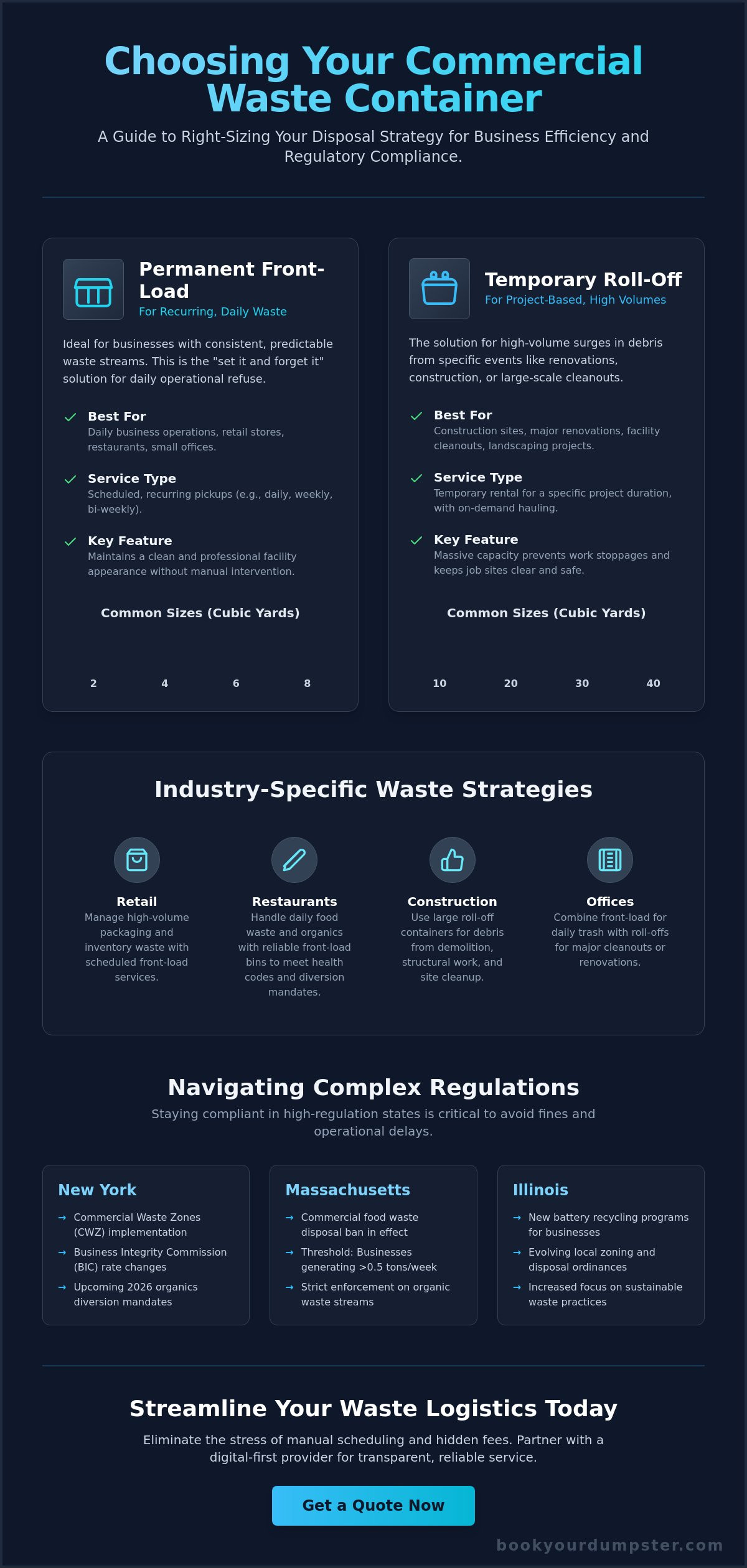
Businesses typically require two distinct types of logistical support. Recurring services handle the consistent output of daily operations. This includes Front load Commercial Waste Pickup for standard refuse or Private Curbside Trash Pickup for smaller storefronts. These are the permanent fixtures of your operational budget that require a set it and forget it approach to keep things running smoothly.
Project-based needs arise during specific phases like renovations, office cleanouts, or construction. These scenarios require temporary roll-off containers rather than permanent bins. You must choose the right tool for the specific volume of debris you generate. A 10 yard dumpster works for small interior remodels. Larger projects, such as full-floor gutting or structural work, require 20, 30, or 40 yard dumpsters to prevent work stoppages. Common triggers for upgrading your service level include increased inventory throughput, on-site structural changes, or new local mandates. Visit Book Your Dumpster USA to match your equipment to your current project scale.
Front-Load vs. Roll-Off: Choosing the Right Commercial Container
Choosing between permanent and temporary containers is the most effective way to control your waste budget. While both fall under the umbrella of commercial waste services, they serve entirely different logistical functions. Permanent containers provide a steady, recurring solution for daily refuse. Temporary roll-off rentals handle the high-volume surges common during renovations or facility cleanouts. Matching the container type to your specific waste stream prevents you from paying for empty space or facing surcharges for overfilled bins. Proper container selection is a technical decision that impacts your facility's safety and operational flow.
Placement is just as critical as container size. Ensure your designated waste area provides clear, unobstructed access for heavy trucks. Blocked enclosures lead to missed pickups and service delays that disrupt your business. Consult the EPA's guide for commercial buildings to optimize your facility layout for maximum efficiency. When you align your container type with a strategic placement plan, you eliminate the friction that usually accompanies waste disposal.
Permanent Front-Load Dumpsters
Front-load dumpsters are the standard for retail, office, and restaurant operations. These units typically range from 2 to 8 cubic yards. Smaller 2-yard bins work well for boutique shops with minimal refuse, while 8-yard bins accommodate high-volume restaurants or large office complexes. You can schedule Front load Commercial Waste Pickup on a daily, weekly, or bi-weekly basis depending on your generation rate. Prioritize units with secure lids to deter pests and prevent unauthorized dumping. Many municipalities require specific enclosures to maintain local aesthetic standards; check your local zoning before installation to avoid fines.
Temporary Roll-Off Rentals for Commercial Projects
Temporary projects require larger capacities than a standard front-load bin can provide. A 10 yard dumpster is often the "goldilocks" size for small commercial renovations, such as flooring upgrades or office gutting. For more detailed specs, read this 10 Yard Dumpster Rental: The Complete Buying Guide for 2026. If your project involve heavy debris like concrete, brick, or roofing materials, you'll need the structural integrity of 20 or 30-yard bins. For massive industrial cleanouts or full-scale construction, the 40 yard dumpster provides the maximum volume allowed on a single haul. Use these larger bins to keep your job site clear and compliant. If you aren't sure which size fits your current project, schedule your next pickup with a specialist who can right-size your order.
Industry-Specific Waste Management Strategies
Generic waste solutions fail because they ignore the specific volume and material types of your industry. A boutique in Soho requires a different logistical approach than a demolition project in Chicago or a restaurant in Boston. Effective commercial waste services must be tailored to these unique demands to prevent service gaps and unnecessary costs. Federal standards set by the Resource Conservation and Recovery Act (RCRA) mandate how businesses handle solid waste. Compliance starts with choosing the right service model for your sector.
Property managers in Queens and the wider NYC area face the challenge of coordinating multi-tenant waste streams. Managing these logistics requires a centralized system to avoid sidewalk clutter and DSNY fines. Implementing Front load Commercial Waste Pickup for larger complexes or scheduled curbside services for smaller units ensures the building remains navigable and compliant with the latest municipal standards. Don't let tenant waste become a liability; establish a clear disposal schedule that matches the building's total occupancy and output.
Construction Debris and Contractor Logistics
Construction and demolition sites operate on razor-thin schedules. Debris accumulation isn't just an eyesore; it's a safety hazard that causes project delays and potential OSHA violations. Use on-demand roll-off services to keep your site clear and your workers safe. For a deep dive into managing these workflows, see The Ultimate Guide to Construction Debris Removal in 2026. Whether you need a 20 yard dumpster for a renovation or a 40 yard dumpster for a commercial gut-out, match the container to your debris type to maintain safety standards and avoid weight limit surcharges.
Retail and Office Waste Optimization
Retailers and office managers often pay for "empty air" by using oversized containers. Right-size your bins based on your actual weekly output to keep costs predictable. For urban storefronts with limited space, Private Curbside Trash Pickup offers a flexible solution that keeps sidewalks clear during business hours. High-volume cardboard and paper waste should be flattened and bundled to maximize bin space. This simple logistical adjustment reduces the frequency of necessary pickups and lowers your overall commercial waste services expenditure. Audit your waste stream quarterly to ensure your container size and pickup frequency still align with your business volume.
Navigating Local Regulations and Compliance in Major Hubs
Compliance in major metropolitan hubs is a logistical requirement that directly impacts your bottom line. In New York City, the Business Integrity Commission (BIC) set maximum rates effective August 31, 2024, at $26.87 per cubic yard of loose refuse. If your establishment generates more than one gallon of trade waste within a seven-day period, you must hire a private carter for disposal. Failing to secure documented commercial waste services leads to heavy municipal fines and potential operational shutdowns. Beyond NYC, states like Massachusetts have lowered the threshold for the commercial organic waste disposal ban. Any business producing more than one-half ton of food waste per week must now divert that material from the landfill.
Staying ahead of these mandates prevents the "hidden fees" and surcharges that often plague unoptimized waste contracts. Illinois recently updated its universal waste regulations for paint and paint-related waste as of August 21, 2025. This change altered reporting requirements for businesses across the state. Treat compliance as a moving target. It requires a partner who understands the specific effective dates and volume thresholds for your region. By Jan 1, 2026, NYC businesses generating at least one ton of organic waste per week must also comply with new diversion mandates. Early preparation ensures you avoid the rush and the penalties associated with non-compliance.
The NYC Commercial Waste Zone Initiative
The rollout of the Commercial Waste Zones (CWZ) program is the largest overhaul of NYC sanitation in decades. The city is divided into 20 zones, with only three authorized carters allowed to operate in each. Business owners in zones like Queens West and Northeast must transition to these authorized providers as the program rolls out to avoid service gaps. This initiative aims to reduce truck traffic and improve safety, but it requires businesses to sign new, specific service agreements. For a deeper look at these regional requirements, read our Dumpster Rental in New York, Illinois, and Massachusetts: The 2026 Complete Guide.
Permits and Street Placement Logistics
Placing a roll-off dumpster on a public street in Chicago or San Francisco requires a specific permit from the local Department of Transportation. In Chicago, if a container blocks a sidewalk or occupies a metered parking space, you must secure a public-way permit before delivery. Similarly, San Francisco mandates street space permits for any container not placed on private property. Managing sidewalk and street access for front-load trucks is also critical; drivers need clear clearance to safely maneuver heavy equipment. Compliance is ultimately the business owner’s responsibility, but a high-functioning hauler simplifies the permit and placement process by providing the necessary technical specs. To ensure your next project meets all local standards, book your compliant waste solution today.
Streamlining Your Business Logistics with Book Your Dumpster USA
Traditional waste management often relies on outdated phone tag and opaque pricing structures that leave business owners guessing. Book Your Dumpster USA replaces this friction with a digital-first approach designed for the modern economy. By optimizing your commercial waste services through an intuitive online booking system, you eliminate the administrative burden of coordinating pickups. This platform provides immediate clarity on container availability and scheduling, allowing you to manage your facility’s output with a few clicks. Whether your operation requires a single 10 yard dumpster for a retail refresh or a complex multi-site schedule for Front load Commercial Waste Pickup, the system scales to meet your specific volume requirements.
Pricing integrity is the foundation of our service model. We identify the "hidden fee" trap that often plagues standard commercial contracts and remove it through transparent, upfront terms. You won't find unexpected fuel surcharges or environmental fees buried in fine print. This focus on honesty acts as a verbal handshake, ensuring that the price you see during the booking process is the price you pay. For businesses operating across state lines, this consistency is vital for maintaining predictable overhead and simplified accounting. Modernizing commercial waste services means providing a high-functioning tool that respects your budget and your time.
The Digital Advantage in Waste Management
Facility managers handle dozens of competing priorities every day. Online scheduling saves hours of administrative labor by providing a centralized dashboard for all waste logistics. You can adjust service frequencies or order additional 20, 30, or 40 yard dumpsters for unexpected surges without making a single phone call. Real-time logistics ensure that punctuality remains a core service promise. We understand the local landscapes of NY, NJ, and IL, from the tight alleys of Chicago to the complex commercial zones of New York. This regional expertise, combined with digital speed, ensures your waste is moved exactly when promised.
Ready to Resolve Your Waste Challenges?
You have moved from a state of logistical clutter to a state of professional resolution. You now understand how right-sizing your containers and staying ahead of local mandates like NYC’s Local Law 199 can protect your profit margins. Don't let waste management remain a source of operational stress. Transition to a partner that treats your debris removal as a critical, high-efficiency utility. Pick your container, select your schedule, and return your focus to growing your business. Use our streamlined system to experience the difference that transparent, professional logistics can make for your bottom line. Book Your Commercial Dumpster Online Today.
Take Control of Your Waste Logistics
Efficient waste management is a competitive advantage. By treating your disposal needs as a critical utility, you eliminate the operational bottlenecks that drain your time and budget. Right-sizing your equipment is the first step toward reducing overhead. Whether you need a 10 yard dumpster for a small renovation or recurring front-load pickups, matching your service level to your actual output ensures you never pay for empty air. Staying compliant with evolving regulations in hubs like NYC or Chicago is no longer a burden when you partner with a high-functioning logistics expert.
Our streamlined online booking system removes the friction from traditional commercial waste services. We leverage deep expertise in local regulations across NY, NJ, IL, MA, and SF to keep your business running smoothly. You get no-nonsense pricing integrity and a dependable schedule you can trust. Stop managing clutter and start managing growth with a partner that values your time as much as you do. Streamline your business waste logistics at BookYourDumpster.com. Your operations deserve the clarity and reliability of a modern disposal strategy.
Frequently Asked Questions
What is the difference between commercial waste service and residential junk removal?
Commercial waste service is a recurring or project-based utility designed specifically for business-generated trade waste and debris. Unlike residential junk removal, which often focuses on one-time furniture or appliance disposal, commercial waste services ensure operational continuity and municipal compliance. Businesses must adhere to strict volume thresholds and disposal mandates that do not apply to standard households.
How do I know what size dumpster my business needs for a renovation?
Select your container based on the debris type and the total square footage of the project. A 10 yard dumpster is the standard choice for small interior refreshes or flooring upgrades. Use 20 or 30 yard dumpsters for heavier materials like brick, concrete, or roofing. For full-scale gut-outs or large commercial construction projects, order a 40 yard dumpster to prevent work stoppages and site congestion.
Are there items that are prohibited in commercial dumpsters?
Hazardous materials, liquids, and specific regulated electronics are prohibited in all commercial containers. In Illinois, you must manage paint as universal waste as of August 21, 2025, and prepare for new battery recycling programs starting in 2026. Massachusetts and New York also have strict bans on disposing of large volumes of organic food waste in standard trash bins. Always check local mandates to avoid heavy non-compliance fines.
How often can commercial waste be picked up in cities like New York or Chicago?
Pickup frequency is determined by your business’s waste generation rate and available storage space. In New York City, any establishment generating more than one gallon of trade waste in a seven-day period must secure a private carter contract. You can schedule Front load Commercial Waste Pickup daily, weekly, or on a custom recurring cadence. This ensures your facility stays clear of overflow and meets local sanitation standards.
Do I need a permit for a commercial roll-off dumpster on my property?
Permits are typically not required if the container stays entirely on private property like a parking lot or loading dock. You must secure a permit from the local Department of Transportation if the dumpster occupies any part of a public street or sidewalk. In cities like Chicago or San Francisco, failing to obtain a public-way permit before delivery results in immediate fines and equipment removal. Verify your placement area before scheduling your delivery.
What happens if my business generates more waste than my current container allows?
Right-size your service level immediately to prevent safety hazards and overflow surcharges. You can increase the frequency of your Private Curbside Trash Pickup or upgrade to a larger permanent bin. Using our digital platform allows you to adjust your service volume as your business throughput changes. Proactive adjustments keep your overhead predictable and your facility in a state of professional resolution.
How do the new NYC Commercial Waste Zones affect my existing service?
The NYC Commercial Waste Zones (CWZ) program requires every business to transition to one of the three authorized carters assigned to their specific zone. This overhaul moves the city from an open-market system to a zoned system to improve safety and reduce truck traffic. You will be required to sign a new service agreement with an authorized provider as the rollout reaches your neighborhood. Stay informed on your zone’s effective date to avoid service gaps.
Can I schedule a one-time commercial pickup for a large cleanout?
Yes, use a temporary roll-off container for one-time events like inventory liquidations, office cleanouts, or renovations. Choose from 10, 20, 30, or 40 yard dumpsters to handle the surge in volume without disrupting your standard commercial waste services. This provides a high-functioning tool for managing large-scale debris removal while maintaining your daily operational flow. Simply pick your size and schedule your delivery online for immediate resolution.


