

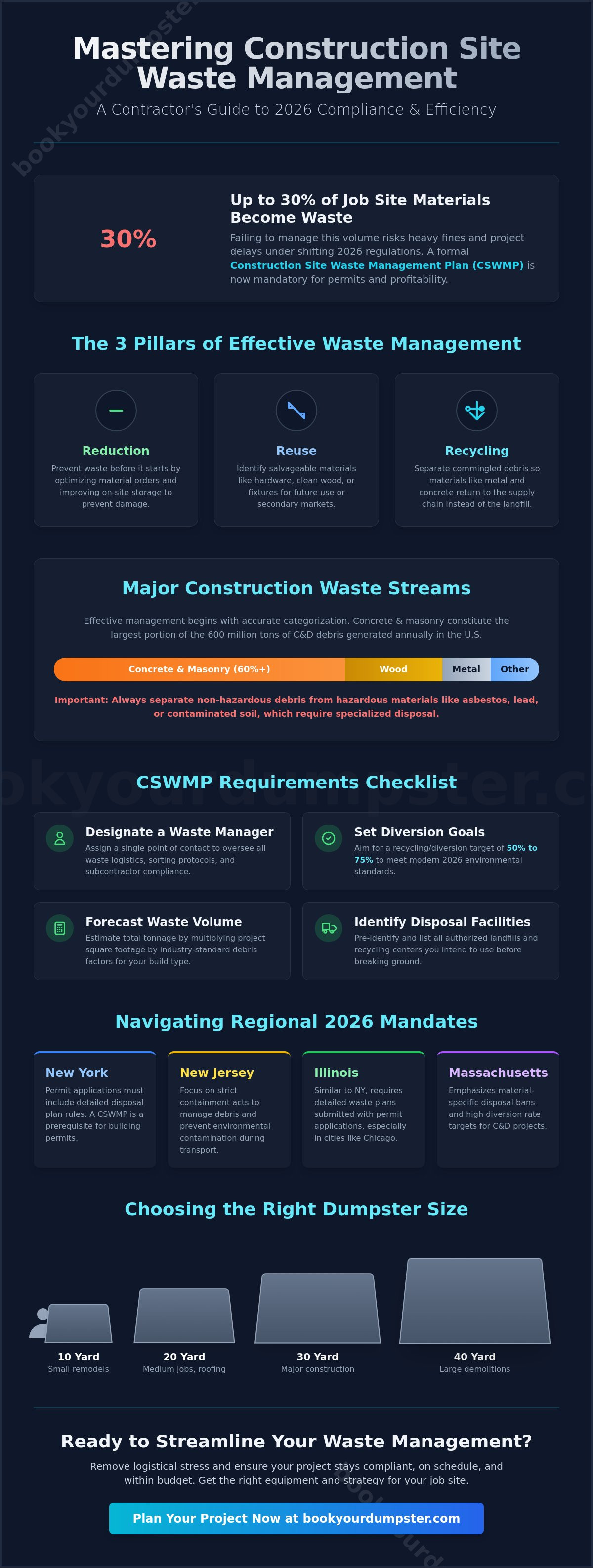
Up to 30% of the materials delivered to your job site will end up as waste before the project is finished. Managing that volume while keeping up with shifting 2026 regulations in cities like New York or Chicago is a major logistical burden. You shouldn't have to risk heavy fines or project delays because of a paperwork error. Meeting the latest construction site waste management plan requirements is now a mandatory step for securing permits and protecting your bottom line.
We understand that you need to focus on building, not deciphering complex environmental codes. This guide provides a clear, actionable checklist to help you master legal compliance and optimize site efficiency. You'll learn exactly what needs to be in your plan to satisfy local inspectors and how to scale your waste strategy using 10 to 40 yard dumpsters. We'll break down the latest 2026 mandates, including New York’s new disposal plan rules and New Jersey's containment acts, so you can stay ahead of the curve and keep your budget intact. Follow these steps to remove logistical stress and maintain full control over your site's environmental footprint.
Key Takeaways
- Learn how the 2026 regulatory shift toward higher diversion rates impacts your permitting and project timelines.
- Use our checklist to master all construction site waste management plan requirements, including debris forecasting and designated site management.
- Determine the best equipment strategy for your site by matching dumpster sizes to your specific waste volume and sorting needs.
- Navigate regional legal nuances in states like New Jersey and New York to avoid costly fines and service interruptions.
- Implement an effective on-site strategy by training subcontractors and designating a leader to oversee waste logistics.
What is a Construction Site Waste Management Plan (CSWMP)?
A Construction Site Waste Management Plan (CSWMP) is a formal logistics document that dictates how a project handles debris from groundbreaking to final inspection. It's a high-functioning tool designed to remove logistical stress by mapping out the collection, transport, and disposal of all materials. In 2026, this plan is no longer optional for professional contractors. It serves as your primary defense against unexpected costs and regulatory delays. By establishing construction site waste management plan requirements early, you ensure your project stays on schedule and within budget.
The industry has shifted toward aggressive diversion rates. State and local governments now prioritize recycling over landfilling to manage the 600 million tons of C&D debris generated annually. Your plan's primary goal is to maximize site safety while minimizing environmental impact. A cluttered site is a dangerous site. A well-executed CSWMP keeps your footprint small and your workers safe. Focus your efforts on the three pillars of waste management:
- Reduction: Prevent waste before it starts by optimizing material orders and improving storage to prevent damage.
- Reuse: Identify materials like hardware, clean wood, or fixtures that can be salvaged for future phases or secondary markets.
- Recycling: Separate commingled debris to ensure materials like metal and concrete return to the supply chain instead of the landfill.
Legal and Regulatory Compliance Obligations
Federal EPA guidelines set the baseline for non-hazardous waste, but local mandates carry the most weight. In 2026, many jurisdictions require a submitted waste plan as a prerequisite for building permits. This is especially true in regions like New York and Illinois, where permit applications must include detailed disposal strategies. If you're pursuing LEED certification, your plan is the backbone of your sustainability score. You must document every ton of diverted material to meet these rigorous standards. Don't let a lack of documentation stall your project or result in heavy non-compliance fines.
Identifying Major Waste Streams
Effective management starts with accurate categorization. Demolition waste typically includes heavy materials like concrete and masonry, which make up over 60% of the C&D stream. You also need to account for wood, metal, and drywall. Separate your non-hazardous debris from hazardous materials immediately. Handling lead, asbestos, or contaminated soil requires specialized protocols. Always consult our hazardous waste disposal guidelines to identify which materials cannot go into a standard dumpster. Clear labeling and sorting prevent cross-contamination and keep your disposal costs predictable.
The Essential Construction Waste Plan Requirements Checklist
Build your plan on a foundation of specific data. Every successful project starts with a clear project overview that identifies the site address, estimated duration, and the designated waste manager. Accountability is non-negotiable. Your designated manager must oversee all construction site waste management plan requirements to ensure subcontractors follow sorting protocols from day one. Without a single point of contact, your plan will likely fail during the first heavy demolition phase. Clear leadership ensures that everyone on site knows exactly where debris goes and who is responsible for the logs.
Establish your diversion goals early. Aim for a recycling target between 50% and 75% to align with modern 2026 environmental standards and local municipal mandates. You must also pre-identify authorized disposal facilities. List every landfill and recycling center you intend to use before you break ground. For a technical deep dive into submittal standards and disposal procedures, refer to the Construction Waste Management and Disposal specifications. This level of detail prevents project stoppages during city inspections and ensures your waste is handled by legitimate, permitted facilities.
Forecasting and Waste Baselines
Estimate your total tonnage before equipment arrives. Calculate expected waste by multiplying your project’s square footage by industry-standard debris factors for your specific build type. Remember that up to 30% of materials delivered to a construction site can end up as waste, so use historical data from your previous jobs to refine these numbers. Overestimating your waste volume leads to paying for unused space in oversized dumpsters. If your forecast suggests a high volume of heavy debris, consider renting a 30 yard dumpster to handle the bulk efficiently without overspending on capacity you don't need.
Documentation and Tracking Procedures
Establish strict tracking procedures to protect your bottom line. Require weight tickets and disposal receipts for every single haul-off from the site. This documentation proves you met your diversion goals and keeps you audit-ready for local inspectors. Set a monthly reporting cadence to update stakeholders on waste costs and recycling percentages. This transparency builds trust and helps you identify inefficiencies in your sorting process. For more advanced tracking tips and logistical strategies, read The Ultimate Guide to Construction Debris Removal in 2026. Consistent reporting removes the guesswork from your overhead and highlights where you can save money on future hauls.
Logistics and Equipment: Choosing the Right Dumpster Sizes
Logistics determine your profit margin. You must select equipment that aligns with your site's physical constraints and the specific construction site waste management plan requirements of your municipality. Start by assessing your site footprint. If you're working in a dense area like Brooklyn or Queens, you might not have room for multiple large containers. However, if local law requires on-site source separation, you must find a way to fit separate bins for wood, metal, and masonry. Evaluate your pick-up frequency carefully. Increasing the size of your container can reduce the number of hauls, but only if the site can accommodate the larger footprint of a 30 or 40-yard unit.
Heavy materials like concrete, brick, and dirt require specialized handling. Standard roll-offs have weight limits that these materials can easily exceed. Using a dedicated container for heavy debris prevents overweight fines and ensures the material can be taken directly to a recovery facility for recycling. This strategy supports your diversion goals and keeps your project compliant with 2026 environmental standards. Efficient equipment scaling ensures that you aren't paying for empty space or facing delays due to overflowing bins. Match your container capacity to your waste forecast to maintain a clean, safe, and profitable job site.
Scaling Equipment: 10, 20, 30, and 40-Yard Options
Select the right tool for the job to avoid logistical bottlenecks. For heavy debris like concrete, masonry, or dirt, a 10-yard container is your best option. It's compact enough for tight urban sites in Queens and stays within weight limits for heavy loads. Read our 10 yard dumpster rental guide to understand how to manage these specialized heavy loads. Our 20 and 30-yard dumpsters serve as the standard for residential renovations and mid-sized commercial builds. They offer the necessary capacity for general debris without taking up excessive space. For major demolition projects or large-scale commercial framing, the 40-yard dumpster is essential. It handles the highest volume of light, bulky debris and minimizes the need for frequent swaps.
Placement and Accessibility Checklist
A waste plan is useless if the truck can't reach the bin. You must ensure a clear, unobstructed path for roll-off trucks to deliver and swap containers. Check for overhead obstructions like power lines, low-hanging trees, or building overhangs that could interfere with the hoisting mechanism. If your site lacks private property for placement, you must secure street permits from the city well in advance. Mark the designated dumpster area clearly to prevent subcontractors from parking in the way. Proper placement prevents site congestion, reduces the risk of property damage, and keeps your crew focused on construction rather than moving trash.
Regional Requirements: NY, NJ, IL, and MA Nuances
Compliance is a moving target. Your construction site waste management plan requirements shift the moment you cross state or city lines. In New York City, the Business Integrity Commission (BIC) oversees every private carter. You must verify your hauler's BIC license before they drop a single container on your site. By early 2026, NYC also requires building permit applicants to submit a formal waste management and disposal plan. This is no longer a suggestion; it is a prerequisite for starting work. Ignoring these local mandates leads to immediate work stoppages and heavy administrative fines.
New Jersey and Massachusetts have some of the country's strictest diversion mandates. New Jersey's 2026 legislative session introduced the Construction Containment and Pollution Prevention Act, requiring contractors to use specific containment measures to prevent site runoff. Meanwhile, Massachusetts has expanded its landfill bans. You cannot dispose of asphalt, brick, concrete, metal, or wood in a standard landfill. These materials must be diverted to recovery facilities. If your plan doesn't account for these specific streams, you'll face rejected loads and increased tipping fees at the gate. Plan for these bans by designating specific containers for heavy debris early in the project.
New York and Queens Compliance
NYC sites must choose between source-separated and co-mingled recycling strategies. Source-separation requires separate bins for metal, wood, and plastic, which is often impossible on cramped Queens job sites. Co-mingled recycling allows for one bin but requires a hauler capable of sorting the debris at a licensed facility. Between January and February 2026, the rollout of Commercial Waste Zones in Queens Northeast and Brooklyn South means you must have a written service agreement with an authorized carter. Reference our guide on Dumpster Rental in New York, Illinois, and Massachusetts to stay updated on these zone-specific changes.
Chicago and Illinois Permit Protocols
Chicago requires a 50% minimum recycling rate for all Construction and Demolition (C&D) projects. To close out your permits, you must submit an Affidavit of Compliance. This document tracks the tonnage of every material diverted from the landfill. As of 2026, the Illinois EPA requires all general construction or demolition debris recovery facilities to hold active permits. Verify that your hauler uses these permitted sites. Materials like clean masonry and wood are effectively banned from Illinois landfills. You must ensure your waste manager understands these local bans to avoid costly fines.
Stay ahead of local inspectors by securing the right equipment now. Select a 20 or 30 yard dumpster to keep your site organized and compliant with all regional laws.
Implementation Strategy: Putting Your Plan into Action
A written plan is only as strong as its execution on the ground. To meet all construction site waste management plan requirements, you must move from paperwork to active site supervision. Designate a 'Waste Champion' immediately. This individual acts as your primary point of contact for hauler coordination and subcontractor compliance. They ensure that your 10 to 40-yard dumpsters are used correctly and that no prohibited materials compromise your recycling streams. Without clear leadership, your diversion goals will disappear under a pile of commingled debris. Accountability at the bin level is the only way to maintain site efficiency.
Start every project with a dedicated waste management kick-off meeting. Train every subcontractor on the specific sorting rules for your site before they swing a hammer. Install high-visibility signage on every container to prevent contamination before it happens. Review your waste logs every Friday afternoon. If you notice a 30-yard bin is consistently overflowing while a 10-yard bin sits empty, adjust your equipment scaling or pick-up frequency immediately. Data-driven adjustments prevent site clutter and save you money on unnecessary hauls. Constant monitoring keeps your overhead low and your site inspection-ready.
Training and Communication on Site
Clear communication prevents costly mistakes. Use bilingual signage to ensure every crew member understands the sorting protocols, regardless of their primary language. Implement a 'zero tolerance' policy for hazardous materials in standard roll-offs. Contaminated loads lead to rejected tons and massive surcharges that can ruin your project's profitability. For specific safety protocols and handling tips, review our Safe Construction Waste Disposal Methods. Keeping your crew informed protects your budget and ensures a high-functioning job site.
Final Reporting and Audit Readiness
Prepare for the final audit long before the job ends. Consolidate every weight ticket and disposal receipt into a final 'Diversion Report' for city inspectors. This document is your primary proof of compliance with 2026 environmental laws in cities like Chicago or New York. Keep digital copies of all records for at least three years post-project to handle any retroactive audits. Finally, perform a cost-benefit analysis. Compare your initial waste forecast against the actual tonnage to refine your strategy for the next project. This cycle of reporting and review turns waste management into a predictable, profitable part of your operation.
Master Your 2026 Waste Logistics
Managing a job site is complex enough without the added stress of regulatory fines or overflowing bins. By now, you understand that accurate forecasting and scaling your equipment from 10 to 40 yards are the keys to a profitable operation. Regional compliance in states like New York, New Jersey, Illinois, and Massachusetts is no longer a suggestion; it's a mandatory step for permit approval and site safety. Adhering to these construction site waste management plan requirements protects your profit margins and ensures your project passes final inspection without delays.
Take control of your site's environmental footprint by implementing the strategies we've discussed. Designate your waste champion, train your crew, and maintain rigorous documentation. We provide the tools you need to succeed with streamlined online booking for 10 to 40 yard containers and expert support for contractor logistics. Our reliable service across NY, NJ, IL, and MA removes the friction from your disposal process. Secure the Right Dumpster for Your Compliance Plan Today and keep your project moving forward with confidence. You've got the checklist; now get to work.
Frequently Asked Questions
What are the basic requirements for a construction waste management plan?
Basic requirements include a project overview, a designated waste manager, and a detailed debris forecast. You must also list target diversion percentages and the specific facilities receiving your materials. These elements form the foundation of most construction site waste management plan requirements in 2026. Clear accountability and specific destination lists ensure your plan passes the initial permit review without unnecessary delays.
Is a waste management plan mandatory for all construction projects in 2026?
Mandates depend on your specific project location and scope. In New York City, 2026 legislation requires these plans for building permit applicants. Chicago has similar rules for most construction and demolition projects. Even if not strictly mandatory in your town, having a plan is a best practice. It prevents logistical chaos and helps you control overhead during heavy demolition phases.
How do I calculate the estimated waste for my construction site?
Calculate your debris by multiplying the square footage of the project by the industry-standard debris factor for that construction type. Industry data shows that up to 30% of materials delivered to a site eventually end up as waste. Use your previous project logs to adjust these baselines. Accurate estimates help you choose between a 20-yard or 40-yard dumpster without wasting budget on empty space.
What is the difference between source-separated and co-mingled recycling?
Source-separated recycling involves using multiple bins on your site to sort wood, metal, and masonry as they are discarded. Co-mingled recycling allows you to put all recyclable materials into a single dumpster for sorting at an off-site recovery facility. Your choice depends on your site's physical space and whether local 2026 laws mandate on-site separation to reduce material contamination.
Can I use a 10-yard dumpster for all types of construction waste?
You can use a 10-yard dumpster for any non-hazardous waste, but it's specifically designed for heavy debris like concrete or soil. Its small footprint is perfect for tight urban sites where space is limited. For general construction or major demolition, you'll likely need 20, 30, or 40-yard options to handle the volume efficiently. Match the container size to your waste stream to avoid overweight fees.
How do LEED requirements affect my construction waste management plan?
LEED certification pushes your construction site waste management plan requirements to a higher level of detail. You must document a minimum diversion rate, often starting at 50% or higher. This requires meticulous record-keeping of every haul, including weight tickets and disposal receipts. Without this paper trail, you won't earn the waste management points necessary for your project's final certification.
What happens if my site fails to meet the recycling goals in the plan?
Non-compliance often leads to municipal fines or delays in closing out your building permits. If your final diversion report fails to meet the goals set in your initial plan, local inspectors may require additional audits or corrective actions. This can stall your project's completion and lead to unexpected administrative costs. Stay on top of your waste logs weekly to ensure you hit your targets.


