Renting the smallest dumpster for a roofing project is often the fastest way to blow your budget. While a 10 yard bin seems economical, the heavy weight of roofing debris frequently triggers expensive overage charges that catch homeowners and contractors off guard. You must accurately calculate the cost to dispose of asphalt shingles by matching your material weight to the right container capacity. Whether you are hauling standard three-tab shingles at 250 pounds per square or heavy architectural shingles exceeding 400 pounds, the math determines your final bill.
It's frustrating to face unpredictable fees and complex recycling mandates that change depending on your zip code. We know you want a reliable, no-nonsense disposal plan that eliminates logistical stress and hidden surcharges. This 2026 guide provides the exact formulas to convert roofing squares into tons and helps you select the right 10, 20, 30, or 40 yard dumpster for your specific tear-off. Follow these steps to secure a predictable flat-rate cost and navigate local recycling requirements with total confidence.
Key Takeaways
- Apply the "Square Rule" to convert roofing measurements into waste tonnage and account for multiple shingle layers to prevent weight overage fees.
- Determine the total cost to dispose of asphalt shingles by evaluating regional tipping fees and local landfill taxes before your project begins.
- Compare disposal methods to understand why a roll-off dumpster provides more predictability and value than labor-intensive junk removal services.
- Identify "clean load" requirements for asphalt recycling to potentially access lower rates and support more sustainable disposal practices.
- Select the correct 10-yard or 20-yard dumpster size based on calculated debris weight to ensure a smooth, single-trip waste removal process.
Understanding the Factors Influencing Shingle Disposal Costs in 2026
Asphalt shingles are among the heaviest materials a contractor or homeowner will ever handle. Unlike bulky furniture or light construction debris, shingles pack tightly and consume weight limits long before they fill the physical space of a container. In 2026, the total cost to dispose of asphalt shingles depends heavily on how your local municipality classifies "heavy debris." Waste facilities prioritize weight over volume because heavy loads increase wear on transport equipment and consume landfill space faster.
Regional landfill taxes in states like New York and Massachusetts have reached new highs in 2026. These taxes are passed directly to the consumer through tipping fees. Additionally, 2026 fuel surcharges now fluctuate based on diesel price indices, making the distance between your job site and the disposal facility a critical pricing factor. Choosing asphalt shingle recycling over mixed-waste disposal is often the most effective way to lower your bill. Clean loads consisting only of shingles, felt paper, and nails typically bypass the higher "mixed C&D" (construction and demolition) rates.
Common factors impacting your final bill include:
- Current regional tipping fees and environmental surcharges.
- 2026 diesel fuel price adjustments for hauling.
- The specific weight of your shingle brand and type.
- The presence of contaminants like wood, metal, or trash.
Weight vs. Volume: The Roofer's Dilemma
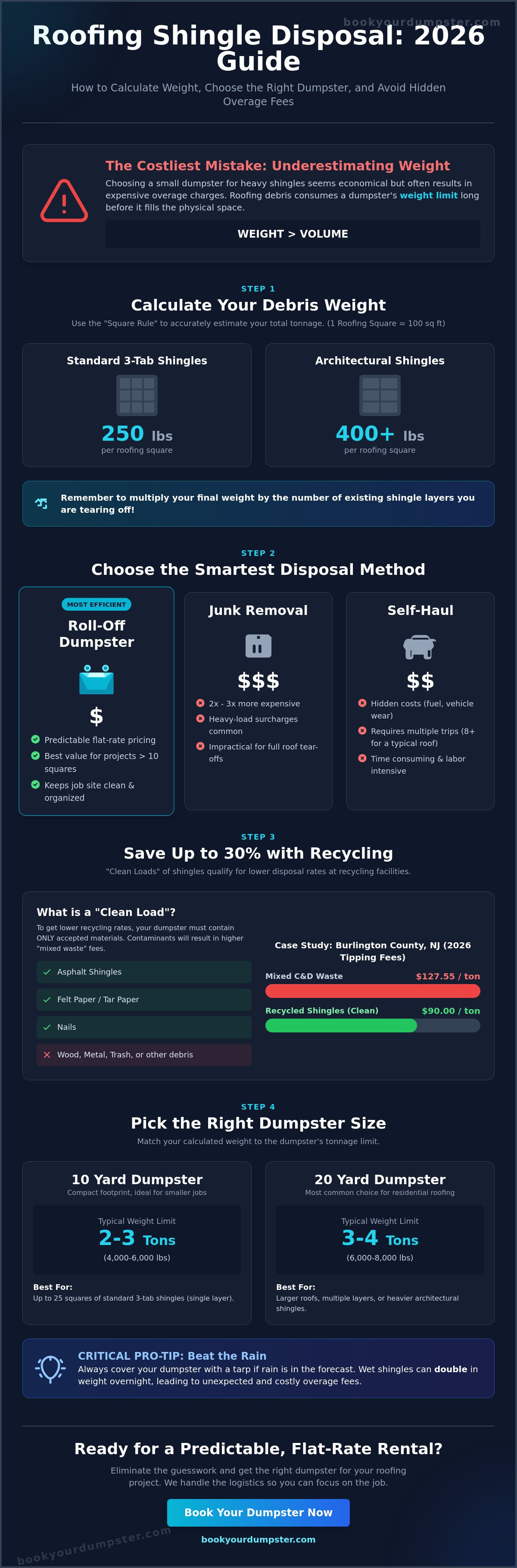
Don't let an empty-looking dumpster fool you. A 20 yard dumpster can hold roughly 4,000 to 6,000 square feet of shingles, but it may hit its tonnage cap well before it is full. Standard rental agreements include a specific weight limit; exceeding this limit triggers significant overage fees. Moisture is your biggest enemy here. Asphalt shingles act like sponges in the rain. A single storm can double the weight of your debris overnight, turning a profitable roofing job into a financial loss. Always cover your dumpster with a tarp if rain is in the forecast.
Regional Cost Variations in NY, NJ, and IL
Disposal regulations vary wildly by geography. In Queens, NY, high population density and strict transport laws drive up the cost to dispose of asphalt shingles compared to suburban New Jersey. For example, in Burlington County, NJ, 2026 rates for recycled shingles sit at $90.00 per ton, while mixed construction waste jumps to $127.55 per ton. In Illinois, state mandates encourage "clean" shingle loads, providing financial incentives for those who keep waste separated. These mandates mirror national trends, such as San Francisco's requirement for 65% diversion of construction waste from landfills. Select a 10 yard or 20 yard dumpster from BookYourDumpster.com to keep your project organized and compliant with these regional mandates.
Choosing the Best Disposal Method: Dumpster vs. Junk Removal vs. Self-Haul
Efficiency is the priority on any roofing job. When you analyze the cost to dispose of asphalt shingles, you have three primary paths: hire a junk removal service, haul the debris yourself, or rent a roll-off dumpster. Junk removal companies often quote based on volume, but they quickly add heavy-load surcharges for roofing materials. You can expect to pay 2 to 3 times more than a dumpster rental because these services must cover manual labor and high tipping fees at the yard. It is a premium service that rarely makes sense for a full tear-off project.
Self-hauling seems like a way to save money, but the hidden "wear and tear" on a personal vehicle is substantial. A standard half-ton pickup truck can safely carry about 1,000 to 1,500 pounds. A 20-square roof of architectural shingles weighs roughly 8,000 pounds, requiring at least eight trips to the dump. Factor in fuel, wait times at the transfer station, and the risk of blowing out your suspension or tires. A 10 yard dumpster provides the perfect balance. It handles the weight of a small to mid-sized roof while maintaining a small footprint on your property. Book Your Dumpster today to avoid the logistical headache of multiple dump trips.
When to Rent a Roll-Off Dumpster
Rent a container for any project exceeding 10 squares, which is 1,000 square feet, of roofing. This allows you to manage your timeline effectively and keep your driveway clear of debris as the work progresses. According to the Asphalt Roofing Manufacturers Association, proper disposal and recycling are critical for managing the environmental footprint of these materials. A dedicated roll-off ensures all waste is contained in one spot, preventing nails and shingle grit from scattering across your lawn. Find the right dumpster size for your roof to ensure your project stays on schedule.
The Reality of Self-Hauling to the Dump
Calculate the true labor involved before choosing to self-haul. For a standard 20-square roof, you will spend hours idling in line at transfer stations and paying individual public dump fees. Transporting heavy, loose debris on highways also carries safety risks if the load is not perfectly secured. Most residential users find that the total cost to dispose of asphalt shingles through self-hauling is higher once you value your time and vehicle maintenance. Stick to a professional roll-off to keep your project simple and your costs predictable.
How to Calculate Your Shingle Weight and Required Dumpster Size
Avoid guessing your debris weight. In the roofing industry, measurements are calculated in "squares," where one square equals 100 square feet of roofing material. To accurately estimate the cost to dispose of asphalt shingles, you must identify the specific shingle type and the number of layers being removed. Standard three-tab asphalt shingles weigh approximately 230 to 250 pounds per square. In contrast, thicker architectural shingles are significantly heavier, weighing between 400 and 430 pounds per square. If your home has a "re-roof" layer, you are effectively doubling your waste tonnage before the project even starts.
Weight is the primary factor that triggers hidden fees. Most rental agreements include a tonnage cap, and exceeding it results in per-ton overage charges. Heavy debris like shingles can quickly push a container past its legal limit. This is why professional contractors prioritize weight calculations over simple volume estimates. By knowing your tonnage upfront, you can select a container that matches your project's specific density.
The Math: Squares to Tons Formula
One square is defined as 100 square feet of roofing material. Calculate your tonnage using this standard formula: (Number of Squares x Layers x Weight per Square) / 2000 = Tons. For a 2,500 square foot home (25 squares) with two layers of architectural shingles, the math is straightforward: (25 x 2 x 430) / 2000 = 10.75 tons. This data, supported by the Asphalt Roofing Manufacturers Association, proves why weight estimates are non-negotiable for budget accuracy. This total tonnage will dictate whether you need a 10 yard or 20 yard dumpster to remain compliant with road safety laws.
Selecting the Right Container Size
Choose a 10 yard dumpster for most residential shingle projects. While a 30 yard or 40 yard bin offers more volume, filling them with heavy shingles often exceeds the legal weight limit of the hauling truck. This creates a safety hazard and leads to expensive "dig-out" fees where you must manually remove material before the driver can leave. A 10 yard dumpster typically holds about 1,000 square feet of roofing material safely. Review our 10 Yard Dumpster Rental guide to understand how these dimensions fit your driveway. When loading, keep the shingles level with the rim. Never overfill the container. Drivers must be able to securely tarp the load for highway transport. If you have a larger roof, consider ordering multiple 10 yard bins or a single 20 yard dumpster to stay within legal weight thresholds.
Step-by-Step Guide to Renting a Dumpster for Asphalt Shingle Recycling
Recycling your old roof is the most effective way to lower the cost to dispose of asphalt shingles. Many regional facilities now prioritize asphalt recovery because these materials are easily repurposed into road paving. To start, identify a local facility that accepts "clean" shingle loads. In 2026, many municipalities offer significantly reduced tipping fees for separated shingles compared to mixed construction debris. For example, in Dane County, WI, clean shingles are accepted at $65.00 per ton, while mixed loads face much higher rates. Success depends on your ability to manage the debris as it comes off the roof.
Schedule your dumpster delivery for the day your tear-off begins. Timing is critical to keep the job site efficient. If the container arrives too early, it occupies valuable space; if it arrives late, shingles pile up on the lawn, creating a safety hazard and killing the grass. Once the container is on-site, focus on site management. Protect your driveway by placing plywood or specialized "street pads" under the dumpster's rollers. This distributes the massive weight of the shingles and prevents the heavy steel bin from cracking your asphalt or concrete surface.
Preparing for a 'Clean' Recycling Load
To qualify for recycling rates and save up to 20% on disposal fees, you must maintain a "clean load." This means the container should only hold shingles, felt paper, and nails. You must separate all other materials. Wood from roof decks, plastic packaging, and metal flashing must go into a separate waste stream or be disposed of as mixed debris. Contaminating a shingle-only load with even a small amount of trash can cause the entire bin to be reclassified as "Construction and Demolition" waste. In Burlington County, NJ, this mistake could raise your rate from $90.00 per ton for recycled shingles to $127.55 per ton for mixed waste. Keep a dedicated trash bin nearby for miscellaneous job site garbage to protect your savings.
Ordering and Placement Logistics
Use an online booking system to secure your container and lock in current rates. This ensures immediate scheduling and provides a digital paper trail for your project. When choosing a placement spot, avoid septic lines, underground utilities, or soft grass that might sink under a ten-ton load. Ensure the driver has a clear path and isn't blocking garage access if you need to move vehicles during the project. Flat-rate pricing is the industry standard for roofing dumpsters in 2026. It protects you from market fluctuations and ensures you know exactly what you are paying before the first shingle is pulled. Order your 10 or 20 yard dumpster now to secure a predictable rate for your next roofing project.
Book Your Dumpster: Localized Solutions for Your Roofing Project
Managing the cost to dispose of asphalt shingles shouldn't be a guessing game. We provide transparent, flat-rate pricing across New York, New Jersey, Illinois, and Massachusetts. Our service removes the logistical stress of roofing by offering containers specifically suited for heavy debris. Contractors consistently choose our 10 yard and 20 yard roll-off dumpsters because they stay within legal weight limits while providing enough volume for a standard tear-off. By supporting local recycling initiatives in areas like Queens and San Francisco, we help you meet diversion mandates without extra paperwork. Secure your dumpster in under five minutes using our streamlined online portal. It is the most efficient way to keep your job site clean and your budget on track.
Professional roofing crews rely on our equipment for its reliability and ease of placement. We understand that a roofing project has many moving parts. You don't have time to wait for a late delivery or deal with surprise surcharges. Our 10 yard dumpster is the industry standard for residential projects, while our 20 yard dumpster provides the extra capacity needed for larger commercial structures. We focus on utility and speed, ensuring your debris is hauled away exactly when the job is done.
Expert Support in the Northeast and Midwest
Navigating the specific waste regulations in Chicago or Boston requires local expertise. We maintain deep knowledge of regional disposal mandates to ensure your project remains compliant. Our team assists residential and commercial clients in selecting the best container for their specific zip code. For a deeper look at managing your project waste, read our guide on Roll Off Dumpster Rental. We provide dedicated customer service that speaks your language and respects your project timeline. Whether you are working in the heart of the city or the suburbs, we have the local logistics handled.
Ready to Start Your Project?
Book Your Dumpster USA removes the friction from waste management. We offer the tools you need to calculate your weight and schedule your haul without the fluff. Our 2026 availability includes same-day or next-day delivery in most major metropolitan areas. Don't let a pile of old shingles stall your progress or damage your property. Take control of your roofing debris now. Book your roofing dumpster online today to lock in your flat-rate price and ensure a smooth cleanup for your next project. We are your dependable partner for every square of shingles you tear off.
Secure Your Project Budget and Timeline
Managing the cost to dispose of asphalt shingles requires precision rather than guesswork. You now have the formulas to convert roofing squares into tonnage and the knowledge to separate your materials for local recycling incentives. Avoid the logistical trap of overfilling large containers. Stick to specialized 10-yard roll-offs designed to handle the density of asphalt debris without triggering highway safety violations. These smaller bins provide the perfect footprint for residential driveways while maintaining the structural integrity needed for heavy loads.
We provide transparent flat-rate pricing to remove the uncertainty of 2026 market surcharges and hidden weight fees. Our service footprint covers key regions including New York, New Jersey, Illinois, Massachusetts, and San Francisco. By choosing a partner who understands regional landfill mandates and "clean load" requirements, you ensure your project stays compliant and on budget. Stop worrying about the mess and start focusing on the build. Rent your 10-yard roofing dumpster today at BookYourDumpster.com. Your clean, organized job site is just a few clicks away.
Frequently Asked Questions
How much does a square of asphalt shingles weigh for disposal?
One square of three-tab asphalt shingles weighs approximately 230 to 250 pounds. Architectural shingles are denser and weigh between 400 and 430 pounds per square. Use these figures to calculate your total tonnage before booking your container. Accurate weight estimation is the only way to control the cost to dispose of asphalt shingles and avoid expensive overage penalties during your project.
Can I mix other construction debris with my shingles in the dumpster?
You can mix debris if you choose a standard construction waste dumpster, but this often increases your disposal rate. Recycling facilities require "clean" loads to offer their most competitive pricing. If you mix wood, metal, or general trash with shingles, the entire container is reclassified as mixed C&D waste. This reclassification results in higher tipping fees at the landfill or transfer station.
What happens if my shingle dumpster exceeds the weight limit?
Exceeding the weight limit results in per-ton overage charges and potential safety risks for the hauler. If the load is too heavy for the truck to lift safely, you must manually remove shingles until it meets legal limits. This "dig-out" process is labor-intensive and costly. Always monitor your tonnage to keep your project moving without these avoidable delays and surprise fees.
Is it cheaper to recycle shingles or send them to a landfill in 2026?
Recycling is generally cheaper in 2026 due to rising landfill taxes and environmental surcharges across the country. Many facilities offer a lower per-ton rate for clean asphalt because the material is repurposed for road construction. By opting for recycling, you reduce the total cost to dispose of asphalt shingles while complying with state-level waste diversion mandates in regions like California and Wisconsin.
Do I need a permit to place a roofing dumpster on the street in New York?
You need a permit from the New York City Department of Transportation (DOT) to place any dumpster on a public street. This requirement applies to all five boroughs to ensure public safety and traffic flow. If you have a private driveway or job site space, you can avoid this extra cost and paperwork. Check local regulations in your specific neighborhood before scheduling your delivery.
How many layers of shingles can I fit in a 10-yard dumpster?
A 10 yard dumpster typically holds about 1,000 square feet of roofing material, which equals 10 squares. If your roof has a single layer, this covers a 1,000 square foot roof surface. If your roof has two layers, the same dumpster only covers 500 square feet of roof surface. Always account for multiple layers when estimating the volume and weight of your roofing debris.
What is a 'clean load' in asphalt shingle recycling?
A "clean load" consists exclusively of asphalt shingles, felt paper, and nails. It must be free of wood, plastic, metal flashing, and general job site trash. Recycling centers use these materials to create asphalt pavement for highways. Any contamination from other construction materials can lead to the load being rejected or charged at the much higher mixed-waste landfill rate instead of the recycling rate.
How do I protect my driveway from a heavy shingle dumpster?
Place plywood boards or specialized protective pads on your driveway before the dumpster arrives. This prevents the heavy steel rollers and the massive weight of the shingles from cracking or denting the asphalt surface. Shingle loads are exceptionally dense, so this extra step is vital for preventing property damage. Ensure the delivery area is clear of vehicles and overhead obstructions for a safe drop-off.