

You open your final invoice and find a massive surcharge for prohibited materials that were never in your bin. Perhaps a missed pickup resulted in extra daily fees you didn't authorize. These surprise costs turn a productive cleanup into a logistical headache. You expect transparency and reliability when managing waste, yet billing errors and weight disputes can happen. Learning how to handle a dumpster rental dispute is the only way to protect your project budget and ensure you only pay for the service you actually received.
It's frustrating to deal with opaque charges after a long week of labor. You deserve a fair resolution based on facts and documentation rather than hearsay. This guide shows you exactly how to navigate weight ticket errors, challenge unfair fees, and communicate effectively with your provider. We will walk through the specific steps to gather evidence, review your contract, and secure the refunds you're owed. Follow this framework to resolve your current issue and establish a system that prevents future billing surprises.
Key Takeaways
- Identify whether your issue is a service failure or a financial error to determine the best path for resolution.
- Learn how to handle a dumpster rental dispute by comparing your signed contract terms with certified weight tickets from the landfill.
- Shift all communication to written channels to create a reliable paper trail for challenging unfair surcharges or missed pickups.
- Gather photographic evidence of your debris levels to provide objective proof when contesting prohibited item fees or weight overages.
- Prevent future billing surprises by choosing providers that offer transparent pricing models and instant digital receipts through online booking.
Identifying the Root Cause of Your Dumpster Rental Dispute
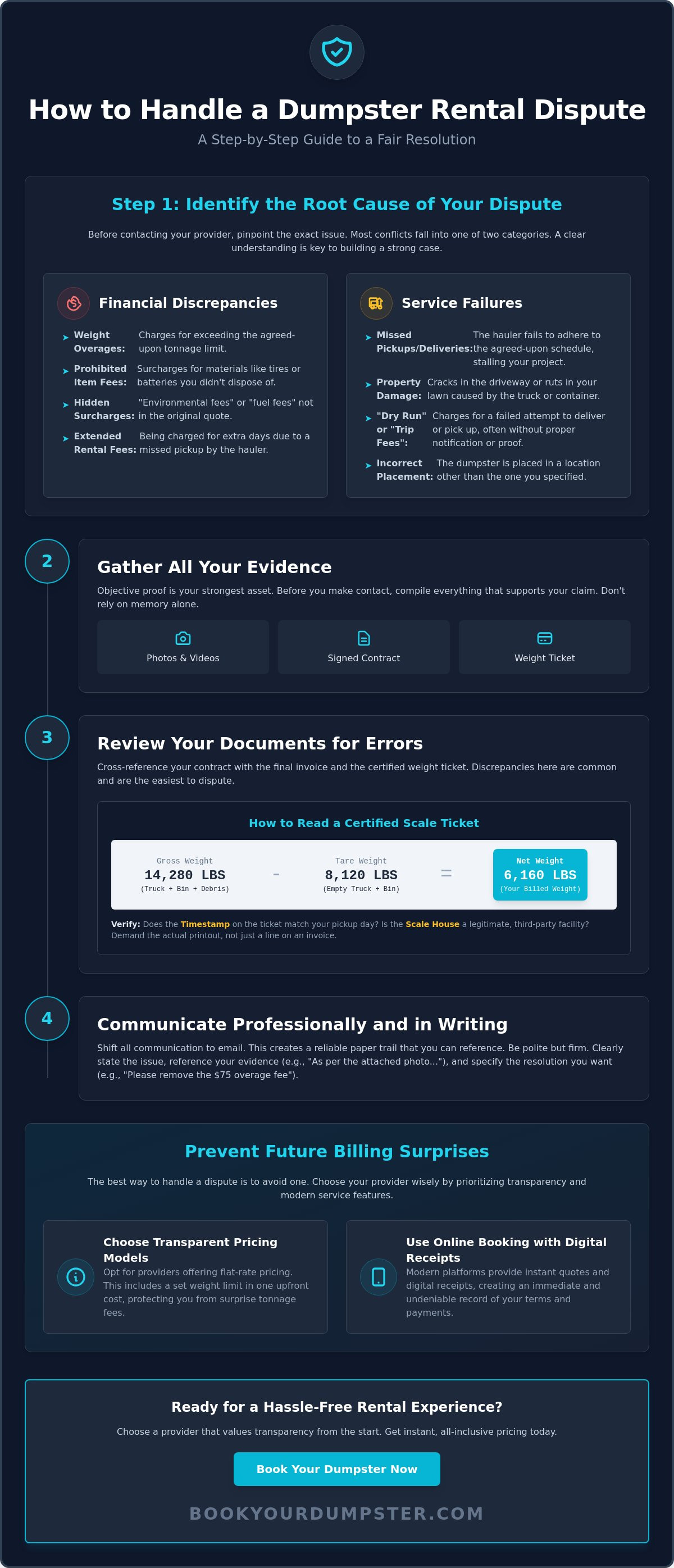
Before you pick up the phone, you must pinpoint exactly where the breakdown occurred. Most conflicts fall into two categories: service failures or financial discrepancies. A service failure involves missed timelines or physical damage, while financial disputes center on unexpected line items. Understanding how to handle a dumpster rental dispute requires you to separate these issues so you can present a clear, evidence-based case to the provider.
First, determine if you worked with a direct hauler or a third-party broker. Brokers don't own the trucks; they outsource the work. If a broker booked your 20 yard dumpster, your dispute is with them, not the driver who dropped it off. Next, look for "dry run" or "trip fees." These are often charged if a driver claims they couldn't place the container due to a parked car or low-hanging branches. If the hauler didn't notify you of the obstruction at the time, you have grounds to contest the fee. Learning how to handle a dumpster rental dispute effectively means knowing which specific fee to target.
A dispute often boils down to a breach of your rental agreement, where one party fails to meet the specific obligations outlined in the contract. Categorize your issue clearly before reaching out:
- Weight Overages: Charges for exceeding the ton limit.
- Prohibited Items: Fees for tires, batteries, or hazardous waste you didn't toss.
- Property Damage: Cracks in asphalt or deep ruts in the lawn.
Common Billing Discrepancies in Waste Management
Transparency varies across the industry. Some providers use flat-rate pricing, while others use tonnage-based models where the final cost is unknown until the bin is weighed. Check your invoice for "environmental fees" or "fuel surcharges" that weren't in your initial quote. These are common "soft costs" that inflate the total. Also, verify the rental period. If you requested a pickup on Friday but the truck didn't arrive until Monday, you shouldn't be charged for those extra three days of rental.
Service Failures and Property Damage Claims
Service-based disputes often stem from missed pickups. When a bin sits full on your job site, it stalls your project and takes up space. Document every missed window. Property damage is more complex. Heavy 40 yard dumpsters can crack older driveways if not placed on protective boards. If you see "blocked access" fees on your bill, ask for time-stamped photos. Reliable haulers will document the obstruction to justify the charge; if they can't provide proof, the charge is likely an error.
Reviewing Your Rental Agreement and Weight Tickets for Errors
Your signed contract is the law of the transaction. If you're investigating how to handle a dumpster rental dispute, your first move is pulling up that digital or paper copy. Verify the specific tonnage limit you agreed to pay for. Many disputes arise because a customer assumes a 20 yard dumpster includes five tons, while the contract only covers two. Once you've confirmed the terms, demand the certified weight ticket. Don't settle for a typed line on an invoice. You need the actual printout generated by the scale house at the landfill or transfer station.
Weight tickets are the most common source of billing errors. Compare the Gross Weight to the Tare Weight. The Tare Weight represents the weight of the empty truck and the container. If the Tare Weight on your ticket looks significantly lower than the truck's standard empty weight, the net weight calculation is flawed. If you suspect systematic overcharging or fraudulent weighing practices, contacting a consumer protection agency is a valid next step. For a standard of what clear, upfront terms should look like, you can use the transparent pricing models at Book Your Dumpster USA as a benchmark for your current provider.
How to Read a Certified Scale Ticket
Scale tickets use three primary figures: Gross, Tare, and Net. Gross is the total weight of the truck, the bin, and your debris. Tare is the weight of the empty vehicle. Net is the difference between the two, which is what you are billed for. Check the timestamp on the ticket. If your bin was picked up on Tuesday morning but the ticket is timed for Wednesday afternoon, the hauler may have added debris from another job. Verify the scale house location; it should be a legitimate, third-party facility, not a private yard without certified scales.
Physical Impossibility: When the Math Doesn’t Add Up
A 10 yard dumpster has a physical volume limit that makes certain weight claims impossible. For example, household junk typically weighs about 250 pounds per cubic yard. A 10-yard bin filled with old furniture and boxes physically cannot weigh 10 tons; it would overflow long before reaching that mass. Unless you loaded the bin with heavy materials like concrete, dirt, or roofing shingles, a massive overage charge is likely a mistake. Watch for "double-dipping" signs, such as identical weights on two different tickets, which suggests the hauler is reusing data to pad invoices. Before booking your next project, check available inventory at Book Your Dumpster USA to ensure you select a size that matches your debris type and weight needs.
Effective Strategies for Negotiating a Resolution with the Provider
Once you've identified the error and gathered your weight tickets, you must engage the provider. Stop all phone conversations immediately. A phone call leaves no record and often leads to a "he-said, she-said" stalemate. If you want to know how to handle a dumpster rental dispute with professional precision, you must move the conversation to email. This creates a chronological log of your attempt to resolve the issue in good faith. A written record is your strongest leverage if the situation escalates to a legal or financial challenge.
Present your evidence in a clinical, non-emotional format. If you're operating in New York or New Jersey, reference state-specific consumer disclosure requirements. These regions often require waste management companies to provide clear, upfront fee structures. If the provider failed to disclose a fuel surcharge or an environmental fee at the time of booking, you have grounds to demand a removal of those charges. Sometimes, an error is mutual. If you overfilled the bin slightly but the weight charge feels astronomical, offer a "fair-market" compromise. Propose paying for the actual tonnage overage at the documented landfill rate rather than the provider’s inflated penalty rate.
The Professional Paper Trail: What to Include
Your email should be a factual breakdown of the project timeline. Include your original booking confirmation from Book Your Dumpster or your specific hauler to show the promised price. List the delivery date, the requested pickup date, and the actual pickup date. Attach high-resolution photos of the load level taken just before the truck arrived. If the container was level-full and you're being charged for a 10-ton load in a 20 yard dumpster, these photos prove the weight claim is physically impossible.
Escalation Paths: When Direct Negotiation Fails
If the hauler refuses to budge, move beyond their customer service department. File a formal complaint with the Better Business Bureau (BBB) to flag their billing practices for other project managers. For legal weight or fee violations, consider contacting the state attorneys general office in your region. This is particularly effective in states like Massachusetts or Illinois, where consumer protection laws for service contracts are strictly enforced. As a final financial tool, you can initiate a credit card chargeback for the specific disputed amount. Banks generally side with the consumer when there is documented evidence of a service failure or a contract violation. Learning how to handle a dumpster rental dispute means knowing when to stop talking and when to start filing official reports.
Step-by-Step Checklist for Resolving Unfair Waste Management Charges
Resolution starts with a total shift in communication. Stop all verbal negotiations. Phone calls leave you with no proof of what was promised or admitted. Move every interaction to recorded or written channels like email or certified mail. This transition ensures you have a verifiable record if you need to escalate the matter. Learning how to handle a dumpster rental dispute requires discipline in documentation. If you don't have it in writing, it didn't happen.
Audit your final invoice with extreme detail. Compare every line item against the dumpster rental prices quoted at the time of your booking. Watch for "pre-authorization" holds on your credit card that were never adjusted. Many companies place a high temporary hold to cover potential overages; if that hold becomes a permanent charge without a corresponding weight ticket, you've been overcharged. Gather your "Before" and "After" photos. These should clearly show the load level of your 10 yard or 20 yard dumpster before the truck arrived for pickup.
Immediate Actions (Hours 1-24)
Contact the company immediately to flag the error. Request an formal "administrative hold" on the disputed portion of the charge. During this initial call, note the full name and job title of every representative you speak with. Ask for the specific name and location of the landfill or transfer station where your debris was weighed. This information allows you to verify if the hauler actually visited that facility on the day of your pickup. Prompt action prevents the charge from settling and becoming much harder to reverse.
Secondary Actions (Days 2-7)
If the provider doesn't issue a correction within 48 hours, draft a formal "Demand for Correction" letter. Send this via email and attach your photographic evidence and contract. Verify the company’s local operating licenses in specific jurisdictions like San Francisco or Queens. Unlicensed haulers have zero leverage in a legal dispute and often fold when they realize you've checked their credentials. If they remain unresponsive, post a factual, non-emotional review on Google or Yelp. Stick to the data: dates, weight discrepancies, and the lack of response. This often triggers a call from a senior manager who has the authority to issue a refund. To avoid these logistical battles entirely, book your next dumpster through a platform that prioritizes transparent, digital-first billing.
Preventing Future Disputes Through Transparent Booking and Pricing
The most effective way to manage waste logistics is to eliminate the variables that cause conflict. While knowing how to handle a dumpster rental dispute is essential once a project goes sideways, proactive project management prevents the need for escalation. Start by using an online booking system that generates instant digital receipts. These receipts serve as a fixed point of reference for your agreed price, tonnage, and rental duration. Avoid companies that rely on vague verbal quotes or handwritten invoices, as these are the primary breeding grounds for billing errors.
Switch to "All-In" pricing models whenever possible. These models bundle the rental, delivery, and a set amount of tonnage into one transparent price. This removes the "weight-ticket guessing game" that often leads to frustration at the end of a project. Additionally, take control of your documentation from day one. Photograph the empty container upon delivery and take a final set of photos immediately before the truck arrives for pickup. These time-stamped images provide indisputable proof of the load level and the condition of your property, leaving no room for the hauler to claim "overfilled" or "prohibited" loads unfairly.
Selecting a Reliable Local Partner
Choose local experts over national brokers. Local teams in NY and NJ understand specific regional disposal fees and municipal regulations better than a call center in another state. When you book a roll off dumpster rental, prioritize providers that offer a "no-hidden-fee" guarantee in their service agreement. This contract language protects you from surprise fuel surcharges or environmental taxes. Reliability is built on transparency; if a provider cannot give you a clear list of potential extra costs upfront, look elsewhere for your project needs.
Best Practices for Load Management
Control what goes into your bin to avoid valid surcharges. Read the prohibited items list out loud to your crew or family members before the project starts. This prevents a single discarded tire or old appliance from triggering a $75 surcharge. Follow these loading rules to maintain compliance:
- Respect the Top-Off Line: Never fill the container past the rim. Overfilled bins are safety hazards and often result in immediate "dig-out" fees.
- Use a Tarp: If rain is in the forecast, cover the bin. Debris like drywall or old carpet absorbs water, significantly increasing the weight on the scale ticket.
- Balance the Load: Distribute heavy materials like concrete or brick evenly across the floor. An unbalanced load can lead to "adjustment fees" if the driver has to reposition the debris for safe transport.
Protect Your Project Budget with Better Data
Resolving a billing error requires a shift from frustration to documentation. You now have the tools to audit weight tickets, challenge physical impossibilities, and maintain a professional paper trail. By focusing on the facts in your contract and the load levels in your photos, you can secure a fair resolution. Knowing how to handle a dumpster rental dispute turns a messy logistical failure into a manageable business correction. Data is your best leverage when project costs spiral out of control.
The best way to avoid these headaches is to partner with a provider that prioritizes transparency. Look for platforms that offer a no-hidden-fee guarantee and provide instant digital booking receipts for every transaction. Direct-to-hauler communication ensures your instructions are never lost in translation. Book Your Next Project with Transparent Pricing at Book Your Dumpster USA to experience a streamlined, honest waste management process. You've done the hard work of cleaning up your site; don't let a billing error stall your progress. Take charge of your next rental and finish your project with confidence.
Frequently Asked Questions
Can I dispute a dumpster weight charge if I think it is wrong?
Yes, you can. Request the certified weight ticket from the scale house and compare the gross and tare weights to ensure the calculation is accurate. If the math doesn't align with your debris type, such as household junk weighing as much as concrete, initiate a formal dispute via email. Learning how to handle a dumpster rental dispute over weight starts with verifying these landfill records against your project reality.
What happens if a dumpster company damages my driveway during delivery?
Document the damage with photos immediately. Review your contract for damage waivers or liability clauses. Many haulers include language that releases them from liability for driveway cracks, but you can still file a claim if you can prove negligence. This includes cases where the driver dropped the container too hard or failed to use protective boards as specifically requested during the booking process.
Are dumpster rental companies allowed to charge hidden fuel surcharges?
Only if they are disclosed in the original agreement or quote. Check your state's consumer protection laws, as some regions require all fees to be transparent at the time of booking. If you find a surcharge on your invoice that wasn't mentioned in your digital receipt, you have grounds to challenge the fee. Treat this as a breach of the agreed pricing and demand a correction based on your initial confirmation.
How do I prove I did not put prohibited items in the dumpster?
Provide time-stamped photos of the dumpster load taken right before the truck arrived for pickup. These images serve as visual evidence of the contents. If the company claims there were tires or batteries buried at the bottom, ask for their own photographic proof from the landfill or transfer station. Without visual evidence from the hauler, their claim is difficult to sustain in a formal billing dispute.
Can I cancel a dumpster rental if the delivery is late?
Yes, but check the cancellation policy in your service agreement first. If the delay stalls your project and violates the promised delivery window, you can request a full refund. Moving your business to a more reliable provider is often the best way to resolve issues involving chronic service failures or missed timelines. Always get the cancellation confirmation in writing to protect your project budget from future charges.
What should I do if the dumpster company won’t pick up the container?
Send a formal written demand for pickup via email to start a paper trail. If they claim the bin is inaccessible or overfilled, ask for photo documentation of the obstruction. Continued refusal to remove the container can lead to unauthorized daily rental fees. Contest these charges through your credit card company if the hauler remains unresponsive to your written requests for service completion.
Is a credit card chargeback the best way to handle a dumpster dispute?
Use a chargeback only as a last resort after direct negotiation fails. Banks require evidence that you attempted to resolve the issue with the merchant first. Provide the bank with your emails, photos, and the original contract. A chargeback is highly effective for unauthorized surcharges or services that were never rendered, such as a missed delivery or a double-billed rental period.
How can I avoid overage fees on a 10-yard dumpster rental?
Monitor your debris volume and weight carefully. A 10 yard dumpster is ideal for small cleanups, but heavy materials like dirt or shingles will quickly exceed weight limits. Use a tarp to prevent rain from soaking your debris and adding water weight. Understanding these logistics is a key part of knowing how to handle a dumpster rental dispute before the final invoice even arrives.