
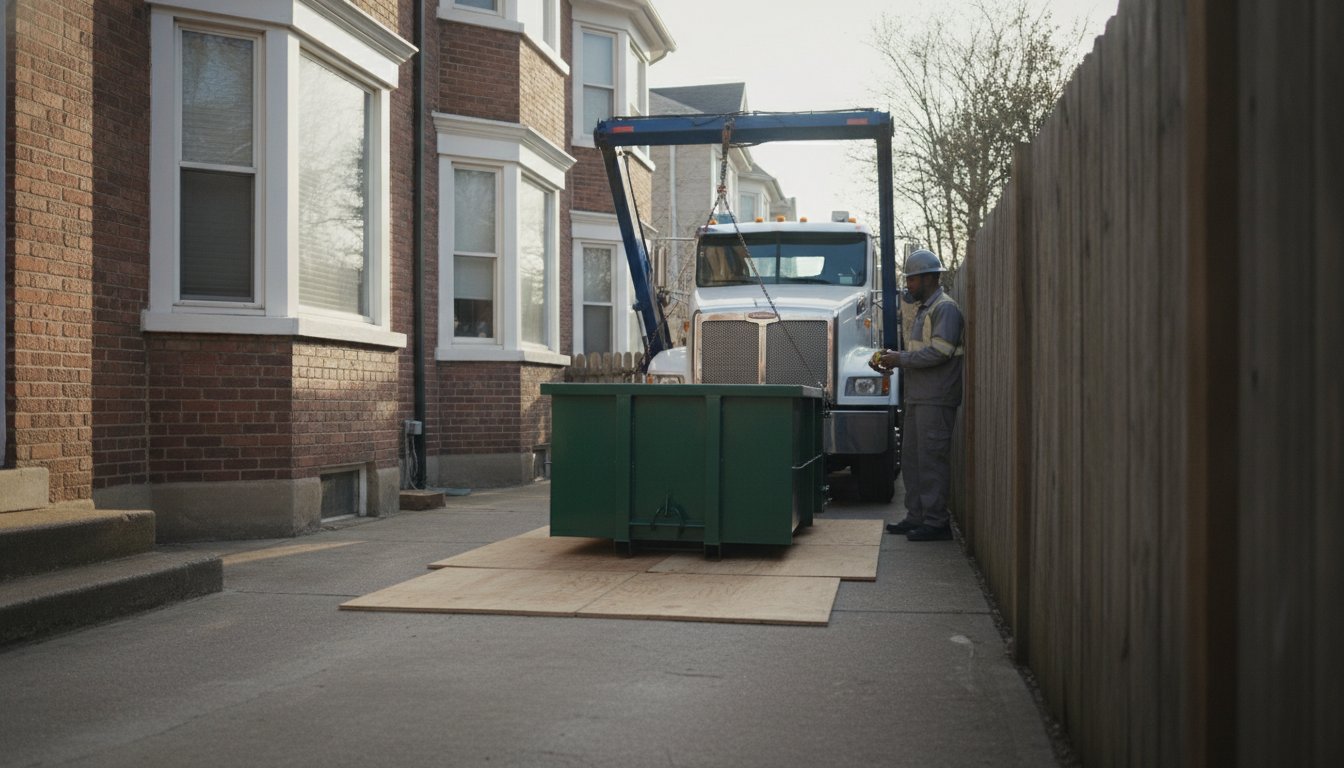
A successful dumpster delivery in tight or narrow driveways is a science of measurement, not a game of luck. You probably worry that a heavy roll-off truck will crack your concrete, snag your gutters, or get stuck halfway through a turn. It's a stressful situation that often ends in a rejected delivery and a costly dry run fee. We understand the logistical pressure of managing a cleanup project in a cramped urban space where every inch counts.
This 2026 guide removes the guesswork and puts you in control. You'll learn exactly how to measure your property to ensure the driver can safely place your container. We'll show you how to prepare your site to prevent property damage and explain why the 10-yard dumpster is the primary tool for restricted spaces. We'll cover the critical 60-foot approach rule, vertical clearance requirements, and the specific criteria you need to book your rental with total confidence.
- Identify the specific horizontal and vertical clearance requirements needed for a successful dumpster delivery in tight or narrow driveways.
- Follow a 5-step framework to measure your driveway entry point and ensure a roll-off truck can maneuver without property damage.
- Discover why the 10-yard dumpster is the preferred choice for urban residential projects with restricted access.
- Implement the Plywood Method to protect your driveway surface from asphalt scarring and concrete cracks.
- Prepare for your rental by providing site photos and specific delivery notes to the logistics team during the booking process.
Understanding Clearance: Can a Dumpster Truck Navigate Your Tight Driveway?
"Dumpster Delivery Clearance" is the minimum volume of space a roll-off truck needs to successfully drop and recover a waste container. Think of it as an invisible box that moves with the vehicle. If any permanent structure, tree, or wire enters that box, the delivery fails. This clearance is split into two categories: horizontal (the width of the path) and vertical (the height above the path). You must account for both dimensions to avoid a rejected delivery.
Many homeowners assume that if their car fits, the truck fits. This is a mistake. Roll-off dumpsters are delivered by heavy-duty trucks that use a hydraulic hoist to tilt the container into place. This mechanism means the truck actually becomes much taller and longer during the drop-off process. In dense urban environments like New York or San Francisco, low-hanging power lines and thick tree limbs are the most frequent causes of a "dry run" fee. Drivers in these cities often face "no-go" situations because overhead utility lines sit lower than the required 22-foot lift height.
Standard Truck Dimensions and Requirements
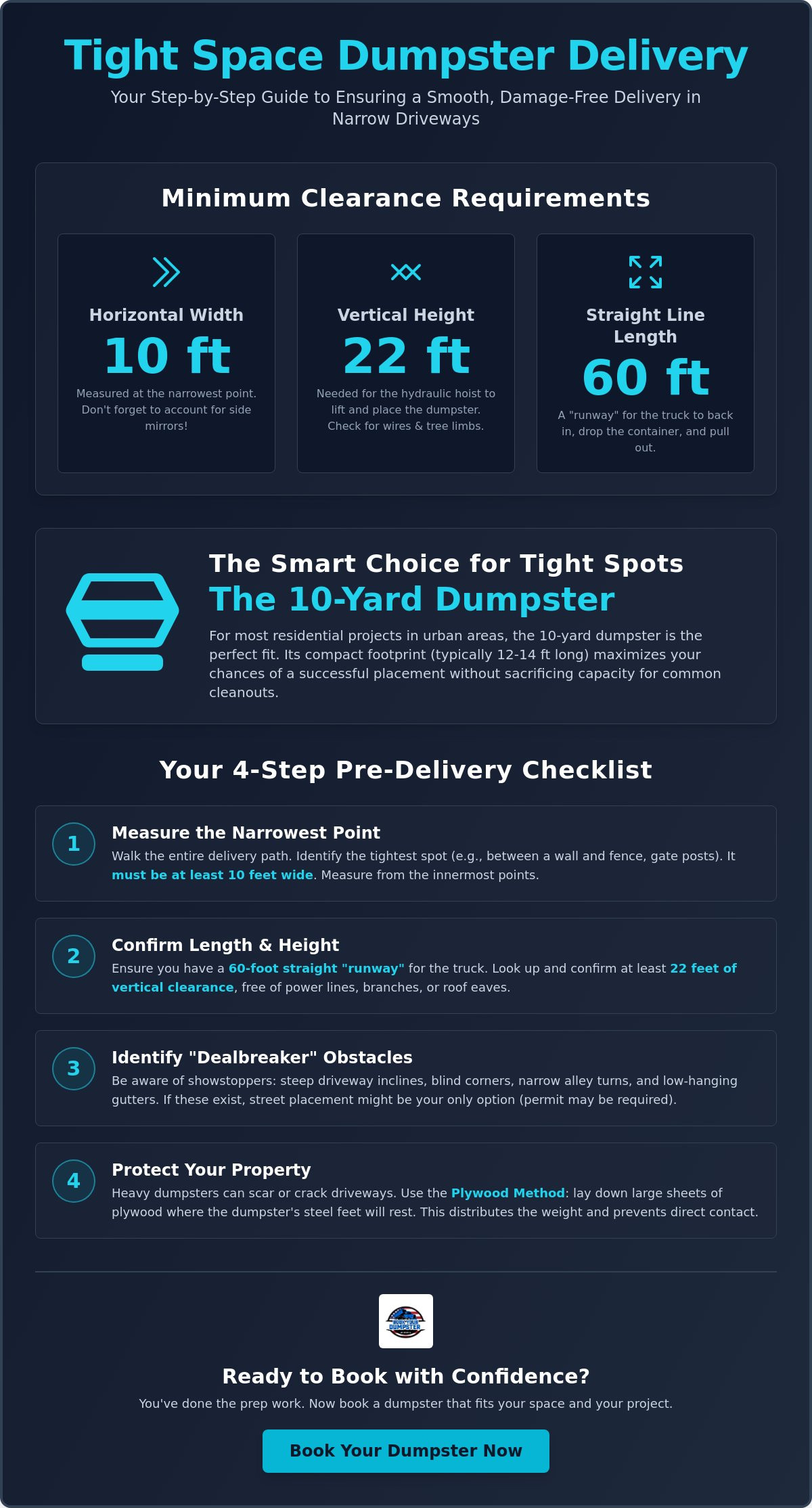
A standard roll-off truck is typically 8 to 10 feet wide. This measurement does not include the side-view mirrors, which can add another 12 to 18 inches on each side. For a safe dumpster delivery in tight or narrow driveways, you need a path that is at least 10 feet wide with clear visibility. If your driveway is exactly 10 feet wide, the driver has zero margin for error.
Do not forget the "swing room." A 30-foot truck cannot make a 90-degree turn into a narrow driveway from a narrow street without significant space to pivot. Once the truck is in position, it needs approximately 22 feet of vertical clearance. The hoist rises high into the air to slide the dumpster off the rails. If your driveway is under a carport or a thick canopy of oak trees, the driver cannot safely raise the bed. Use the site tools at Book Your Dumpster to confirm your space meets these requirements before finalizing your order.
Identifying 'Dealbreaker' Obstacles
Some obstacles make a delivery impossible. Permanent gate posts are the most common. If your gate opening is exactly 9 feet wide, most drivers won't risk the liability of hitting your masonry. Steep driveway inclines also pose a risk. If the slope is too aggressive, the dumpster may slide or the truck's rear may scrape the pavement. This creates a safety hazard for the driver and your property.
Blind corners and narrow alleyway turns are also major hurdles. Drivers must be able to back into the space with a clear line of sight. If the truck has to "snake" through a series of tight turns, the risk of property damage increases. Overhanging eaves and gutters often get overlooked during measurements. A gutter that sticks out 6 inches from your roofline can easily be crushed by the dumpster as it descends from the truck bed. Always look up and around before you book.
Measuring Your Space: A Step-by-Step Guide for Narrow Access
Precision is the only way to guarantee a successful dumpster delivery in tight or narrow driveways. Eyeballing the space or assuming a truck can fit because your SUV does often leads to logistical failure. Drivers follow strict industry safety standards to prevent property damage and personal injury. If the dimensions don't work, the driver will waive off the delivery to protect your home. Use this framework to verify your site capacity before you book.
Step 1: Measure the Narrowest Point
Walk your driveway and identify the absolute narrowest section. This is usually the distance between gate posts, the corner of your house, or a retaining wall. You must have at least 10 feet of clear width. Clear Width is the distance between the two closest immovable objects on the delivery path. If your gate opening is 9 feet 6 inches, the truck cannot pass. Always measure from the innermost edge of the hardware, not the posts themselves, to ensure the mirrors have enough clearance.
Step 2: Calculate the Total Length for the Truck and Dumpster
A roll-off truck needs approximately 60 feet of straight-line space to drop a container. This "runway" allows the truck to back in, tilt the hoist, and pull forward as the dumpster slides off the rails. You also need to account for the actual footprint of the container. A 10 yard dumpster typically measures 12 to 14 feet in length. If your driveway is only 20 feet long and ends at a garage door, the truck won't have enough room to pull forward after the drop. Ensure you have the combined length of the truck and the dumpster clear of all vehicles and debris.
Step 3: Checking for Overhead Obstructions
Look up. Most delivery failures in dense areas like Queens or Boston happen because of low-hanging street lights or utility wires. You need 22 feet of vertical clearance to raise the hoist safely. You can estimate this by using a 20-foot reach-pole or by comparing the height to a two-story house. Never attempt to place a dumpster directly under a basketball hoop or low tree limbs. If you have doubts about your measurements, you can schedule your rental and provide these specific dimensions to the dispatcher during the checkout process. Clear communication ensures the logistics team sends the right equipment for your specific urban layout.
Choosing the Right Size: Why the 10-Yard Dumpster Wins in Tight Spots
Selecting the wrong container size is the fastest way to trigger a delivery failure. While volume matters for your debris, maneuverability determines if the truck can actually reach your drop site. A 10-yard dumpster is the "Urban Standard" for a reason. Its compact footprint provides the necessary wiggle room for a successful dumpster delivery in tight or narrow driveways where larger units simply won't fit. Choosing a smaller size often allows logistics teams to use more agile, single-axle trucks that can pivot in radii that would trap a standard roll-off vehicle.
Proper size selection also keeps your project compliant with safety standards. Adhering to OSHA waste disposal regulations requires maintaining a clear and organized workspace. In a cramped urban lot, a massive 30-yard container can block emergency exits or obstruct the driver's line of sight. By prioritizing a smaller footprint, you ensure that waste removal remains a background utility rather than a logistical bottleneck.
The 10-Yard Advantage for Homeowners
The typical dimensions of a 10-yard container are approximately 12 feet long by 8 feet wide. This footprint is roughly equivalent to a single standard parking space. Because it's shorter than most passenger trucks, it fits comfortably in driveways that have limited depth. If your property has a "blind" entry or requires the truck to back in from a narrow street, this shorter length is your best insurance policy against property damage. For most residential cleanouts, a 10 Yard Dumpster Rental: The Perfect Size for Your Project offers the ideal balance of capacity and accessibility.
When to Step Up to a 20-Yard Dumpster
You can still achieve a dumpster delivery in tight or narrow driveways with a 20-yard unit, but your "runway" requirements change. A 20-yard dumpster is usually 22 feet long. That is 10 feet more steel than the 10-yard model. To drop this container, the truck needs a straight-line approach of at least 65 to 70 feet. If your driveway has a curve or a sharp angle near the entrance, the 20-yard unit will likely hang up on the corners. Use this rule of thumb: if you cannot park two full-sized SUVs end-to-end in your driveway with room to spare, stick with the 10-yard option. The risk of a "dry run" fee or a rejected delivery increases significantly once you move beyond the 12-foot container length.
Safe Placement Strategies: Protecting Your Property During Delivery
A successful dumpster delivery in tight or narrow driveways involves more than just fitting the truck into the gap. You must also protect the surface underneath. A 10-yard dumpster weighs several thousand pounds before you even start loading it. Once full, it can hold 2 to 3 tons of debris. This concentrated weight can easily scar fresh asphalt or crack aging concrete. You need a proactive strategy to ensure your property remains intact after the container is hauled away. Surface Protection is the proactive use of barriers to prevent cosmetic or structural driveway damage.
Preparation starts with clearing the drop zone. Remove all vehicles, bicycles, and children's toys from the delivery path. Even if you measured 10 feet of width, a stray trash can or a low-hanging basketball hoop can obstruct the driver's maneuverability. Ensure the area is completely level. If the driver detects soft ground or a steep incline that might cause the dumpster to shift, they may refuse the drop to avoid liability. This simple preparation saves you from expensive repair bills and keeps the project on track.
The Plywood and Plank Technique
Professional contractors always use the plywood method to safeguard residential surfaces. Lay down two sheets of 3/4-inch plywood or several 2x10 wood planks exactly where the dumpster's metal rollers will land. Wood acts as a shock absorber. It distributes the heavy load across a wider surface area. This prevents the metal rollers from sinking into hot asphalt during summer months or crushing thin concrete. Don't rely on the driver to provide these materials. Have your wood ready before the truck arrives to keep the delivery moving efficiently.
Navigating Local Permits for Street Placement
Sometimes, the driveway is simply too restricted for a safe drop. If your measurements from the previous sections show a "no-go" scenario, pivot to street placement. Regulations vary by location. For example, dumpster rental in New York, Illinois, and Massachusetts often requires specific DOT permits for street use. In New Jersey, you might need a local police permit. These permits often take 5 to 10 business days to process, so plan ahead to avoid delays.
Coordinate with your neighbors before the delivery day. You need at least 60 feet of curb space to allow the roll-off truck to back in and align with the street. If a neighbor parks their car in your "approach" zone, the driver cannot complete the job. Clear communication prevents "dry run" fees and keeps your project on schedule. If you are ready to secure a container for your property, you can book your dumpster online and specify your placement preferences in the delivery notes to ensure a smooth arrival.
Booking Your Tight-Space Delivery with Book Your Dumpster USA
The success of your project depends on clear communication before the truck ever leaves the yard. Our digital booking platform is designed to handle the complexities of dumpster delivery in tight or narrow driveways by gathering critical data at the point of sale. When you select your container, use the "Delivery Notes" field to flag your property as a restricted access site. Specify the exact width of your gate or the presence of low-hanging wires. This information allows our dispatchers to assign the most agile vehicle in our fleet to your specific address, reducing the risk of a dry run fee.
Visual data is the most effective tool for our logistics team. We strongly encourage you to upload a photo of your driveway and the street-side approach during the booking process. A single image helps our drivers plan their backing angle and identify potential "dealbreaker" obstacles like hidden utility meters or decorative stonework. This proactive step ensures that when the driver arrives, they already have a plan for placement. Follow this final checklist 24 hours before your roll off dumpster rental arrives to guarantee a seamless drop-off:
- Clear the Runway: Move all personal vehicles to the street to provide the truck with at least 60 feet of straight-line approach space.
- Verify Width: Double-check that gate openings or house corners provide at least 10 feet of clear width.
- Prep the Surface: Place your 3/4-inch plywood or 2x10 planks in the designated drop zone to prevent asphalt scarring.
- Look Up: Ensure no new obstructions, like low-hanging branches or temporary festive lights, interfere with the 22-foot vertical lift zone.
Communication with Your Driver
Our drivers are experts in navigating the dense urban grids of Queens, Boston, and San Francisco. They understand that a dumpster delivery in tight or narrow driveways requires patience and precision. Upon arrival, the driver will perform a final safety walk-through. If the space is exceptionally tight, we recommend being present or reachable by phone during the delivery window. This allows the driver to confirm the exact placement of your plywood and ensures the container door faces the correct direction for your loading needs. We prioritize punctuality and professional communication to remove the stress from your cleanup logistics.
Ready to Start Your Project?
Managing waste in a cramped environment shouldn't be a source of project delays. The Book Your Dumpster USA online platform simplifies the entire rental process. Whether you need a compact 10-yard dumpster for a residential cleanout or a 20-yard unit for a larger renovation, our system provides the transparency and reliability you need. We focus on pricing integrity and on-time service so you can focus on your work. Don't leave your delivery to chance. Book your dumpster delivery now and experience a professional, no-nonsense approach to urban waste management.
Secure a Successful Drop-Off Today
Don't let a cramped property stall your cleanup project. You now have the exact framework to measure your clearance, protect your driveway surface, and select the right container size. Remember that successful dumpster delivery in tight or narrow driveways is always the result of proactive preparation and professional logistics. By choosing a 10-yard dumpster and following the 60-foot approach rule, you eliminate the risk of rejected deliveries and unnecessary property damage. Trust the measurements you've taken and the strategies we've outlined to ensure your site is ready for the truck's arrival.
We are specialists in 10-yard compact dumpsters and employ expert drivers who are deeply experienced in navigating complex urban logistics. You can rely on our transparent pricing with no hidden delivery fees to keep your renovation budget on track. Take the final step in your project planning and move from a state of clutter to a state of resolution. Our team is ready to handle the heavy lifting while respecting the constraints of your residential space.
Book Your Narrow Driveway Dumpster Delivery Today and get your project finished with total confidence.
Frequently Asked Questions
How wide does my driveway need to be for a dumpster delivery?
Your driveway must be at least 10 feet wide to accommodate a standard roll-off truck. This measurement provides the necessary clearance for the vehicle's body and side-view mirrors. If your entrance is narrower than 10 feet, the driver cannot safely enter without risking damage to your gate posts or the truck itself. Always measure the narrowest point of the path, not just the area where the dumpster will sit.
Can a dumpster truck deliver over a fence or wall?
No, roll-off trucks cannot lift a container over a fence, wall, or other vertical obstruction. The delivery mechanism involves a hydraulic hoist that slides the dumpster off the back of the truck bed onto the ground. The truck must be able to back directly into the drop zone. If a permanent barrier blocks the path, you must choose an alternative location or secure a permit for street placement.
What happens if the driver decides the driveway is too narrow?
If a driver determines that a dumpster delivery in tight or narrow driveways is unsafe upon arrival, they will waive off the delivery. This results in a "dry run" fee, which typically ranges from $75 to $150 in 2026. To avoid this cost, use the measurement steps outlined in this guide and provide site photos during the booking process so our team can verify access before the truck is dispatched.
Will a dumpster crack my concrete or asphalt driveway?
A full dumpster can crack older or thin driveway surfaces due to its concentrated weight. A 10-yard dumpster can hold 2 to 3 tons of debris, which exerts significant pressure on the contact points. You can prevent structural damage and surface scarring by using 3/4-inch plywood sheets or 2x10 wood planks to distribute the weight. This simple precaution is the most effective way to protect your property during the project.
Do I need to be home when the dumpster is delivered to a tight space?
It is highly recommended that you are present or reachable by phone during a first-time delivery in a restricted space. Your presence allows the driver to confirm the exact placement and ensure the container door is oriented for easy loading. If you cannot be home, you must clearly mark the drop zone with cones or chalk and ensure the path is entirely clear of vehicles and debris.
Can you place a dumpster on a steep hill or incline?
Dumpsters cannot be placed on steep hills or aggressive inclines because of the risk of the container sliding or tipping. If the slope is too sharp, the truck's rear may also scrape the pavement during the hoist process. Drivers have the final authority on safety and will refuse placement on any surface that compromises the stability of the container or the vehicle.
How much vertical clearance is needed for the dumpster truck?
You need a minimum of 22 feet of vertical clearance to allow the truck to raise its hoist and drop the container. This space must be completely free of power lines, low tree limbs, and building eaves. In dense urban areas, overhead utility lines are the most common reason for delivery failure. Always look up and verify that the lift zone is clear before scheduling your drop-off.
Can I put a dumpster in a narrow alleyway?
Placement in an alleyway is only possible if the alley is at least 10 feet wide and provides a 60-foot straight-line approach for the truck. Most residential alleys do not offer the necessary turning radius for a 30-foot roll-off truck to maneuver. If your alleyway is a dead-end or lacks the required width, you should pivot to a street placement permit to ensure a successful delivery.


