

Choosing the largest container available is often the most expensive mistake you can make on a job site. While it's tempting to size up to be safe, an oversized bin can block essential access points or lead to structural damage on residential driveways. Understanding specific dumpster dimensions is the only way to ensure your waste management plan stays on budget and on schedule. You need a container that holds your debris without consuming every square inch of your available workspace.
We know the frustration of ordering a bin only to realize it won't fit past the gate or that it's too small for your bulky demolition debris. This guide provides a clear roadmap to master dumpster sizing for any project. You'll learn to accurately estimate waste volume, confirm the physical footprint of 10, 20, 30, and 40-yard models, and verify placement requirements for safe delivery. We will also cover how to avoid common weight overage fees so you can book your next rental with total confidence. Stop guessing at volume and start planning with precision.
Key Takeaways
- Learn to distinguish between internal cubic volume and the external footprint to ensure your container fits safely on your property.
- Compare specific dumpster dimensions for 10, 20, 30, and 40-yard models to select the most efficient size for your project scale.
- Master delivery logistics by applying the "Rule of 60" for ground clearance and confirming 23 feet of overhead space for safe operation.
- Discover why sizing up for bulky items prevents weight overages and the logistical headache of requiring a second haul.
- Use our streamlined online booking tool to match your specific renovation or construction needs with the right equipment instantly.
Understanding Cubic Yardage vs. External Dimensions
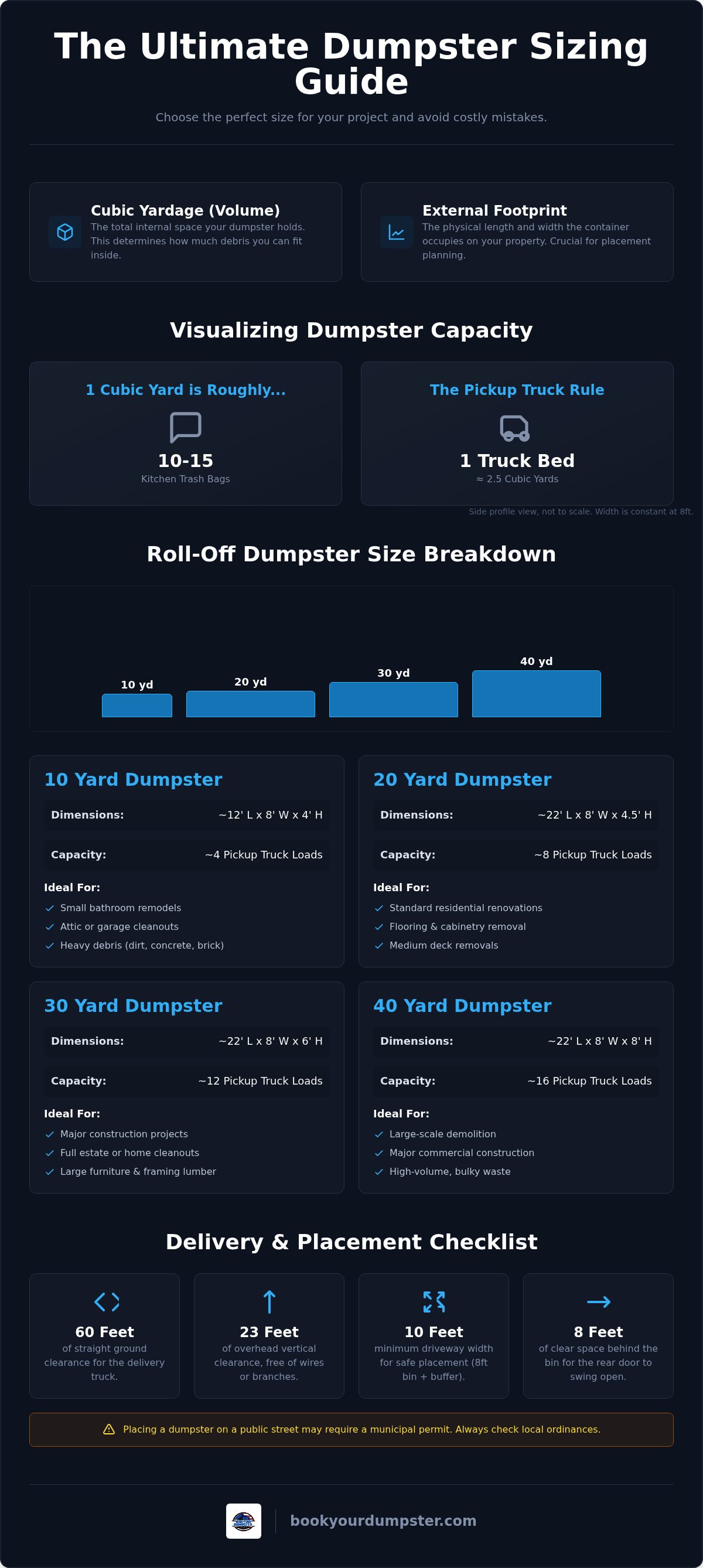
Understanding dumpster dimensions starts with a clear distinction between volume and footprint. While cubic yardage tells you how much debris the bin holds, the external dimensions determine where that bin can actually sit on your property. Most standard roll-off dumpster sizes share a consistent width of 8 feet. This uniformity exists because delivery trucks must navigate standard traffic lanes and residential streets safely. While the width remains constant, the length and wall height vary to create different capacities. Choosing the right design depends on whether you value ease of loading or a smaller footprint.
Low-profile designs feature shorter walls. These are ideal for heavy debris like concrete, brick, or soil because you can toss materials over the side without straining. High-wall designs maximize volume by extending upward. This keeps the total length shorter, which is helpful for tight spaces, but it usually requires you to load everything through the rear door. Always confirm the specific height of your rental if you plan to load it from the side of a trailer or a high porch.
Visualizing Dumpster Capacity
Cubic yardage is the total internal volume of the container regardless of its physical shape or external height. To visualize this, consider a standard 13-gallon kitchen trash bag. One cubic yard accommodates roughly 10 to 15 of these bags when they are moderately packed. If you are handling larger debris, use the pickup truck rule. A standard pickup truck bed, filled level to the top, holds about 2.5 cubic yards. Therefore, a 10-yard dumpster replaces four full trips to the landfill in a standard truck. Use this comparison to estimate your waste volume before you commit to a specific size.
Why Footprint Matters for Residential Rentals
Measure your driveway width carefully before scheduling a delivery. Since most dumpsters are 8 feet wide, a standard 10-foot wide driveway only offers a one-foot buffer on either side. This tight clearance leaves no room for error during the drop-off. You must also account for the door swing. Roll-off containers feature a large rear door that swings open horizontally to allow for easy walk-in loading. Leave at least 6 to 8 feet of clear space behind the container to ensure the door can open fully. If your driveway is short, a long container might block the sidewalk or extend into the street. This often requires a municipal permit and additional safety equipment like reflective cones or tape. Verify your local street blocking ordinances to avoid unexpected fines during your project.
Roll-Off Dumpster Dimensions: 10 to 40 Yard Breakdown
Choosing a container requires a calculated look at your project waste and the space available for the bin. Most rental units follow industry standards for waste equipment to ensure they fit safely on transport trucks and residential streets. These dumpster dimensions are standardized to help you plan your staging area with precision. Whether you are clearing out a small garage or managing a full-scale demolition, matching the bin to the debris type is the first step toward a clean job site.
10 And 20 Yard Size Specifications
The 10-yard dumpster is the residential favorite for tight driveways and heavy materials. It typically measures 10 to 12 feet long, 8 feet wide, and 3.5 to 4 feet high. Use this compact choice for bathroom remodels, attic cleanouts, or heavy debris like dirt and concrete. Its low walls allow you to toss heavy items over the side without excessive lifting. For a deeper look at this model, see our 10 Yard Dumpster Rental: The Complete Buying Guide for 2026.
The 20-yard dumpster is the industry standard for residential renovations. It measures 22 feet long, 8 feet wide, and 4.5 feet high. This size offers the perfect balance of capacity and footprint. It fits in most standard driveways while providing enough room for flooring, cabinetry, and deck removals. If you are unsure about your volume, the 20-yard is often the safest bet to avoid a second haul and extra fees.
30 And 40 Yard Size Specifications
Larger projects demand specialized equipment capable of handling bulky or high-volume waste. The 30-yard and 40-yard models maintain a 22-foot length and 8-foot width but increase capacity through wall height. A 30-yard dumpster stands 6 feet high and is built for major construction and estate cleanouts. This height makes it ideal for long items like framing lumber or large furniture. Consult The Ultimate Guide to Construction Debris Removal in 2026 for professional staging advice.
The 40-yard dumpster provides maximum capacity for commercial and industrial debris. It features 8-foot walls, making it the largest roll-off available. You can't easily toss items over the side of this bin. You must use the rear swing door to walk your materials inside. This size is reserved for massive building tear-downs or window replacement projects on large commercial structures. Review your specific dumpster dimensions before delivery to ensure your site has the necessary vertical clearance for these tall walls. Use our online tool to verify availability in your city today.
Commercial Front-Load Dumpster Dimensions
While roll-off containers handle temporary project debris, commercial front-load containers provide permanent waste management for businesses and multi-family housing. Understanding these dumpster dimensions is critical because these bins occupy a fixed footprint on your property. Unlike roll-offs that slide off a rail system, front-load bins are serviced by trucks using hydraulic arms that lift the container over the vehicle cab. This operation requires significant vertical clearance. You must ensure at least 25 feet of overhead space to prevent the truck arms or the bin itself from striking power lines, overhangs, or tree limbs during pickup.
Front-load bins differ from roll-offs in both shape and utility. They are designed for consistency and frequency. Most front-load models maintain a standard width of approximately 6 feet to fit between the fork pockets of the collection truck. The depth and height vary based on the yardage, but the footprint remains much more compact than the 22-foot length of a standard construction bin. This makes them ideal for tight alleys and designated waste enclosures.
Small to Medium Commercial Sizes (2-4 Yards)
Small businesses with limited space typically opt for 2-yard or 4-yard containers. The 2-yard bin is the most compact option, measuring roughly 6 feet wide, 3 feet deep, and 3 feet high. It's the ideal choice for small offices or retail shops that generate light paper waste and general refuse. The 4-yard dumpster is often called the "sweet spot" for medium-sized businesses and restaurants. At approximately 6 feet wide, 4 feet deep, and 5 feet high, it handles a higher volume of food waste or packaging without requiring a massive parking lot footprint. These smaller sizes are easy to place against a wall or in a single parking stall.
Large Commercial Sizes (6-8 Yards)
High-volume entities like apartment complexes, large grocery stores, and industrial warehouses require 6-yard or 8-yard containers. These bins stand significantly taller, with 8-yard models reaching up to 7 feet in height. Because of their size and weight when full, these containers usually require a dedicated concrete enclosure. When designing an enclosure, you must account for the dumpster dimensions plus at least 2 feet of clearance on all sides for maneuverability. Ensure the approach for the truck is clear of parked cars and low-hanging structures. A 6-yard bin typically measures 6 feet wide by 5 feet deep, while the 8-yard expands the depth and height to maximize capacity for daily or weekly pickups. Confirm your site's ground level is flat and reinforced to support the frequent weight of a heavy-duty collection vehicle.
Measuring Your Space: Clearance and Delivery Logistics
Measure your staging area before the truck arrives. Successful delivery depends on the space around the bin, not just the dumpster dimensions themselves. Follow the "Rule of 60" to avoid a failed delivery fee. This rule requires 60 feet of straight-line clearance. The truck needs this distance to back in, tilt the rail, and pull away after the drop. If your driveway doesn't meet this length, the driver may have to leave the site without dropping the bin. Planning for this space ensures the truck can maneuver without hitting your property or parked cars.
Verify vertical clearance. You need at least 23 feet of overhead space. Roll-off trucks tilt the container high during the delivery process. Low-hanging power lines, tree branches, or building eaves will obstruct the hoist. Account for the vehicle width too. While the container is 8 feet wide, the truck requires 10 feet of width to clear its mirrors and deploy stabilizers. In high-density areas like Queens, San Francisco, and Boston, these requirements are non-negotiable for safe operation. Drivers in these metros are experts at precision, but they can't bypass the laws of physics.
Driveway and Surface Preparation
Protect your driveway surface. The steel wheels of a roll-off can damage soft asphalt or decorative concrete. Lay down plywood sleepers or 2x4 boards to create a protective barrier between the bin and your pavement. Ensure the ground is level. We don't drop containers on steep slopes or soft soil. Also, identify any underground utilities before the truck arrives. Never place a bin over a septic tank or water line. The weight of a filled 30-yard container can crush residential pipes, leading to expensive repairs that far exceed the cost of the rental.
Street Placement and Permits
Plan for street placement if your driveway is too small or inaccessible. Local regulations in Illinois, Massachusetts, and New York require specific right-of-way permits for any container placed on public property. Check your city's parking restrictions and street cleaning schedules before you book. You don't want a municipal ticket on top of your rental costs. Review our Dumpster Rental in New York, Illinois, and Massachusetts: The 2026 Complete Guide for localized advice. Schedule your rental online once your permit is secured to ensure a seamless delivery. We recommend coordinating your permit dates with our real-time availability to avoid paying for a bin that you can't legally place yet.
Booking the Right Size with Book Your Dumpster USA
Matching your specific project needs to the correct dumpster dimensions shouldn't be a guessing game. We have engineered our service to remove the logistical friction from waste management. Once you've measured your driveway and checked for overhead obstructions, our platform helps you finalize your selection with precision. We offer a range of roll-off containers, including 10, 20, 30, and 40-yard models, to handle everything from minor residential cleanouts to massive commercial builds. Our system is designed for speed and clarity, ensuring you get the right tool for the job without unnecessary delays.
Choose your size based on the nature of your debris. We often recommend sizing up if you're dealing with bulky, non-compressible items like old sofas, cabinetry, or large tree stumps. These items create air pockets that consume volume quickly. It's much more cost-effective to rent a 20-yard bin once than to realize a 10-yard bin is full halfway through your project. Our commitment to pricing integrity means the quote you see is the price you pay. We don't hide "oversize" fees in the fine print. You get transparent terms and a reliable partner for your project in New York, New Jersey, and across our national service areas.
Streamlined Online Booking
Secure your rental in under five minutes using our digital booking tool. Simply enter your zip code to see real-time availability for our entire fleet. You can select your delivery date and provide specific placement instructions directly through the interface. We prioritize clear communication. You'll receive a confirmation with your scheduled window and a checklist for delivery day. This ensures your site is ready for the truck and that the dumpster dimensions you chose fit perfectly into your workflow. We handle the logistics so you can focus on the work.
Reliable Service Across the USA
We combine national reach with deep local expertise in metros like Chicago, San Francisco, and Queens. Our drivers understand the specific challenges of urban deliveries, from narrow alleyways to strict municipal parking regulations. The Book Your Dumpster USA promise centers on punctuality and transparency. We arrive when we say we will and pick up your waste on schedule. This reliability has made us a trusted partner for both homeowners and professional contractors. Ready to clear the clutter? Book your dumpster now.
Optimize Your Project Staging with Precision Sizing
Selecting a container involves more than a simple guess. You now understand how to balance internal volume with the physical footprint to protect your driveway and ensure truck access. By measuring your specific site for the 23-foot vertical clearance and 60-foot approach required, you eliminate the risk of failed deliveries and wasted time. It's the most effective way to keep your site organized and safe throughout the duration of your project.
Accuracy in estimating dumpster dimensions protects your budget from hidden overage fees and the logistical mess of needing a second bin. We provide 10, 20, 30, and 40-yard sizes with transparent, up-front pricing across NY, NJ, IL, MA, and SF. Don't let waste management stall your progress or clutter your workspace with unnecessary debris. Secure your dumpster size and book online today. Your project deserves a reliable partner that values punctuality and pricing integrity as much as you do. Take control of your cleanup and move forward with confidence.
Frequently Asked Questions
What are the standard dimensions of a 20-yard dumpster?
Standard 20-yard dumpster dimensions are 22 feet long, 8 feet wide, and 4.5 feet high. These measurements ensure the bin fits on a standard roll-off truck while providing 20 cubic yards of internal volume. It's the most common choice for residential deck removals and kitchen remodels. Always confirm your external footprint before booking to ensure your driveway can accommodate the 22-foot length without blocking public access points or sidewalks.
Will a 10-yard dumpster fit in a standard parking space?
A 10-yard dumpster easily fits within a standard parking space. Most parking stalls are roughly 9 feet wide and 18 feet long. Since a 10-yard bin typically measures 10 to 12 feet in length and 8 feet in width, it leaves enough room for the truck to maneuver during drop-off. This makes it the ideal choice for apartment complexes or urban projects where space is limited and driveway access is unavailable.
How much vertical clearance does a roll-off truck need for delivery?
A roll-off truck requires a minimum of 23 feet of vertical clearance to deliver a container. The hoist mechanism tilts the bin high into the air during the unloading process. You must clear all low-hanging tree branches, power lines, and building overhangs before the driver arrives. If the truck cannot safely extend its rail due to overhead obstructions, you will be charged a dry run fee and delivery will be rescheduled.
Can I put a 30-yard dumpster on my driveway?
You can place a 30-yard dumpster on a residential driveway if it is at least 22 feet long and structurally sound. The weight of a filled 30-yard container is substantial; you must use plywood sleepers to protect the pavement from cracking. Ensure the surface is level and free of underground septic tanks or water lines. If your driveway is too short, you must secure a street permit for public placement instead.
What happens if my debris exceeds the height of the dumpster walls?
All debris must be level with the top of the container for safe transport. Drivers cannot legally haul overfilled bins because loose items pose a significant hazard on public roads. If your waste sticks out above the rim, you will have to remove the excess material yourself. You will also likely face a trip fee for the driver to return once the load is properly secured and safe for the highway.
Do I need a permit if the dumpster dimensions exceed my property line?
You need a permit if the dumpster dimensions require placement on a public street, sidewalk, or right-of-way. Most municipalities require these permits to ensure the bin doesn't obstruct traffic or emergency vehicles. Regulations vary significantly between cities like Chicago and Boston. Secure your permit through your local public works department before scheduling your delivery to avoid city fines or the immediate, forced removal of the container from the site.
Are there different dimensions for 'low-boy' dumpsters used for concrete?
Low-boy containers feature a specialized design with walls that are usually only 2 to 3 feet high. While they maintain the standard 8-foot width, their shorter profile prevents you from overloading the bin with heavy materials like concrete, brick, or dirt. These materials are extremely dense and can easily exceed truck weight limits in standard-height bins. Using a low-boy ensures you stay within legal hauling limits and avoid heavy weight-related penalties.
How much space is needed behind the truck to drop the dumpster?
You must provide 60 feet of straight-line clearance to drop a roll-off container. This distance includes the length of the truck and the space needed for the driver to pull forward after the bin touches the ground. The area must be clear of parked cars, equipment, and debris. If the truck has to navigate a curve or an incline, you may need additional room to ensure a safe placement without property damage.


