
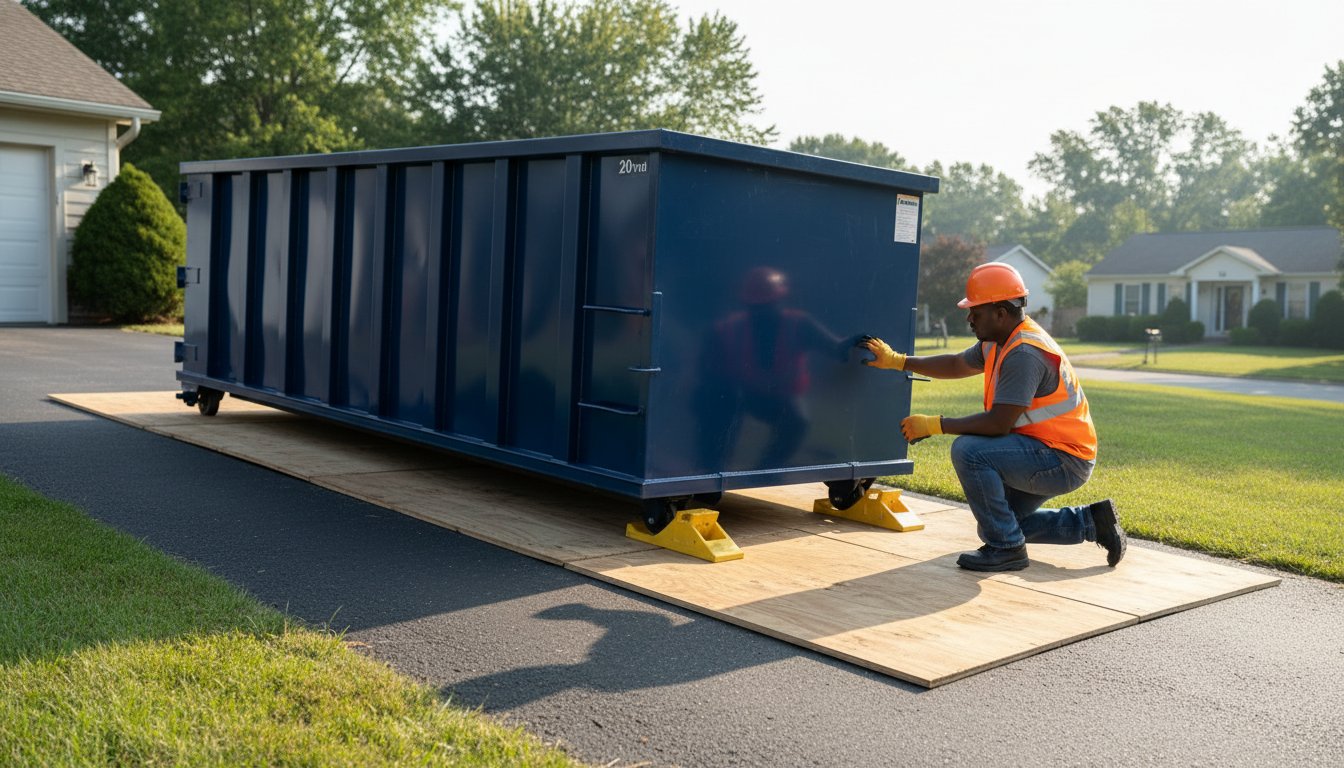
Gravity is a constant, but a sliding ten-ton container is a choice you can avoid. You likely worry about your 20 yard dumpster rolling into the street or leaving permanent gouges in your asphalt. It's a valid concern. Most homeowners feel a surge of anxiety the moment they realize their driveway isn't perfectly flat. With waste collection fatality rates reaching 41.4 per 100,000 workers in 2023, safety isn't just a suggestion; it's a requirement for a successful delivery.
This guide provides the exact safety protocols for successful dumpster placement on a sloped driveway so you can stop guessing and start prepping. You'll learn how to create a stable foundation using 3/4-inch plywood and wheel chocks. We also provide a clear framework to help you decide if your incline is safe or if you need an alternative plan. Follow these steps to ensure your rental arrives without delay and stays exactly where it belongs.
Key Takeaways
- Verify your driveway's grade against the 15-degree rule to prevent delivery refusals and ensure equipment stability.
- Use a smartphone level app or a simple rise-over-run calculation to get an accurate measurement of your incline before you schedule.
- Secure the necessary safety equipment, such as heavy-duty wheel chocks and structural wood planking, for successful dumpster placement on a sloped driveway.
- Clear a 60-foot linear path and mark a specific Target Box with chalk to provide the driver with a precise and safe landing zone.
- Understand how professional providers like Book Your Dumpster USA manage challenging urban slopes with specialized equipment and local expertise.
Can You Put a Dumpster on a Sloped Driveway? The Short Answer
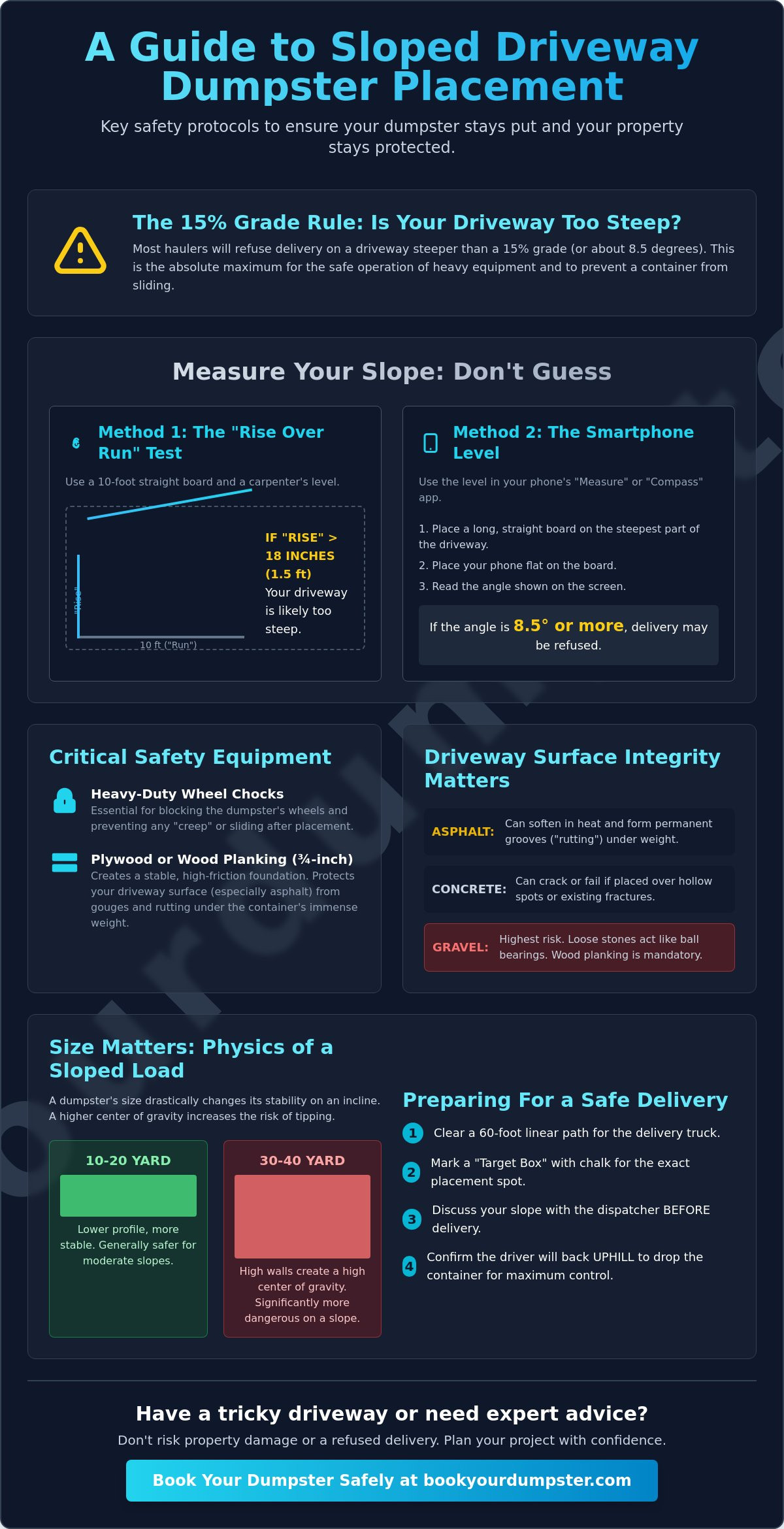
Yes, you can. Most residential driveways with moderate inclines are perfectly compatible with roll-off containers. However, dumpster placement on a sloped driveway isn't a "one size fits all" situation. Most haulers draw a hard line at a 15% grade. This means for every 10 feet of driveway length, the elevation shouldn't change by more than 1.5 feet. If your incline is steeper than this, the delivery truck might lose traction or the container could slide during the drop-off process.
The roll-off truck's hydraulic system handles the heavy lifting, but it relies on physics to stay grounded. The direction of the slope also dictates the delivery strategy. Drivers prefer to back the truck uphill so the container remains level with the bed as it slides off. If they have to drop the unit while facing downhill, the risk of the container "running away" from the truck increases. Always discuss the direction of your incline with the dispatcher before the truck arrives.
When a Slope is Too Steep for Delivery
Identify visual cues before you book. If your driveway feels like a workout just to walk up, it's likely too steep for heavy machinery. A full 10 yard dumpster carries immense weight. On an unserviceable incline, this weight creates "creep," where the container slowly migrates toward the street. Drivers have the final say on safety for liability reasons. They'll refuse a drop-off if they believe the angle compromises their equipment or your property's integrity.
The Physics of a Sloped Load
Gravity shifts the container's center of mass toward the lowest point. This shift puts extreme pressure on the rear door hinges and latches. If you place the container sideways across a slope, you risk a "top-heavy" tip-over event. This instability is tied to the angle of repose, which is the steepest angle at which a material remains stable without sliding. Once you exceed this point, catastrophe is inevitable.
Size matters when calculating risk. A 10-yard unit has a low profile and stays relatively stable. However, a 40-yard dumpster is significantly more dangerous on a slope. Its high side walls and massive volume create a high center of gravity. A slight tilt that seems manageable for a small bin can lead to a structural failure or a tip-over with a 40-yard unit. Keep dumpster placement on a sloped driveway limited to smaller containers whenever possible to maintain a safe center of gravity.
How to Measure Your Driveway Incline Before Booking
Do not guess your driveway's slope. A visual estimate is often deceptive and leads to driver refusals on delivery day. Precision is the only way to ensure a safe dumpster placement on a sloped driveway. You must measure the steepest section where the container will actually sit, rather than the average grade of the entire drive. If the wheels rest on a sharp 18% incline while the rest of the drive is flat, the setup remains unstable.
Calculate your grade in two minutes using the "Rise over Run" method. Find a straight 10-foot board and a carpenter’s level. Hold the board perfectly level with one end touching the driveway. Measure the vertical distance from the elevated end of the board down to the pavement. If that gap is 18 inches, you have a 15% grade. This is the standard maximum limit. If the gap is wider than 18 inches, your driveway is too steep for a safe roll-off delivery. Confirm these numbers before you schedule your rental to avoid logistical delays.
Using the Smartphone Level Method
Your phone is a precision tool for this task. Open the "Measure" app on an iPhone or the "Compass" app on Android to access the level feature. Do not place the phone directly on the pavement, as small pebbles can skew the reading. Instead, lay a long, straight board on the steepest part of the driveway and place your phone flat on top of it. Read the percentage or degree shown. A 15% grade equals roughly 8.5 degrees. If your phone shows 10 degrees or higher, you've exceeded the safety threshold for heavy equipment.
Evaluating Surface Integrity
The material under the wheels determines how the load behaves on an angle. Asphalt is flexible and softens in the sun. A heavy container on a slope can cause "rutting," where the weight pushes the asphalt downhill and creates permanent grooves. Concrete is more rigid but will fail if placed over hollow spots or existing spiderweb cracks. These cracks often expand under the lateral pressure of a sloped load.
Gravel presents the highest risk. Loose stones act like ball bearings under heavy steel wheels. If your placement area is gravel, you must use structural wood planking to create a high-friction foundation. OSHA regulations for equipment on inclines require that wheels are chocked to prevent movement, which is a non-negotiable step on unstable surfaces. Inspect your surface for oil leaks or loose debris that could reduce traction before the truck arrives.
Critical Safety Equipment for Sloped Dumpster Placement
Success on an incline requires more than a skilled driver. You must provide the physical barriers necessary to fight gravity. Managing dumpster placement on a sloped driveway means preparing the site with industrial-grade materials before the truck arrives. A loaded container can easily exceed 20,000 lbs. Standard residential equipment will fail under this pressure. You're responsible for the stability of the site once the driver departs.
Never use plastic car chocks for a roll off dumpster rental. They'll crush or slide. Invest in heavy-duty rubber chocks with a high-grip base. Rubber provides superior friction on both asphalt and concrete compared to metal alternatives. Place the chocks firmly against the down-slope wheels. This creates a mechanical stop that prevents the unit from "walking" down the drive during loading. Don't rely on the truck's winch to hold the container in place. Winches are designed for tension during the pull; they aren't permanent parking brakes.
Use the "Plywood Sandwich" method to protect your property. Lay down sheets of 3/4-inch plywood where the rollers will land. For maximum protection, double these layers. This distributes the weight across a wider surface area and prevents the steel rollers from gouging your driveway. If you're working in winter conditions, your prep work must include salt and sand. Remove every patch of ice from the placement zone. Ice acts as a lubricant. Even a slight incline becomes a skating rink for a ten-ton bin if the surface isn't bone-dry and gritted. Apply sand generously to create a high-friction landing zone for the steel wheels.
Winter deliveries on a slope demand extra vigilance. Follow this protocol:
- Shovel the entire 60-foot delivery path to bare pavement.
- Apply heavy-duty ice melt two hours before the truck arrives.
- Spread a layer of coarse sand over the "Target Box" to increase friction.
- Ensure your wheel chocks are dry and free of snow buildup.
Choosing the Right Wheel Chocks
Prioritize rubber over metal. Metal chocks can skitter across smooth concrete like a hockey puck. Rubber bites into the surface, especially when under the weight of a 20 or 30 yard dumpster. Always chock the wheels that face the bottom of the hill. If the slope is significant, chock both sides of the rear wheels. This redundant safety measure ensures the container stays put even if the ground shifts slightly during a heavy rainstorm.
Plywood and Planking Strategies
Select planks that are at least 4 to 6 feet long. Shorter blocks can kick out or tip when the rollers hit them. Position the planks so they align with the truck’s rails. This ensures the container transitions smoothly from the truck bed to the ground. Long planks provide a stable runway that keeps the load balanced during the most volatile part of the delivery. Using thin wood like 1/2-inch plywood is a mistake; the weight of the dumpster will snap it, leaving your driveway exposed to damage.
Step-by-Step Guide: Preparing for a Sloped Delivery
Preparation turns a high-risk delivery into a routine task. For a safe dumpster placement on a sloped driveway, you must clear a 60-foot linear path. Roll-off trucks are long and require significant room to maneuver before they begin the tilt. Use chalk or bright tape to mark a "Target Box" on the pavement. This visual guide tells the driver exactly where to center the load. It eliminates guesswork and ensures the wheels land squarely on your protective barriers.
Pre-position your 3/4-inch plywood and rubber chocks next to this box. Don't wait for the truck to pull in to start hunting for supplies. When the driver arrives, conduct a quick arrival briefing. Point out the slope, your marked box, and any specific concerns about the surface. Clear communication prevents mid-delivery adjustments that can be dangerous on an incline. If you have any doubts about the site, schedule your delivery with a provider that prioritizes safety protocols.
The Day-Before Checklist
Start your preparation 24 hours early. Check for overhead obstructions first. Roll-off trucks require 14 to 16 feet of vertical clearance to raise the hoist. Trim low-hanging tree limbs and identify any low power lines. If your driveway is narrow, your neighbor might need to move their car so the truck can swing wide. A courtesy knock saves time and frustration. Finally, sweep the area. Remove loose gravel, standing water, or oil spots. These reduce the friction needed to keep your container secure.
During the Drop: Positioning for Safety
Position the rear doors toward your project area. Don't assume they must face downhill. If you're cleaning out a garage at the top of the hill, the doors should face the garage for easier loading. The driver will use a "Slow Drop" technique to maintain control. Watch as the rollers engage your pre-placed wood planks. The transition from the truck bed to the ground should be controlled and steady without any sudden drops.
Once the container is on the ground, verify its stability immediately. Place your heavy-duty chocks against the down-slope wheels. Check for any shifting or "creep" before the driver unhooks the cable. If the container moves even an inch, ask the driver to reposition it. Only when the unit is fully chocked and stationary should the driver depart. Take control of your site safety and book your dumpster with the confidence that your prep work is complete.
Professional Solutions for Challenging Driveways
Challenging terrain requires a professional partner who understands local geography. Book Your Dumpster USA specializes in the logistical hurdles of tight, sloped urban placements. While a standard driveway might be straightforward, the narrow drives of Massachusetts or the steep hills of San Francisco demand a higher level of driver competence. We prioritize reliability and clear communication to ensure your project doesn't stall because of a delivery refusal. Our drivers don't just drop and go; they assess the surface to ensure a safe dumpster placement on a sloped driveway.
Don't settle for a hauler who avoids hills. Choose a team that treats your slope as a technical task, not a reason to no-show. We maintain pricing integrity even when the logistics get complicated. You won't face hidden fees for the extra time it takes to secure a complex load. We provide the expertise needed to manage the physics of your site so you can focus on your cleanup or renovation project.
Regional Considerations: NY, NJ, and MA
Permit requirements vary wildly by city. In New York City, placing a container on a sloped street requires specific documentation from the Department of Transportation. Our local teams understand these regional nuances. In Illinois and Massachusetts, winter incline hazards mean our drivers look for specific soil compaction and pavement types before attempting a drop. We won't leave you guessing about whether your site is accessible. Our drivers understand the local climate and how it affects dumpster placement on a sloped driveway throughout the year.
Beyond the Driveway: Creative Placement
If your driveway exceeds the 15% grade safety threshold, you need a pivot. The "Street-Park" alternative is often the most viable solution. This usually requires a permit from your local public works department; fees typically range from $10 to $200 depending on your municipality. Always check with your HOA for specific rules regarding street placement.
Opting for a 10 yard dumpster is another strategic move for difficult sites. The lighter footprint reduces the risk of surface damage and lateral movement on sensitive inclines. If you're unsure, contact our dispatch team for a custom site assessment. We can often review photos of your location to provide a definitive answer before the truck ever leaves the yard. This proactive approach eliminates the stress of delivery day and ensures your container is positioned exactly where you need it.
Secure Your Project Site Today
Managing a project on an incline doesn't have to be a logistical nightmare. You now have the tools to measure your grade, identify the 15% safety limit, and prepare your site with the right protective barriers. Success depends on using 3/4-inch plywood and industrial-grade rubber chocks to prevent movement once the container is set. By following these safety protocols, you protect your property and ensure a seamless delivery process.
Don't let a steep driveway stall your cleanup or renovation. We provide expert drivers specifically trained to handle the physics of sloped terrain. Our team operates across NY, NJ, IL, MA, and SF, offering the local expertise needed for challenging urban environments. We maintain transparent, no-nonsense pricing so you can budget with confidence. Ensuring a safe dumpster placement on a sloped driveway is simply a matter of preparation and professional execution.
Take the next step in your project with a partner who understands your site's specific needs. Book Your Reliable Dumpster Rental Online Today. Your prepared site is ready for a safe, professional delivery.
Frequently Asked Questions
Can a roll-off dumpster slide down a sloped driveway?
Yes, a roll-off container can slide if the surface lacks friction or the incline is too steep. Heavy steel rollers on smooth concrete or loose gravel create a low-friction environment. Once the weight of the debris increases, the downward force can overcome the initial placement. Always use rubber chocks and ensure the surface is dry to maintain a secure position throughout the duration of your rental period.
What is the maximum grade for a dumpster delivery?
The industry standard maximum grade is a 15% incline. This translates to an 8.5-degree angle or a 1.5-foot rise over a 10-foot horizontal run. Most roll-off trucks lose the necessary traction or hydraulic control beyond this point. If your driveway exceeds this limit, the driver will likely refuse the delivery to prevent equipment damage or property injury. Measure your steepest section before the truck arrives.
Do I need to be home when the dumpster is delivered on a slope?
You should be present during a sloped delivery to ensure the container lands exactly on your protective barriers. Sloped sites require immediate stabilization that only a person on the ground can verify. You'll need to confirm the alignment with your pre-placed plywood and set the wheel chocks the moment the cable is unhooked. Being home prevents the driver from making a safety-based "no-go" decision in your absence.
Will a dumpster damage my sloped asphalt driveway?
Unprotected asphalt is highly susceptible to rutting and gouging on an incline. The lateral pressure of a 20,000-pound load pushes the pavement downhill, especially on hot days when asphalt softens. Use double-layered 3/4-inch plywood to distribute this weight across a larger surface area. This precaution prevents the steel rollers from sinking into the drive and creating permanent structural damage that requires expensive repairs later.
Should I place the dumpster doors facing uphill or downhill?
Position the doors toward your work area to make loading easier and safer. While many assume doors must face downhill, it's often safer to have them face uphill if your debris source is at the top of the drive. This prevents heavy items from rolling out of the container when you open the latch. Discuss the orientation with the driver during the arrival briefing to determine the most stable configuration for your specific site.
How do I prevent a dumpster from moving once it's loaded?
Prevent movement by using industrial rubber wheel chocks on the down-slope side of the rollers. This is a critical part of dumpster placement on a sloped driveway. The chocks act as a mechanical stop that fights gravity as the container's weight increases. Don't rely on the truck's winch or a thin piece of wood. Only heavy-duty rubber provides the necessary bite to keep a fully loaded 30 or 40 yard dumpster stationary.
Do I need special permits for a dumpster on a sloped street?
You usually need a permit if the dumpster encroaches on a public sidewalk or street. While private driveways rarely require them, city-specific regulations in places like New York or Chicago are strict about sloped street placements. Permit fees generally range from $10 to $200. Check with your local public works department or HOA at least one week before delivery to avoid fines or immediate container removal.
What happens if the driver refuses to place the dumpster on my slope?
If a driver deems your slope unsafe, they'll suggest an alternative placement area or a smaller container. Drivers have the final authority because they're liable for equipment failure and property damage. You might need to pivot to a street placement or a 10-yard dumpster to manage the weight more effectively. Successful dumpster placement on a sloped driveway relies on the driver's professional judgment and your willingness to adapt the plan.


