
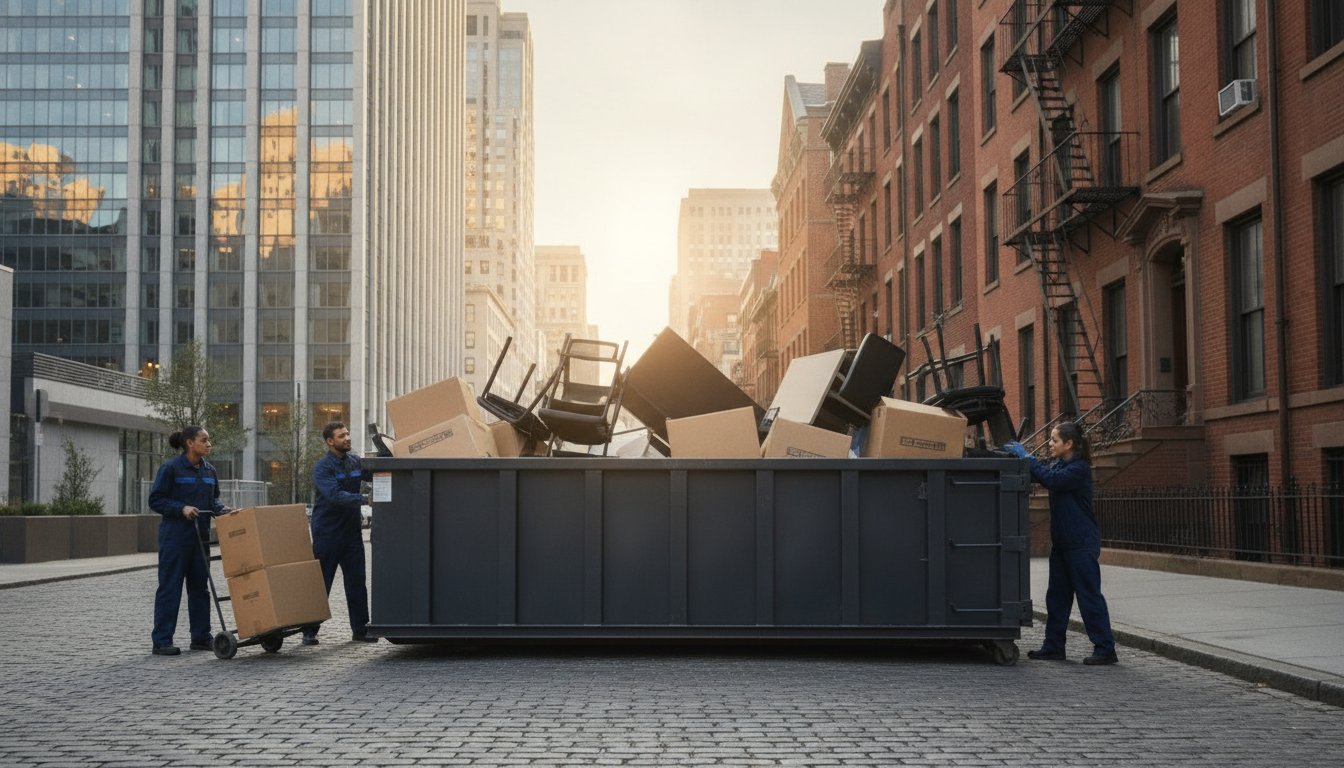
An uncoordinated office cleanout can cost your business more in city fines and overweight fees than the actual renovation. You understand the logistical nightmare of staging a dumpster service for office cleanouts in high-density urban corridors where space is at a premium and local inspectors are vigilant. Between the narrow streets of Boston and the strict sidewalk regulations in Manhattan, one wrong move leads to a stalled project and unnecessary expenses.
It's frustrating to deal with hidden overage charges or the confusion of state-specific permit requirements in NJ, NY, or MA. This guide provides a professional roadmap to master your workspace transition in 2026 without the stress. You'll learn to select the correct container, navigate regulations like the NY SHIELD Act for secure document disposal, and avoid EPA penalties that can reach $70,117 per day for improper e-waste handling. We cover the essential steps to ensure your office is clutter-free, compliant, and cleared on a transparent schedule.
Key Takeaways
- Categorize your debris before scheduling. Identify bulk furniture and sensitive documents to streamline your waste stream management and avoid sorting delays.
- Match your project volume to the right container. Learn why a 20-yard dumpster service for office cleanouts is the professional standard for mid-sized workspace transitions.
- Secure necessary permits for urban placement. Determine if your city requires a right-of-way permit for curbside placement or if a loading dock drop-off is more efficient.
- Execute a phased inventory and tagging system. Organize your debris into staging areas to ensure a rapid, efficient filling process once the unit arrives on-site.
- Avoid surprise overages and regulatory penalties. Master the specific rules for office waste profiles to maintain budget integrity and ensure compliance with local disposal laws.
Assessing Your Office Cleanout Scope and Waste Profile
Successful facility management begins with a clear objective. Identify the primary driver for your project before you schedule a dumpster service for office cleanouts. Relocation projects often involve strict move-out dates that require rapid debris removal. Downsizing efforts demand more surgical precision to separate essential assets from waste. General productivity cleanouts allow for more flexibility but still require a structured timeline to avoid disrupting daily operations. Determine your deadline early to prevent logistical bottlenecks.
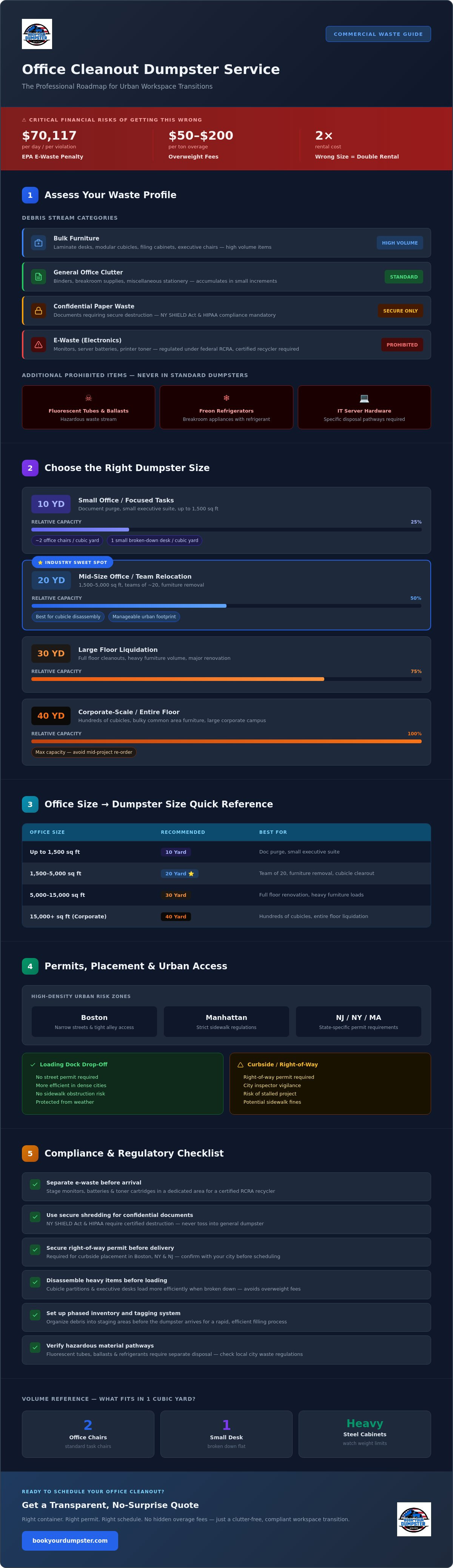
Categorize your debris types into distinct streams. Bulk furniture, such as laminate desks and modular cubicles, consumes significant volume quickly. General office clutter, including old binders and breakroom supplies, adds up in smaller increments. You must also account for confidential paper waste. While standard dumpsters handle general trash, sensitive documents require secure destruction to comply with the NY SHIELD Act or HIPAA regulations. Understanding these waste management principles ensures you don't mix restricted materials with general debris.
Prepare for the e-waste factor. Federal RCRA regulations are strict regarding electronics. You cannot toss monitors, server batteries, or printer toner into a standard roll-off. Non-compliance is expensive. The EPA can impose fines of up to $70,117 per day for each violation. Separate these items into a dedicated staging area for specialized handling by a certified recycler.
Conducting a Commercial Waste Audit
Visualize your volume before booking. A single cubic yard typically holds about two standard office chairs or one small desk broken down. Don't underestimate the weight of your inventory. Steel filing cabinets and heavy executive desks can quickly push you toward overweight fees, which typically range from $50 to $200 per ton. High-volume items like cubicle partitions are awkward to load. Plan to disassemble these pieces to maximize the space inside your container and keep your dumpster service for office cleanouts efficient.
Identifying Prohibited Office Materials
Check your building for restricted items. Fluorescent light tubes and ballasts from older office suites are considered hazardous and are prohibited from standard dumpsters. The same applies to refrigerators containing freon from the company breakroom. Distinguish between true trash and recyclable commercial assets. Modern IT equipment and server hardware often contain materials that require specific disposal pathways. Keep these items out of the general waste stream to ensure your project remains compliant with local city waste regulations.
Choosing the Right Dumpster Size for Your Office Project
Selecting the incorrect container size is a costly mistake that stalls your project. If you underestimate your volume, you'll face the 'double rental' trap, paying for a second haul and wait time that your budget didn't account for. A professional dumpster service for office cleanouts provides the specific capacity needed to handle everything from bulky executive desks to thousands of pounds of paper records. Choosing the right size on day one keeps your workspace transition on schedule and your costs predictable.
The 10-Yard Dumpster is ideal for focused tasks like document purging or clearing out a small executive suite. For mid-sized renovations or moving a team of 20, the 20-Yard Dumpster is the industry sweet spot. It offers enough room for furniture without a massive footprint. When you're liquidating an entire floor or disassembling hundreds of cubicles, move directly to 30-yard or 40-yard containers. These heavy-duty solutions ensure you don't run out of space mid-workflow.
Office Size to Dumpster Capacity Mapping
Small offices up to 1,500 square feet typically generate enough debris to fill a single small unit. Reviewing a 10 yard dumpster rental guide helps you visualize how many desks and chairs fit in this footprint. Medium offices between 1,500 and 5,000 square feet require the 20-yard container, especially when coordinating furniture removal. For large corporate floors, manage 40-yard containers to accommodate the sheer volume of partitions and bulky common area furniture. Before you start loading, ensure your plan aligns with federal waste disposal regulations to keep your project compliant.
Weight Limits and Overages for Office Furniture
Office furniture is deceptively heavy. A single bank of four-drawer vertical filing cabinets can weigh over 600 pounds when empty. Oak conference tables and heavy-duty steel desks add up quickly, potentially exceeding your container's capacity. A tonnage limit is the maximum weight of waste, measured in tons, that a rental agreement allows to be hauled away for a set price before additional fees apply. Distribute weight evenly across the floor of the dumpster rather than piling it at one end. This prevents pick-up delays and safety hazards during transport. If you aren't sure which size fits your inventory, you can view our commercial dumpster options to compare capacities and find the best fit for your facility.
Logistical Planning: Permits, Placement, and Urban Access
Once you've audited your waste and selected a size, you must secure the physical space for the container. Urban office cleanouts present unique challenges that residential projects don't face, particularly regarding sidewalk access and traffic flow. A professional dumpster service for office cleanouts requires more than just a delivery address; it requires a coordinated logistics plan that accounts for city ordinances and building management rules. Failure to plan for these variables results in rejected deliveries and costly project delays.
Coordinate with your building manager immediately to verify their Certificate of Insurance (COI) requirements. Most commercial landlords won't allow a dumpster on their property without specific liability coverage listed on the provider's insurance. If you cannot place the unit in a private loading dock, you'll need to evaluate curbside placement. Consult the EPA guide to commercial waste management to ensure your staging area doesn't interfere with local environmental or safety protocols. Scheduling your delivery for late evening or early weekend hours often bypasses peak traffic and reduces disruption to neighboring tenants.
Securing Permits in Major Metro Areas
If your dumpster must sit on a public street or sidewalk, you are entering the "Right of Way." This requires a specific permit from the local Department of Transportation (DOT). Requirements vary wildly by region, so review the specific rules for dumpster rental in New York, Illinois, and Massachusetts before you book. Lead times for these permits can range from 48 hours to two full weeks. Don't wait until the day of the cleanout to check. The cost of non-compliance is steep, as city inspectors frequently issue fines for unpermitted containers that block public access or parking zones.
Placement Logistics for High-Rise Offices
Measure your delivery zone with precision. High-rise buildings often have loading docks with low overhangs or tight alleys that standard trucks can't navigate. A standard roll-off truck requires approximately 22 to 25 feet of vertical clearance to tilt its bed and safely slide the container onto the ground. If you're placing the container on private asphalt or decorative concrete, use 4x8 sheets of plywood to distribute the weight and prevent surface cracking. Clear all parked vehicles and debris from the drop zone at least one hour before the scheduled arrival to ensure a seamless dumpster service for office cleanouts experience.
How to Execute the Cleanout: A Step-by-Step Workflow
Execute your project with a phased approach to maximize efficiency and control costs. Don't treat the arrival of the container as the starting gun for sorting. Phase 1 involves inventory and tagging. Decide what stays, what gets donated, and what goes to the waste stream before the truck arrives. Use high-visibility tags to mark items for disposal. This prevents the accidental loss of valuable equipment during the chaos of a move. Phase 2 is staging. Move all tagged debris to a central loading area near the building exit or dock. This preparation ensures your team spends their time filling the unit rather than navigating hallways once the dumpster service for office cleanouts is on-site.
During the staging phase, separate your electronic waste. While standard office furniture and clutter go into the container, items like monitors, server hardware, and lithium-ion batteries require dedicated recycling. Creating a separate e-waste zone prevents these restricted materials from contaminating your general waste stream. Phase 3 is the loading strategy. Place heavy, flat items like tabletop surfaces and steel cabinets at the bottom to create a stable base. Phase 4 is the final inspection. Walk the perimeter of the container to ensure no hazardous materials or prohibited liquids were tossed in by mistake.
Efficient Loading Techniques for Commercial Waste
Maximize every cubic yard of space by breaking down modular furniture. Disassemble cubicle partitions and remove legs from conference tables to eliminate air pockets that waste capacity. Keep the walk-in door clear and accessible until you've loaded the heaviest items. Always follow the level load rule. You cannot fill the container above the top rim. Overfilled dumpsters are illegal to transport and will lead to rejected pickups and additional service fees. If you're ready to schedule your project, book your commercial dumpster rental online to secure your delivery date.
Managing Confidential Data and Paper
Integrate your document destruction plan with your roll off dumpster rental strategy. Mass document purges often happen during cleanouts, but standard dumpsters are not secure for sensitive records. Use locked shredding bins for payroll, medical, or legal files to stay compliant with the NY SHIELD Act or HIPAA. Recycle bulk non-confidential paper separately if your volume is high. This reduces the weight in your primary container and supports corporate sustainability goals while maintaining strict data privacy standards.
Secure Your Office Cleanout with Book Your Dumpster USA
Facility managers require a waste partner who understands that every hour of delay impacts the corporate bottom line. Book Your Dumpster USA provides a pragmatic, professional dumpster service for office cleanouts designed to remove logistical friction from your workspace transition. We focus on reliability and direct communication. You get a high-functioning tool for your project, not a list of excuses. Our transparent pricing models respect your corporate budget by eliminating the hidden fees and opaque overage charges common in the waste industry.
Our digital-first booking system allows you to secure a container for projects in NY, NJ, IL, and MA within minutes. We've modernized the traditional industrial sector to match the speed of your business. This efficiency extends to our ground operations, where we maintain strict compliance with all local city waste regulations. We don't just drop a box. We provide the local expertise necessary to navigate the complex permitting and placement requirements of high-density urban corridors without the stress of city fines.
The Book Your Dumpster USA Advantage
Reliability and punctuality are our core metrics. We respect your move-out deadlines because we know the cost of a stalled renovation or a missed lease handover. Our inventory includes a full variety of sizes, including 10, 20, 30, and 40-yard dumpsters. This ensures you have the exact capacity required for any office scale, from small document purges to full-floor liquidations. We bring specialized local expertise to major hubs, including Queens and the East Coast, as well as San Francisco. We understand the specific street-loading challenges and building management protocols unique to these high-traffic areas.
Get Started on Your Office Cleanout Today
Streamline your project by using our online system for a 60-second booking. Before you start, have your specific building access rules and any required Certificate of Insurance (COI) details ready. Knowing your permit needs for street placement will also speed up the process. Our platform guides you through the selection and scheduling phases with minimal cognitive load. Move from a state of clutter to a state of resolution with a partner who values your time and urgency. Book your office cleanout dumpster now to secure your delivery and ensure a seamless workspace transition.
Master Your Workspace Transition
A successful office cleanout requires more than just heavy lifting. It demands precise logistical planning, from selecting the right container size to navigating complex urban permit requirements. By following a structured workflow of inventorying, staging, and strategic loading, you ensure your project stays on schedule and within budget. Utilizing a reliable dumpster service for office cleanouts is the most efficient way to maintain compliance with local regulations while avoiding the hidden costs of project delays or overweight fees.
Book Your Dumpster USA offers a specialized 10 to 40 yard roll-off fleet to handle any project scale. We provide expert permit handling in NY, NJ, IL, and MA, so you don't have to worry about city fines. Our no-nonsense, transparent commercial pricing means you can plan your corporate budget with total confidence. Schedule your professional office cleanout dumpster here to clear your workspace with ease. You're ready to transform your office into a productive, clutter-free environment.
Frequently Asked Questions
What size dumpster is most common for a standard office cleanout?
The 20-yard dumpster is the most frequent choice for a standard office project. It provides the capacity to handle modular furniture, cubicle partitions, and bulk office supplies without occupying an excessive footprint in a parking lot or loading dock. For smaller suite purges or document-heavy projects, a 10-yard container is often sufficient to meet your needs without wasting space.
Can I put old office chairs and desks in a roll-off dumpster?
Yes, you can place standard office chairs and desks in a roll-off container. Disassemble large desks and remove legs from conference tables to maximize space and prevent air pockets that waste capacity. Heavy steel filing cabinets are also acceptable. Monitor the total weight to avoid exceeding the tonnage limit specified in your rental agreement, as heavy furniture adds up quickly.
Do I need a permit to put a dumpster on the street in Queens or Chicago?
You must secure a right-of-way permit if the dumpster sits on a public street or sidewalk in Queens or Chicago. City inspectors in these high-density areas are vigilant and issue substantial fines for unpermitted containers. Check with the local Department of Transportation or your provider to confirm lead times. These permits often require two days to two weeks for approval.
What happens if my office furniture makes the dumpster too heavy?
Exceeding the weight limit results in overweight fees, which typically range from $50 to $200 per ton. Heavy materials like oak executive desks or full filing cabinets can push a container over its limit faster than expected. Distribute weight evenly across the floor. Consider renting a larger 30 or 40-yard unit if you have high-density materials to avoid these extra charges.
How long can I keep the dumpster at my office location?
Most standard rental agreements cover a seven-day period. You can often extend this duration for a daily fee if your renovation or move-out timeline changes. Always schedule your pickup at least 24 hours in advance. This ensures the truck arrives exactly when your cleanout is complete and prevents the container from sitting idle and blocking building access or parking zones.
Are there items my office building might prohibit me from putting in the dumpster?
Office buildings and waste regulations prohibit hazardous materials like fluorescent light tubes, ballasts, and electronics. E-waste requires specialized handling due to federal RCRA regulations. Improperly disposing of these items can lead to EPA fines of up to $70,117 per day. Verify your building's specific disposal policy for breakroom appliances, especially refrigerators containing freon, which require certified removal services before disposal.
Do you offer same-day delivery for urgent office moves?
Professional logistics for a dumpster service for office cleanouts typically require 24 to 48 hours of lead time. This ensures equipment availability and allows for proper permit compliance in urban areas. Don't wait until the day of your move to schedule. Plan your project schedule in advance to secure your preferred delivery window and avoid last-minute disruptions to your business operations.
Can I rent multiple dumpsters at once for a large corporate liquidation?
Yes, you can rent multiple dumpsters simultaneously for large corporate liquidations or full-floor move-outs. We coordinate staggered deliveries and pickups to keep your workflow moving without overcrowding your loading dock. This strategy is essential when using a dumpster service for office cleanouts to manage high volumes of cubicle walls and partitions efficiently while keeping your project on a strict move-out schedule.


