
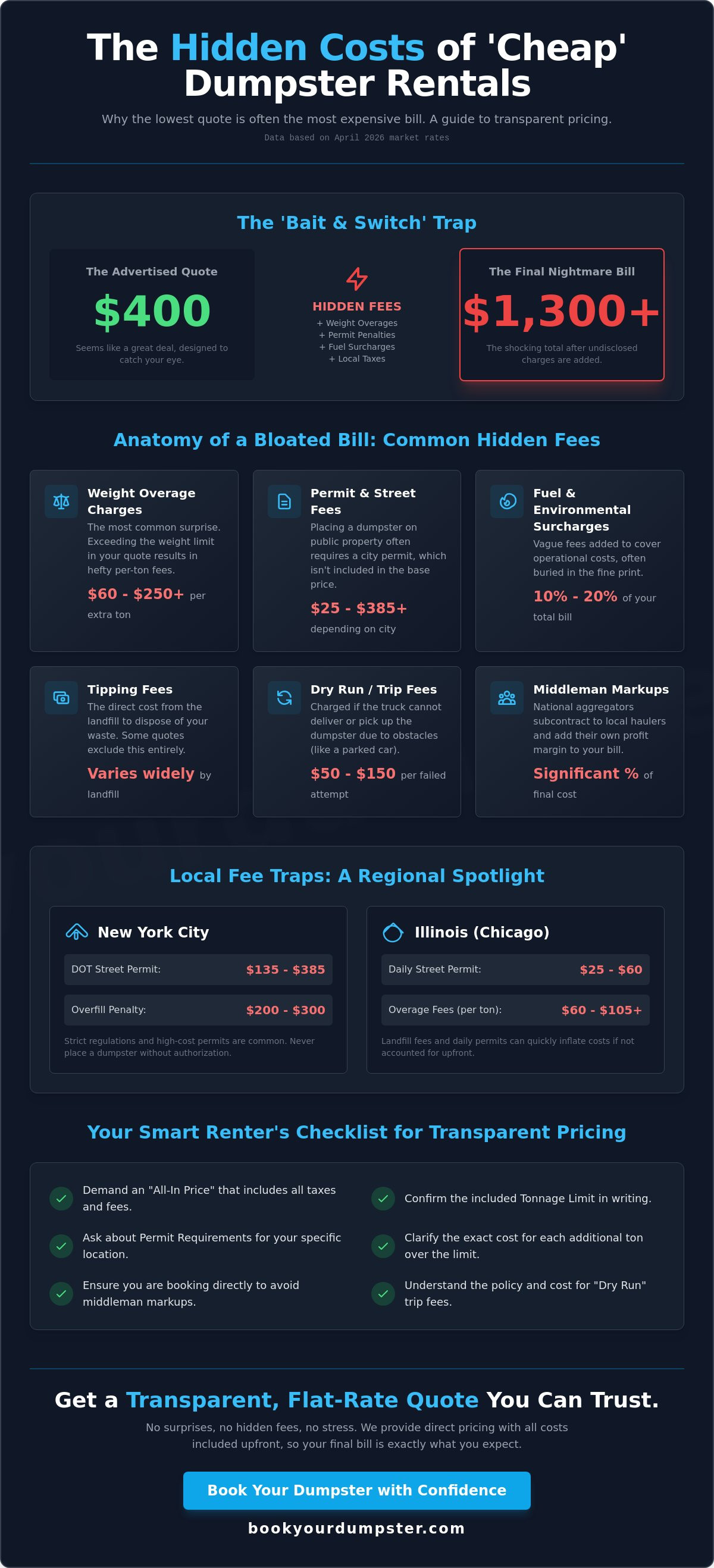
The lowest quote on your screen is often the most expensive bill you will ever pay. In major hubs like Paterson, Ann Arbor, or Chicago, a $400 estimate can quickly balloon into a $1,300 nightmare once you factor in weight overages and permit penalties. You need a straightforward price that stays the same from delivery to pickup. We know that finding cheap dumpster rentals without hidden fees is about transparency, not just a low initial number. It's frustrating to deal with surprise $250 per ton overweight charges after your project is already finished.
Learn how to spot deceptive pricing and secure the most cost-effective dumpster for your local project. This guide breaks down current April 2026 market rates, highlighting how prices can vary significantly across regions, from starting points around $440 to averages near $500. We'll explain common permit requirements in areas like Paterson and Ann Arbor, and how to avoid Chicago's $60 daily street permit fees. You will get a clear understanding of weight limits and regional waste bans so your final invoice is exactly what you expected. Book your dumpster with confidence through **Book Your Dumpster USA** by knowing exactly what to look for in the fine print.
Key Takeaways
- Identify common bait-and-switch tactics used by national aggregators to avoid paying double the initial quote.
- Master the process of finding cheap dumpster rentals without hidden fees by identifying regional surcharges in cities like NYC, Chicago, and Boston.
- Compare flat-rate versus variable pricing models to determine which structure offers the best value for your specific debris weight.
- Use our essential checklist to confirm all-in pricing and tonnage limits before you schedule your delivery.
- Eliminate middleman markups by booking directly with local experts who prioritize on-time delivery and transparent billing.
The 'Cheap' Dumpster Trap: Why Low Quotes Often Cost More
The lowest price on your screen is rarely the final amount you pay. In the waste management industry, a hidden fee is any cost not clearly stated in your initial base quote. Many national aggregators use a "Bait and Switch" tactic to win your business by offering a low entry price while burying the actual costs in the fine print. For residents in New York, Illinois, and Massachusetts, transparency is far more important than the initial dollar figure. Finding cheap dumpster rentals without hidden fees requires looking past the bold text and into the breakdown of the service. If a price seems significantly lower than the regional average, it's usually a red flag. These companies often lack their own trucks and sub-contract the work, adding a middleman markup that you pay for later.
What Exactly Are Hidden Fees in Waste Management?
Fuel surcharges and environmental compliance fees often appear as surprises on your final invoice. A "base price" usually covers only the rental of the roll-off dumpster and its delivery. It doesn't include the weight of your debris or the local taxes required in high-regulation states. In Illinois and New York, regional disposal taxes can add 10% to 20% to your bill depending on the municipality. Always demand an "all-in price" that includes these mandatory government fees. Ask specifically if the quote includes the "tipping fee," which is what the landfill charges to process your waste. If it isn't in writing, expect to see it on your credit card statement next month.
The True Cost of a 'Cheap' Rental
Consider a typical case study from April 2026. A homeowner in Chicago finds a $350 rental online. After the project, they receive a $580 bill. The difference comes from two tons of weight overages at $90 per ton and a $50 "dry run" fee because a parked car blocked the driveway during pickup. These costs are avoidable with clear communication. Book Your Dumpster USA eliminates the middleman markup and provides direct pricing. We tell you the weight limit upfront and explain the delivery requirements clearly to avoid trip fees. This direct approach ensures your project stays on budget without the stress of unexpected costs. Choose a provider that respects your time and your wallet by offering a predictable final bill. Visit Book Your Dumpster USA to see how transparent pricing simplifies your cleanup project.
Local Fee Traps in New York, Illinois, and Massachusetts
High-density urban centers like New York City, Chicago, and Boston present unique logistical challenges that national brokers often ignore. Local labor costs in the Northeast and Midwest are significantly higher than the national average, which directly influences base pricing. National call centers often quote a generic rate that doesn't account for city-specific hurdles like narrow alleys or limited parking. Regional experts understand these nuances and provide more accurate total costs. When you are choosing a local dumpster service like Book Your Dumpster USA, you are paying for that regional knowledge. This expertise is critical for finding cheap dumpster rentals without hidden fees because it identifies local costs before the truck arrives at your site.
New York: Navigating Permit Fees and Street Placements
In New York City, you can't simply drop a container on the curb without proper authorization. The NYC DOT requires a permit for any dumpster placed on city property. As of April 2026, these permits cost between $135 and $385. If your provider fails to mention this, expect a city violation notice or a surprise charge on your final bill. Residents must also account for "overnight" parking regulations that lead to additional fines. Construction debris in the Empire State is subject to strict disposal regulations. For instance, loading a dumpster past the fill line in NYC can trigger fees between $200 and $300. Understanding these rules is essential for consumer protection from hidden fees and ensuring your project stays on budget.
Illinois and Massachusetts: Disposal Taxes and Tonnage Limits
Illinois and Massachusetts have their own sets of financial traps that can derail a budget. In Chicago, street permits range from $25 to $60 per day if you can't use a private driveway. Landfill overage fees in the city average $60 to $90 per additional ton, while Southern Illinois charges up to $105 per ton over the allowance. Massachusetts is even stricter due to its comprehensive waste ban. Disposing of mattresses or box springs carries a $100 fee per item. Televisions and computer monitors add $50 each to your bill, and tires cost $40. These are state-mandated environmental surcharges, not arbitrary company fees. Congested areas in downtown Chicago or Boston also frequently trigger "trip fees." If a driver cannot access your site due to traffic or illegal parking, you pay for the failed attempt. Finding cheap dumpster rentals without hidden fees requires knowing these local specifics before you sign a contract.
Don't get caught off guard by regional mandates. Verify if your quote includes these specific state taxes and environmental surcharges. Professional services manage these logistics for you and remove the stress of local red tape. Schedule your delivery with a provider that knows your neighborhood and its specific rules. This prevents a low-cost project from turning into a financial burden.
Flat Rate vs. Variable Pricing: Which is Actually Cheaper?
Choosing between flat rate and variable pricing determines whether you stay on budget or face a massive invoice. A flat rate provides one price for a specific size and a set weight limit. Variable pricing offers a low base price but adds "per ton" charges after the dumpster is weighed at the landfill. While the low entry fee of a variable model is a common psychological trick, it often leads to a much higher final cost. For heavy materials like concrete, dirt, or roofing shingles, variable pricing is a high-stakes gamble. Finding cheap dumpster rentals without hidden fees is easier with a flat rate because you know the total cost before the project begins.
When to Choose Flat Rate Pricing
Flat rate pricing is the most reliable option for residential cleanouts. Most homeowners struggle to estimate the weight of old furniture and household clutter. Contractors also prefer this model to keep project bids accurate. It ensures predictability in regions with complex regulations. For example, understanding NYC Department of Transportation permit rules is easier when your provider bundles these logistics into a single price. You can find a detailed breakdown of regional costs in our Dumpster Rental Prices in New York, Illinois, and Massachusetts: 2026 Guide. This approach removes the stress of calculating disposal taxes and environmental surcharges on your own. It's the simplest way to avoid the billing headaches common in the waste industry.
Calculating Your Weight Needs to Avoid Overages
Estimating weight is the hardest part of the rental process for most DIYers. A standard 10-yard dumpster typically holds between two and three tons of debris. To visualize this, a 20-yard container holds roughly six pickup truck loads of material. If you're cleaning out a basement or a garage, the weight adds up faster than you think. Heavy items like wet carpet or soaked drywall can push you over your limit instantly. Follow the golden rule of dumpster sizing: when in doubt, go one size up. Paying for a slightly larger container is always cheaper than paying hundreds in overweight penalties. This strategy is the most effective way of finding cheap dumpster rentals without hidden fees during a major renovation.
Don't let a low-ball quote lead to a high-cost surprise. Choose the pricing model that fits your project's specific debris type. Book Your Dumpster USA provides a clear weight allowance and a predictable final bill. Schedule your delivery today to keep your project moving forward without the financial stress of variable billing.
Checklist for Finding Cheap Dumpster Rentals Without Hidden Fees
Finding cheap dumpster rentals without hidden fees starts with a systematic audit of your quote. Most national aggregators rely on your lack of industry knowledge to pad their profits with surprise charges. Don't let a low-ball estimate lead to a $1,000 bill. Use this checklist to verify every line item before you sign a contract or provide payment information. A truly transparent provider will answer these questions without hesitation.
- Step 1: Demand the 'All-In' price. This figure must include base rental, delivery, pickup, and all state-mandated environmental taxes. For example, New York City rentals in April 2026 average $489, but this can climb if taxes aren't included upfront.
- Step 2: Confirm the tonnage limit. Every container size has a specific weight allowance. If you exceed this in Chicago, you'll face overage fees between $60 and $90 per ton. In NYC, that penalty jumps to $200 or $250 per ton.
- Step 3: Ask about 'dry run' fees. If a driver arrives and can't drop the dumpster because of a parked car or low-hanging wires, companies often charge a trip fee. Confirm this amount before scheduling.
- Step 4: Check the rental duration. Most quotes cover 7 to 10 days. Verify the exact daily rate for extensions so you aren't surprised if your project runs long.
- Step 5: Verify permit responsibility. In Chicago, street permits cost $25 to $60 per day. Ask if the company manages this filing or if the burden is on you.
Critical Questions to Ask Before You Give Your Credit Card
Pick up the phone and speak to a representative. Ask if the fuel surcharge is already baked into the quote. Many companies add a 5% to 15% fuel fee at the very end. Inquire about the exact cost per ton for overages. In Massachusetts, this is typically $200 per ton as of April 2026. Finally, ask about specific items. Massachusetts enforces strict waste bans, meaning a single mattress or box spring will trigger an automatic $100 extra charge. Knowing these details upfront is the only way to maintain a predictable budget.
Spotting Red Flags in Online Listings
Vague pricing is the biggest warning sign. Avoid any listing that only uses "starting at" prices without a clear upper limit or weight breakdown. If a company refuses to provide a written quote via email, hang up. A lack of local physical addresses in Illinois, New York, or Massachusetts is another major red flag. It usually means you're dealing with a broker who doesn't own any trucks. These middlemen add a 20% to 30% markup and have zero control over on-time delivery. Protect your project by finding a direct provider that offers straightforward, honest pricing. Book your dumpster with a company that values transparency as much as you do.
Book Your Dumpster: Direct Pricing for NY, IL, and MA Projects
Stop searching and start booking. Book Your Dumpster USA operates with a simple philosophy: provide the equipment you need at the price we quoted. We eliminate the middleman markup that typically inflates costs by 20% or more. When you book with us, you aren't dealing with a broker or a national call center in another time zone. You're working with a team that manages the trucks and understands the logistics of your specific region. Finding cheap dumpster rentals without hidden fees shouldn't be a research project. We provide transparent weight limits and a commitment to on-time delivery so you can stay focused on your work. We own the logistics chain, which means we control the schedule and the final bill.
The 10-Yard Dumpster: The King of Cost-Efficiency
For DIY homeowners and small renovation projects, the 10-yard container is the most logical choice. It offers the lowest entry price while providing enough volume for a standard room remodel or a major garage cleanout. You can learn more about specific dimensions and weight limits in our 10 Yard Dumpster Rental: The Complete Buying Guide for 2026. This size is particularly popular in high-density areas like Boston or Brooklyn because it fits into tight driveways and street spots where a 30-yard unit would be impossible to place. To get the most for your money, maximize the space inside
Take Control of Your Project Budget Today
Don't let your renovation or cleanup stall because of a confusing invoice. You now have the tools to navigate regional fee traps and avoid the bait and switch tactics used by national brokers. Finding cheap dumpster rentals without hidden fees is possible when you prioritize direct communication and flat-rate pricing models. Remember to confirm your weight allowance and check for local permit requirements in cities like NYC or Chicago before the truck arrives. This knowledge ensures your final bill matches your initial quote every time.
Book Your Dumpster USA provides the reliability you need with no-nonsense direct pricing. We specialize in 10-40 yard roll-offs across New York, Illinois, and Massachusetts. Our modern online system ensures you get an instant confirmation and a transparent weight limit for your specific container. Stop guessing and start cleaning. Secure your transparent, no-hidden-fee dumpster rental today. We have the logistics under control so you can focus on the job at hand. Your project deserves a partner that values honesty as much as you do. Get your debris out of the way now.
Frequently Asked Questions
What is the average cost of a dumpster rental without hidden fees?
Dumpster rental prices vary by city, with New York City averaging $489 and Chicago averaging $658 as of April 2026. In the Greater Boston area, you can expect to pay between $500 and $700 for a standard unit. These rates reflect the local disposal taxes and labor costs in the Northeast and Midwest. Finding cheap dumpster rentals without hidden fees requires getting a quote that includes these regional averages upfront rather than as a surprise addition.
How do I avoid overweight charges on my dumpster rental?
Stay under your container weight limit by choosing a size that fits your specific debris type. Heavy materials like dirt or concrete can trigger fees of $200 per ton in Massachusetts or $105 per ton in Southern Illinois. Use a 20-yard or 30-yard unit for large cleanouts to ensure you have enough capacity. Never fill the container past the designated fill line to avoid safety fines and expensive overage charges.
Do I need a permit for a dumpster rental in Chicago or NYC?
You must obtain a permit if the dumpster sits on a public street or right-of-way in Chicago or New York City. NYC DOT permits cost between $135 and $385 as of April 2026. In Chicago, expect to pay between $25 and $60 per day for street placement. Professional rental companies usually handle these filings for you, but you should always confirm this responsibility before the delivery date to avoid city violations.
Are fuel surcharges always a hidden fee?
Fuel surcharges are only hidden fees if they aren't disclosed in your initial price quote. Many companies add a 5% to 15% surcharge at the end of the rental period to cover transportation costs. A transparent provider will bundle these expenses into a flat-rate price. Always ask for an all-in quote that accounts for current fuel prices to keep your project budget predictable and stable throughout the project.
What happens if the dumpster is blocked during pickup?
A blocked dumpster results in a "dry run" or "trip fee" because the driver cannot complete the service. This happens when parked cars, low-hanging branches, or locked gates prevent access to the container. You'll be charged for the driver's time and fuel even if the dumpster isn't picked up. Ensure the path is clear on your scheduled pickup day to avoid these avoidable and frustrating logistical expenses.
Can I negotiate dumpster rental prices to get a better deal?
Direct local providers are more likely to offer better deals than national brokers who add middleman markups. Contractors and businesses with high-volume needs can often secure lower rates through long-term service agreements. While base prices for residential DIYers are generally fixed, you can save money by finding cheap dumpster rentals without hidden fees through companies that own their own fleet. Direct booking removes the extra 20% commission fee.
What items are typically excluded from a standard 'cheap' rental price?
Standard quotes exclude hazardous materials, tires, and specific electronics due to state-mandated waste bans. In Massachusetts, adding a mattress or box spring to your load will trigger an automatic $100 fee per item. Tires usually cost an extra $40 each, and televisions can add $50 to your bill. Verify the prohibited items list for your specific state to ensure your final invoice doesn't include these mandatory environmental surcharges.


