

In a clinical environment, a single breach in dust containment or a delayed debris pickup isn't just a logistical hiccup; it's a direct threat to patient safety and your facility's accreditation. You already know that managing hospital and healthcare facility renovation waste requires a level of precision that standard construction sites never face. Between strict ICRA Class IV standards and the nightmare of urban dumpster placement, the margin for error is nonexistent. It's difficult to balance patient care with the grit of a demolition phase, especially when one misstep leads to cross-contamination or failed safety audits.
This 2026 guide gives you the tools to master these logistical demands while keeping your project on schedule. We'll show you how to maintain site efficiency and meet the latest regulatory requirements, including the shift toward mandatory electronic manifests. You will learn the best practices for waste segregation to avoid the 7 to 10 times higher costs of regulated medical waste disposal. We also cover how to select the right container sizes, like a 10-yard dumpster for tight sterile zones, to ensure your renovation stays clean, compliant, and cost-effective from start to finish.
Key Takeaways
- Distinguish between general construction debris and regulated medical waste to avoid unnecessary disposal costs.
- Implement ICRA-compliant debris pathways to protect patient safety and pass facility audits.
- Use strategic on-site waste segregation to lower tipping fees and maximize recycling of wood and metal.
- Select the correct container size for hospital and healthcare facility renovation waste to navigate tight urban campus footprints.
- Leverage 24/7 online booking for timely dumpster swaps that keep your healthcare project on a strict timeline.
Defining Hospital Renovation Waste vs. Clinical Waste
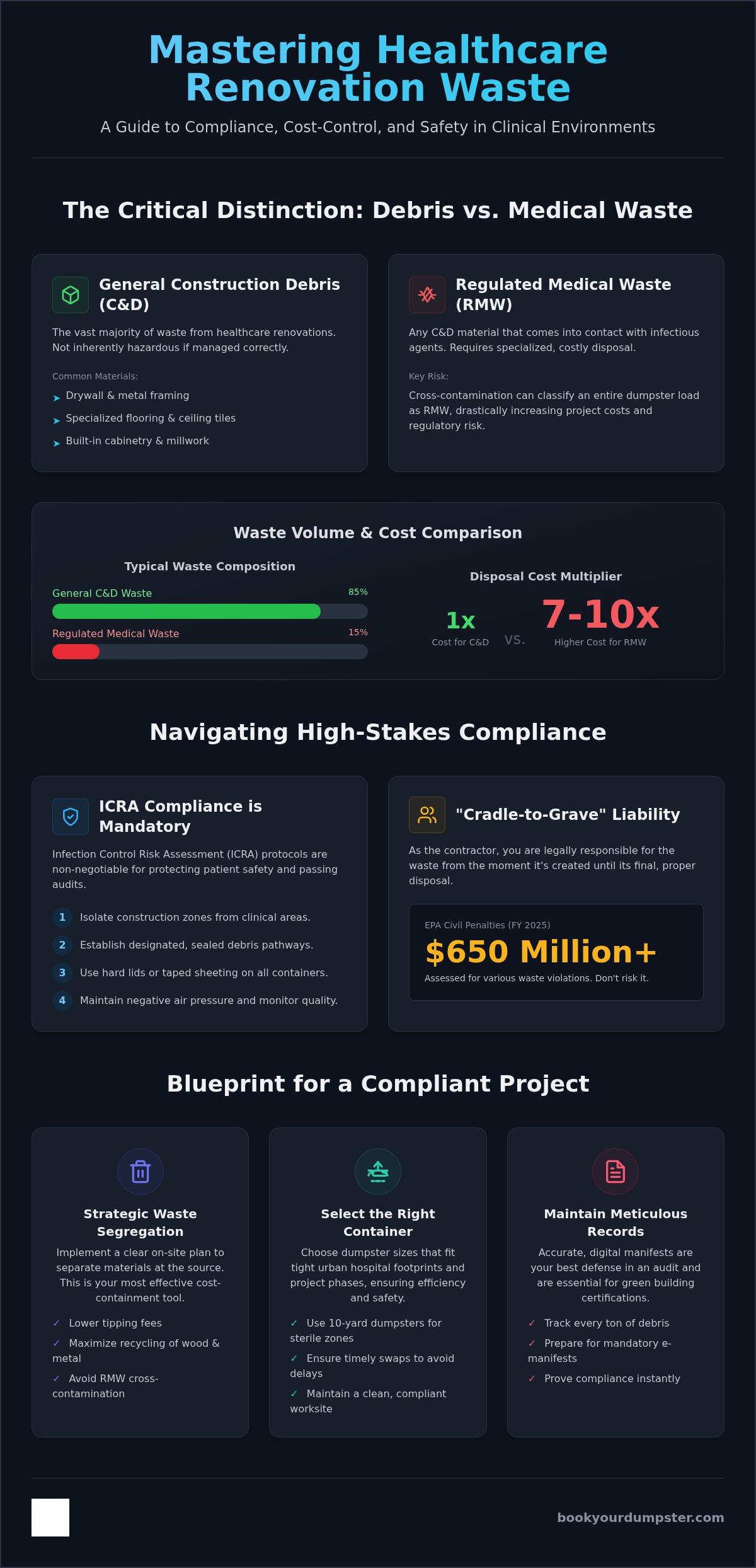
Don't let the sterile environment fool you. When a hospital begins a renovation, the vast majority of the resulting debris is standard construction and demolition (C&D) material. It isn't inherently infectious or hazardous. However, the legal and financial stakes for misclassifying this material are massive. You must distinguish between non-hazardous hospital and healthcare facility renovation waste and actual clinical waste to keep your budget from exploding. Mismanagement doesn't just slow down your timeline; it invites regulatory scrutiny that most contractors can't afford.
Industry data shows that roughly 85% of waste generated by healthcare facilities is general, non-hazardous waste. For a renovation contractor, this is a significant advantage. It means most of your load can go into a standard roll-off container rather than undergoing expensive specialty treatment. The trouble starts when boundaries blur. Any contact with Biomedical waste management protocols changes the status of your debris instantly. If a piece of demolition drywall is contaminated with infectious material, that entire dumpster load may require treatment as Regulated Medical Waste (RMW). Since RMW costs 7 to 10 times more to process than standard solid waste, proper segregation is your most effective cost-containment tool.
Select a partner that understands these distinctions. Book Your Dumpster USA provides the logistical speed and transparent pricing required for these sensitive environments. You can manage your project through our online booking system, ensuring your C&D waste stays separate from clinical streams without slowing down your crew.
Common Materials in Healthcare Renovations
Materials found in these projects are often high-grade but categorized as standard debris if handled correctly. Expect to manage large volumes of the following:
- Drywall and metal framing from patient room reconfigurations and office expansions.
- Specialized flooring including medical-grade vinyl, epoxy coatings, and rubberized surfaces.
- Ceiling tiles and non-load bearing wall structures.
- Built-in cabinetry and medical-grade millwork from nurse stations or labs.
The Legal Responsibility of the Contractor
You own the waste from the moment it hits the bin until it reaches its final destination. This is "Cradle-to-Grave" liability. If your hauler dumps hospital and healthcare facility renovation waste illegally, the EPA holds you responsible, not just the driver. In fiscal year 2025, the EPA assessed over $650 million in civil penalties for various waste violations. Don't take that risk. Ensure your hauler is licensed for commercial debris in strict markets like New York, Illinois, or Massachusetts.
If you're chasing LEED or local green building certifications, you'll need precise documentation showing where every ton of metal and wood went. Keep your manifests organized and digital to stay ahead of 2026 mandates. Accurate record-keeping is the only way to prove compliance during a safety audit or a surprise inspection.
ICRA Compliance: Safe Debris Removal Protocols
Infection Control Risk Assessment (ICRA) is not a suggestion; it is a mandated protocol by The Joint Commission and FGI Guidelines. It dictates every move you make when handling hospital and healthcare facility renovation waste. This assessment determines the level of containment required based on the type of construction and the vulnerability of nearby patients. If your waste removal plan lacks a clear ICRA strategy, you risk cross-contamination that can lead to healthcare-associated infections. Compliance starts with a plan that isolates the construction zone from the clinical environment entirely.
Establishing designated debris pathways is your first tactical move. You cannot transport dusty debris through active patient hallways or near sterile supply rooms. Map out a route that utilizes service elevators and dedicated exits. Every cart or container leaving the work zone must be sealed or covered with a hard lid or taped polyethylene sheeting. This prevents fine particulates from escaping into the facility's air stream during transit. Implementing effective Construction and demolition debris strategies ensures that your containment efforts extend beyond the work zone and into the final disposal phase.
Air quality monitoring is a continuous job. Use dust suppression techniques and maintain negative pressure to keep contaminants trapped. When you're ready to move material off-site, you can schedule a roll-off delivery online to keep your site clear and compliant without disrupting hospital operations.
Containment Strategies for Interior Work
Maintain a strict barrier between the project and the patient. Use HEPA-filtered negative air machines to ensure that air only flows into the construction zone, never out. For fine debris, bag the material inside the sterile environment before placing it into transport carts. Timing is also critical. Schedule the most intensive debris removals during off-peak hours to minimize the number of people exposed to the transport route.
Dumpster Loading Safety
The transition from the building to the dumpster is a high-risk moment for dust migration. ICRA Class IV requirements mandate that the containment zone maintains negative pressure and achieves 12 air changes per hour (ACH) to prevent any migration of hazardous particles into clinical areas. Position your roll-off container away from any building air intake vents to prevent exhaust and dust from being pulled back into the hospital's HVAC system. Cover your dumpsters every night to prevent wind from scattering debris and to keep pests away from the site. This simple step maintains the professional, controlled appearance required on a medical campus.
Strategic Waste Segregation for Cost Containment
Waste segregation is the most direct way to protect your project’s bottom line. In a medical setting, the line between a standard disposal fee and a budget-breaking penalty is thin. Proper on-site sorting ensures that your hospital and healthcare facility renovation waste doesn't get cross-contaminated with high-cost clinical streams. When you separate materials at the source, you reduce the total volume of waste sent to landfills and lower your tipping fees. It's a simple process that requires discipline from your crew but pays off in project transparency and audit readiness.
For most wing expansions or floor guts, a 20 or 30-yard dumpster is the workhorse of the job site. These sizes handle the bulk of mixed construction and demolition debris efficiently. Efficiency disappears if a single bag of infectious waste enters the bin. As previously mentioned, treating regulated medical waste (RMW) is 7 to 10 times more expensive than standard debris. One mistake turns a routine swap into a financial disaster. Keep your construction bins strictly for C&D materials. If you need a reliable schedule for these high-volume swaps, book your next roll-off container online to ensure your site stays clear of clutter.
Recyclable Materials in Hospital Builds
Hospitals use high-value materials that shouldn't end up in a landfill. System upgrades often yield significant amounts of copper piping and electrical wiring. Separate these metals to recoup costs or meet your facility's sustainability targets. Steel studs and aluminum window frames from demolition are also prime candidates for recycling. Additionally, new medical equipment arrives in massive amounts of cardboard. Flatten and stack this material separately. This saves space in your primary 30-yard dumpster and ensures you aren't paying C&D rates for air and paper.
Managing Hazardous Surprises
Older healthcare wings often hide legacy materials like asbestos insulation or lead-based paint. If you uncover these during demolition, stop work immediately. These materials require specialized abatement and CANNOT go into a standard roll-off dumpster. The same rule applies to mercury-containing devices, such as older thermostats or specialized medical gauges. Mixing these into your hospital and healthcare facility renovation waste can lead to massive EPA fines and immediate site shutdowns. In fiscal year 2025, the EPA's civil penalties hit a nine-year high. Don't let a hazardous oversight put your contract at risk. Identify and isolate these materials before they ever reach the loading dock.
Logistics: Selecting the Right Dumpster Size for Medical Sites
Managing hospital and healthcare facility renovation waste requires a deep understanding of physical site limitations. Unlike a standard residential construction site, a hospital campus is a high-traffic zone with zero room for error. If a dumpster blocks an ambulance bay or an emergency exit, the consequences are life-threatening. You must plan your placement with surgical precision. In dense urban areas like Queens, New York, or Boston, Massachusetts, space is at a premium. You often have to work within narrow alleyways or shared service docks where every inch counts.
Navigating permit requirements is another critical hurdle. In cities like Chicago or San Francisco, placing a roll-off container on a public street requires specific local permits that must be secured before the truck arrives. Failure to do so leads to immediate fines and project delays. Timely swaps are equally vital. A full dumpster that sits idle creates a bottleneck, forcing your crew to stockpile debris in sensitive clinical areas. This buildup violates the safety protocols we discussed earlier and creates a fire hazard. Reliable, scheduled pickups are the only way to maintain a steady workflow.
Don't let logistical bottlenecks stall your project. Select your dumpster size and book online today to secure your delivery window and keep your site moving.
Urban Logistics and Site Constraints
Avoid placing containers near ambulance bays, emergency zones, or main patient entrances. If you must use a parking structure or an underground level, check the weight limits first. A loaded 40-yard dumpster can easily exceed the structural capacity of a parking deck. For projects in high-regulation zones, review our dumpster rental in New York guide for specific borough rules and permit details. Proper planning ensures you don't face a site shutdown due to a placement violation.
Choosing Your Capacity
Selecting the wrong size wastes money and space. Match your container to the specific phase of your project to keep the loading zone efficient:
- 10-Yard Dumpster: Ideal for small interior renovations. Use this for heavy, dense materials like flooring, bathroom tile, or concrete slabs where weight limits are a concern.
- 20-Yard Dumpster: The standard choice for patient room renovations. It provides enough capacity for drywall and light framing without taking up excessive space on the dock.
- 30-Yard and 40-Yard Dumpsters: Reserve these for major structural demolition, wing expansions, or large-scale facility upgrades. These containers handle high-volume hospital and healthcare facility renovation waste, such as long steel studs and bulky cabinetry.
Partnering with Book Your Dumpster USA for Healthcare Success
Contractors choose Book Your Dumpster USA because we prioritize reliability over fluff. In the high-stakes world of medical construction, you need a partner who understands that a missed pickup is a safety violation. We handle the logistical heavy lifting so you can focus on meeting your ICRA standards. Our team brings deep local expertise to major hubs like New York, New Jersey, Illinois, Massachusetts, and San Francisco. This ensures your project stays compliant with regional regulations regarding hospital and healthcare facility renovation waste disposal. We maintain strict pricing integrity. This transparency is vital for complex commercial budgets where every line item is scrutinized by facility stakeholders.
Our no-nonsense approach removes the traditional friction of waste management. We don't use high-level jargon or hidden fees. Instead, we provide functional tools that respect your time and urgency. By modernizing a traditional industrial sector through digital convenience, we give you the control needed to manage multiple job sites simultaneously. Trust us to act as a dependable expert that understands the specific pressures of a healthcare environment. We know that your reputation depends on a clean, efficient site, and we provide the roll-off solutions to make that happen.
Reliability for Critical Timelines
Punctual delivery is our standard, not a premium feature. We know that debris buildup in a sensitive clinical area isn't just an eyesore; it's a direct threat to patient health and site efficiency. Our dedicated support team manages large-scale commercial healthcare accounts, ensuring that your 30 or 40-yard containers are swapped exactly when needed. For a deeper look at managing complex job sites, read our guide on construction debris removal. We keep your project moving forward without the logistical stress of chasing down a late hauler.
Getting Started with Your Renovation
Securing your waste management plan takes minutes, not days. Use our streamlined online portal for 24/7 project planning and scheduling. This digital-first approach allows facility managers to book swaps outside of traditional business hours, matching the 24/7 nature of healthcare operations. Whether you're planning a small clinic update or a massive wing expansion, we provide the full range of container sizes from 10 to 40 yards.
Start by selecting your location and choosing the container size that fits your specific project. If you're working in a tight urban zone, remember our previous advice on using a 10-yard dumpster for dense materials like tile or masonry. We'll handle the logistics so you can maintain a sterile and safe environment. Don't let hospital and healthcare facility renovation waste clutter your job site or compromise patient safety. Book your dumpster online now to lock in your delivery schedule and finalize your waste management plan.
Secure Your Healthcare Project Timeline
Success in medical renovation depends on your ability to separate clinical risks from construction efficiency. By strictly managing your hospital and healthcare facility renovation waste, you avoid the high costs of medical waste contamination and ensure your site passes every safety audit. Remember that most of your debris is non-hazardous; don't let a lack of segregation turn a standard load into a financial liability. Proper ICRA compliance and smart dumpster sizing are the keys to a smooth demolition phase.
Logistics don't have to be a headache. Whether you're working in a tight alleyway in Chicago or a sprawling campus in New York, selecting the right 10, 20, 30, or 40-yard container keeps your site clear. Book Your Dumpster USA provides the direct, professional service commercial contractors need to stay on schedule. Book your healthcare renovation dumpster online today to secure your delivery in San Francisco, Chicago, or New York. We remove the logistical stress so you can focus on building a safer facility. You've planned for safety; now execute with confidence.
Frequently Asked Questions
Can I put medical waste in a construction dumpster?
No, you must never mix regulated medical waste (RMW) with construction debris. Doing so contaminates the entire load, forcing you to pay specialty disposal rates that are 7 to 10 times higher than standard fees. Keep sharps, biohazards, and pharmaceuticals in their designated clinical containers. Construction roll-offs are strictly for non-hazardous materials like drywall, metal, and wood. Proper segregation at the source is the only way to maintain your project budget.
What size dumpster is best for a hospital room renovation?
A 20-yard dumpster is the most efficient choice for a standard patient room renovation. It provides ample space for drywall, framing, and light fixtures without occupying a large footprint on the loading dock. If your project involves removing heavy materials like thick masonry or floor bedding, opt for a 10-yard dumpster to stay within the weight limits of the hauling truck and prevent damage to hospital parking surfaces.
How does ICRA affect how I load my dumpster?
ICRA protocols mandate strict dust and particulate control during the loading process. You must ensure all hospital and healthcare facility renovation waste is bagged or covered before it leaves the containment zone. When loading the dumpster, keep the container covered when not in use to prevent wind-blown dust from entering clinical areas. Position the bin away from the facility's air intake vents to maintain indoor air quality and patient safety.
Do I need a permit for a dumpster at a healthcare facility in NYC?
Yes, you need a permit if the dumpster sits on a public street or sidewalk in New York City. The NYC Department of Transportation (DOT) requires specific approvals for any roll-off container placed in the public right-of-way. If the dumpster stays entirely on private hospital grounds, you generally don't need a street permit, but you must still verify local zoning and facility-specific placement rules with the hospital's engineering department.
How often should dumpsters be emptied at a hospital site?
Empty your dumpsters as soon as they reach capacity or at the end of each major demolition phase. Allowing debris to overflow creates a safety hazard and violates the clean-site requirements typical of medical campuses. Use our online booking system to schedule timely swaps. This prevents the accumulation of loose material that could attract pests, create fire hazards, or impede emergency vehicle access to the facility.
What happens if hazardous materials like asbestos are found during renovation?
Stop all demolition immediately and seal the area if you discover asbestos, lead, or mercury. You must hire a licensed abatement contractor to remove these materials according to federal and state laws. Never place hazardous substances into a standard roll-off container. Mixing these materials into your general waste stream leads to massive EPA fines and potential legal action. Abatement must be completed and documented before general renovation work resumes.
Can I rent a dumpster for a hospital project in San Francisco?
Yes, Book Your Dumpster USA provides roll-off containers for healthcare projects throughout San Francisco. We understand the city's strict diversion requirements and tight urban logistics. Select your size online to manage your hospital and healthcare facility renovation waste while complying with local California regulations. Our team ensures your delivery and pickup align with the city's specific traffic patterns and permit regulations to avoid unnecessary project delays.
Is a 10-yard dumpster enough for a clinic cleanout?
A 10-yard dumpster is sufficient for small clinic cleanouts involving furniture, cabinetry, and minor flooring removal. It is particularly useful for interior renovations in sterile zones where space for a larger bin is unavailable. However, if the cleanout includes bulky items or large volumes of drywall from multiple exam rooms, a 20-yard dumpster is a more practical and cost-effective choice to ensure you don't require multiple, expensive swaps.


