
![How Much Does It Cost to Rent a Dumpster in NY, IL, and MA? [2026 Pricing Guide]](https://getautoseo.com/storage/hero_images/article_1045703_1776025384.jpg)
Why does the final bill for a home renovation often look nothing like the initial quote? When you ask how much does it cost to rent a dumpster, you deserve a straight answer that includes every line item from tonnage to local taxes. You likely expect a simple transaction, but instead, you're often met with confusion over Chicago street permits or NYC weight limits. It's frustrating to plan a project when a basic logistical cost feels like a moving target.
We have this under control. This 2026 guide removes the guesswork by providing a transparent breakdown of rental costs, local permit fees, and regional pricing factors for New York, Illinois, and Massachusetts. You'll gain the knowledge needed to choose the right size and avoid those predatory overage fees. We provide the facts so you can book your dumpster with total confidence. Read on to see the specific regulations and price drivers that will define your waste removal budget this year.
Key Takeaways
- Understand the 2026 pricing landscape and see how regional demand in NY, IL, and MA impacts your bottom line compared to national averages.
- Learn exactly how much does it cost to rent a dumpster by evaluating container sizes and the critical weight limits that influence total project expenses.
- Identify local pricing nuances, including high landfill costs in the Northeast and the logistical challenges of delivery in dense urban centers like Chicago and NYC.
- Follow our "right-sizing" checklist and loading tips to maximize your cubic yardage and eliminate unnecessary overage fees.
- Secure your rental with confidence using the Book Your Dumpster USA transparent pricing model to ensure a hassle-free, on-time delivery.
Average Costs to Rent a Dumpster in 2026
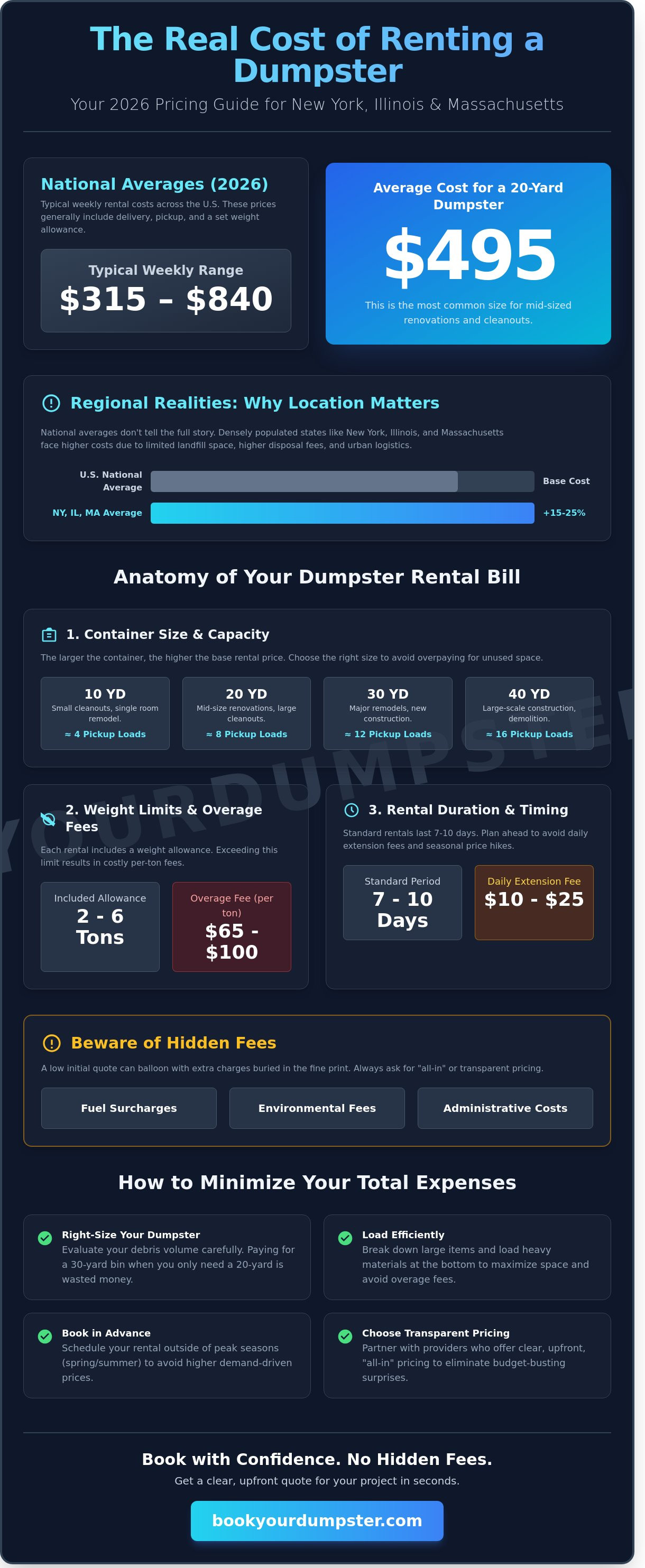
Budgeting for a renovation or cleanout starts with one question: how much does it cost to rent a dumpster? In 2026, residential and commercial roll-off rentals typically range from $315 to $840 per week. This price generally covers the delivery of the container, a set rental period, and the final pickup. Most companies also include a specific weight allowance, usually between two and six tons. If you exceed this limit, expect to pay additional fees per ton. You'll encounter two primary pricing structures: flat-rate and variable. Flat-rate models bundle all fees into one price, while variable models charge a base rate plus disposal costs after the debris is weighed at the landfill.
National Averages vs. Regional Realities
National averages rarely tell the whole story. While the average weekly cost for a standard 20-yard container in the United States is approximately $495, regional factors cause significant price swings. In states like New York, Illinois, and Massachusetts, customers often see rates 15% to 25% higher than the national median. High population density and limited landfill capacity in these metro hubs drive up disposal fees. Labor costs in the waste management sector have risen by 5% since 2025, and fuel prices remain a volatile factor for haulers in 2026. Rural areas benefit from lower overhead, but if you live in a coastal or major metro area, prepare for higher baseline quotes due to these logistical pressures.
Initial Quotes vs. Final Invoices
Price transparency is a common pain point in this industry. It's frustrating to see a $300 quote turn into a $550 final bill. This happens when companies hide essential dumpster rental cost factors in the fine print. Common "extra" charges include fuel surcharges, environmental fees, and administrative costs. Some haulers also charge daily extension fees if the project runs over schedule. To avoid these surprises, look for "all-in" pricing models. Book Your Dumpster provides clear, upfront pricing to eliminate the stress of hidden fees. Choose your container size, see your total cost immediately, and schedule your delivery. Knowing how much does it cost to rent a dumpster shouldn't require a degree in logistics. Stick with providers that value directness and reliability.
Primary Factors That Determine Your Rental Price
Understanding how much does it cost to rent a dumpster requires looking past the initial quote. Several variables shift the final price. You need to account for what you're tossing, how much it weighs, and how long the container sits on your property. Pricing is rarely a flat rate; it's a calculation of logistics, disposal fees, and equipment availability.
Container Size and Capacity
Size is the most visible price driver. Most providers offer 10, 20, 30, and 40-yard options. A 10-yard dumpster typically handles 4 pickup truck loads of debris. It's ideal for small basement cleanouts or single-room flooring removals. For more details on these smaller units, read our 10 Yard Dumpster Rental Guide. 20-yard bins serve mid-sized renovations, while 30 and 40-yard containers are reserved for major construction. Larger bins carry higher base fees because they occupy more space on the delivery truck and require more fuel to transport.
Weight Limits and Overage Charges
Every rental includes a specific tonnage allowance. This is the "hidden" variable that often surprises DIYers. If your debris exceeds the pre-set limit, you'll face overage charges. In the Northeast and Midwest, these rates typically range from $65 to $100 per additional ton. Heavy materials like concrete or stone are too dense for standard roll-offs and require specialized "low-boy" rentals to ensure safe transport. Following New York waste management regulations ensures you stay compliant with local disposal laws while managing your budget.
Rental Duration and Timing
Most standard agreements cover a 7 to 10 day rental window. If your project runs long, expect daily extension fees ranging from $10 to $25. Demand spikes during spring and summer months. High demand can limit availability and drive up local prices in Chicago or Boston. If you have your debris ready to go, ask about "drop and pick" same-day services to minimize the time a container sits in your driveway. You can book your dumpster online to lock in your preferred dates early and avoid seasonal price hikes.
Debris Type and Disposal Costs
What you throw away changes the cost. Household junk is generally cheaper to dump than construction and demolition (C&D) waste. Landfills charge different rates based on the material's processing requirements. Mixing prohibited items like tires or electronics into a standard load will result in immediate penalties. Always specify your waste type during the booking process to receive an accurate quote. This transparency prevents unexpected charges when the truck hits the scale at the transfer station.
Local Pricing Nuances in New York, Illinois, and Massachusetts
Regional logistics dictate your final invoice. In Massachusetts, landfill capacity dropped by approximately 30% between 2010 and 2024. This scarcity drives up tipping fees, which are the per-ton costs charged by disposal sites. When you ask how much does it cost to rent a dumpster, realize that these back-end disposal costs represent a large portion of your quote. New York and Illinois also enforce strict environmental regulations that increase operational overhead for haulers. Book Your Dumpster USA manages these regional variables by optimizing routes and using local hubs to keep your costs predictable.
Urban density in NYC and Chicago creates unique delivery challenges. Drivers in Manhattan or the Chicago Loop face narrow streets and strict idle-time laws. These factors increase fuel consumption and labor hours. We handle the logistical stress of these tight spaces. Our team ensures your container arrives on time, regardless of local traffic patterns or street layouts. We focus on reliability so your project stays on schedule. Choose your size and let us handle the transport logistics.
Permit Requirements and Street Placement
Placement determines your paperwork. If you can't fit a bin on your driveway, you need a "Right of Way" permit. In Boston, a street occupancy permit typically costs between $40 and $150 depending on the duration and location. Chicago requires a Public Way Use permit for any street placement. Secure these at least 72 hours before your project starts to avoid delivery delays. If the dumpster sits on your private driveway, you usually skip these municipal fees and the associated red tape. Follow these local guidelines to ensure a smooth drop-off:
- Boston: Apply for a Street Occupancy Permit through the City of Boston website.
- Chicago: Contact your local ward office for Public Way Use requirements.
- NYC: Ensure your hauler has the necessary DOT permits for on-street placement.
Regional Disposal and Landfill Fees
Disposal costs vary wildly by state line. Massachusetts maintains strict waste bans on materials like mattresses and textiles, updated in November 2022. These regulations force haulers to sort loads more thoroughly, which increases the labor cost. Illinois generally offers lower tipping fees than the Northeast because it has more available landfill volume. Check with local transfer stations to see how waste flows in your specific zip code. Understanding these regional shifts helps explain how much does it cost to rent a dumpster in your specific market. We provide transparent pricing that accounts for these state-mandated fees upfront. Book your dumpster today to lock in a rate that includes these regional variables without hidden surprises.
How to Minimize Your Total Dumpster Rental Expenses
Understanding how much does it cost to rent a dumpster involves more than just looking at the initial quote. Total expenses often fluctuate based on how you manage the bin once it arrives on your property. To keep your project under budget, focus on volume management and weight accuracy. Follow this checklist to "right-size" your rental and avoid paying for unused air or expensive overage fees:
- Estimate by the truckload: A 10-yard dumpster holds roughly 3 pickup truck loads of debris. If your pile exceeds 6 loads, move up to a 20-yard container.
- Calculate weight density: Standard household junk is light, but construction debris is heavy. One cubic yard of dry loose soil weighs approximately 2,000 pounds.
- Avoid the 15% rule: If you think you might be within 15% of the weight limit, always choose the larger size. It's cheaper to pay for a larger bin upfront than to pay $100 or more in per-ton overage penalties.
Loading efficiency also plays a major role in cost control. Place large, flat items like plywood or broken-down boxes at the bottom first. This creates a solid foundation and prevents air pockets that waste valuable cubic yardage. If you're disposing of heavy materials like concrete, brick, or yard waste, request a "clean load" bin. Mixing 2 tons of concrete with general household trash often forces the entire load to be processed at a higher disposal rate. Keeping heavy materials separate allows for recycling at a lower flat fee.
Watch out for "neighborly" additions. An unsecured dumpster is an invitation for others to toss in heavy sofas or bags of trash. A single unauthorized mattress can trigger a $50 surcharge, and extra weight can push you over your tonnage limit. Use a tarp to cover the bin overnight to deter illegal dumping and prevent rainwater from soaking your debris, which adds significant weight.
Avoiding Prohibited Item Penalties
Items like tires, car batteries, and mattresses require specialized handling due to environmental regulations. These materials can't be crushed in standard landfills and often carry individual fees ranging from $25 to $75 per item. To see a comprehensive list of what stays out of the bin, review the Roll Off Dumpster Guide. Removing these items before pickup ensures your final invoice matches your initial quote.
Scheduling and Loading Efficiency
Efficiency starts before the truck arrives. Clear the drop-off path of cars, low-hanging branches, and debris. If a driver cannot safely place the container, you will likely face a "dry run" or "trip" fee, which typically costs between $150 and $200. To maximize your investment, break down all furniture and boxes. If your renovation is small, consider coordinating with a neighbor. Splitting the base cost of a 20-yard dumpster is often more economical than renting two 10-yard bins separately.
Don't let hidden fees inflate your project budget. Book your dumpster now for a transparent, no-nonsense rental experience.
Booking Your Dumpster with Transparent, Upfront Pricing
Managing waste in New York, Illinois, or Massachusetts requires local knowledge. Regulations change frequently. Disposal fees vary significantly by county. When you ask how much does it cost to rent a dumpster, the answer often depends on the integrity of your provider. Out-of-state brokers often add middleman fees that inflate your final bill. Choosing a local expert ensures you don't get hit with unexpected surcharges for weight limits or specific debris types common in these high-traffic regions. We understand the specific permit requirements in Chicago, the logistical hurdles in Boston, and the disposal mandates in New York City.
The Book Your Dumpster USA online booking system removes the guesswork from the process. You see the price upfront. You select your drop-off date. You get back to work. We've modernized a traditional industry by prioritizing digital convenience and straightforward honesty. Our system is designed for speed, allowing you to secure a container in minutes rather than spending hours on the phone. We've eliminated the opaque pricing structures that plague the waste management industry, replacing them with a verbal handshake based on transparency.
The Book Your Dumpster USA Advantage
We built our service on reliability and pragmatic, no-nonsense logistics. You need a container that arrives on schedule and stays within your budget. We offer a full range of roll-off containers to fit any project scale:
- 10-Yard: Best for small basement cleanouts or minor yard waste.
- 20-Yard: Ideal for kitchen remodels or deck removals.
- 30-Yard: Suitable for major home additions or large estate cleanups.
- 40-Yard: The standard for commercial demolition and industrial sites.
Professional contractors managing high-volume sites should review our Construction Debris Removal Guide for specific logistical strategies. We handle the mess so you can focus on the build. Our commitment to on-time delivery means your crew isn't standing around waiting for a bin to arrive. When you're calculating how much does it cost to rent a dumpster, remember to factor in the cost of project delays caused by poor service. We eliminate that risk.
Ready to Clear the Clutter?
Don't let waste pile up. A cluttered job site is a dangerous job site. Secure your dumpster size early to avoid availability issues during peak renovation months. We respect your schedule. We respect your budget. Our "no hidden fees" promise means the price you see is the price you pay.
Choose your size. Schedule your delivery. Clear the clutter today. Efficient waste management is a key part of your project's success. Book your dumpster now and experience a professional approach to disposal that puts you in control.
Secure Your 2026 Dumpster Rental Today
Understanding how much does it cost to rent a dumpster is the first step toward a successful renovation or clean-out. This guide highlighted how regional disposal fees in states like New York and Massachusetts directly influence your bottom line. You've seen that selecting a precise roll-off size based on your specific debris volume prevents expensive overage penalties. We eliminate the guesswork by providing a no hidden fees guarantee and on-time delivery throughout NY, IL, and MA. Our platform is built for speed and reliability. You can complete your online booking in under 2 minutes without waiting for a representative to call you back. We provide the tools you need to keep your job site clear and your schedule on track. Take the logistical weight off your shoulders and let us handle the heavy lifting. Your project deserves a straightforward waste solution that respects your time and your budget. We're ready to help you finish the job.
Book your dumpster now with transparent pricing
Frequently Asked Questions
Is it cheaper to rent a dumpster or hire a junk removal service?
Renting a dumpster is more cost-effective for large projects where you handle the labor. Junk removal services charge for the crew's time and truck space, often costing 50% more than a roll-off rental for the same volume of waste. Choose a rental to work at your own pace. Review local rates to see how much does it cost to rent a dumpster versus hiring a full-service hauling team.
How much weight can I actually put in a 20-yard dumpster?
A 20-yard dumpster typically holds 2 to 3 tons of debris, which equals 4,000 to 6,000 pounds. This capacity accommodates approximately 120 33-gallon trash bags. Don't exceed the weight limit marked on the container. Overloading creates safety risks during transport and leads to additional disposal charges. Use a larger bin if you plan to dispose of heavy materials like brick or asphalt.
Do I need a permit if the dumpster is on my driveway in New York?
You don't need a permit for a dumpster placed on private property in New York. The New York City Department of Transportation only requires permits when the container sits on a public street or sidewalk. Ensure your driveway provides 20 feet of vertical clearance for the delivery truck. Clear all vehicles and obstacles from the drop-off zone before your scheduled delivery time to avoid delays.
What happens if I go over the weight limit on my rental?
Exceeding the weight limit results in pro-rated overage fees based on the extra tonnage. Landfills charge by the ton, and these costs pass directly to the user. Keep heavy materials like dirt, rocks, or concrete separate to avoid these surcharges. Monitor your fill level throughout the project. Ensure all debris remains flush with the top of the container to allow for safe tarping and transport.
Can I put a mattress in my rental dumpster in Massachusetts?
Massachusetts state law prohibited mattresses and box springs from landfills starting November 1, 2022. You must recycle these items through specific state-mandated programs instead. Placing a mattress in your roll-off container results in a rejection at the transfer station and extra handling fees. Contact your local municipal recycling center to find a dedicated drop-off location for bedding materials. Follow these regulations to avoid project interruptions.
How long can I keep the dumpster for the initial rental price?
Standard rental periods usually last 7 to 14 days depending on your specific service area. You can extend this duration for a flat daily fee if your cleanup takes longer than planned. Schedule your pickup online the moment your project is complete. We focus on on-time removal to keep your driveway clear. Simple scheduling ensures you don't pay for extra days you don't need.
Are there extra fees for delivery and pickup?
Book Your Dumpster provides transparent pricing that includes delivery, pickup, and a specific weight allowance. You won't see hidden surcharges for standard transport within our service zones. Understanding how much does it cost to rent a dumpster requires looking at the total price upfront. Extra costs only apply if you dispose of prohibited items or exceed the weight limit specified in your agreement.
What is the most cost-effective dumpster size for a bathroom remodel?
A 10-yard dumpster is the most efficient choice for a standard 50-square-foot bathroom renovation. It easily holds the debris from a full gut, including the bathtub, toilet, vanity, and floor tiles. This size fits into tight driveways and provides sufficient capacity without the cost of a larger bin. Select this compact option to manage your renovation waste while keeping your project budget under control.


