

Nearly 40 percent of all dumpster rentals in the U.S. are 20-yard models, yet many renters still end up paying hundreds in penalties because they confuse volume with weight. It's a common frustration to open your credit card statement and find unexpected charges for a bin that wasn't even full. Learning how to avoid dumpster overweight fees is essential for any homeowner or contractor who wants to maintain project profitability. You shouldn't have to worry that a sudden rainstorm or a pile of shingles will double your disposal costs.
We provide a direct, no-nonsense approach to managing your waste logistics. This guide offers a clear framework for estimating debris weight and selecting the right 10, 20, 30, or 40 yard dumpster for your needs. You'll gain the confidence to load your container correctly and protect it from environmental weight gains like rain or snow. Follow these professional techniques to keep your total project costs low and your cleanup schedule on track.
Key Takeaways
- Understand the difference between dumpster volume and weight tonnage to stop unexpected charges on your statement.
- Use specific conversion tools for household and construction materials to estimate your total load weight accurately before booking.
- Master strategic loading techniques by placing heavy items flat on the bottom and distributing weight evenly for safe transport.
- Discover how to avoid dumpster overweight fees by factoring in local DOT road limits and regional disposal regulations.
- Consult with waste experts to select the ideal 10, 20, 30, or 40-yard dumpster size based on your project's material density.
Understanding Dumpster Weight Limits and Overage Charges
Every rental agreement includes a pre-negotiated weight allowance. This is the specific amount of debris, measured in tons, that you can dispose of for your flat-rate price. Understanding this limit is the foundational step in learning how to avoid dumpster overweight fees. If your load exceeds this tonnage, you'll face overage charges that mirror the landfill's tipping rates. These fees aren't arbitrary penalties; they represent the actual cost of processing heavier loads at the disposal site. When you stay within your limit, you ensure your project remains on budget.
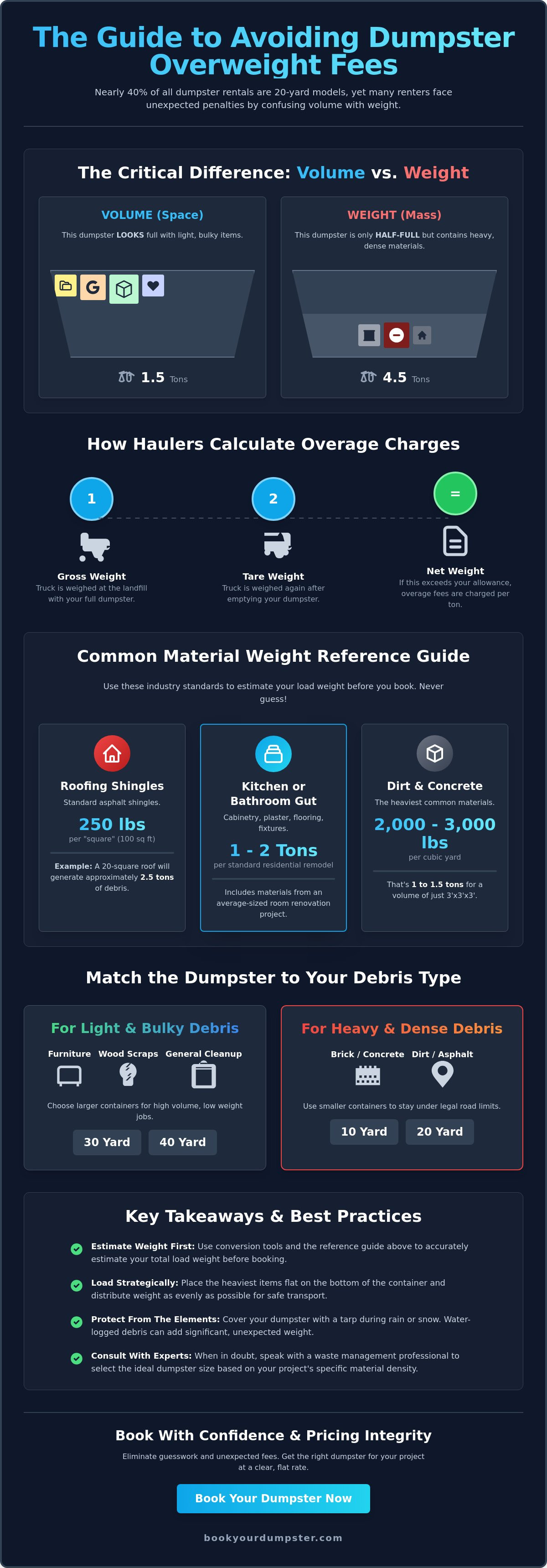
There is a critical distinction between capacity and weight limit. Capacity refers to volume, or how much physical space your items occupy inside the container. Weight limit refers to the mass of those items. Roll-off dumpsters are designed to hold specific volumes, such as 10 or 20 cubic yards, but the trucks hauling them must adhere to strict Department of Transportation (DOT) regulations. Overloaded containers are a major safety hazard. They increase stopping distances and can cause structural damage to residential roads. If a load is significantly over the limit, a driver may refuse the pick-up entirely to avoid legal fines or equipment failure.
Why Volume and Weight Are Not the Same
Think about the difference between a 10-yard dumpster filled with dry cushions and one filled with wet concrete. Both take up the same amount of air space, but the concrete weighs several tons more. This is why we recommend using smaller containers for dense materials. A 10-yard or 20-yard bin is the standard choice for dirt, brick, or asphalt. If you attempt to fill a 40-yard bin with heavy construction debris, the truck won't be able to safely lift it. Matching the density of your waste to the correct container size is the most effective way to manage your logistics.
How Haulers Calculate Overage Charges
Haulers follow a precise scaling process at the landfill or transfer station. The truck is weighed when it enters the facility (gross weight) and again after it empties the load (tare weight). The difference between these two numbers is your net debris weight. If this final number exceeds your rental agreement's allowance, you'll be billed for the excess. Most landfills charge by the ton; however, many regions apply a full-ton minimum even if you're only slightly over the limit. To keep your costs predictable and learn how to avoid dumpster overweight fees, always consult with an expert at Book Your Dumpster USA before you schedule a 30 or 40-yard bin for heavy materials.
Estimating Your Debris Weight Before Booking
Guessing is not a strategy. If you wait until the truck arrives at the scale house to find out your weight, you've already lost the game. Learning how to avoid dumpster overweight fees starts with basic math before you ever place an order. Most people underestimate the density of construction materials. While a sofa is bulky, it's relatively light. Conversely, a single pallet of tile or a stack of drywall can weigh as much as a small car. You must account for this density to keep your project profitable.
Use your project's square footage to predict your waste tonnage. For example, if you're stripping a roof, you need to know how many "squares" (100 square foot areas) you're removing. Following construction waste management best practices involves calculating these numbers ahead of time to select the most efficient container. This proactive approach prevents the logistical headache of a bin that's too heavy to move.
Common Material Weights Reference Guide
Rely on these industry standards to guide your estimation process. These figures help you visualize the mass of your debris before it hits the bin:
- Roofing Shingles: A single layer of standard asphalt shingles weighs approximately 250 lbs per square. A 20-square roof will contribute 2.5 tons of weight.
- Kitchen or Bathroom Gut: A standard residential gut job typically generates 1 to 2 tons of debris, including cabinetry, plaster, and flooring.
- Dirt and Concrete: These are the heaviest materials you'll encounter. One cubic yard of dirt or concrete weighs between 2,000 and 3,000 lbs.
Choosing the Right Size for Your Debris Type
Your debris type dictates your container choice. Reserve 30 or 40-yard dumpsters for light, bulky items like furniture, wood scraps, or general household cleanups. These large bins provide the volume you need without quickly hitting weight limits. However, heavy materials like brick, dirt, or asphalt are strictly restricted to 10 or 20-yard bins to ensure the truck can safely lift the load.
The 10-yard dumpster is the gold standard for heavy materials. Its smaller size prevents you from overfilling the container beyond the truck's lifting capacity. If a bin is too heavy, the driver cannot legally or physically transport it. This results in a "dry run" fee, where you pay for the truck's trip even though the dumpster stays on your property. You'll then have to remove material by hand before the hauler returns. Avoid this logistical nightmare by being realistic about your material's density. If you're unsure about your project's specific requirements, consult our team to get an expert recommendation on the right tonnage allowance.
Best Practices for Loading Your Roll-Off Container
Efficient loading is a technical skill that directly impacts your bottom line. You must treat the interior of your bin like a puzzle where every piece has a specific place. Start by loading the heaviest items first. Place flat, heavy materials like old plywood, doors, or large furniture pieces directly on the bottom of the bin. This creates a stable base and lowers the center of gravity for the transport truck. You must distribute this weight evenly from the front to the back. An imbalanced load can make the truck unstable during the haul, leading to safety issues or a refused pick-up.
Maximize your available space by breaking down large items. Flatten every cardboard box and dismantle furniture whenever possible. This eliminates air pockets that waste valuable volume. While you want to fill the gaps, you must never load debris past the top rail. Haulers require a "level-full" load to safely secure the container with a mesh tarp for transit. If items are protruding from the top, the driver will ask you to remove them before they can leave your property. This results in wasted time and potential "dry run" fees. Following these loading steps is a primary strategy for how to avoid dumpster overweight fees while ensuring a smooth removal process.
The Danger of 'Water Weight' and Wet Debris
Environmental factors are often overlooked, but they can significantly inflate your bill. Porous materials like drywall, mattresses, and untreated wood act as sponges during a storm. A standard queen mattress typically weighs about 70 pounds, but it can absorb enough water to double in weight after a single heavy rain. If you're managing a renovation project during the spring or winter, keep your dumpster covered with a heavy-duty tarp when it's not in use. Preventing "heavy water" from soaking your debris is one of the easiest ways to maintain your weight allowance.
Separating Mixed Loads to Save Money
Strategic sorting can lead to lower total project costs. "Clean loads" that consist only of a single material, such as concrete or wood, often have different processing requirements at the landfill. If your project involves both heavy masonry and light household junk, consider renting two smaller bins. Using a 10-yard dumpster for the concrete and a 30-yard dumpster for the lighter materials prevents you from overloading a single large container. This separation is a professional tactic for how to avoid dumpster overweight fees. Be mindful that certain items, such as tires or appliances, often carry flat-rate "per-item" fees that are billed separately from your tonnage allowance. Always check with Book Your Dumpster USA to clarify which items might trigger these additional charges.
Navigating Local Regulations in Major Metro Areas
Local ordinances often override standard rental agreements. If you're arranging a dumpster rental in New York, you'll find that urban density leads to stricter enforcement of gross vehicle weight ratings. New York's infrastructure, particularly in older boroughs like Queens, cannot always support the weight of a maxed-out 40-yard bin. Understanding these regional constraints is a vital part of how to avoid dumpster overweight fees. City-specific rules are designed to protect aging roads and underground utilities from the stress of heavy transport trucks.
In Chicago, the Department of Transportation (DOT) sets firm limits on road weight to protect public property. If you place a dumpster on a public street, you'll need a permit. As of 2026, a 1-3 day permit in Chicago costs $100, while a 30-day permit costs $150. These permits aren't just about space; they often come with weight stipulations that prevent heavy containers from damaging the asphalt. If your load is too heavy for the residential street's rating, the driver may be legally required to refuse the haul, leaving you with a dry run fee and a container you must partially unload.
Massachusetts and San Francisco also maintain tight permit requirements that can impact your project's logistics. In San Francisco, placing a bin on a public right-of-way requires a permit and often mandates specific waste diversion reporting. If your project in Massachusetts involves heavy materials, check local ordinances first. Some municipalities restrict the placement of heavy roll-offs on residential streets during the spring thaw to prevent road buckling. Ignoring these seasonal weight limits can lead to significant fines from the city on top of your rental costs.
Commercial vs. Residential Weight Restrictions
Commercial job sites generally handle higher tonnage allowances because they're located on industrial-grade roads designed for heavy traffic. However, these sites face much stricter sorting rules. Residential streets in suburban New Jersey and Massachusetts have lower "over-the-road" weight limits. If a truck exceeds these limits while leaving a neighborhood, the hauler faces heavy DOT fines. These costs are inevitably passed on to the customer. Always verify street placement rules with your local city hall before scheduling a 20 or 30-yard bin for a residential project.
Handling Prohibited Items That Inflate Your Bill
Prohibited items are a common source of hidden costs that catch many renters off guard. In Queens and parts of New Jersey, disposing of batteries, paints, or chemicals in a standard bin is strictly forbidden. If these items are found during the tipping process, you'll face a "contamination fee" that can be much higher than a standard overage charge. For heavy items like old refrigerators or appliances, look for local bulk pickup alternatives instead of tossing them in the bin. Removing these dense items from your load is a smart tactic for how to avoid dumpster overweight fees. Book your city-compliant dumpster with a team that understands your local weight limits.
Booking Your Dumpster with Pricing Integrity
The final step in mastering how to avoid dumpster overweight fees is selecting a provider that prioritizes transparency. Many companies lure customers with the lowest initial quote only to hide a significantly lower weight allowance in the fine print. When you choose the cheapest option without verifying the tonnage, you're often setting yourself up for an expensive surprise on your final statement. Pricing integrity means knowing exactly what you're paying for before the bin arrives on your driveway or job site. Our streamlined online booking process clarifies these weight limits at checkout, ensuring you have the data needed to stay on budget.
Reliability in waste management isn't just about the equipment; it's about the removal of logistical stress. Choose a partner that respects your project timeline and your bottom line. Whether you're managing a residential cleanout or a large-scale construction project, the goal is to move waste efficiently without hidden penalties. By following the loading and estimation strategies outlined in this guide, you can confidently manage your debris weight. Start your project with a clear understanding of your tonnage to avoid the common pitfalls of the rental industry.
The Book Your Dumpster USA Advantage: No Hidden Fees
We maintain a commitment to punctuality and pricing integrity across New York, Illinois, and our entire service network. Our diverse fleet includes 10, 20, 30, and 40-yard dumpsters, allowing us to match the right container to your specific material density. We don't use teaser rates that lead to massive overage charges later. Instead, we provide functional, transparent terms that emphasize ease and clarity. If you're ready for a straightforward rental experience, you can Book Your Dumpster USA online today and see your weight allowance upfront. This digital-first approach eliminates the guesswork and moves you quickly from clutter to resolution.
Consulting Our Specialists for Accurate Sizing
If you're still unsure about your total tonnage, don't guess. Provide our team with specific project details for a more accurate weight estimate. We encourage homeowners and contractors to share photos of their debris piles or detailed material lists. Our specialists use this information to provide professional sizing advice, helping you decide between a 20-yard or 30-yard bin based on density rather than just volume. This extra step is a highly effective way to learn how to avoid dumpster overweight fees before the container is even delivered. Start your project today with a dependable expert who respects your budget and provides the high-functioning tools you need for a successful cleanup.
Control Your Project Costs with Smart Waste Logistics
Successful debris management requires a shift from guessing to calculating. By matching your material density to the right container size and loading heavy items flat on the bottom, you maintain control over your final bill. Mastering how to avoid dumpster overweight fees is about more than just saving money; it's about ensuring a safe, efficient cleanup that respects your neighborhood's infrastructure and local regulations. You now have the framework to estimate tonnage accurately and load your bin like a professional.
We simplify this process through digital convenience and honest communication. Whether you are working in New York, Illinois, Massachusetts, New Jersey, or San Francisco, our team provides the specific tonnage data you need at checkout. We offer 10, 20, 30, and 40-yard dumpsters to handle any scale of residential or commercial waste. Stop worrying about hidden charges and start your next phase of construction with a dependable partner. Rent Your Dumpster with Transparent Pricing Now and experience the reliability of a modernized waste service. You have the tools and the knowledge to finish your project on budget and on time.
Frequently Asked Questions
How much weight is typically included in a 10-yard dumpster rental?
A 10-yard dumpster typically includes a weight allowance between 1 and 2 tons. This limit is designed for heavy, dense materials like dirt, brick, or concrete that would exceed the lifting capacity of a larger bin. Always confirm the exact tonnage included in your agreement at the time of booking. Choosing this size for heavy masonry is a primary strategy for those learning how to avoid dumpster overweight fees.
What happens if my dumpster is overweight?
You will be billed for the excess tonnage based on the landfill's current tipping fees. Most haulers charge a prorated rate per ton for anything over your initial allowance. In some regions, disposal facilities apply a full-ton minimum charge even if you're only a few hundred pounds over. These charges appear on your final invoice after the truck is weighed at the scale house to ensure pricing integrity.
How can I estimate the weight of my construction debris?
Estimate your weight by multiplying the volume of your debris by its average density. For example, a cubic yard of loose household junk weighs significantly less than a cubic yard of wet plaster or sod. Use a material conversion chart to calculate the approximate tonnage of your specific pile before you order. This proactive calculation is the most reliable way to ensure your project stays within its pre-negotiated weight limit.
Does rain increase the weight of my dumpster load?
Rainwater significantly increases the weight of porous debris like drywall, wood, and carpeting. These materials act as sponges, absorbing moisture that can add hundreds of pounds to your total load. If a storm is forecasted, secure a heavy-duty tarp over the top of the bin. Keeping your debris dry is a simple but effective technique for anyone focused on how to avoid dumpster overweight fees during a seasonal cleanup.
Are there items that don't count toward the weight limit but still cost extra?
Certain items trigger flat-rate surcharges regardless of how much they weigh. Tires, mattresses, and major appliances often require specialized handling or recycling that isn't covered by standard landfill tipping fees. These per-item charges are added to your bill separately from your tonnage allowance. Always disclose these items to your service provider before loading them to maintain full transparency in your project costs and avoid unexpected statements.
Can the truck driver refuse to pick up my dumpster if it's too heavy?
A driver will refuse to pick up your dumpster if it exceeds the truck's mechanical lifting capacity or legal road weight limits. Overloaded bins pose a serious risk to the driver and public safety, as they can lead to equipment failure or increased stopping distances. If your bin is deemed unsafe, you'll face a dry run fee. You must then remove enough material to make the load legal for transport.
Is it cheaper to rent a larger dumpster or pay an overweight fee?
It is almost always more cost-effective to rent a larger dumpster upfront than to pay overage fees on a smaller one. Overage rates are typically higher than the cost of upgrading from a 20-yard to a 30-yard or 40-yard bin. Choosing the correct size at the start provides a higher weight allowance and prevents the logistical headache of a refused pick-up. This professional approach keeps your total project costs predictable and manageable.
How do I know the final weight of my dumpster after it's hauled away?
The final weight is determined by a certified scale at the disposal facility or transfer station. The truck is weighed upon entry and again after emptying the container to calculate the net weight of your debris. You can request a copy of the scale ticket if you need official documentation of the load. This transparent process ensures you only pay for the exact amount of waste you disposed of during your rental period.


