
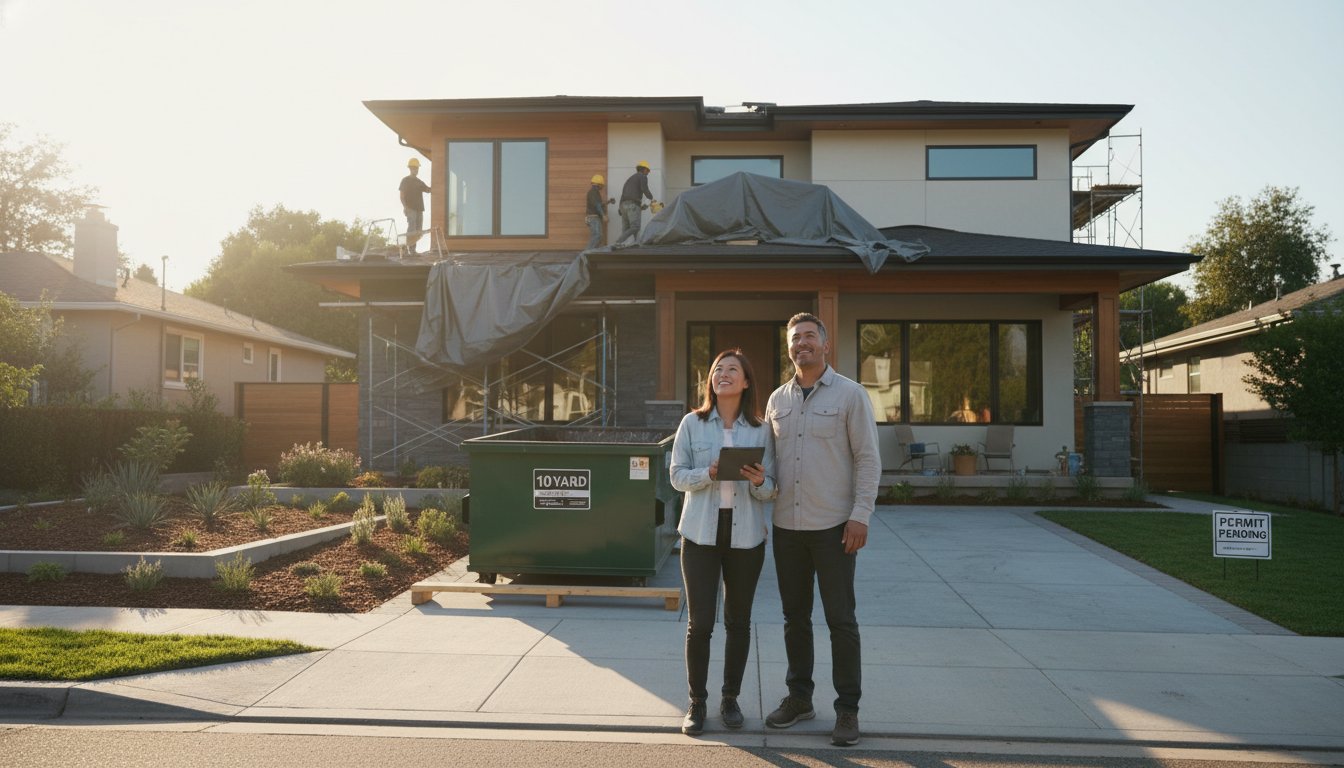
Your HOA board has the power to shut down your home renovation before the first delivery truck even arrives. A single violation notice for an unapproved bin can result in daily fines and immediate project delays. Learning how to get an HOA approval for a dumpster is a critical first step that many homeowners overlook until it's too late. With 78.1 million people now living in governed communities, staying compliant with your specific neighborhood bylaws is the only way to protect your budget.
We understand that navigating board regulations feels like an unnecessary hurdle when you just want to clear out the junk. You shouldn't have to choose between a clean job site and a legal battle with your neighbors. This guide provides the exact process to secure your approval quickly, avoid common placement mistakes, and keep your project on schedule. We will break down how to read your CC&Rs, what documentation to provide, and how to handle city permits versus association rules. Use these steps to get a "yes" on your first try and keep your renovation moving forward.
Key Takeaways
- Review your community CC&Rs to understand specific debris management rules and avoid daily violation fees.
- Follow our proven submission guide to learn how to get an HOA approval for a dumpster on your first attempt.
- Identify common board restrictions regarding placement and duration to keep your project compliant and on schedule.
- Frame your dumpster request as a safety measure and engage neighbors early to prevent complaints and speed up board processing.
- Select a compact container like a 10-yard dumpster to minimize the physical footprint and simplify the approval process.
Navigating HOA Dumpster Rules: Why Approval is Essential in 2026
A home renovation is a complex logistical operation. Managing waste is often the messiest part. In 2026, more than 78.1 million Americans live in communities governed by a Homeowner Association (HOA). These organizations exist to maintain property values and neighborhood aesthetics. They have the legal authority to dictate what sits in your driveway and for how long. Ignoring these rules is a fast track to financial penalties. If you are planning a project, understanding how to get an HOA approval for a dumpster is just as important as hiring a contractor. Skipping this step often results in immediate stop-work orders that can freeze your entire renovation.
The Legal Basis: CC&Rs and Architectural Guidelines
Your relationship with your community is defined by a contract. This document, known as the Covenants, Conditions, and Restrictions (CC&Rs), gives the board its power. Most CC&Rs classify a roll-off container as a temporary structure or a visual nuisance. Before you book a 20-yard dumpster, locate your CC&Rs and look for sections regarding debris, waste management, or architectural changes. You will likely find that any exterior modification or large equipment delivery requires a review by the Architectural Review Committee (ARC). These committees evaluate whether the equipment will damage common property or disrupt the neighborhood visual consistency. In 2026, states like California and Florida have tightened laws regarding HOA transparency; homeowners in New York and Massachusetts should similarly monitor local 2026 updates regarding notification requirements and fine caps.
HOA vs. City Permits: Knowing the Difference
Municipal laws and HOA rules are two separate hurdles. A city permit from a local government in Chicago or Queens allows you to place a bin on a public street. It does not grant permission to place that same bin on your private driveway if your HOA forbids it. Conversely, board approval doesn't mean you can block a public sidewalk. Follow the street versus driveway rule: if the dumpster touches public asphalt, call the city. If it sits on your property, talk to the board. In many cases, you may need both approvals to stay compliant. Understanding how to get an HOA approval for a dumpster involves recognizing these jurisdictional boundaries early. Boards prioritize property value and aesthetic consistency. They want to ensure your waste management plan doesn't involve an overflowing bin sitting in view of the street for a month. Secure your internal permission first to avoid daily violation fees that can reach hundreds of dollars depending on your state current legal caps.
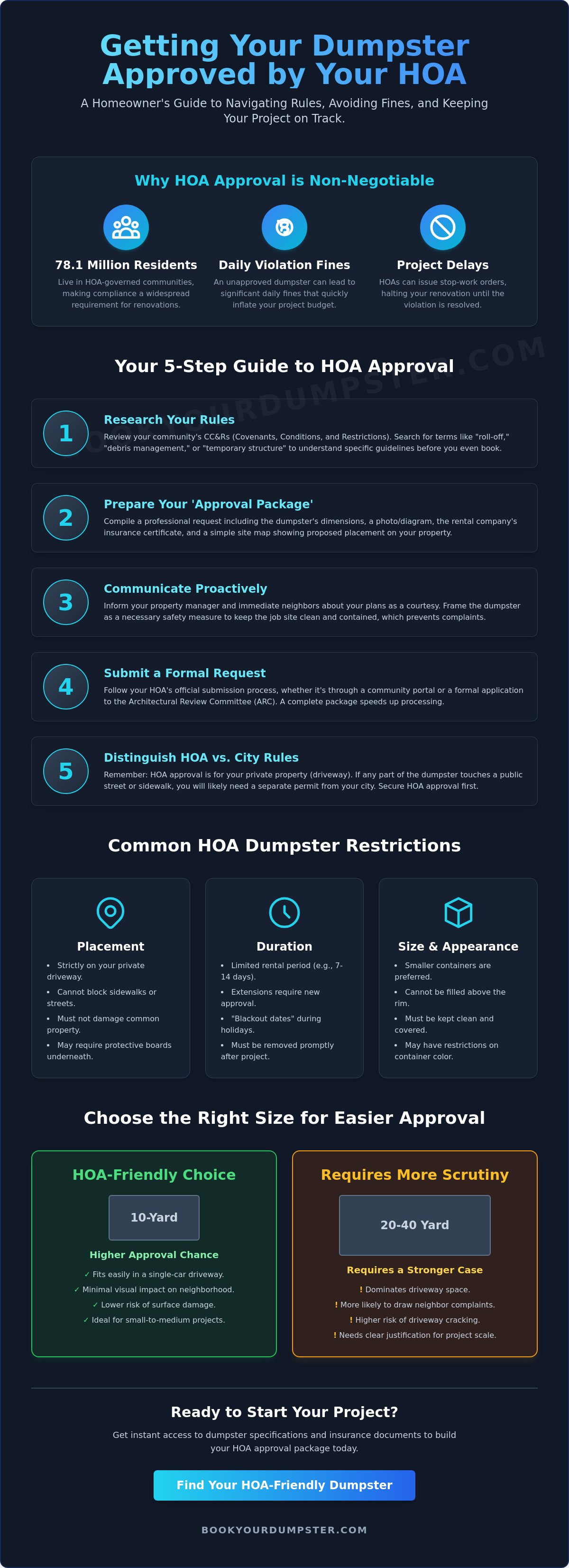
How to Get HOA Approval for a Dumpster: A 5-Step Submission Guide
Securing board consent requires more than a casual email. You need a professional logistics plan that addresses the board's primary concerns: property damage and neighborhood aesthetics. By treating your request like a formal project proposal, you reduce the likelihood of a rejection or a request for more information. Following a structured process is the most effective way to learn how to get an HOA approval for a dumpster while keeping your renovation timeline intact.
Step 1: Research and Initial Inquiry
Start by logging into your community portal. Search for keywords like "roll-off," "temporary structure," or "waste container." These documents often outline specific "blackout dates" during holidays or community events when heavy equipment is strictly prohibited. Contact your property manager to ask about pre-approved placement locations. Some boards have already designated specific areas of a driveway that minimize the impact on neighbors. For broader context on standard neighborhood governance, the Community Associations Institute offers resources that many board members use to set their own policies. Knowing these standards helps you speak their language during the inquiry phase.
Step 2: Preparing Your 'Approval Package'
A complete application prevents back-and-forth delays. Your package should include the technical specifications of the bin you intend to use. When compiling your documentation, remember that knowing how to get an HOA approval for a dumpster depends on the level of detail you provide regarding size and weight. Include a photo or diagram of the specific container, such as a compact 10-yard dumpster, which is often easier for boards to approve due to its smaller footprint. Book Your Dumpster USA provides these technical specifications instantly during the booking process so you can attach them to your request without delay. Also, provide a copy of the rental company’s insurance certificate to prove the association isn't liable for accidents on the property.
Step 3: Draft a Detailed Site Plan
Visual clarity removes doubt from the committee's mind. Use a printed satellite view of your property or a simple hand-drawn diagram to show exactly where the bin will sit. Mark the distance from the sidewalk and ensure it doesn't block any common access points or fire hydrants. If you plan to place the bin in a shared driveway, include a signed note of support from your neighbor. This proactive step eliminates the board's fear of future complaints and shows you've considered the community's needs. Explicitly state that you will place plywood under the rollers to prevent driveway cracking, which is a common requirement for approval.
Step 4: Define Your Project Timeline
Submit your application with a firm start and end date for the project. Boards are hesitant to approve "open-ended" waste management plans, so a clear 7 to 10-day window is usually the sweet spot for a quick "yes." If you anticipate delays, mention your plan for requesting a formal extension. Once you have your dates set and your site plan ready, you can submit the package through the official HOA portal or via the property manager's email. This organized approach positions you as a responsible homeowner and moves your application to the top of the pile.
Common HOA Dumpster Restrictions: Placement, Duration, and Size
Every community association operates with a unique set of standards. While some boards are lenient, most enforce strict limitations on how long a waste container can remain visible. Understanding these specific limitations is the second half of learning how to get an HOA approval for a dumpster. If you fail to adhere to the approved duration or placement, you risk incurring daily fines. In 2026, state laws have capped these penalties in several regions. For instance, California limits most non-safety violations to $100, while Virginia caps them at $50. However, Colorado allows fines up to $500. Avoid these costs by knowing the rules before the delivery truck arrives.
Time Limits and Extension Policies
Most associations allow a rental period of 7 to 14 days. This window is designed to accommodate standard residential cleanouts without turning the neighborhood into a permanent construction zone. Always request three days more than your contractor estimates. Project delays are common; labor shortages and material price fluctuations in 2026 often push timelines back by 2% to 4%. If you realize the project will run long, notify the board at least 48 hours before your original deadline. Proactive communication prevents the automatic trigger of "overstay" fines. Never assume a "silent" extension is acceptable. Boards prioritize the removal of heavy equipment to maintain the community's aesthetic appeal.
The 'Driveway Only' Rule
HOAs almost universally forbid placing dumpsters on the street. Street placement creates liability issues, blocks emergency vehicle access, and damages common-area asphalt. Expect the board to mandate placement on your private driveway. You must also adhere to proximity rules. Most sets of CC&Rs require the bin to be set back at least five feet from the sidewalk or property line. This ensures pedestrian safety and prevents disputes with neighbors. To protect your property and satisfy board requirements, use surface protection. Laying down plywood or specialized pads is often a non-negotiable condition for approval. This prevents the heavy steel rollers of a 30-yard dumpster from cracking your driveway surface.
Aesthetics and Weight Considerations
Some high-end associations have "visual screening" requirements. This might mean placing a temporary privacy fence or a neutral-colored tarp over the bin when it's not in use. Boards also monitor weight limits to protect community-maintained roads. If your project involves heavy demolition debris, ensure you aren't exceeding the maximum tonnage allowed by the association's infrastructure rules. Excessive weight can lead to structural damage that the HOA will bill directly to your account. Match your project volume to the smallest possible container footprint to minimize these risks and secure a faster approval.
Strategic Tips for Fast-Tracking Your HOA Dumpster Request
Securing a fast "yes" from your board depends on how you frame the request. Instead of calling it a "trash bin," use the professional term "roll-off container." This small shift in vocabulary signals that you're running a professional, organized project rather than a chaotic cleanup. Position the container as a critical safety measure for the entire block. Explain that it prevents loose nails, jagged wood, and heavy debris from littering the driveway or blowing into common areas. A contained job site is a safe job site. Boards prioritize safety and liability reduction. Learning how to get an HOA approval for a dumpster involves managing perceptions as much as following rules.
To further improve your chances, offer a formal "Visual Mitigation Plan." Promise to keep a neutral-colored tarp over the top of the bin when work isn't active. This proactive step shows you respect the neighborhood's aesthetic standards and understand how to get an HOA approval for a dumpster without disrupting the community view. It addresses the board's fear of a "neighborhood eyesore" before they even bring it up.
Neighbor Relations and Preventing Complaints
Most board friction starts with a single neighbor complaint. Head this off by talking to your immediate neighbors before the delivery truck arrives. Inform them of the exact delivery and pickup dates so they aren't surprised by a large truck in the cul-de-sac. Ensure your planned placement doesn't block shared sightlines or make it difficult for them to navigate their own driveways. Proactively promise that there will be no "early morning" noise. Instruct your rental provider to avoid drop-offs before 8:00 AM. When neighbors feel respected and informed, they are far less likely to report you to the property manager for a minor technicality.
Handling an HOA Denial
If you receive a denial letter, don't treat it as the end of the project. Ask the board to cite the specific CC&R section or architectural rule they used to justify the rejection. Often, the board's concern is the physical footprint of the equipment. Propose a smaller alternative to address this. Switching to a 10-yard dumpster can resolve concerns about driveway space or visual bulk while still providing enough capacity for most residential cleanouts. If your project involves an emergency, like sudden water damage or a fallen tree, request an "expedited variance." Boards usually have the power to bypass standard 30-day waiting periods for urgent property protection. Once you've addressed the board's specific feedback, schedule your dumpster delivery to get your renovation back on track.
Choosing the Right Dumpster Size to Secure HOA Approval
The physical footprint of your waste container often determines how quickly a board signs off on your request. A massive bin that hangs over the sidewalk or dominates the front of a home is a red flag for architectural committees. Boards prioritize neighborhood aesthetics and unobstructed access for emergency vehicles. To increase your chances of a "yes," match your project volume to the smallest possible container footprint. Understanding how to get an HOA approval for a dumpster requires a balance between your disposal needs and the community's visual standards. Selecting a compact model demonstrates that you are minimizing the project's impact on your neighbors.
The 10-Yard Advantage for Residential HOAs
For most residential communities, the 10-yard dumpster is the gold standard for easy approval. These units typically feature a compact footprint of 12 feet by 8 feet. This size allows the bin to sit comfortably within a standard parking space or a short driveway without encroaching on common property. Because they have lower side walls, they are less likely to trigger aesthetic complaints regarding "visual blight." This size is the ideal choice for bathroom remodels, attic cleanouts, or small deck removals. When you propose a 10-yard bin, you're presenting a manageable, low-profile solution that boards find difficult to reject.
Professional Support from Book Your Dumpster USA
Navigating different state regulations and local board quirks is a challenge. We have extensive experience helping homeowners secure approvals in New York, Illinois, and Massachusetts. Our streamlined online booking system provides the exact technical specifications your board needs to see. You can download dimensions and weight capacities immediately to include in your application package. This transparency removes the guesswork for property managers and speeds up the review process. If your project requires more capacity, we also offer 20-yard, 30-yard, and 40-yard dumpsters to handle larger construction debris volumes while maintaining professional standards.
Follow this final checklist to ensure your project stays compliant from delivery to pickup:
- Verify the Permit: Confirm if you need a city permit in addition to HOA approval.
- Document the Approval: Keep a digital copy of the board's "yes" on your phone.
- Protect the Surface: Have plywood ready for the delivery driver to place under the rollers.
- Notify Neighbors: Send a quick text to immediate neighbors about the delivery date.
- Respect the Schedule: Ensure the bin is loaded and ready for pickup before the approved deadline.
Don't let board bureaucracy stall your home improvement plans. Secure your equipment from a provider that understands the logistical needs of governed communities. Book Your Dumpster Online Now to get the reliable service and technical data you need for a stress-free renovation.
Take Control of Your Project Logistics Today
Mastering how to get an HOA approval for a dumpster ensures your renovation starts without a violation notice on your front door. You now have the tools to navigate CC&Rs, draft a professional site plan, and manage neighbor relations effectively. Board approval is fundamentally about proving your project won't damage common property or disrupt neighborhood aesthetics. By choosing a low-profile container and providing clear timelines, you eliminate the board's primary reasons to say no.
Our professional roll-off delivery experts support homeowners across NY, NJ, IL, and MA. We provide the technical specs and reliable service needed to satisfy strict architectural committees. Whether you need a compact 10-yard bin or a larger 20, 30, or 40-yard dumpster for heavy demolition, we have the right fit for your driveway. Stop worrying about board bureaucracy and focus on your home improvement goals instead.
Take the first step toward a clean, compliant job site. Secure Your Board-Friendly 10-Yard Dumpster Today. Your project is too important to leave to chance.
Frequently Asked Questions
Can an HOA legally prevent me from renting a dumpster?
Yes, your association can legally restrict or ban dumpsters based on the CC&Rs you signed when purchasing your home. These documents are binding contracts that grant the board authority over neighborhood aesthetics and property usage. If the bylaws categorize a roll-off container as a nuisance or a prohibited temporary structure, you must comply. Always verify the specific language in your governing documents before scheduling a delivery to avoid legal disputes.
How long does it typically take to get HOA approval for a dumpster?
Expect the approval process to take between 7 and 30 days depending on your board's meeting schedule. Most Architectural Review Committees (ARC) meet once a month to review exterior modification requests. To speed up the timeline, submit a complete application package with technical specs and a site plan. Proactive homeowners who provide all documentation upfront often receive a faster response than those who leave details out.
What happens if I place a dumpster without HOA approval?
Placing a bin without consent usually triggers immediate daily fines and potential stop-work orders for your project. In 2026, many states have established caps on these penalties. For example, California limits most non-safety fines to $100 per violation, while Colorado allows up to $500. Beyond the financial cost, an unapproved bin damages your relationship with the board and may lead to a permanent denial of future renovation requests.
Do I need a dumpster permit if the bin is in my driveway?
You generally don't need a municipal permit for a dumpster placed on your private driveway, but you still require HOA permission. City permits are typically reserved for public right-of-ways like streets or sidewalks. However, your association acts as a private governing body with its own permitting process. Learning how to get an HOA approval for a dumpster is the only way to ensure your driveway placement is fully compliant with local neighborhood rules.
My HOA denied my dumpster request; what are my next steps?
Review the denial letter to identify the specific rule or aesthetic concern cited by the board. If the rejection was based on size, propose a more compact 10-yard dumpster to reduce the visual impact on the street. You can also request a variance hearing to explain the necessity of the project. If the work is an emergency, such as repairing water damage, ask for an expedited review to protect the property from further harm.
Are there specific dumpster colors that HOAs prefer or ban?
Some high-end associations require neutral-colored bins or mandate that containers be covered with a dark tarp when not in use. Bright, neon-colored rental bins often draw more scrutiny from architectural committees concerned with neighborhood aesthetics. If your board is particularly strict about visual standards, ask your rental provider for a neutral-colored unit. Providing this detail in your application shows the board that you are committed to maintaining community standards.
How can I protect my driveway from dumpster damage to satisfy the HOA?
Use heavy-duty plywood or specialized rubber pads under the dumpster's steel rollers to prevent cracking or scraping. Document this protection plan in your submission to reassure the board that you won't damage the driveway or common-area pavement. This proactive step addresses one of the board's primary concerns: long-term property maintenance. Showing that you have a plan for surface protection makes it much easier to understand how to get an HOA approval for a dumpster quickly.
Should I tell my HOA if I'm only keeping the dumpster for 24 hours?
Yes, you should always notify the association regardless of the rental duration. Even a 24-hour placement can trigger a neighbor complaint or a violation notice from a property manager on a routine inspection. Informing the board shows transparency and professional courtesy. It also prevents the board from initiating a formal enforcement action that could outlast the actual time the dumpster sits on your property.


