
Your HOA's CC&Rs are not a permanent "no" to your home project; they are a checklist for professional waste management. Most homeowners feel a surge of anxiety the moment they consider a dumpster rental in an HOA community. You worry about a neighbor reporting the bin, or worse, receiving a $100 fine notice because the container stayed in the driveway for three days instead of two. It's a valid concern when nearly 80 million Americans live under community association rules that often supersede local city ordinances.
You shouldn't have to choose between a clean home and a peaceful relationship with your board. This 2026 guide teaches you exactly how to secure approval, choose the right dumpster size, and manage your debris without triggering a violation. We will break down the latest legal protections in states like Florida and California, explain how to use 4'x8' boards to prevent driveway damage, and provide a step-by-step plan to get your project finished fast. Follow these instructions to keep your project legal and your standing in the neighborhood secure.
Key Takeaways
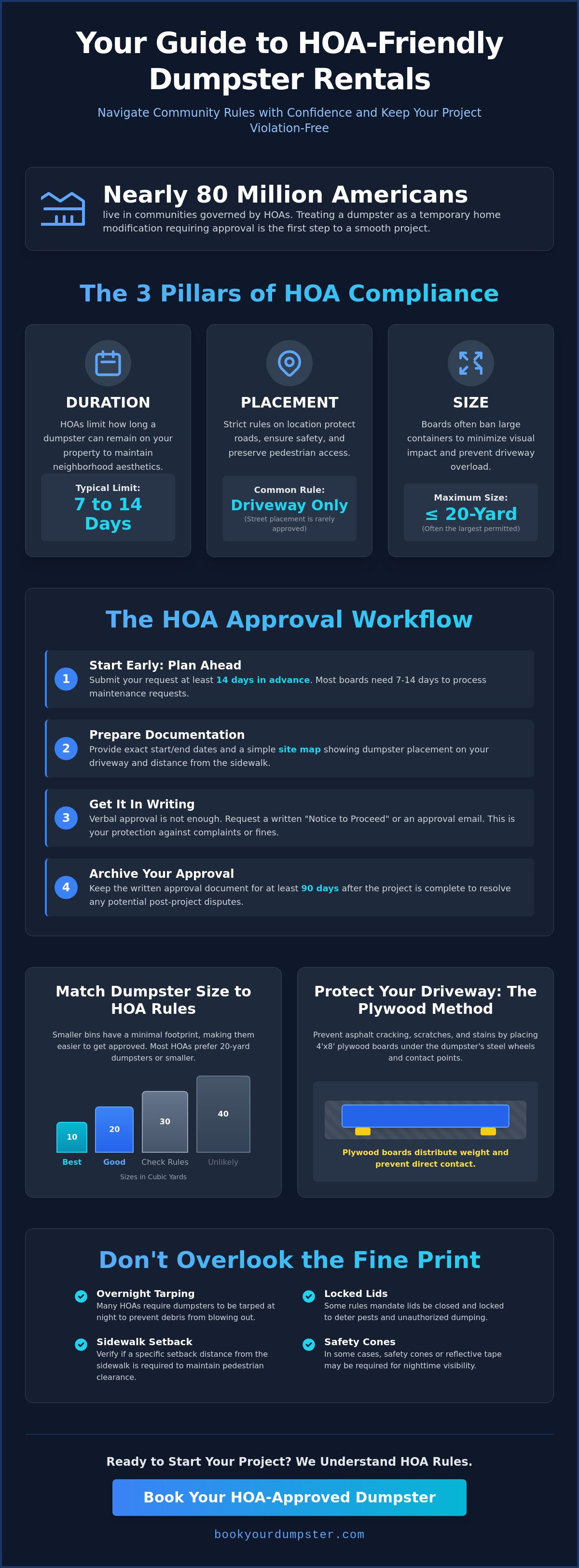
- Identify the three pillars of HOA compliance—duration, placement, and size—to ensure your project stays within legal CC&R guidelines.
- Start your approval process at least 14 days in advance to navigate board reviews and avoid last-minute scheduling conflicts.
- Select the right bin size for a dumpster rental in an HOA community to minimize the footprint on your driveway and maintain neighborhood aesthetics.
- Implement the "Plywood Method" to protect your property from asphalt cracking and meet strict community setback requirements.
- Coordinate your waste removal with professional providers who understand the specific regulatory landscapes of New York, New Jersey, and Illinois.
Understanding HOA Dumpster Rules and CC&Rs
Living in a Homeowner Association (HOA) means you've agreed to a specific set of Covenants, Conditions, and Restrictions, commonly known as CC&Rs. These documents are legally binding contracts that govern how you maintain your property. In the context of waste management, CC&Rs dictate how and when you can bring external equipment onto your lot. A dumpster rental in an HOA community is never a simple drop-and-go operation. You must treat the container as a temporary modification to your home's exterior that requires specific oversight.
HOA boards focus on three main pillars when regulating roll-off containers: duration, placement, and size. They enforce these rules to protect property values and maintain community aesthetics. A massive 40-yard bin overflowing with debris for three weeks creates an eyesore and signals a lack of project management. Boards also prioritize road safety and structural integrity. Heavy delivery trucks can crack thin asphalt or block emergency vehicle access. This is why placement rules are often the strictest part of the local code. Properly managing a dumpster rental in an HOA community requires adhering to these visual and safety standards from day one.
Don't overlook the hidden requirements buried in the fine print. Many associations mandate that dumpsters remain tarped at night to prevent debris from blowing into a neighbor's yard. Others require lids to be closed and locked to deter pests or unauthorized dumping. Ignoring these small details leads to immediate fines, even if you have general project approval. Check your local rules for overnight restrictions or requirements for safety cones around the bin.
Where to Find Your Community’s Specific Rules
Log into your resident portal or check the physical handbook you received at closing. Look specifically for sections titled "Architectural Guidelines" or "Temporary Structures." If the language is vague, email your property manager directly. Ask for the written policy regarding roll-off containers. Having a digital trail protects you if a neighbor files a complaint later. You can also visit Book Your Dumpster to find a size that fits within common community dimensions.
Common Restrictions You Will Likely Encounter
Most communities enforce a 7 to 14 day limit for on-site containers. You will likely be restricted to driveway placement only. Street parking often requires additional municipal permits and board waivers that are difficult to obtain. Size is another frequent hurdle. Many HOAs ban containers larger than a 20-yard dumpster to ensure the bin doesn't dominate the streetscape. Always verify if your board requires a specific setback distance from the sidewalk to maintain pedestrian clearance.
How to Get HOA Approval for Your Dumpster Rental
Do not wait until the morning of your project to notify your board. Securing approval for a dumpster rental in an HOA community requires a proactive approach. Most boards operate on a fixed meeting schedule or use a third-party management company that needs 7 to 14 days to process architectural or maintenance requests. If you skip this step, you risk a "stop work" order or daily fines that quickly exceed the cost of the rental itself. Start the process the moment you finalize your contractor's schedule or your DIY timeline.
Documentation is your best defense against neighborhood conflict. Before you contact the board, have your exact start and end dates finalized. Prepare a simple site map. This doesn't need to be a professional blueprint; a bird's-eye sketch of your driveway showing exactly where the roll-off will sit is sufficient. Clearly mark the distance from the sidewalk and the street. This level of detail proves you've considered the community's safety and aesthetics. Once you have these details, you can view available inventory to match your approved footprint.
Always request a written "Notice to Proceed" or an approval email. Verbal permission from a neighbor who happens to be on the board isn't enough. If a different board member or a concerned neighbor reports the bin, that written document is your primary protection. It proves you followed the established rules and protects you from retroactive fines. Keep this document accessible until the bin is physically removed from your property.
Step-by-Step: The HOA Approval Workflow
Follow this sequence to minimize friction. First, identify the specific submission method, whether it's a digital portal or a direct email to the property manager. Second, attach your site map and project timeline to your formal request. Third, confirm receipt of the request in writing. Finally, archive the written approval for at least 90 days after the project ends. This ensures you have a record if any property damage disputes arise later.
The Art of the Request: What to Say to the Board
Use professional, neutral language to set a cooperative tone. Instead of saying "I'm getting a dumpster," say "I am requesting temporary placement of a waste container for a scheduled home improvement project." State clearly that you will use driveway protection and provide the exact removal date. This transparency reduces the board's fear of a permanent eyesore or property damage. Professionalism often results in faster approvals and fewer follow-up questions.
Choosing the Right Dumpster Size for HOA Compliance
Select the correct bin size to improve your approval odds. In most residential developments, visual impact is the primary concern for the board. A massive container that towers over a sedan or blocks a neighbor’s line of sight will trigger immediate scrutiny. When planning a dumpster rental in an HOA community, you must balance your project's volume requirements with the physical constraints of your driveway and the community’s aesthetic standards. Smaller bins are generally easier to approve because they don't dominate the streetscape.
Size also correlates with weight, which is a major concern for associations responsible for private road maintenance. Heavy equipment can cause hairline fractures in asphalt or sink into pavers. Most boards prefer smaller containers because they distribute weight more safely across residential surfaces. Choose a compact model to demonstrate that you're being mindful of the common infrastructure. It reduces the risk of the board holding you liable for pavement repairs after the project ends. If you aren't sure about the weight limits on your street, check your resident handbook for specific tonnage restrictions.
Visibility is the final factor. A low-profile bin stays below the height of most garage doors and fences, making it less of an eyesore. This "out of sight, out of mind" approach is the most effective way to avoid neighborhood conflict. If the bin doesn't look like a commercial construction site, neighbors are less likely to report it. Keep the project contained and professional by matching the container to the scale of your home.
The 10-Yard Advantage: Small Footprint, High Efficiency
The 10-yard dumpster is widely considered the "goldilocks" size for homeowner associations. Its footprint is roughly equivalent to a standard SUV, meaning it fits comfortably within a single parking space without encroaching on the sidewalk. This size is ideal for bathroom remodels, basement cleanouts, or small roofing repairs. Because it's shorter than larger models, it remains unobtrusive and is frequently approved without the lengthy debates associated with larger bins. It provides enough capacity for about three to four pickup truck loads of debris while maintaining a professional appearance.
When to Scale Up: Managing Larger 20 or 30 Yard Projects
Larger projects like kitchen renovations or whole-home flooring replacements might require a 20-yard or 30-yard dumpster. Be prepared to justify this choice to your board. A 20-yard bin is the industry standard for most residential work, but it's noticeably longer than a 10-yard model. If you must scale up, ensure you have the driveway length to accommodate the bin while keeping it behind the property's setback line. Avoid 40-yard dumpsters for a dumpster rental in an HOA community unless you're managing a major structural rebuild. These bins are designed for commercial sites and often violate the height and weight restrictions found in typical residential CC&Rs.
Placement and Property Protection Strategies
Proper placement is the final step in maintaining a professional relationship with your board. Even with written approval, a dumpster rental in an HOA community can become a liability if it damages common property or blocks pedestrian traffic. You must position the container on a hard, level surface that complies with your specific community setback requirements. Most associations require the bin to remain entirely behind the front plane of the house or at least five feet back from the sidewalk. This ensures the streetscape remains open and safe for residents.
Clear access is non-negotiable for a successful delivery. Ensure your driveway is free of vehicles, basketball hoops, or low-hanging branches before the truck arrives. If the driver can't safely place the bin on the first attempt, you may face dry-run fees and project delays. A professional delivery minimizes noise and disruption, which keeps your neighbors from filing complaints. Once you've cleared the path, you can schedule your drop-off with confidence.
Protecting Your Driveway from Roll-Off Damage
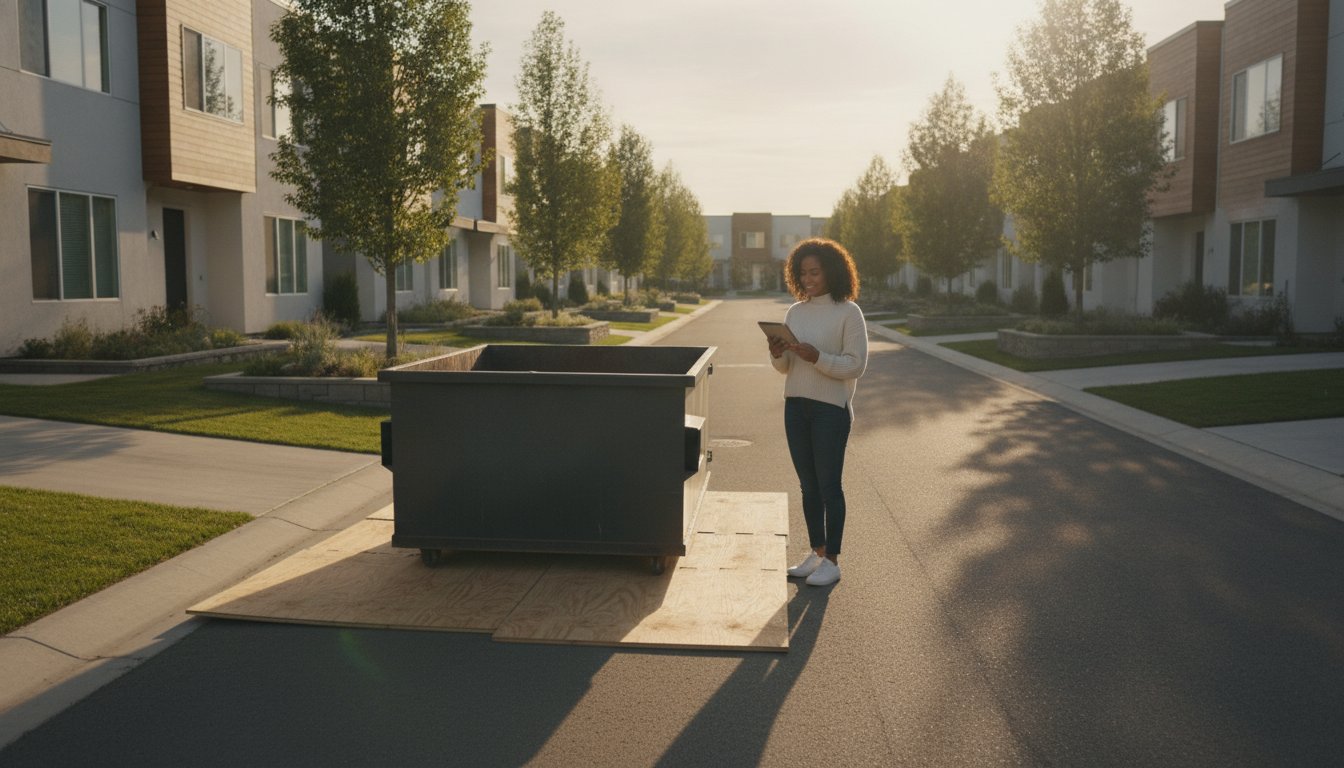
Execute the "Plywood Method" to prevent structural issues. Place two 4'x8' sheets of plywood or heavy-duty boards on your driveway exactly where the bin's steel wheels will land. This simple step distributes the weight of the container and prevents asphalt cracking or concrete staining. It also serves as a visible sign to the HOA board that you're taking active steps to protect the property's value. Don't risk your security deposit or face repair assessments by skipping this 10 minute preparation.
Safety and Aesthetics: Keeping the Site Clean
A messy dumpster invites scrutiny. Sweep the area around the bin daily to remove nails, dust, or stray debris. If your CC&Rs require it, use a heavy-duty tarp to cover the load overnight. This prevents debris from blowing into neighboring yards and keeps the project looking organized. A clean site is the most effective way to manage a dumpster rental in an HOA community without attracting negative attention from local enforcement officers.
Booking Your HOA-Friendly Dumpster Rental
Finalizing your dumpster rental in an HOA community requires a partner that respects your timeline and your property's strict regulations. Book Your Dumpster USA removes the logistical friction by providing transparent inventory and immediate scheduling. Our system is designed for homeowners who need to move from board approval to project execution without technical delays. By choosing a provider that understands the nuances of residential waste management, you ensure that your bin arrives on time and leaves before your HOA's grace period expires.
Efficiency is the core of our service. You don't have time to wait for a salesperson to call you back with a quote while your HOA's 14-day approval window is ticking. Our digital-first platform allows you to select your bin, verify the footprint, and confirm the delivery date in minutes. This speed is essential for maintaining good standing with your neighbors and avoiding the fines associated with unauthorized equipment on your lot. We provide the reliability you need to focus on your renovation rather than the logistics of waste removal.
Why Local Expertise Matters in Managed Communities
Every region has specific disposal laws and community standards that impact your project. We maintain deep local expertise in New York, New Jersey, and Illinois, ensuring that your rental complies with both municipal and association-level requirements. Our drivers are familiar with the tight turns and narrow driveways common in planned developments across these states. This regional knowledge prevents delivery accidents and ensures that your bin is placed exactly where your board authorized it. We act as your local partner, bridging the gap between professional waste management and residential compliance.
Schedule Your Rental with Book Your Dumpster USA
Take control of your home project by using our streamlined online booking tool. Start by selecting the size that matches your board-approved site map. Whether you need a compact 10-yard bin or a larger 20-yard container, our inventory is updated in real-time to prevent scheduling conflicts. Enter your delivery details, provide any specific gate codes or placement instructions, and secure your date instantly. This transparency eliminates the guesswork and provides a clear record you can share with your property manager.
Close the loop by scheduling your pickup at the same time you book your delivery. Most HOAs are strict about the 3 to 14 day limits for on-site containers. Don't wait until the bin is full to think about removal. By setting a firm pickup date during the initial booking, you guarantee that the bin will be gone as soon as your work is complete. This proactive approach satisfies the "three pillars" of HOA compliance and keeps your project moving toward a successful resolution. Visit Book Your Dumpster today to secure your equipment and finish your project on schedule.
Master Your Next Home Project Without HOA Conflict
Managing a dumpster rental in an HOA community requires a balance of early planning and professional execution. You've learned that securing a written "Notice to Proceed" and choosing a low-profile 10-yard bin are the most effective ways to satisfy board requirements. By using the plywood method for driveway protection and maintaining a clean site, you eliminate the common triggers for neighborhood complaints and fines. These steps move your project from a logistical headache to a streamlined success.
Book Your Dumpster USA provides the reliability you need for managed communities. We offer professional delivery across New York, New Jersey, Illinois, and Massachusetts with a focus on punctuality and transparent online pricing. You won't find hidden fees here; just straightforward service designed to get your waste removed quickly and legally. Take the next step in your renovation by choosing a partner that respects your community's rules as much as you do.
Book Your HOA-Friendly 10-Yard Dumpster Today
You have the tools and the plan to finish your cleanup without the stress of violations. Start your project today and enjoy a clutter-free home tomorrow.
Frequently Asked Questions
Can my HOA legally prevent me from renting a dumpster?
Yes, your HOA has the legal authority to regulate or prohibit external equipment based on the CC&Rs you signed at closing. These rules usually focus on the duration and placement of the bin rather than a total ban on waste removal. However, 2026 legislation in states like Florida and California now limits the fining power of boards and requires they provide fair notice before taking enforcement action.
How long can a dumpster typically stay in a driveway in an HOA?
Most associations allow a container to remain on your property for 3 to 14 days. This window is designed to cover the length of a standard residential project, such as a basement cleanout or a small remodel. If your project exceeds this timeframe, you must submit a written extension request to the board to avoid daily fines that can accumulate quickly.
What happens if I don't get approval before the dumpster arrives?
You will likely face an immediate violation notice and a financial penalty. In many jurisdictions, these fines are capped at $100 per individual violation, but they can reach a $1,000 aggregate cap if the bin isn't removed. The board may also issue a formal demand for the bin's immediate removal, which creates additional logistical costs and halts your home project.
Do I need a city permit in addition to HOA approval?
You only need a municipal permit if the bin sits on a public street or right-of-way. If the dumpster stays entirely on your private driveway, a city permit is rarely required, but the HOA's private regulations still apply. Always check your local building department's website if you live in a high-density area where street placement is your only option.
Will a 10-yard dumpster fit in a standard single-car driveway?
Yes, a 10-yard dumpster has a footprint similar to a standard SUV and fits easily within a single parking space. This compact size is the ideal choice for a dumpster rental in an HOA community because it doesn't block the sidewalk or encroach on your neighbor's property line. It provides enough capacity for small projects while remaining low-profile and easy to approve.
Can I put my dumpster on the street if the HOA says no to the driveway?
Street placement is almost never allowed in managed communities. HOA boards typically own the private roads within the development and prohibit any obstructions that might block emergency vehicles or mail delivery. Even if the street is public, your community's bylaws likely forbid street parking for heavy equipment. Stick to your driveway to stay compliant.
How do I prevent neighbors from putting their trash in my rented dumpster?
Secure the top of your bin with a heavy-duty tarp and bungee cords every evening. This creates a physical barrier that discourages others from using your container for their own waste. Most people won't go through the effort of unhooking a tarp to dump trash. Keeping the area well-lit or within view of a doorbell camera also serves as an effective deterrent.
Are there specific colors of dumpsters that HOAs prefer?
HOAs don't usually require specific colors, but they prefer neutral tones like navy, dark green, or black that don't clash with the neighborhood's aesthetic. Avoid using bins with bright, neon colors that attract negative attention to your work site. A clean, professionally maintained dumpster rental in an HOA community is less likely to cause friction if it looks like a standard utility tool.


