
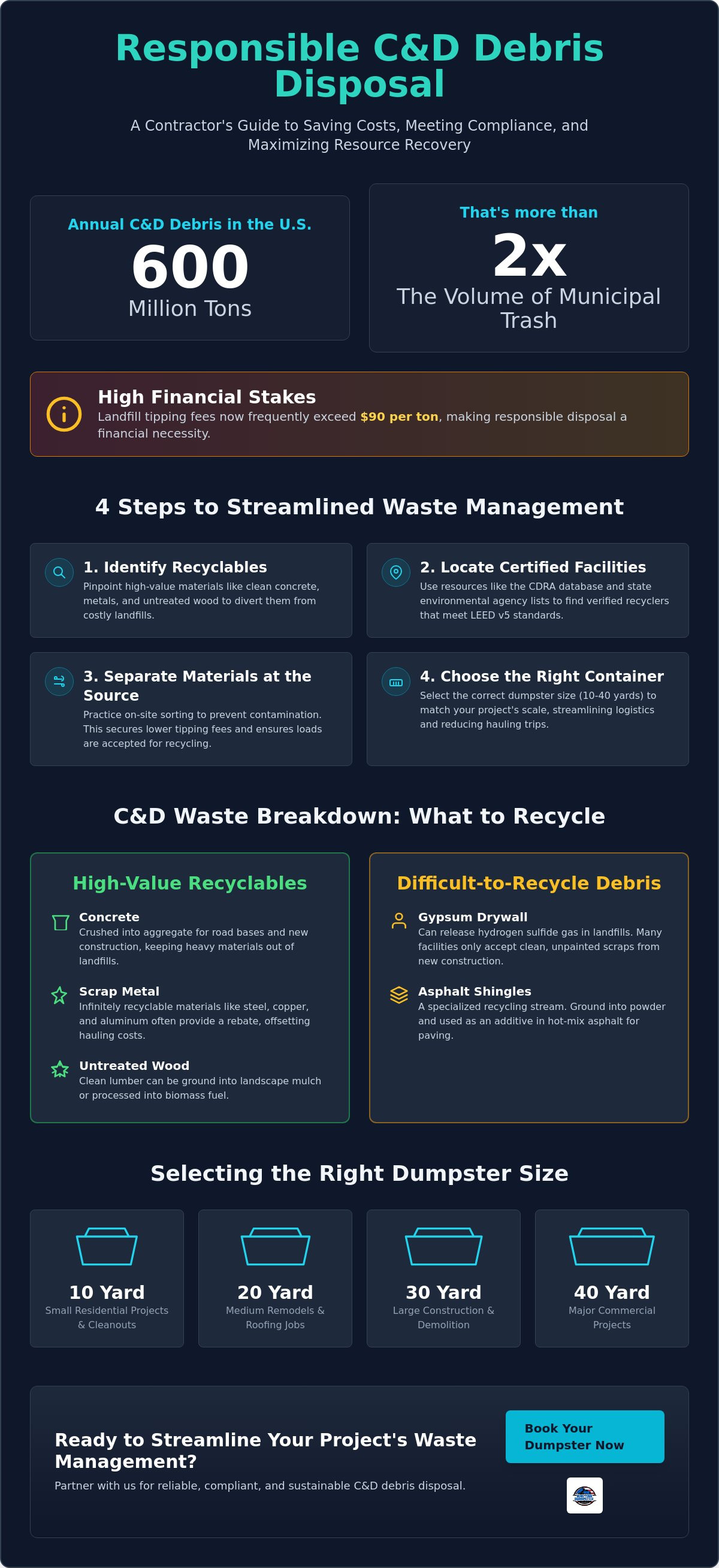
The United States generates 600 million tons of construction and demolition debris every year, which is more than double the volume of standard municipal trash. Realize that landfill tipping fees now frequently exceed $90 per ton, making responsible construction debris disposal a financial necessity rather than a suggestion. You likely face the same pressure as every other contractor to meet strict LEED v5 diversion targets or navigate complex city mandates in places like New York or San Francisco. Managing this waste shouldn't be the most stressful part of your project.
Learn the exact steps to identify, sort, and transport C&D waste to certified facilities to save on disposal costs and meet environmental standards. This guide eliminates the guesswork and helps you implement a streamlined waste management plan that works. We will walk you through material-specific sorting techniques and show you how to find third-party verified facilities that accept your heavy debris. Follow this framework to lower your project costs and maintain total compliance with the latest 2026 building codes.
Key Takeaways
- Identify recyclable materials like clean concrete and gypsum to avoid the high costs of contaminated waste disposal.
- Locate certified facilities using the CDRA database and state environmental resources to satisfy LEED v5 and local green building codes.
- Practice responsible construction debris disposal by separating materials at the source to secure lower tipping fees.
- Choose the right container size, from 10 to 40 yards, to streamline your logistics and reduce the number of hauling trips.
Understanding C&D Waste: What Materials Can Be Recycled?
The annual generation of 600 million tons of C&D debris in the United States highlights a massive opportunity for resource recovery. Effective responsible construction debris disposal transforms what looks like trash into usable raw materials. Most projects contain a mix of inert solids and organic matter that facilities can process if they remain uncontaminated. Understanding the composition of Demolition waste is the first step toward reducing your project's environmental footprint and avoiding unnecessary landfill costs. By diverting these materials in 2026, you help mitigate the rising pressure on regional landfills while securing lower disposal rates for your business.
You must distinguish between clean debris and contaminated waste before loading any container. Clean debris consists of raw materials free from hazardous substances or general garbage. Contaminated waste includes anything mixed with asbestos, lead-based paint, or household refuse. If you allow food waste or hazardous liquids into your recycling stream, the entire load will be rejected at the scale. This results in standard landfill tipping fees, which are significantly higher than recycling rates. Maintain strict site discipline to ensure every load remains eligible for recovery.
High-Value Recyclables: Concrete, Metal, and Wood
Concrete is the most commonly recycled material on construction sites. Facilities crush old slabs and foundations into aggregate used for road bases and drainage layers. This process keeps heavy minerals out of landfills while providing a cheaper alternative to virgin stone. Scrap metals like copper wiring, structural steel, and aluminum also carry high market value. These materials are infinitely recyclable and often provide a rebate that offsets your hauling costs. Untreated wood is another prime candidate for recovery. Clean lumber can be ground into landscape mulch or processed into biomass fuel. Keep these streams separate to maintain their market value and ensure acceptance at the recycling center.
Difficult-to-Recycle Debris: Drywall and Asphalt Shingles
Gypsum drywall presents unique challenges due to its chemical composition. When buried in landfills, gypsum can release hydrogen sulfide gas, which creates severe odor issues. Many facilities only accept clean drywall scraps from new construction rather than painted sheets from demolition. Asphalt shingles are also a specialized recycling stream. Recyclers grind them into a powder used to improve the durability of hot-mix asphalt for paving projects. A clean C&D load consists of a single material type like 100% concrete, while a dirty load contains mixed debris that requires manual sorting. Use a 10 or 20 yard dumpster from Book Your Dumpster USA to keep these high-value materials organized on your site.
How to Find a Certified C&D Recycling Facility Near You
Don't waste time driving to a landfill only to find they won't accept your load. Finding the right destination for responsible construction debris disposal depends entirely on your specific material mix. Start your search with the Construction & Demolition Recycling Association (CDRA) member database. This directory lists professional facilities committed to material recovery rather than simple landfilling. For localized data, consult state-specific environmental agencies like the New York Department of Environmental Conservation (DEC) or the New Jersey Department of Environmental Protection (DEP). These agencies maintain updated lists of permitted facilities that can handle heavy debris while following the Sustainable Management of Construction and Demolition Materials guidelines.
Using National and State Databases
The EPA provides a Disaster Debris Recovery Tool that maps thousands of facilities nationwide. Use this tool to identify regional recovery options that you might miss with a standard search. Some states have strict mandates that simplify your search. In Massachusetts, specific waste bans require you to recycle materials like asphalt, brick, and concrete. You can also use Google Maps for quick results, but you must use precise keywords. Search for "C&D recovery facility" or "concrete recycling" rather than just "dump site" to avoid general landfills that don't prioritize recovery.
Verifying Facility Certifications
Certifications prove a facility actually does what it claims. Look for the Recycling Certification Institute (RCI) stamp. This is crucial if your project needs to comply with LEED v5 standards. RCI certified facilities undergo third-party audits to verify their diversion rates. If you need a diversion report for your records, ask for it before you dump. Be aware that a transfer station is not always a recovery facility. A transfer station might just consolidate trash before sending it to a landfill. A true recovery facility sorts the debris to pull out recyclables. If you want to skip the logistics of finding and driving to these sites yourself, you can rent a roll-off dumpster to keep your site organized while the hauling process is managed for you.
Call the facility before you leave the job site. Confirm their current tipping fees and ask if they accept your specific materials. Some municipal centers in cities like Queens or San Francisco accept small loads from residents but have strict rules for contractors. Check for weight limits and material purity requirements to avoid being turned away at the scale. Taking ten minutes to verify these details ensures your responsible construction debris disposal plan stays on schedule and within budget.
Sorting and Preparing Debris for Maximum Recyclability
Effective responsible construction debris disposal relies on what you do before the hauler arrives. Don't mix your waste into one pile. It's a fast way to drive up your tipping fees. Landfills charge a premium for mixed C&D because they have to pay for the labor to sort it later. If you want to keep your project under budget, implement a sorting strategy immediately. Designate specific areas for concrete, untreated wood, and scrap metal using clear boundaries and high-visibility signage.
Source Separation vs. Commingled Recycling
Source separation is the gold standard for high-quality recycling. It keeps material purity high and disposal costs at their lowest. Clean concrete often costs significantly less to dump than mixed debris because it requires no further processing. However, if you're working on a cramped site in Jersey City or downtown Chicago, you might not have room for four different piles. In these cases, commingled recycling is a better logistical choice. You'll pay a higher rate for the convenience of a single container, but you save on site space and labor time. Analyze your square footage before deciding which method fits your project.
Managing Contaminants and Hazardous Waste
Contamination is the fastest way to turn a recyclable load into expensive trash. A single bag of household garbage or a few pieces of food waste can cause a facility to reject an entire 30 yard dumpster of clean concrete. Be aggressive about site rules. Use clear signage on every bin to ensure crews don't mix trash with recyclables. Protect your materials from the elements. Rain turns gypsum into a soggy mess and makes wood too heavy and prone to mold for recovery. If it's wet or muddy, it's often unrecyclable.
Identify hazardous materials like asbestos or lead-painted wood before demolition starts. These require specialized handling and cannot be mixed with standard recyclables under any circumstances. For wood recycling, follow this simple rule: if it's treated, painted, or glued, it's trash. Clean, untreated lumber and pallets are always accepted. Keeping these rules in mind ensures your responsible construction debris disposal efforts result in diverted waste rather than a rejected load at the gate. Stay disciplined with your sorting to maximize your project's environmental and financial performance.
The Logistics of Debris Removal: Dumpsters vs. Hauling
Moving tons of debris requires a plan that prioritizes speed and safety. You can't rely on a standard pickup truck for heavy demolition projects. A single truck bed holds roughly 2.5 cubic yards of material. To clear a site requiring a 20-yard container, you would need eight round trips. Factor in fuel, labor hours, and landfill wait times at the scale. It's inefficient and expensive. A roll-off dumpster centralizes your responsible construction debris disposal, allowing you to focus on the build instead of the waste.
Why Roll-Off Dumpsters are the Standard for C&D Recycling
A roll off dumpster rental simplifies your job site by keeping debris off the ground. This reduces tripping hazards and keeps your project in compliance with OSHA safety standards. For large-scale demolition, one-and-done hauling is the only way to maintain a tight schedule. Choose a 10 yard dumpster if you're dealing with heavy, dense materials like concrete or brick. These containers have lower walls, making them easier to load with a skid-steer while staying within strict road weight limits. Larger 20, 30, or 40 yard dumpsters work best for light, bulky items like wood framing, drywall, or old cabinetry.
Navigating Local Regulations in NY, NJ, and IL
Logistics get complicated in dense urban areas. If you're working in Chicago or New York City, you likely need a permit to place a dumpster on a public street. These "Right of Way" permits often require several days of lead time and a specific fee paid to the city. Don't wait until the day of delivery to check these requirements. In New Jersey, local ordinances might restrict the hours for dumpster delivery and pickup to reduce noise in residential zones. Check the 2026 Resource Guide for Debris Removal to see how these rules apply to your specific zip code.
Coordinate your delivery and pickup times to match your project's pace. If your bin is full, your crew stops working. Schedule a swap-out before you hit capacity to keep the site moving. You need a partner who values punctuality as much as you do. Ready to clear your site and stay on schedule? Order your dumpster online and get back to the build.
Partnering with Book Your Dumpster USA for Sustainable Projects
Managing the logistics of responsible construction debris disposal requires a partner with specialized local knowledge. We support projects across New York, New Jersey, Illinois, and Massachusetts by providing the infrastructure needed to meet your diversion goals. Don't let waste management become a bottleneck on your site. Our system is built to handle the heavy lifting and logistical coordination while you focus on the build. You get the benefit of our local expertise in cities like San Francisco and Queens, where recycling mandates are strictly enforced.
Selecting Your Dumpster Size
Choose from our 10, 20, 30, or 40-yard containers to match your project's specific waste volume. If you're a homeowner tackling a renovation, our 10 Yard Dumpster Rental Guide provides the exact specifications you need to avoid overage fees. These roll-off units are engineered for the weight of heavy construction debris, ensuring they remain stable and secure on your property until pickup. Selecting the right size upfront prevents the need for multiple hauls and keeps your site organized from start to finish.
Direct Booking and Local Support
Access our streamlined platform at bookyourdumpster.com to schedule your delivery in seconds. We prioritize pricing integrity, meaning the quote you see is the price you pay. There are no hidden fees or surprise surcharges. By choosing a partner that understands local mandates, you ensure your responsible construction debris disposal plan is executed perfectly. We provide reliable, on-time delivery and pickup to keep your timeline intact. Start your sustainable cleanup today by booking a container that fits your schedule and your budget.
Streamline Your Next Construction Project
Mastering your job site waste is a matter of logistical planning and disciplined sorting. By separating materials like clean concrete and untreated wood, you significantly lower your project costs and meet the latest 2026 environmental standards. Effective responsible construction debris disposal isn't just about following rules; it's about maximizing the efficiency of your entire operation. You've learned how to identify recyclables and locate certified recovery facilities that keep your project in compliance with LEED v5 requirements.
Stop letting waste management slow down your progress. We provide the tools you need to stay on schedule with 24/7 online booking and transparent pricing that eliminates surprises. Whether you're working in NY, NJ, IL, MA, or SF, we deliver the right container to your site exactly when you need it. Book Your Roll-Off Dumpster Now and take control of your project cleanup. Clear your site. You've got a build to finish, and we're here to help.
Frequently Asked Questions
How do I find a certified recycling facility for C&D waste in my city?
Use the Construction & Demolition Recycling Association (CDRA) database to locate facilities that meet high recovery standards. You can also contact your local municipal waste department or state environmental agency for a list of permitted C&D processors. Searching for RCI certified facilities ensures the site follows third-party verified diversion protocols. Always call ahead to confirm they accept your specific material mix and check their current hours of operation.
Is it cheaper to recycle construction debris than to throw it in the trash?
Recycling is often more cost-effective because tipping fees for clean, sorted materials like concrete are lower than mixed landfill rates. You can also generate revenue by selling scrap metals like copper and aluminum to local yards. Implementing responsible construction debris disposal strategies reduces the weight of your landfill loads, which directly lowers your total disposal costs. Avoiding commingled waste is the fastest way to save on project overhead.
What materials are considered construction and demolition debris?
C&D debris includes heavy materials like concrete, brick, stone, and asphalt, along with lighter items such as wood, drywall, and metal. It also encompasses glass, plastics, and salvaged building components like doors or plumbing fixtures. These materials are generated during the construction, renovation, or total demolition of structures and roads. Keep these items separate from standard household trash to ensure they are eligible for recycling at specialized recovery facilities.
Can I put mixed construction waste in a single recycling dumpster?
Yes, you can use a commingled recycling bin, but it typically costs more than a source-separated container. Commingled loads go to a material recovery facility where they are sorted by machines and labor. This is a great logistical choice for tight job sites where you don't have room for multiple piles. However, if you want the lowest fees, separating your wood, metal, and concrete into individual containers is the better financial move.
Do I need a permit to have a construction dumpster on my driveway?
You generally don't need a permit to place a dumpster on your private driveway. Permits are typically required only when the container sits on a public street, sidewalk, or right-of-way. Rules vary by city, so always check with your local building department or homeowner's association before delivery. If you're working in a dense urban area, confirm the local parking regulations to avoid fines or delays during your project.
What happens to concrete and brick after it is recycled?
Recycled concrete and brick are crushed and screened to create high-quality aggregate for new construction. This material is commonly used as a stable base for roads, parking lots, and sidewalks. It also serves as drainage rock or structural fill for new buildings. By reusing these heavy materials, the industry reduces the need for virgin stone and gravel. This process keeps millions of tons of heavy debris out of local landfills every year.
How can I get a LEED-compliant waste diversion report for my project?
Request a diversion report directly from your waste hauler or the RCI-certified recycling facility where your debris is processed. These reports document the total weight of materials diverted from the landfill versus what was disposed of as trash. To meet LEED v5 standards, ensure the facility uses third-party verification for their recovery rates. Tracking this data from day one is essential for earning green building credits and proving your project's environmental performance.
Are there items I am prohibited from putting in a C&D recycling bin?
You must never put hazardous materials like asbestos, lead-based paint, or chemical solvents in a C&D recycling bin. Prohibited items also include tires, batteries, electronics, and appliances containing refrigerants. Putting these items in a recycling container will result in the entire load being rejected and sent to a landfill at a much higher cost. Always consult your hauler's prohibited items list to maintain responsible construction debris disposal and avoid expensive contamination fees.


