
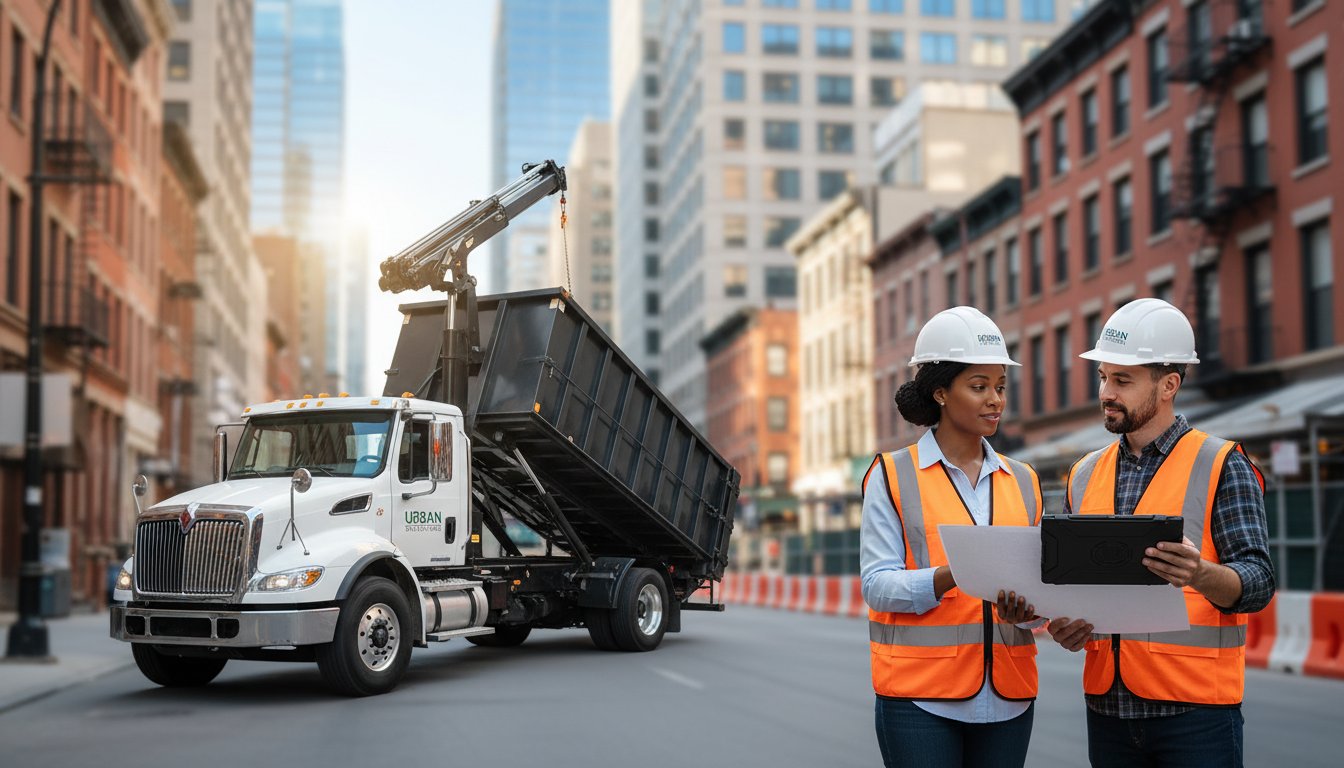
A single oversight in your waste management plan can stall a 14-day renovation and trigger heavy municipal fines. Managing debris removal across New York, Illinois, and Massachusetts requires more than just a truck; it demands a clear understanding of 2026 disposal mandates. You shouldn't have to spend your project hours decoding complex permit requirements or worrying about the hidden fees that often inflate waste management costs. We know the frustration of staring at a pile of construction waste without a clear path to get it off your property.
We agree that handling construction waste is the most frustrating part of any job site, especially when local laws change every season. This 2026 resource guide gives you the tools to master local regulations and choose the most efficient disposal methods for every material type. You'll learn how to navigate strict state laws, identify your specific waste category, and follow a streamlined process to book your roll-off container instantly. We've broken down the essential logistics for New York, Illinois, and Massachusetts so you can focus on the build while we handle the haul. Read on for a complete breakdown of regional disposal rules and professional solutions that keep your project on schedule.
Key Takeaways
- Identify the critical differences between C&D waste and household trash to choose the most effective disposal method for your project.
- Navigate complex permit requirements in New York, Illinois, and Massachusetts to avoid unexpected municipal fines and delays.
- Evaluate the cost-saving benefits of roll-off rentals versus full-service labor to maximize your project budget and efficiency.
- Master the logistics of debris removal with a step-by-step guide to professional site clearance and systematic waste management.
- Select the ideal container size—from 10 to 40 yards—to perfectly match your specific construction, yard, or storm-related waste volume.
What is Debris Removal and Why Does It Matter?
Debris removal is the systematic clearance of construction and demolition (C&D) waste from job sites and residential properties. It is a specialized service that keeps projects on schedule and sites safe for workers. To fully grasp What is debris, consider the heavy, non-biodegradable materials left behind after a structural change. This process covers three primary sectors: large-scale residential cleanouts, commercial interior renovations, and emergency disaster recovery. Professional disposal isn't just about aesthetics. It's a logistical necessity for safety and site efficiency.
Professional disposal is a safety requirement. Loose piles of wood, metal, and concrete create tripping hazards and fire risks. In 2026, environmental mandates also dictate how these materials are handled. You can't simply dump C&D waste into a local landfill. It requires a documented chain of custody to ensure hazardous materials like lead-based paint or asbestos are separated. Efficient debris removal keeps your project compliant with state laws in New York, Illinois, and Massachusetts. Failing to manage these materials properly leads to project delays and steep fines from local building departments.
The Difference Between Debris and Standard Junk
Don't confuse building debris with standard household junk. Junk usually refers to loose items like old furniture, clothing, or broken appliances. Building debris consists of "hard" materials. This includes concrete slabs, asphalt shingles, drywall, and structural lumber. These materials are significantly heavier and more abrasive than household waste. Because of this weight, they require heavy-duty roll-off containers. Standard garbage trucks don't have the hydraulic lift capacity to haul several tons of masonry or steel. Professional debris removal ensures these materials go to C&D landfills or recycling centers rather than clogging up municipal waste streams.
Debris Removal Trends in 2026
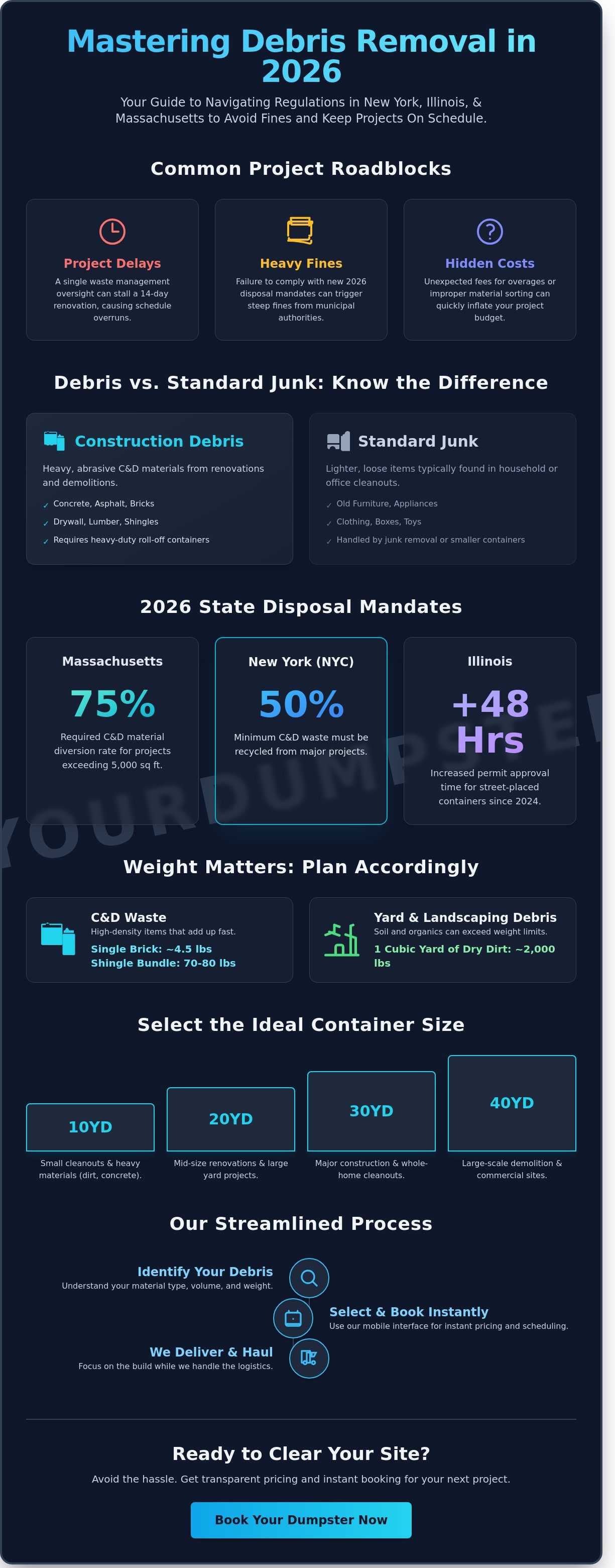
The waste management industry changed rapidly leading into 2026. In the Northeast, recycling mandates are now the priority. Massachusetts now enforces a 75% diversion rate for all C&D materials on projects exceeding 5,000 square feet. This shift makes removal a more technical task. You must sort materials at the source or use a facility that guarantees high diversion rates. Digital-first booking is the new baseline for efficiency. Contractors and homeowners no longer wait for callbacks. They book your dumpster through mobile interfaces that provide instant pricing and schedule confirmation. New 2026 regulations in Illinois have also tightened project timelines. Permit approvals for street-placed containers now take 48 hours longer than they did in 2024. This makes early scheduling essential for avoiding work stoppages.
Common Types of Debris and Project-Based Needs
Effective debris removal starts with a clear understanding of what you're hauling. Not all waste is equal. A 20-yard container filled with household junk weighs significantly less than the same container filled with concrete. You'll exceed the truck's lifting capacity long before you fill the volume if you're working with heavy materials like brick, dirt, or stone. Precision in matching your material to the container prevents overage fees and ensures a safe pickup.
Construction and Demolition (C&D) Waste
Materials like asphalt shingles, vinyl siding, and engineered flooring dominate these projects. Professional construction debris removal involves separating hazardous items from standard lumber. In 2026, New York City regulations mandate that at least 50% of C&D waste from major projects must be recycled. You'll deal with high-density items like 4.5-pound bricks and bundles of shingles that weigh 70 to 80 pounds each. Don't guess on the weight. Choose a heavy-duty roll-off designed for C&D to keep your site compliant and moving forward.
Yard and Landscaping Debris
Managing organic waste requires regional awareness. In Illinois, spring cleanups often involve heavy clay soil and sod that can quickly max out a container's weight limit. Massachusetts projects frequently deal with dense oak and maple branches that require significant volume but less weight capacity. The New York tri-state area sees a 30% increase in yard waste volume during the autumn leaf-fall and post-winter thaw. Soil is a primary concern. A single cubic yard of dry dirt weighs approximately 2,000 pounds. Wet mud weighs even more. Match your container size to the expected weight of the material to avoid logistical delays.
Disaster and Storm Debris Management
Coastal regions in Massachusetts and New York face unique challenges from Atlantic storm surges. Cleanup involves water-damaged drywall, salt-soaked carpeting, and sediment. Speed is essential because mold typically begins to grow within 24 to 48 hours of water exposure. You must coordinate with local municipal efforts for large-scale recovery to ensure you aren't blocking emergency access routes. For large-scale recovery, book your dumpster as soon as the weather clears to secure a container before local demand spikes. This proactive approach prevents hazardous materials from sitting on your property and causing further structural or environmental damage.
Dumpster Rental vs. Junk Removal: Making the Choice
Choosing the right method for debris removal depends on your project's volume and your preferred timeline. Junk removal services are a quick fix for small, gathered piles, but they often lack the capacity for serious construction or cleanout work. In most Northeast markets, including New York and Massachusetts, the cost-per-cubic-yard for a roll-off rental is roughly 40% lower than full-service hauling. You're paying for the container's volume, not a crew's hourly labor, which makes dumpsters the pragmatic choice for budget-conscious homeowners and contractors.
Junk removal services typically charge based on how much space you fill in their truck, often in increments of 1/4 or 1/2 loads. This pricing model becomes expensive fast. For a project like a full kitchen tear-out, you might need four trips from a junk removal crew. A single 20-yard roll-off handles that entire volume at a fraction of the price. You trade your own labor for significant cash savings and the ability to work at your own pace. Furthermore, junk removal teams often refuse heavy construction and demolition materials like concrete or brick because their trucks aren't rated for high-density loads. Roll-offs are engineered for these heavy materials.
- Cost Efficiency: Lower price per cubic yard for large waste volumes.
- Project Control: Keep the container on-site for the duration of your project.
- Heavy Capacity: Safely dispose of concrete, asphalt, and roofing shingles.
- Site Safety: Prevent piles of trash from accumulating in your yard or workspace.
When to Choose a Roll-Off Dumpster
Renovations and roofing projects generate waste over several days or weeks. A dumpster stays on-site, acting as a central collection point that keeps your property clear. For smaller residential tasks like a garage cleanout or a bathroom remodel, a 10 yard dumpster rental is the most efficient choice. It fits in tight driveways while holding the equivalent of four pickup truck loads. Contractors prefer this setup because it keeps the job site organized and reduces the risk of accidents caused by loose debris removal piles.
Understanding the Logistics of Roll-Offs
The process is simple and transparent. You schedule a drop-off, and we deliver the unit to your specified location. This "Fill and Forget" approach defines the roll off dumpster rental experience. It gives you total control over your schedule. Unlike junk removal, where you must be ready when the truck arrives, a dumpster waits for you. Placement is key for a smooth delivery. Ensure your driveway is clear of vehicles and low-hanging branches. Most residential driveways support the weight easily, but you can place plywood boards down to protect the surface. Just watch your weight limits. Exceeding the ton limit for your specific container size can result in overage fees. If you're unsure about your project's weight, Book Your Dumpster professionals can help you select the right capacity to avoid surprises.
Navigating Local Debris Regulations in NY, IL, and MA
Compliance with municipal waste codes is not optional. Cities like New York, Chicago, and Boston issued over 15,000 sanitation-related citations in 2024. Ignoring local laws leads to work stoppages and heavy daily fines. If you place a container on public property, you almost always need a Right-of-Way permit. This permit grants legal permission to occupy street or sidewalk space. Without it, local enforcement can remove your container at your expense. It's your responsibility to ensure the site is cleared and permitted before the truck arrives.
New York Debris Removal Guidelines
Navigating NYC DOT permits requires planning. You must obtain a permit through a licensed carting company before delivery if the dumpster sits on a public street. New York State Part 360 regulations currently mandate that 50% of all construction and demolition waste from large projects must be recycled. Urban density makes logistics difficult. Narrow streets in Manhattan or Brooklyn require precise timing for debris removal to avoid blocking traffic or violating noise ordinances. Failing to secure a permit can result in fines exceeding $1,000 per day.
Illinois and Chicago Waste Rules
Street placement in Chicago follows a distinct permitting process. If you put a dumpster in a public alley or street, you need a Public Way Permit from the Department of Business Affairs and Consumer Protection. Illinois EPA (IEPA) standards mandate that non-hazardous debris must be separated from prohibited items like electronics or lead-acid batteries. Winter adds another layer of complexity. Between December and March, Chicago's snow removal routes trigger immediate relocation orders for any containers blocking plows. Always check the 311 system for current local restrictions before scheduling.
Massachusetts Disposal Standards
Environmental rules in Massachusetts are among the strictest in the country. The MassDEP waste bans include materials like asphalt, brick, concrete, and gypsum wallboard. These items can't go into general landfills. In Boston, the Public Works Department handles street occupancy permits, which often require a 72-hour notice. If your project is in a historic district like Beacon Hill, you face additional scrutiny. These areas often have weight limits for trucks and specific hours for drop-offs. Ensure your debris removal plan accounts for these 2026 mandates to avoid project delays.
- Check for local historic district restrictions before booking.
- Verify the permit duration, as most expire after 30 days.
- Confirm the specific materials allowed by the IEPA or MassDEP.
- Ensure the container has reflective tape for night visibility.
Don't let permit paperwork stall your project. Book your dumpster today and let us handle the logistics.
Book Your Dumpster: The Direct Path to Resolution
Debris removal shouldn't be a logistical headache that stalls your progress. We've simplified the entire waste management cycle through our streamlined online booking platform. You can secure a container in under five minutes, whether you're managing a job site in Chicago, a home renovation in Boston, or a commercial cleanout in Manhattan. Our digital-first approach removes the need for lengthy phone calls and endless paperwork. You get exactly what you need without the friction.
Our inventory features 10, 20, 30, and 40-yard containers to accommodate any project scale. We understand that reliability is your primary concern, so we prioritize a swift delivery and pick-up cadence. Based on our 2025 internal performance data, we maintain a 98% on-time delivery rate across our service areas. When your project hits a deadline, you can trust that your dumpster will be there. We also eliminate the common industry practice of adding unexpected costs. Our "No Hidden Fees" promise means your quote includes delivery, pickup, and disposal up to the specified weight limit. You see the final price before you confirm the order.
How to Choose Your Size
Selecting the correct container prevents you from overpaying for unused space or requiring multiple hauls. We recommend 10-20 yard dumpsters for residential cleanouts, small deck removals, or kitchen remodels. These units occupy a footprint similar to a standard passenger vehicle, making them ideal for tight driveways in older neighborhoods. For major construction and large-scale commercial projects, our 30-40 yard containers are the standard choice. These larger units handle high-volume materials and bulky items efficiently. For a deeper look at local regulations and specific requirements, read our dumpster rental guide for NY, IL, and MA.
The Booking Process: Problem to Solution
We designed our system to move you from a state of clutter to a state of resolution with minimal cognitive load. Follow these three steps to clear your site:
- Step 1: Select your region and project type. This ensures we provide a container that meets the specific disposal laws of your state.
- Step 2: Choose your container size based on your estimated debris volume. Our interface provides clear dimensions for each option.
- Step 3: Schedule your delivery and get to work. Tell us where to place the unit, and our drivers will handle the rest.
Don't let waste accumulate and create safety hazards on your property. Take action now and secure your equipment. Book Your Dumpster today to ensure your project stays clean, compliant, and on schedule.
Take Control of Your Project Site Today
Managing a renovation or construction project in 2026 requires more than just labor. It demands a firm grasp of state-specific waste regulations across New York, Illinois, and Massachusetts. You've learned how to distinguish between the high costs of manual junk removal and the logistical efficiency of a roll-off container. Effective debris removal starts with choosing the right equipment for your specific cubic yardage to avoid overages or project delays. We've simplified these logistics so you can focus on the build. Our platform provides instant online booking for all container sizes, ensuring your project stays on schedule from start to finish. We service three states including New York, Illinois, and Massachusetts with a commitment to straightforward service. You get transparent pricing with no hidden fees and a reliable partner who understands the urgency of your timeline. Don't let waste stall your progress or clutter your workspace. Take the final step toward a clean, safe, and compliant job site right now. Your resolution is only a few clicks away.
Book your dumpster and clear your debris now
Frequently Asked Questions
What is considered debris vs. regular trash?
Debris consists of construction and demolition waste like wood, drywall, and roofing shingles. Regular trash, or Municipal Solid Waste (MSW), includes everyday household items like food scraps and packaging. While trash goes to standard landfills, debris requires specialized disposal sites. Separating these materials is essential because debris is often heavier and subject to different state recycling mandates in New York and Illinois.
Do I need a permit for debris removal in New York or Chicago?
You need a permit if you place the dumpster on a public street or sidewalk in New York City or Chicago. In NYC, the Department of Transportation (DOT) issues these permits, while Chicago requires a Public Way Use permit. If the container sits entirely on your private driveway or property, you generally don't need one. Always verify local zone requirements before you book your dumpster to avoid city fines.
Can I put heavy materials like concrete and dirt in any dumpster?
You cannot put heavy materials like concrete, asphalt, or dirt in a standard roll-off container. These dense materials require a specialized heavy-load dumpster, usually capped at 10 cubic yards. Filling a standard 30-yard bin with dirt would exceed the legal weight limit for the transport truck. This leads to safety hazards and significant overweight penalties. Choose the right size for your specific material to keep your project on track.
How much does debris removal cost in 2026?
Industry data from 2026 indicates that debris removal costs typically range from $480 to $920 depending on your specific region and material weight. In high-demand areas like Boston or Manhattan, prices often sit at the higher end of this scale due to increased landfill tipping fees and local fuel costs. These rates usually include a specific weight allowance, so monitor your load to stay within your initial budget.
What happens to the debris after it is picked up?
Your waste travels to a Construction and Demolition (C&D) recycling center or a licensed transfer station. These facilities sort the load to recover materials like scrap metal, clean wood, and concrete. In 2026, many regional regulations require facilities to divert 65% of debris from landfills. This process turns your old renovation waste into reusable aggregate or fuel, supporting more sustainable building practices across the Northeast and Midwest.
Are there items that are prohibited in a debris dumpster?
Hazardous materials, chemicals, and electronics are strictly prohibited in all debris containers. This includes items like car batteries, propane tanks, wet paint, and appliances containing refrigerants. Massachusetts state law also bans specific waste-ban items like mattresses and tires from standard bins. Placing these in your dumpster results in immediate rejection at the scale and additional handling fees. Read the full prohibited list before starting your cleanup.
How long can I keep a roll-off dumpster on my property?
Most debris removal rentals include a standard period of 7 to 10 days. If you need more time, you can extend the rental for a pre-set daily rate. It's best to schedule your pickup as soon as the project ends to avoid blocking your driveway or incurring extra costs. Fast, reliable scheduling ensures your site stays clean and your project remains on its original timeline without any logistical stress.
What is the difference between C&D waste and MSW?
C&D stands for Construction and Demolition waste, while MSW refers to Municipal Solid Waste, or standard household garbage. C&D includes heavy materials like steel, brick, and lumber from building projects. MSW consists of organic waste and consumer packaging. Because C&D materials are often recyclable, they go to different processing plants. Choosing the correct category ensures you follow local disposal laws and helps manage your overall project costs effectively.


