
Choosing the smallest container on the lot is often the most expensive mistake you can make. While a 10-yard bin looks affordable, underestimating your debris leads to $250 per ton overweight fees in NYC or $90 per ton overages in Chicago. You need a strategy that bypasses these hidden traps. Learning how to save money on a dumpster rental 2026 requires more than just price shopping. It demands a focus on precision, regional compliance, and timing.
You likely feel that waste management costs are becoming unpredictable, especially with new 2026 regulations like the NYC Bin requirements or the updated solid waste rules in Massachusetts. We promise to give you the tactical framework needed to slash your rental costs by optimizing your container size and navigating local permit fees. This guide breaks down the specific pricing trends in NY, IL, and MA, including how to snag 20% off-season discounts and avoid common fines. Follow these steps to ensure a predictable, low-cost rental experience for your next project.
Key Takeaways
- Calculate your debris volume accurately to select the right 10 to 40-yard container and avoid paying for unused space.
- Master how to save money on a dumpster rental 2026 by placing your roll-off on private property to bypass costly "Right-of-Way" permit fees.
- Adopt the "Flat-Pack" loading strategy to break down materials and fit more into a smaller, cheaper dumpster.
- Book mid-week deliveries during the late winter off-season to secure the most competitive rates and avoid peak-season price hikes.
- Identify prohibited materials like tires and chemicals early to prevent unexpected fines and environmental surcharges at the scale.
Right-Sizing Your Project to Avoid the 'Air Space' Tax
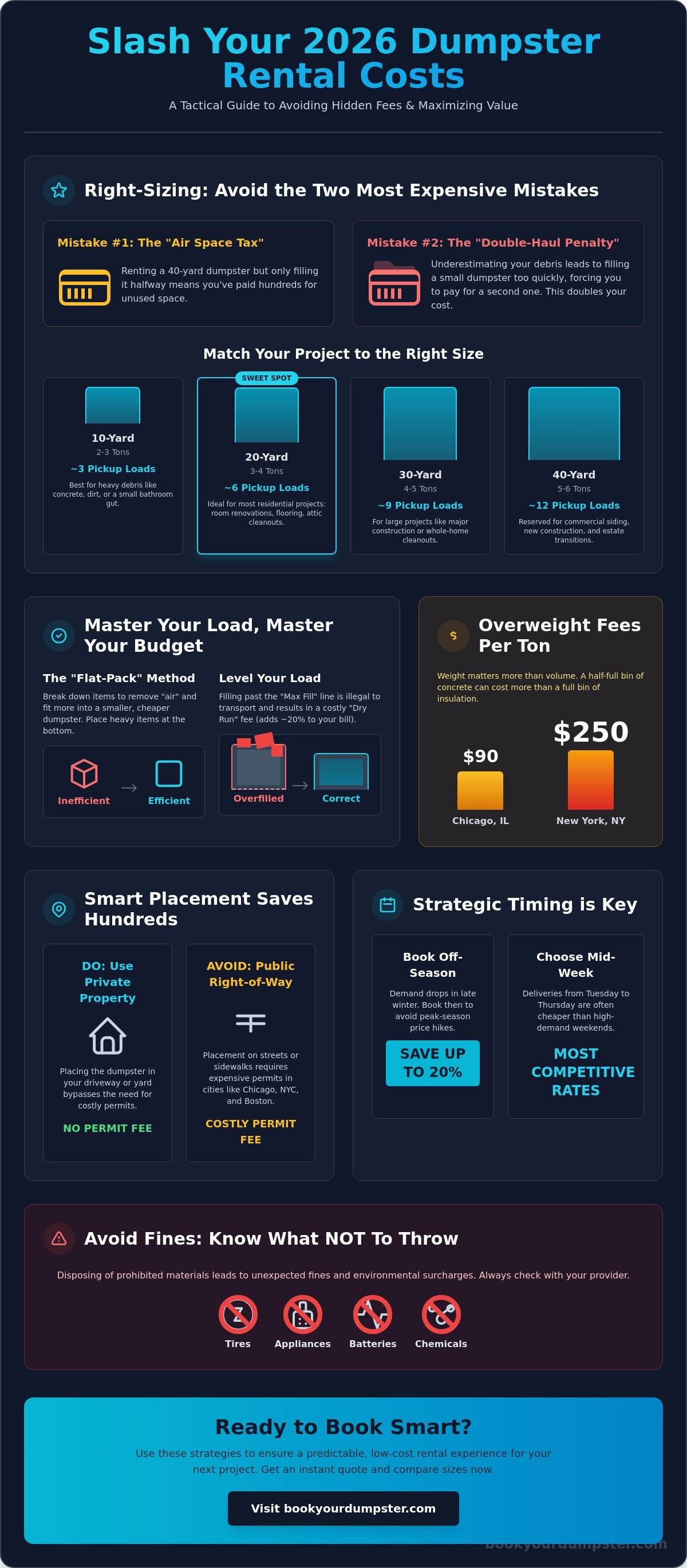
Stop paying for air. Many homeowners and contractors make the mistake of ordering the largest container available to be "safe," but this creates an immediate financial drain known as the Air Space Tax. If you rent a 40-yard dumpster and only fill half of it, you've wasted hundreds of dollars on volume you didn't need. Mastering the selection process is the most direct way to learn how to save money on a dumpster rental 2026. Precision is your best tool for keeping project costs under control.
Understanding Roll-off dumpster cost factors is essential before you book. Most providers offer a hierarchy of 10, 20, 30, and 40-yard units. Choosing the wrong one leads to the "Double-Haul" penalty. This happens when you underestimate your waste, fill a small dumpster too quickly, and have to pay for a second delivery and pickup. This mistake effectively doubles your logistical costs. Instead, calculate your debris volume by measuring your waste in cubic yards; one cubic yard is roughly the size of a standard kitchen stove.
The 20-yard dumpster is the "sweet spot" for most residential projects in 2026. In New York City, a 20-yard unit typically costs between $350 and $600 for a one-week rental. It provides enough capacity for approximately 6 pickup truck loads of debris without the massive footprint of commercial-grade bins. If you are unsure, visit Book Your Dumpster USA to compare dimensions and ensure your site can accommodate the delivery truck.
Matching Project Types to Dumpster Sizes
- 10-Yard: Use this for high-density, heavy materials. It's the standard for dirt, concrete, or small bathroom gut jobs. It typically holds 2 to 3 tons of debris.
- 20-Yard: This is the most popular residential size. Choose this for whole-room renovations, flooring removals, or attic cleanouts.
- 30 to 40-Yard: Reserve these for major construction, estate transitions, or commercial siding projects. A 40-yard bin holds about 12 pickup truck loads.
The True Cost of Overfilling
Filling your dumpster past the "Maximum Fill" line is a recipe for instant fines. Drivers cannot legally haul "top-heavy" loads because they pose a significant safety hazard on the highway. If a driver arrives and finds an overflowing container, they will initiate a "dry run." This failed pick-up attempt can add 20% to your total bill through additional service fees. Overfill fees are a preventable logistical surcharge triggered by poor loading discipline or incorrect sizing. Stick to the weight limits; for example, Chicago landfill overage fees currently range between $60 and $90 per ton. Keep your load level and your costs predictable.
Navigating Regional Permit Costs in NY, IL, and MA
Permits are often the invisible line item that can unexpectedly inflate your budget. To truly know how to save money on a dumpster rental 2026, start by considering where you'll place the bin. In many cities across New York, Illinois, Massachusetts, and even nearby states like New Jersey and Michigan, placing a roll-off on a public street or right-of-way requires a permit. Cities such as Chicago, Paterson, and Ann Arbor are key examples where these fees are non-negotiable and vary significantly by municipality. You can often bypass these costs entirely by clearing space on your private property, like a driveway or side lot. If the dumpster doesn't touch the sidewalk or
Master the Art of Loading: Weight Limits and Debris Densities
Space is only half the battle. If you want to master how to save money on a dumpster rental 2026, you must understand that weight often matters more than volume. A dumpster filled with fluffy insulation is cheap. A dumpster filled halfway with wet concrete can trigger massive overage fees. In the Chicago area, landfill overage fees typically range between $60 and $90 per ton. In NYC, that price jumps to $200 or $250 per ton. To keep your costs predictable, you need a loading strategy that maximizes space while respecting tonnage caps.
Use the "Flat-Pack" method. Break down every cardboard box. Disassemble old furniture and cabinetry. By removing the "air" from your items, you fit more into the same container. This prevents the need for a larger, more expensive size. Following EPA guidelines on reducing construction waste not only helps the environment but also keeps your project lean and affordable. Place heavier items at the bottom and distribute the weight evenly to ensure the driver can safely lift the load.
Watch the forecast. In the Northeast, a single heavy rainstorm or snow event can add hundreds of pounds to your load. Debris like drywall, carpeting, and wood act as sponges. If your dumpster doesn't have a lid, cover it with a heavy-duty tarp to keep the water out. You don't want to pay landfill rates for rainwater. This simple step can save you over $100 in weight surcharges on a standard residential project.
Weight Limits for Common Household and Construction Items
Household waste averages 250 to 300 pounds per cubic yard. Compare that to mixed construction debris, which hits 350 pounds per yard. Solid concrete is the heaviest material, weighing approximately 4,050 pounds per cubic yard. If you are disposing of brick, dirt, or asphalt, stick to a 10-yard dumpster. Most haulers won't allow these materials in larger bins because the truck cannot legally or physically lift the weight. For more specialized advice on managing professional job sites, check out The Ultimate Guide to Construction Debris Removal in 2026.
Protecting Your Driveway to Avoid Repair Costs
Protect your property to save even more. A full 20-yard dumpster can weigh over 10 tons. Use 2x4s, plywood, or specialized "street pads" under the rollers to prevent asphalt cracking or lawn damage. Communicating with the driver about precise placement saves time and avoids costly property damage. Property protection is a hidden form of rental savings because it eliminates the need for driveway repairs after the project ends. Place your boards before the truck arrives to ensure a seamless delivery.
Strategic Scheduling and Seasonal Booking Hacks for 2026
Timing is the most overlooked variable in your project budget. If you want to master how to save money on a dumpster rental 2026, you must look beyond the base price and examine the calendar. Demand for roll-off containers peaks from early spring through late fall, which often drives up prices and limits availability. You can secure off-season discounts of 10% to 20% by scheduling your project between October and March. This seasonal strategy is particularly effective for interior renovations or basement cleanouts that don't require warm weather. Planning your waste removal during these slower months ensures you get the container size you need without the peak-season premium.
The day of the week also impacts your bottom line. Most customers request Friday deliveries to start weekend projects, creating a logistical bottleneck. This often leads to delays or higher "rush" fees. Choose a Tuesday or Wednesday delivery instead. These "Mid-Week" slots are more reliable and give you a full buffer of weekdays to fill the container before the weekend. This ensures your labor crew isn't sitting idle waiting for a truck to arrive. Reliability is a form of savings; every hour your contractors wait for a dumpster is money out of your pocket.
The 2026 Digital Booking Revolution
Modern waste management has moved away from phone tag and manual invoices. Using the instant online quotes at Book Your Dumpster USA eliminates middleman fees and provides immediate price transparency. Digital-first platforms allow you to lock in rates instantly, protecting you from sudden fuel price hikes or 2026 carbon-tax surcharges that some cities now apply to weekend hauls. Use mobile notifications to track your driver in real-time. This connectivity allows you to schedule an immediate pickup the moment your bin is full, preventing the dumpster from sitting on your property longer than necessary. Book Your Dumpster USA online today to secure the best available mid-week rate for your zip code.
Rental Periods vs. Project Timelines
Don't let your rental period expire before the job is done. Most standard rentals cover 7 to 10 days, but daily extensions can quickly drain your budget. Align your labor crew's schedule so they are ready to load the moment the dumpster hits the pavement. If you are managing a large-scale commercial project, negotiate "Extended Rental" rates upfront rather than paying daily late fees. Avoid "Dry Run" fees by ensuring the site is completely clear on your scheduled pickup day. If a car blocks the driveway or the container is inaccessible, you'll pay for the driver's time without actually getting the waste removed. Set a "Pickup Reminder" on your phone 24 hours before the deadline to double-check the site and confirm the load is level.
Avoiding the 'Hidden Fee' Trap with Book Your Dumpster USA
Don't let a low sticker price fool you. The final invoice often tells a different story when companies tack on unexpected environmental fees or fuel surcharges after the container is hauled away. Learning how to save money on a dumpster rental 2026 requires you to demand a flat-rate quote from a provider like Book Your Dumpster USA. This all-inclusive model covers the delivery, pickup, and a specific tonnage cap in one transparent price. Variable-rate estimates might look cheaper initially, but they leave you vulnerable to fluctuating landfill costs and administrative markups. Always ask for a breakdown of what the base fee includes before you provide your credit card information. If a quote doesn't explicitly mention the tonnage limit, you're likely walking into a trap.
Scrutinize every line item for fuel surcharges. In 2026, many national providers have introduced dynamic fuel pricing that can change between your booking date and your delivery date. By booking with a local partner, you lock in a stable rate that isn't subject to these corporate markups. You should also verify the "Tonnage Cap" for your specific container. While Section 3 covered weight densities, the fee structure itself is what drains your budget. In New York, overage fees can reach $250 per ton. A flat-rate quote from a reputable local hauler is the only way to ensure your project stays within its financial boundaries.
The Prohibited Items Checklist
Prohibited items are the fastest way to trigger a massive fine. In Massachusetts, strict waste bans include mattresses and textiles. The state is working toward a goal of reducing solid waste to no more than 450 pounds per capita by July 1, 2026, making haulers more vigilant than ever. In Illinois, electronics are banned from landfills under the Electronic Products Recycling and Reuse Act. If these items end up in your roll-off, the hauler will charge you a contamination fee or refuse the pickup. This creates a dry run fee, which is a major budget killer. For a complete look at regional costs and prohibited materials, visit our Dumpster Rental Prices in New York, Illinois, and Massachusetts: 2026 Guide.
- Electronics: Monitors, printers, and computers are banned in IL landfills.
- Hazardous Materials: Liquid paint, batteries, and motor oil trigger environmental fines.
- Heavy Bulky Items: Tires and mattresses often require a per-item surcharge in MA and NY.
- Propane Tanks: These are strictly prohibited due to explosive risks during transport.
The Book Your Dumpster USA Promise
Book Your Dumpster USA is built on no-nonsense pricing. We eliminate the middleman, which means you don't pay extra margins to a broker who has never seen a truck. Our local service ensures you get on-time delivery without the hidden surprises found in national contracts. Direct booking benefits include real-time support and the ability to adjust your schedule without administrative penalties. Choose a partner that respects your project's urgency and your budget's limits. Book your dumpster now and experience hassle-free waste management with the most reliable experts in NY, IL, and MA.
Take Control of Your 2026 Project Costs
Managing a renovation or cleanout in New York, Illinois, or Massachusetts doesn't have to break your budget. You now have the tactical framework to avoid the most common financial pitfalls. By right-sizing your container, you bypass the "Air Space Tax." By placing your bin on a driveway, you eliminate city permit fees. Most importantly, you know that weight distribution and weather protection are the keys to avoiding tonnage surcharges. These strategies ensure your waste management remains a tool for progress rather than a source of stress.
Mastering how to save money on a dumpster rental 2026 is about making informed, proactive decisions. Don't leave your project's bottom line to chance with brokers who hide fees in the fine print. Rely on local expertise to ensure your roll-off arrives on time and leaves without a surprise invoice. We provide the transparency you need to focus on the work, not the waste. Our team understands the specific regulations in your zip code and stands ready to help you execute a clean, cost-effective project.
Book Your Dumpster Now for Transparent, Local Service. Our no hidden fees guarantee and on-time delivery record make us the trusted partner for projects across NY, IL, and MA. Start your cleanup today with total cost certainty.
Frequently Asked Questions
What is the cheapest dumpster rental size for a home cleanout in 2026?
The 10-yard dumpster is the most affordable option for small residential projects. It typically holds 2 to 3 tons of debris, which is roughly equivalent to 3 pickup truck loads. This size is ideal for heavy materials like dirt or concrete. If you're researching how to save money on a dumpster rental 2026, starting with this compact size prevents you from paying for unused space.
How much do permits cost for a dumpster in Chicago vs. New York City?
In New York City, a DOT permit costs between $135 and $385 and is obtained by the carting company. Chicago requires a Public Way permit for any container placed on a city street. While the average Chicago rental is approximately $350, unauthorized street placement triggers daily city fines. You can avoid these costs in both cities by placing the dumpster on your private driveway.
Can I save money by sharing a dumpster with a neighbor?
Sharing a dumpster with a neighbor is an effective way to split the base rental and delivery fees. This strategy works well for small cleanouts that don't require a full container. You must still monitor the total weight carefully. If the combined debris exceeds the tonnage limit, you'll both be responsible for overage fees that reach $250 per ton in some regions.
What happens if I go over the weight limit on my dumpster rental?
Exceeding the weight limit triggers a per-ton overage fee. In the Chicago area, landfill overage fees are typically between $60 and $90 per ton. In New York City, expect to pay an additional $200 to $250 per ton for any materials exceeding the limit. Drivers may also refuse to pick up an overflowing container due to highway safety regulations, resulting in a dry run fee.
Is it cheaper to rent a dumpster or hire a junk removal service?
Renting a dumpster is usually the cheaper choice for projects larger than 3 cubic yards. Junk removal services charge a premium for their labor and the space used in their trucks. By renting a roll-off, you handle the loading yourself and save on those high labor costs. This makes dumpsters the superior value for whole-room renovations or major estate cleanouts.
How do I avoid hidden fees when renting a dumpster in Massachusetts?
Avoid hidden fees in Massachusetts by requesting a transparent, flat-rate quote that includes all environmental surcharges. Be mindful of the state's strict waste bans on mattresses and textiles. If these items are found in your load, you'll face significant contamination fines. Always confirm the tonnage cap and fuel surcharges before you finalize your booking to ensure a predictable final bill.
Are there discounts for long-term commercial dumpster rentals?
Long-term commercial projects often qualify for volume-based discounts or lower daily rental rates. Contractors who manage multiple job sites can negotiate better terms by scheduling high-frequency hauls. Businesses looking for how to save money on a dumpster rental 2026 should ask about monthly billing cycles. These professional agreements offer more stability than one-time residential rentals for projects lasting over 30 days.
What is the best way to load a dumpster to save space and money?
The best loading strategy is the "Flat-Pack" method. Break down every cardboard box and disassemble furniture to eliminate empty air pockets. Place your heaviest materials at the bottom to maintain a stable center of gravity. Distribute the weight evenly and ensure the debris doesn't rise above the top rail. This prevents safety fines and ensures the driver can haul the load on the first attempt.


