

Is your current waste provider acting as a partner or a bottleneck for your daily operations? For many business owners, scheduling a recurring commercial dumpster service feels like a low priority until a missed pickup leads to a city code violation or a foul-smelling loading dock. You shouldn't have to guess when your trash will disappear or worry about hidden surcharges appearing on your monthly statement. It's time to treat waste management as a precision tool rather than a messy afterthought.
We understand that managing a commercial site is demanding enough without the stress of overflowing bins. This guide provides a pragmatic, step-by-step framework to audit your specific waste volume, select the right container size, and establish a pickup schedule that actually works. We'll walk you through navigating 2026 regulations, such as organic waste diversion requirements, and setting up a seamless digital booking system. By the end of this article, you'll have a clear plan to maintain a clean site and ensure predictable monthly expenses.
Key Takeaways
- Conduct a 14-day waste audit to establish an accurate baseline and avoid paying for more capacity than your business actually needs.
- Select the right container for your site footprint, with options ranging from compact 10-yard bins for urban alleys to high-capacity 40-yard dumpsters.
- Streamline your operations by scheduling a recurring commercial dumpster service that aligns with your peak business hours and disposal volume.
- Coordinate critical logistics, such as gate codes and clear access paths, to ensure reliable pickups and prevent city code violations.
- Utilize digital booking tools to secure transparent rates and maintain total pricing integrity across your monthly waste management expenses.
Why Your Business Needs a Recurring Commercial Dumpster Service
A recurring service is defined by reliability. It involves scheduled waste collection at fixed intervals, typically weekly, bi-weekly, or monthly. While on-call roll-off rentals work for short-term cleanups, permanent commercial locations require a more consistent approach. Managing Commercial waste effectively requires moving away from reactive requests and toward a proactive logistics plan. This shift ensures your operations never grind to a halt because of a blocked loading dock or a full bin.
Compliance is a major driver for this transition. In high-density areas like New York and San Francisco, municipal waste regulations are strictly enforced. City inspectors don't offer warnings for trash spilling onto public sidewalks or attracting pests. Scheduling a recurring commercial dumpster service eliminates the "overflow crisis" that leads to heavy fines and health code violations. It creates a predictable environment where waste is handled before it becomes a liability for your brand or your neighbors. You aren't just paying for a haul; you're paying for the peace of mind that comes with an empty bin.
The Financial Benefits of Scheduled Hauls
Switching to a recurring schedule simplifies your overhead management. You gain predictable billing cycles that align with your monthly accounting, making it easier to track expenses across multiple locations. One-time hauls often come with fluctuating market rates and last-minute rental surcharges. By locking in a recurring service, you secure long-term contract stability. You also eliminate the risk of expensive emergency pickup fees. These fees are common when businesses wait until the last second to request service during peak demand periods. Consistency protects your bottom line from unexpected spikes in operational costs.
Operational Efficiency and Site Safety
Your site's appearance is your first impression. For retail and restaurant locations, a clean exterior is non-negotiable. Overflowing bins suggest a lack of control and can drive customers away. Beyond aesthetics, scheduled hauls improve workplace safety. General refuse and debris that sit too long become tripping hazards or fire risks. A recurring schedule ensures your dumpster footprint remains manageable and your paths stay clear for employees and delivery drivers. It's about maintaining a professional environment where the logistics of waste don't distract from your core business goals. Keep your site tidy and your focus on your customers.
Step 1: Conduct a Waste Audit to Determine Your Needs
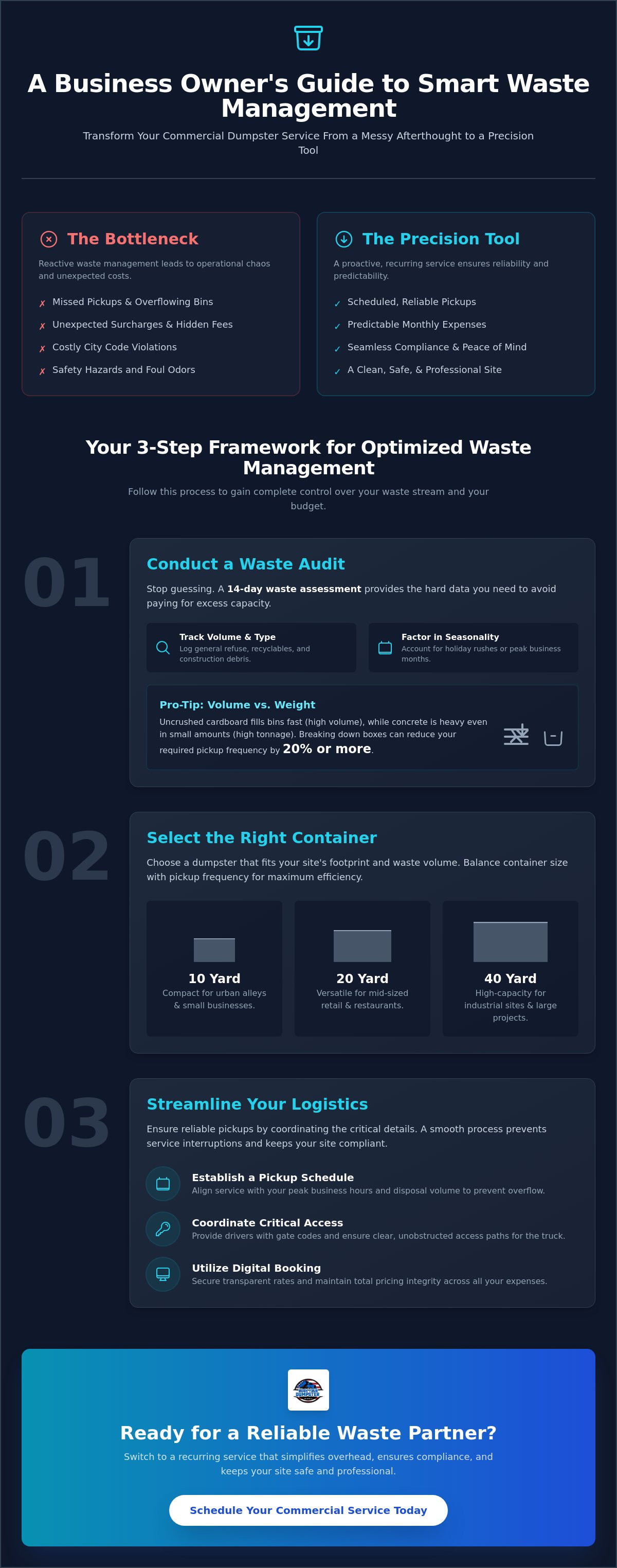
Before scheduling a recurring commercial dumpster service, you need hard data. Most businesses overpay because they estimate their needs based on a single busy afternoon or a gut feeling. Instead, you should conduct a waste assessment to understand your actual output. Track your volume for 14 consecutive days. This timeframe is long enough to capture typical fluctuations and the inevitable surge of weekend activity. Identify if you're primarily disposing of general refuse, heavy construction debris, or recyclable materials like cardboard. If your business is seasonal, like a retail shop during the holidays or a landscaping company in the spring, factor in those peak months now to avoid a mid-year logistics crisis.
Physical space is just as important as waste volume. Measure your designated enclosure or parking area carefully. A 40-yard dumpster won't fit in a narrow urban alley, no matter how much waste you produce. Ensure there's a clear path for the truck to maneuver without hitting overhead wires, low-hanging branches, or parked cars. Accessibility is a common point of failure in waste contracts. If you're unsure which container fits your specific footprint, you can view container dimensions online to verify your site's capacity before you commit to a long-term agreement.
Measuring Volume and Tonnage
Cubic yardage measures space, but tonnage measures weight. This distinction is critical for your budget. Volume-heavy waste, like uncrushed cardboard, fills bins quickly but stays under weight limits. Weight-heavy waste, such as concrete or roofing materials, can trigger overweight fees even if the bin looks half-empty. Break down all boxes and use compaction where possible. This simple step can reduce your required pickup frequency by 20% or more.
Frequency vs. Size: The Balancing Act
Urban environments like Queens often require a 10-yard or 20-yard container paired with frequent pickups to save space. Industrial sites with ample room should choose a 40-yard roll-off with monthly hauls. Always apply the 80% Rule: schedule your pickups to occur when the bin reaches 80% capacity. This provides a safety buffer for unexpected busy days, ensuring you never face an overflow fine or a health code violation.
Step 2: Select the Right Commercial Container Size
Your waste audit reveals how much you throw away; now you must decide where to put it. Selecting the wrong size leads to two outcomes: paying for empty air or dealing with constant overflows. When scheduling a recurring commercial dumpster service, you must balance your volume with your site's physical constraints. We offer 10, 20, 30, and 40-yard options to match any project scale. For those managing boutique retail or small cafes, our 10 yard dumpster rental guide provides a deep dive into small-scale solutions.
Material density is a critical factor in this decision. If your business generates heavy debris like concrete, dirt, or brick, you must use smaller containers. Large 40-yard bins filled with heavy materials often exceed legal road weight limits, making them impossible to haul safely. Match your container to your material to avoid these logistical stalls and keep your site moving. High-capacity bins are for volume, not weight.
10 And 20 Yard Dumpsters: Small to Mid-Size Businesses
These units are the workhorses of the service industry. They are best for restaurants, small retail shops, and standard office cleanouts. A 10-yard dumpster is ideal for tight urban alleys in cities like Boston or San Francisco where every inch of pavement matters. These containers typically fit within a standard parking spot or a small loading zone. They handle general waste and light renovation debris without dominating your property's footprint. Use these for high-frequency pickups in congested areas.
30 And 40 Yard Dumpsters: Industrial and Construction Sites
Large-scale operations require high-capacity solutions. Choose a 30 or 40-yard dumpster for warehouse management or massive debris removal. These bins handle significant volume, but they require substantial clearance. A roll-off truck needs a straight, wide path to drop and retrieve these units safely. If you're managing a job site, refer to our construction debris removal guide to optimize your workflow. Ensure your site can accommodate the swing radius and weight of these industrial-sized tools before booking.
Step 3: Finalize Your Pickup Schedule and Logistics
Once you've selected your bin size, the focus shifts to execution. Scheduling a recurring commercial dumpster service requires precise coordination between your site manager and the hauler. Start by selecting pickup days that minimize disruption to your peak business hours. For a restaurant, this often means early morning pickups before the lunch rush. For a construction site, mid-week hauls keep the workflow moving without the bottleneck of a Friday afternoon cleanup. Your goal is to make waste removal invisible to your customers while keeping it highly efficient for your staff.
Don't let paperwork stall your operations. If your dumpster sits on a public right-of-way in New Jersey or New York, you likely need a municipal permit. These costs vary by city, but failing to secure one can lead to immediate work stoppages. Coordinate access by providing gate codes or keys to your hauler well in advance. Drivers can't complete the service if they're locked out by a security fence or blocked by employee parking. Set up your digital account immediately to track invoices and adjust your schedule as your business volume changes. If you require additional privacy when registering for new business platforms, you can discover RentalNumbers.com for secure SMS verification services. Ready to set your schedule? Book your commercial dumpster service today to lock in your preferred pickup dates and ensure pricing integrity.
Accessibility and Placement Logistics
Approach is everything when it comes to heavy machinery. A roll-off truck needs a 50 to 60 foot straight approach to drop or swap a container safely. Before the first delivery, check for overhead obstructions like power lines or low-hanging branches that could snag the lift mechanism. In dense urban areas, prioritize sidewalk clearances to keep pedestrians safe and avoid city citations. A poorly placed bin isn't just a nuisance; it's a liability that can lead to fines or property damage.
Setting the Frequency: Weekly, Bi-Weekly, or Monthly?
Finding the "sweet spot" for frequency depends on your waste type. Food-based businesses usually require weekly pickups to prevent smells and pests, even if the bin isn't at total capacity. Industrial sites managing dry goods might prefer bi-weekly or monthly hauls to maximize container value. If you experience a sudden surge in volume, use your online portal to request an "on-call" extra pickup. Punctuality is the hallmark of a professional hauler. Ensure your provider respects your time as much as you do by maintaining a consistent, reliable rhythm.
Book Your Dumpster USA: Your Partner in Commercial Waste
Reliability in waste management isn't a luxury; it's a requirement for any high-functioning business. Book Your Dumpster USA provides a streamlined online booking system built specifically for the speed of modern commerce. You don't have time for long sales calls or waiting days for a return email. Our platform allows for immediate scheduling, giving you total control over your site logistics from any device. When you're scheduling a recurring commercial dumpster service, you need a partner that values efficiency as much as you do. We've modernized the traditional waste sector to match your digital-first workflow.
Pricing integrity is the foundation of our business model. We provide transparent rates across major markets including New York, New Jersey, Illinois, Massachusetts, and San Francisco. You won't find hidden environmental fees or surprise fuel surcharges on your monthly statement. We believe a verbal handshake should be backed by digital transparency. This no-nonsense approach is why contractors and property managers trust us to handle their most demanding commercial sites. We remove the logistical stress so you can focus on your core operations. Our system ensures you pay for the service you receive, with no opaque billing structures to decipher.
Our Service Areas: From Queens to San Francisco
Navigating regional regulations requires local expertise and a direct approach. Whether you're dealing with strict disposal standards in Queens or complex waste diversion laws in San Francisco, we understand the local landscape. We provide dedicated support for multi-location businesses that operate across state lines, ensuring consistency in service quality and billing. For a deeper look at regional requirements, read our guide on dumpster rental in NY, IL, and MA. We simplify the compliance process so you stay ahead of municipal inspections and avoid costly site delays.
The Book Your Dumpster USA Advantage
We offer pragmatic solutions for every commercial need, from compact 10-yard bins for tight urban spaces to industrial 40-yard containers for major construction projects. Our communication is action-oriented and direct. We respect your time by providing clear updates and punctual pickups that keep your loading docks clear. There is no fluff or filler in our service delivery; we act as a high-functioning tool in your operational arsenal. Visit our homepage now to get a free quote and secure your recurring schedule. Take command of your waste management today and experience the difference of a professional, reliable partnership.
Take Control of Your Commercial Waste Management
Transitioning from reactive waste management to a proactive schedule is the most effective way to protect your bottom line. By conducting a 14-day audit and selecting a container that fits your site's specific footprint, you eliminate the risk of overflow fines and logistical delays. Success depends on clear coordination regarding gate access and local permits. Scheduling a recurring commercial dumpster service isn't just about trash; it's about building a reliable operational foundation for your business.
Book Your Dumpster USA is ready to be that foundation. We provide streamlined online booking for 10 to 40 yard dumpsters with transparent pricing and no hidden fees. Whether you're managing a single retail shop in Queens or multiple construction sites across San Francisco, we offer the local expertise you need. Our service areas cover NY, NJ, IL, MA, and SF with a focus on punctuality and pricing integrity. Schedule your recurring commercial dumpster service today to streamline your site operations. You've done the audit; now let us handle the heavy lifting.
Frequently Asked Questions
How often can I change my recurring dumpster pickup schedule?
You can adjust your pickup frequency as your business volume fluctuates. Most schedule changes require a 24 to 48-hour notice to ensure logistical coordination. Use your digital account portal to submit these requests immediately without waiting for a representative to call you back.
What happens if my commercial dumpster overflows before the scheduled pickup?
Request an "on-call" extra pickup through your online dashboard the moment you notice the bin is nearing capacity. Don't wait for your next scheduled haul. Overfilled containers often lead to city code violations, pest issues, and safety hazards for your employees and customers.
Are there specific permits required for recurring dumpsters on my property?
Permits are typically not required if the container remains entirely on private property. However, if the dumpster must sit on a public street or a city right-of-way, you must secure a municipal permit. Check your local regulations in cities like New York or San Francisco to ensure compliance before delivery.
Can I schedule different sizes for different locations under one account?
Yes, you can manage multiple containers across various sites from a single billing profile. This flexibility allows you to match a 10-yard bin to a small retail storefront and a 40-yard bin to a large warehouse site. Managing all locations under one dashboard simplifies your overhead tracking.
What items are prohibited in a recurring commercial waste container?
Prohibited items include hazardous materials, liquid waste, tires, batteries, and electronics. These materials require specialized disposal under the EPA's Universal Waste Rule. Placing restricted items in your bin can result in landfill rejection fees or environmental fines. Always verify your waste stream during your initial audit.
How do I determine if I need a front-load or a roll-off dumpster for my business?
Base your decision on your waste volume and site footprint. Front-load bins are ideal for consistent, low-density general waste in permanent enclosures. If you manage high-volume construction debris or industrial materials, choose a roll-off dumpster. We provide 10, 20, 30, and 40-yard roll-off options to handle heavy-duty disposal needs.
What is the minimum contract length for a recurring waste service?
Contract lengths vary based on your location and service requirements. While some agreements offer month-to-month flexibility, longer terms often provide better pricing stability. Discuss your specific project duration with your provider to ensure the terms align with your business goals and budget.
How does Book Your Dumpster USA handle billing for recurring services?
We use a transparent, digital-first billing system that prioritizes pricing integrity. When scheduling a recurring commercial dumpster service, you receive clear invoices on a fixed monthly cycle. There are no hidden surcharges or opaque fees. You can track every haul and payment through your secure online account.


