
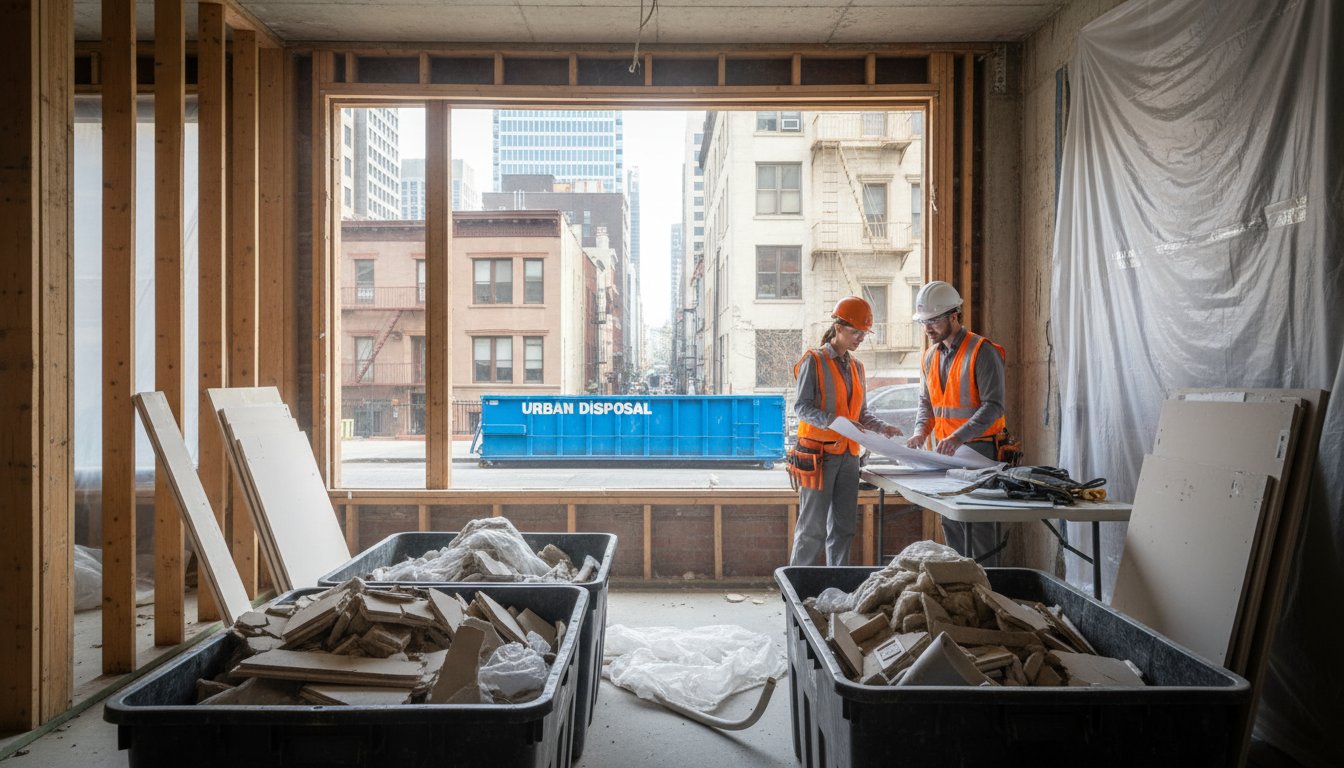
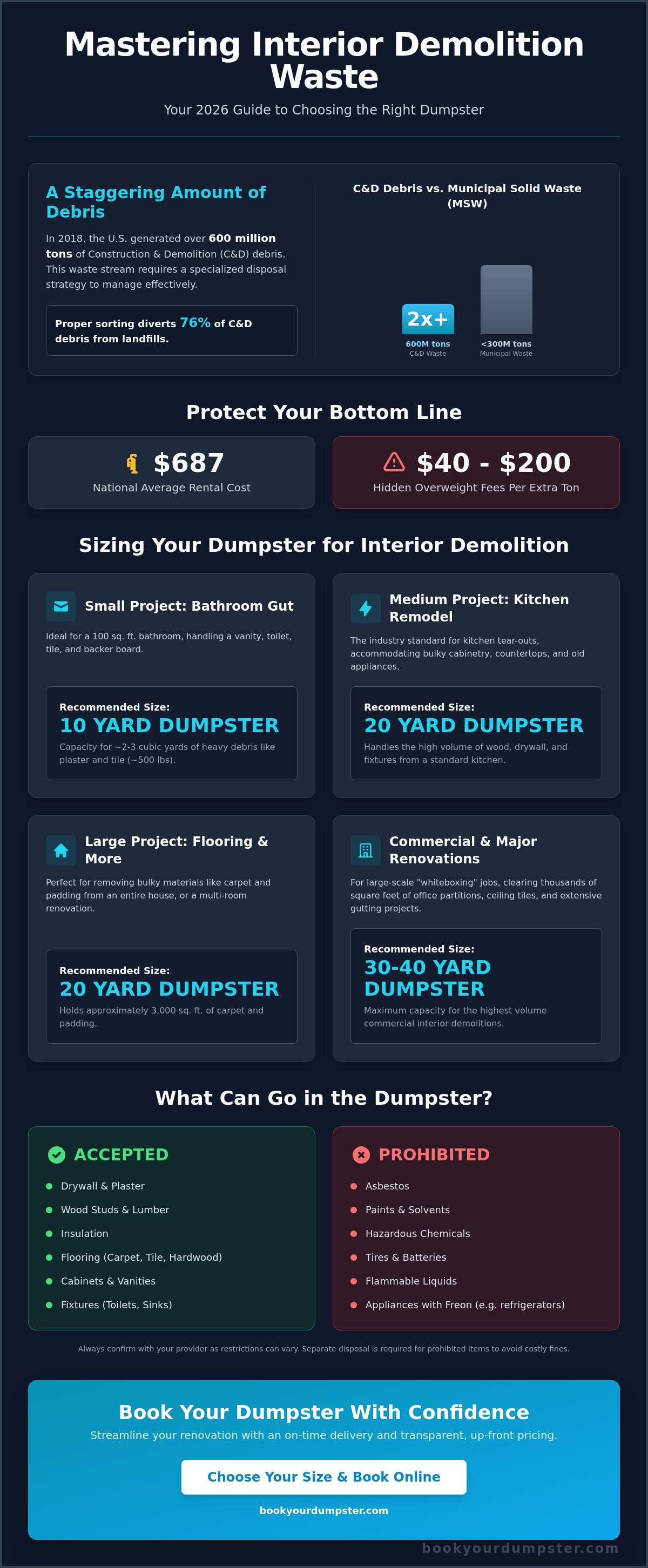
In 2018, the United States generated over 600 million tons of construction and demolition debris. This volume is more than double the country's total municipal solid waste output. When you're gutting a 500-square-foot space, that weight adds up faster than most contractors expect. Selecting the wrong interior demolition dumpster leads to hidden overweight fees that range from $40 to $200 per extra ton. You need a container that fits your tight urban driveway without the stress of prohibited material confusion or late deliveries.
We agree that waste management should be the most reliable part of your project. This 2026 guide teaches you how to select the correct container size and manage debris efficiently to protect your bottom line. We will cover current national rental averages, which sit at $687, and provide a clear checklist for prohibited items like asbestos. Choose your size and schedule your delivery using our professional strategy for a seamless project from start to finish.
Key Takeaways
- Understand why interior gutting requires a specialized waste strategy compared to exterior work to maintain a safe and organized job site.
- Calculate your debris volume based on square footage to select the right interior demolition dumpster size and avoid paying for unused space.
- Identify which fixtures and construction materials are accepted and which hazardous items require separate disposal to prevent costly landfill fines.
- Master logistical planning for tight urban spaces and learn how to protect your driveway from pavement damage using street pads.
- Streamline your renovation with an online booking process that guarantees on-time delivery and transparent, up-front pricing.
Why Interior Demolition Requires a Specialized Dumpster Strategy
Interior gutting is a surgical process. It requires a disposal strategy that accounts for high-volume, low-weight materials. Unlike exterior demolition, which often involves heavy concrete or masonry, interior work generates massive amounts of Demolition waste like drywall, wood studs, and insulation. These materials fill up space fast but rarely hit the heavy weight limits of larger containers. For most residential gutting projects, a 10 Yard Dumpster or a 20 Yard Dumpster is the ideal "sweet spot." It fits in tight driveways and provides enough cubic yardage for a standard kitchen or bathroom tear-out. In the United States, we generate over 600 million tons of C&D debris annually. Managing your portion of that waste requires a clear plan.
Maintaining a safe job site starts with a centralized waste point. When you pile debris in a corner, you create trip hazards and fire risks. Use an interior demolition dumpster to keep the work area clear. This approach is more efficient than hiring a junk removal crew. With a rental, you have 24/7 access to your disposal point. You don't have to wait for a third-party team to arrive and navigate through your home. You fill the container on your schedule. It’s a pragmatic solution for contractors and homeowners who value their time and need results without the fluff.
The Logistics of Interior Gutting
Efficient gutting requires managing the flow of debris from the room to the container. Use the dumpster to control dust and prevent secondary messes. When you practice surgical demolition, you remove only what is necessary. This precision keeps your disposal costs low and your site organized. According to 2018 EPA data, 76% of C&D debris is diverted from landfills through proper sorting. A dedicated dumpster on-site makes this sorting possible. It keeps your project timeline on track by removing the bottleneck of waste accumulation. Choose your size based on your square footage to ensure you don't overpay for space you don't need.
Dumpsters vs. Bag-Based Disposal
Don't trust heavy lath or plaster to thin, bag-based disposal systems. These materials are dense and often contain sharp nails that puncture plastic easily. A steel roll-off container offers the structural integrity required for heavy interior debris. For any project larger than a small closet, roll-offs are significantly more cost-effective. You avoid the high per-bag cost and the hassle of managing multiple pickups. Visit Book Your Dumpster USA to choose your size and schedule your delivery. We offer transparent pricing so you can budget your renovation with confidence and avoid hidden fees.
Sizing Your Interior Demolition Dumpster for 2026
Choosing the right container size is the difference between a profitable job and a logistical nightmare. If you underestimate your debris volume, you'll pay for a second rental, doubling your delivery fees and stalling your crew. Most interior gutting projects fall into the 10 to 20-yard range. These sizes handle the high-volume, low-weight nature of drywall and wood studs without occupying too much space on a residential property. For larger commercial "whiteboxing" jobs, where you're clearing out thousands of square feet of office partitions and ceiling tiles, you'll need to scale up to a 30 Yard Dumpster or 40 Yard Dumpster. Proper disposal of these materials follows EPA guidelines on C&D materials to ensure environmental compliance and site safety.
Calculating your needs starts with the square footage of the room. A standard 100-square-foot bathroom gut usually generates about 2 to 3 cubic yards of waste. However, once you add heavy tile, plaster, and fixtures, that volume expands. An interior demolition dumpster provides the necessary buffer to keep your site clean. To get started on your project today, choose your size and book online to lock in your delivery date.
Matching Container Size to Room Type
For a bathroom gut, a 10 Yard Dumpster is almost always sufficient. It handles the vanity, toilet, and approximately 500 pounds of tile and backer board. Kitchen remodels are more demanding. Between cabinetry volume and old appliances, a 20 Yard Dumpster is the industry standard. If you're tackling whole-house flooring, remember that carpet and padding are bulky. A 20-yard bin can hold roughly 3,000 square feet of carpet, but hardwood or heavy subflooring may require a larger weight capacity. Consult our 10 Yard Dumpster Rental Guide for specific dimensions and load-bearing details.
Volume vs. Weight Limits
Interior debris is often deceptive. Drywall is light, but plaster and lath are incredibly dense. Landfills charge by the ton, and exceeding your weight limit results in fees ranging from $40 to $200 per extra ton. Avoid "overfill" penalties by layering your debris. Place heavy items like sinks and tile at the bottom. Fill the gaps with lighter materials like insulation and wood scraps. This strategy keeps the load level and prevents debris from shifting during transport. Never fill your container past the "Max Fill" line; haulers cannot legally transport overloaded dumpsters, which leads to "dry run" fees and project delays.
What Can (and Cannot) Go in an Interior Demo Dumpster?
Don't treat your rental like a catch-all pit. Interior gutting produces a specific mix of materials that requires careful sorting to avoid landfill penalties. Most projects involve a combination of "soft" debris like drywall and "hard" debris like ceramic tile. While concrete and asphalt have recovery rates over 95%, wood and drywall recovery rates often sit below 25%. Using an interior demolition dumpster correctly ensures that your recyclable materials reach the right facility while keeping your job site compliant with local waste diversion mandates.
Accepted materials generally include standard construction debris. You can safely dispose of wood studs, cabinetry, carpeting, and non-asbestos insulation. Fixtures such as porcelain sinks, toilets, and non-freon appliances are also permitted. However, heavy masonry requires a different approach. If you're tearing out a brick chimney or a concrete subfloor, notify your provider. These materials are incredibly heavy and can quickly trigger overweight fees, which typically range from $40 to $200 per extra ton depending on your local landfill rates.
Common Interior Construction Debris
Drywall and sheetrock make up the bulk of interior waste volume. Break these panels down to maximize the space in your 10 or 20 Yard Dumpster. When managing flooring, calculate your weight carefully. Ceramic tile weighs significantly more than laminate or hardwood. A 100-square-foot patch of tile can weigh up to 500 pounds. For internal framing, cut long timber and studs into smaller sections. This prevents "bird-nesting," where large gaps of empty space are trapped beneath long boards, wasting the cubic yardage you paid for.
Prohibited Items and Safety Risks
Safety is a non-negotiable priority. Federal regulations under the Resource Conservation and Recovery Act (RCRA) strictly prohibit hazardous materials in standard roll-offs. This includes lead-based paint, chemically treated wood, and asbestos. If your building was constructed before 1980, you must assess it for asbestos before demolition begins. Most jurisdictions require an asbestos renovation notification form at least 10 working days before work starts. Never toss flammable liquids, batteries, or electronics into the bin. Major cities have specific e-waste programs for these items to prevent soil contamination and landfill fires. Keep your project on track by sticking to approved construction materials and following local disposal protocols.
Logistical Planning for Urban Interior Demolition
Urban job sites require a higher level of logistical precision. In cities like Queens, San Francisco, and Boston, narrow driveways and tight street corners are the norm rather than the exception. You cannot simply drop a container and hope for the best. An interior demolition dumpster must be placed strategically to allow for easy debris loading while maintaining access for emergency vehicles and neighbors. If you are managing a renovation in Southern California, you can visit LA Dumpster Bins to secure a container that fits your specific urban layout. For high-speed commercial guts, we recommend an "Empty and Return" schedule. This ensures your crew never stops working because the bin is full. You schedule a swap, we haul the full container, and we drop a fresh one immediately. This high-velocity approach keeps your project on track and your site clear of piling debris.
Navigating Tight Spaces and City Rules
Local regulations vary significantly by municipality. If your project requires placing the container on a public sidewalk or street, you must secure a permit. These permit fees typically range from $10 to $150 depending on your city's requirements. For detailed local advice, read our guide on dumpster rental in New York, Illinois, and Massachusetts. In tight urban neighborhoods, consider a 10-yard bin. These have a lower profile, making them easier to load manually in confined spaces. Always check for overhead obstructions like power lines or low-hanging branches before the truck arrives. If a driver cannot safely drop the unit, you may face "dry run" fees that inflate your project costs.
Site Preparation and Protection
Protecting the property is as important as removing the waste. Use 3/4-inch plywood or specialized "street pads" to create a buffer between the heavy steel roll-off and the pavement. This prevents cracking in asphalt or decorative concrete. When moving debris from the interior to the interior demolition dumpster, protect your hardwood floors and carpets with ram board or heavy-duty plastic. Clearly mark the delivery spot with orange cones or chalk. This helps our drivers place the unit exactly where you need it, ensuring the hydraulic lift has at least 22 feet of vertical clearance to operate safely. Proper prep prevents property damage and ensures a seamless delivery experience.
Don't let logistical hurdles slow down your demolition timeline. We handle the delivery details so you can focus on the gut gutted space. Book your interior demolition dumpster online today and choose the delivery date that fits your schedule.
Book Your Interior Demolition Dumpster with Confidence
Eliminate the anxiety of the unknown. Many traditional waste companies hide fuel surcharges or administrative fees until the final invoice arrives. We reject that model. You receive transparent, up-front pricing before you even enter your payment details. Whether you're gutting a single-family kitchen in Massachusetts or whiteboxing a large retail space in San Francisco, your project depends on a predictable budget. Renting an interior demolition dumpster shouldn't be a financial gamble. Our digital-first system provides an instant quote, allowing you to move from the planning phase to the demolition phase with total confidence.
We've modernized a traditional industry to match the speed of your project. You don't have time to wait for a callback or navigate a complex phone menu. Our online platform allows you to secure your rental in under two minutes. We focus on the logistics so you can focus on the manual labor. With a heavy emphasis on reliability, we ensure that your container arrives when promised, keeping your crew on schedule and your site clear of debris across NY, NJ, IL, and the San Francisco area.
The Book Your Dumpster USA Advantage
We built our service for professionals and homeowners who value efficiency over fluff. Our logistics network is optimized to reduce overhead, which is how our dumpster rental prices remain competitive in high-demand urban markets. We understand that a late delivery can cost a contractor thousands in lost labor hours. That's why we prioritize on-time arrival and clear communication. You get direct access to a team that understands the specific requirements of an interior demolition dumpster, providing the right tool for the job every time.
Schedule Your Delivery Today
Finalize your project plans today. Before you book, walk your site one last time. Verify that the delivery area is free of parked cars and that there's sufficient overhead clearance for the truck. Confirm that your debris doesn't include any of the prohibited hazardous materials mentioned in earlier sections. Our streamlined booking process is straightforward. You select your container size, choose your date, and receive an instant confirmation. No phone tag and no waiting. On delivery day, we place the unit exactly where you need it. Book Your Dumpster USA now to secure your schedule and clear your site with a partner you can trust.
Secure Your Project Timeline Today
Successful interior gutting depends on precision. You now have the strategy to match your debris volume to the correct container size and navigate the logistical hurdles of tight urban spaces like Queens or San Francisco. By identifying prohibited materials early, you avoid the heavy overweight fees that often surprise unprepared contractors. We've simplified the disposal process so you can focus on the physical work. It's about removing the logistical stress and keeping your site safe for your crew and the property owner. Proper planning prevents the bottlenecks that derail renovation schedules.
Since 2018, we've provided easy online booking that respects your project timeline. Our on-time delivery guarantee ensures your crew never stands around waiting for a bin. You get transparent pricing with no hidden fees; it's a straightforward verbal handshake that keeps your renovation budget under control. Choose a partner that understands the utility of a well-placed roll-off. Choose your size and book your interior demolition dumpster today. Let's get that space cleared and ready for the next phase of your build. You have the plan; now take the action to finish the job.
Frequently Asked Questions
How much weight can an interior demolition dumpster hold?
Weight limits depend on the container size you book for your project. A 10 Yard Dumpster typically handles 2,000 to 4,000 pounds, while a 20 Yard Dumpster can hold up to 6,000 pounds. Exceeding these limits triggers landfill overweight fees, which average $40 to $200 per extra ton. Always check your specific rental agreement for the tonnage limit to avoid unexpected surcharges on your final invoice.
Can I put old carpeting and padding in the dumpster?
Yes, carpeting and padding are accepted in your interior demolition dumpster. These materials are bulky but relatively light compared to masonry. For a 1,000-square-foot room, expect the carpet and padding to occupy about 4 to 5 cubic yards of space. Cut the carpet into manageable strips and roll them tightly to maximize the available volume in your container and keep the site organized.
Do I need a permit for a dumpster if it stays on my driveway in Queens?
You do not need a permit if the container stays entirely on your private driveway in Queens. Permits are only required by the NYC Department of Transportation if the dumpster occupies public space like a street or sidewalk. These public permits range from $10 to $150. Ensure your driveway has at least 10 feet of width and 22 feet of vertical clearance for the delivery truck to operate.
What happens if I overfill my interior demo dumpster?
Overfilling your bin prevents our drivers from safely transporting the load on public roads. If debris is piled above the "Max Fill" line, we cannot legally haul it. You will be required to remove the excess material and may face a "dry run" fee for the attempted pickup. Keep all materials level with the top of the container to ensure a seamless removal and avoid project delays.
Can I dispose of kitchen appliances like stoves and dishwashers in the bin?
You can dispose of non-freon appliances like stoves, dishwashers, and microwaves in your roll-off. Items containing refrigerants, such as refrigerators or air conditioners, are strictly prohibited due to federal environmental regulations. These require specialized disposal to prevent chemical leaks. Place heavy appliances at the bottom of the container to maintain a stable center of gravity during transport and maximize the remaining cubic yardage.
How long can I keep the dumpster on my property for an interior gut?
Our standard rental period typically covers 7 to 10 days. Most interior gutting projects for a single room are completed within this window. If your project timeline extends beyond the initial agreement, you can add extra days for a daily rate between $40 and $100. Schedule your pickup online as soon as your demolition is finished to clear your site quickly and move to the next phase.
Is drywall considered hazardous waste in Massachusetts or Illinois?
Drywall is not classified as hazardous waste in Massachusetts or Illinois, but it is subject to strict disposal regulations. Many states require drywall to be diverted from landfills to recycling facilities to reduce gas emissions. Ensure your drywall is free of lead paint or asbestos. If the material was installed before 1980, you must perform a hazardous material assessment before your interior demolition dumpster arrives on site.
What is the best dumpster size for a 1,000 sq. ft. flooring removal?
A 20 Yard Dumpster is the most efficient choice for a 1,000-square-foot flooring removal. This size provides 20 cubic yards of volume, which easily accommodates carpet, padding, or laminate. If you are removing heavy ceramic tile, the weight will add up quickly. A 20-yard bin offers the necessary capacity to handle approximately 5,000 pounds of dense flooring material without exceeding legal transport limits or triggering overweight fees.


