

The $30 bag you grabbed from the home improvement store aisle might be the most expensive waste solution you ever buy. Many homeowners assume that small projects require small containers, but the math often tells a different story. When you factor in collection fees that can range from $130 to over $350, the question, is a Bagster cheaper than a small dumpster, becomes a matter of volume and weight. If you have more than three cubic yards of debris, you are likely overpaying for the illusion of convenience.
We understand the frustration of trying to budget for a renovation only to find hidden fees at the finish line. You need a straightforward comparison to ensure you aren't paying professional prices for a retail bag. This guide delivers a clear breakdown of the 2026 price landscape for residential and contractor cleanups. We compare the cost-per-cubic-yard for both options, examine how heavy debris like tile or concrete affects your choice, and provide a roadmap to help you select the most efficient disposal method for your specific project needs. Stop guessing about your waste management costs and start your project with a solid financial plan.
Key Takeaways
- Compare the 3-cubic-yard capacity of a canvas bag to the 10-cubic-yard capacity of a steel roll-off to see which fits your project scope.
- Calculate the total cost of collection and materials to determine if a Bagster is cheaper than a small dumpster for your specific volume of debris.
- Avoid overage charges and safety issues by understanding the strict 3,300-pound weight limit of bags compared to the heavy-duty capacity of steel containers.
- Match your container to your task, using bags for minor refreshes and 10-yard dumpsters for full room remodels or basement cleanouts.
- Leverage the lower cost-per-cubic-yard of a 10-yard dumpster to maximize your budget on any project requiring more than one bag.
Bagster vs. Small Dumpster: Understanding the Core Differences
You're staring at a pile of debris and a yellow bag in a retail aisle. It looks simple. However, the logistics of waste removal are rarely as cheap as the initial purchase price suggests. A Bagster is technically a Flexible Intermediate Bulk Container (FIBC) designed for single use. It holds 3 cubic yards. In contrast, a 10-yard dumpster is a heavy-duty steel roll-off container designed to handle more than triple that volume. Deciding whether is a Bagster cheaper than a small dumpster requires looking past the $30 price tag at the store. You must calculate the total cost of collection and the physical limitations of each container.
What is a Bagster?
You buy these bags at home improvement stores. They're collapsible and easy to store in a garage until you're ready. This makes them popular for small DIY projects like a half-bath renovation or a single-closet cleanout. The bag costs about $30 upfront. But the bag is useless without the pickup service. You must schedule a crane truck to lift the bag from your property. This requires specific conditions. Your bag must be placed within a certain distance of the street, and there can't be low-hanging branches or power lines overhead. If your driveway is long or your trees are overgrown, collection might be impossible.
What is a 10-Yard Dumpster?
This is the entry-level choice for professional waste management. It's a steel bin delivered by a roll-off truck. It holds 10 cubic yards of waste. That's roughly equivalent to four standard pickup truck loads. If you're tackling a full room remodel or a major basement purge, this size is usually the baseline. It handles bulkier items that would puncture or overfill a canvas bag. For a deep dive into dimensions and capacity, check out our 10-yard dumpster rental guide.
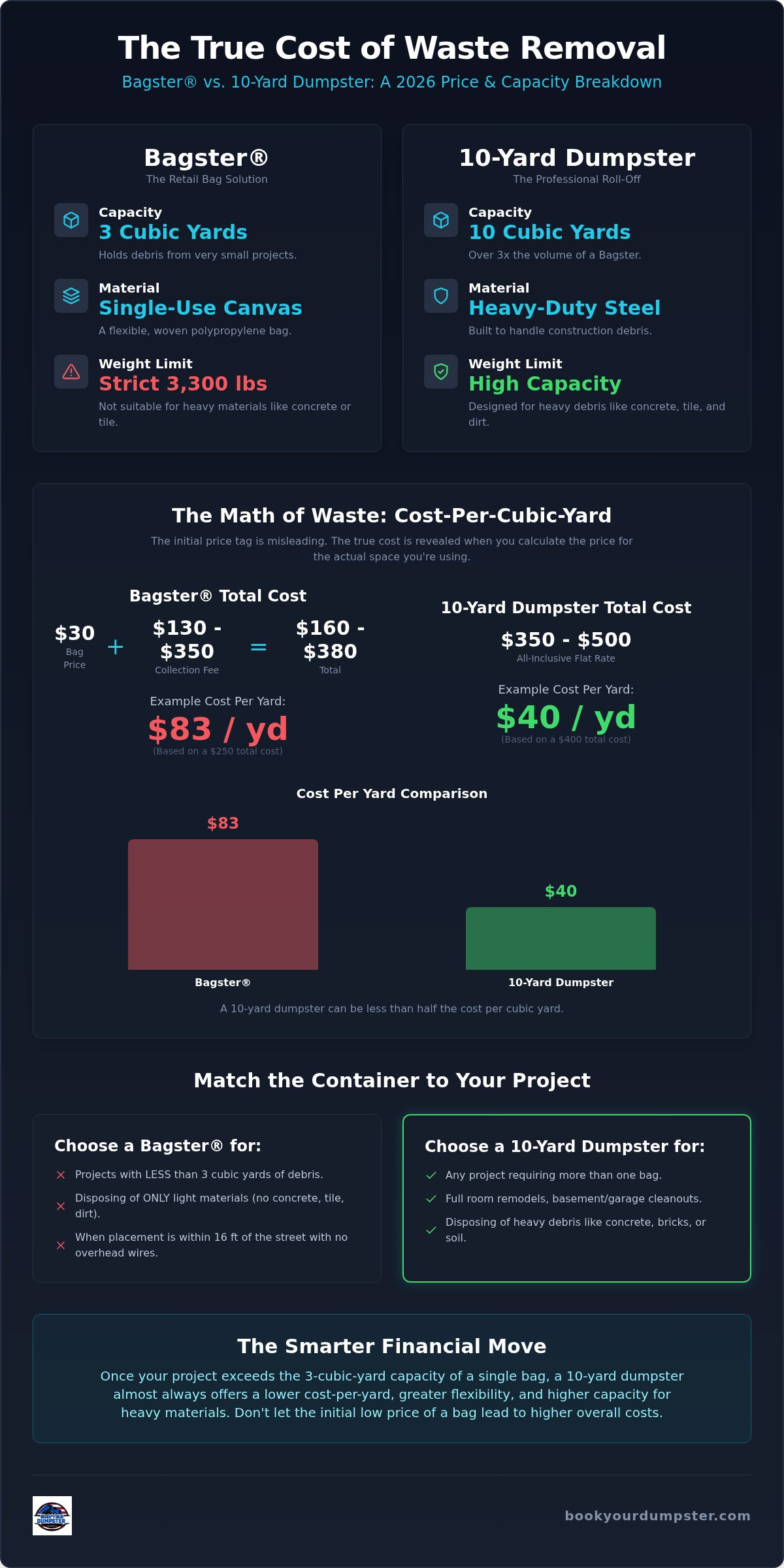
The biggest difference lies in how you pay. Bagsters use a two-part system: the retail price and the pickup fee. In 2026, pickup fees typically range from $130 to $350 depending on your zip code. Small dumpsters usually operate on a flat-rate model. This price typically covers delivery, a set rental period, and haul-away. While the upfront cost of a dumpster is higher, the all-in price per cubic yard is often lower. If your project grows beyond three yards, the math shifts quickly. You'll soon find that the answer to is a Bagster cheaper than a small dumpster is almost always "no" once you need a second bag.
The Math of Waste: Comparing Volume and Total Cost
Determining if is a Bagster cheaper than a small dumpster requires a calculator and an honest look at your debris pile. Many homeowners see the low retail price of a bag and stop there. They forget that waste management is a volume-based business. A 10-yard dumpster holds exactly 10 cubic yards of construction and demolition debris. A Bagster holds only 3 cubic yards. This means one small dumpster replaces 3.3 Bagsters. If your project fills more than one bag, you've likely already crossed the tipping point where a roll-off is the better financial move.
Calculating the Total Bagster Price
The true cost of a bag is a two-part equation. You pay roughly $30 for the physical bag at the store. The real expense is the pickup fee. These fees vary wildly by zip code. In 2026, pickup fees in high-demand areas like New Jersey or Massachusetts often range from $150 to $300. If you live in a high-cost region, the all-in price for a single 3-yard bag can easily hit $330. Buying a second bag doubles that cost immediately. Two Bagsters can cost you over $600 while providing only 60% of the capacity of a single 10-yard dumpster. This is the hidden trap of "convenient" retail waste solutions.
10-Yard Dumpster Rental Pricing
A professional 10-yard dumpster rental typically costs between $350 and $500. This rate usually includes delivery, a set rental period, and a specific weight allowance. For a more detailed look at regional variations, consult our dumpster rental prices guide for local estimates. While the upfront price is higher than a single bag, the cost-per-cubic-yard is significantly lower. A $400 dumpster costs you $40 per yard. A $250 Bagster pickup costs you $83 per yard. You pay more than double for the same amount of space when you choose the bag.
Weight limits also play a role in the final bill. Dumpster rentals often include a weight allowance of 1 to 2 tons. This buffer prevents the overage charges that often surprise DIYers. If you are cleaning out a basement or stripping a kitchen, the debris adds up fast. Before you commit to a retail bag, view current dumpster rental rates to see how much you can save by choosing a professional-grade container. Most users find that the simplicity of a flat-rate dumpster removes the stress of calculating individual bag fees and hidden regional surcharges.
Weight Limits and Debris Restrictions: The Hidden Catch
Weight often dictates whether is a Bagster cheaper than a small dumpster. A canvas bag has a strict 3,300-pound limit. This sounds like a lot until you start demolition. Steel roll-off containers are engineered for density. If you exceed a bag's weight limit, the crane truck won't lift it. You'll be left with a heavy, unmovable mess on your lawn. Comparing dumpster rental prices helps you see that the weight allowance in a professional rental often covers the risk of overages that bags simply cannot handle.
Heavy Debris Challenges
Concrete, brick, and soil are the enemies of canvas bags. A few layers of old tile or a small section of sidewalk can push you past the 3,300-pound safety threshold. Most bag services prohibit filling the container entirely with heavy materials. For these jobs, a 10-yard dumpster is the safer, more reliable tool. It allows you to dispose of dense waste without worrying about the bag tearing or the crane failing. Review our guide to construction debris removal to manage heavy waste effectively and avoid project delays.
Access and Pickup Logistics
Logistics often override cost. Bagsters must be placed within 13 feet of the curb. This ensures the crane truck can reach the straps. If you have a long driveway or no street parking, this requirement is a major hurdle. You also need 18 feet of vertical clearance. Low branches or power lines will stop a pickup immediately. These physical constraints make the bag a difficult choice for many residential properties with mature landscaping or complex layouts.
Roll-off dumpsters offer more flexibility. Experienced drivers can place a 10-yard bin in tight driveways or specific spots on your job site. This saves you from hauling heavy debris across your property to reach a bag at the curb. If a bag is deemed "uncollectible" due to weight or placement, you'll face failed trip fees. These extra charges quickly eliminate any initial savings. Choose the container that fits your site's physical reality, not just your budget. Don't let a "cheap" bag turn into a logistical nightmare because of a low-hanging tree limb or a heavy pile of shingles.
Choosing the Right Container for Your Local Project
Choosing the right container is a matter of scale. You might ask is a Bagster cheaper than a small dumpster when looking at a small pile of junk, but the physical reality of your project should drive the decision. Efficiency depends on volume. Don't let a small price tag at the store lure you into a solution that can't handle your actual debris load. Matching the container to the task ensures you don't end up with an unmovable bag on your lawn or a half-empty dumpster in your driveway.
Project-Based Recommendations
For a small half-bathroom refresh or a single-room carpet removal, a 3-yard bag is often sufficient. These projects generate light, low-volume waste. However, move to a full kitchen remodel or a basement cleanout, and the 10-yard dumpster becomes the clear winner. It provides the depth needed for cabinetry, furniture, and large appliances. For projects exceeding 10 yards, such as a whole-home estate cleanout or a multi-room renovation, you should consider a 20 or 30-yard dumpster. These larger containers offer better efficiency by reducing the number of hauls required. Roofing projects are a different category entirely. Asphalt shingles are extremely heavy. A standard square of shingles weighs roughly 250 pounds. A small roof replacement will exceed the 3,300-pound weight limit of a canvas bag within minutes. Always choose a steel roll-off for roofing to ensure safe transport and predictable pricing.
Regional Logistics in NY and IL
Waste management rules change based on your zip code. In Queens, New York, street space is at a premium. If your property lacks a driveway, you must secure a street permit for any container. Suburban Illinois often has more driveway space but may have strict Homeowners Association (HOA) rules regarding how long a container can sit on your property. Some municipalities require specific reflective tape or lighting if a dumpster is parked on a public road overnight. If your driveway is too narrow for a standard delivery, you need a service that understands local street placement regulations. Determining is a Bagster cheaper than a small dumpster often comes down to these local permit costs and space constraints. A bag might avoid a permit in some cases, but the weight limits often make it a moot point for professional-grade renovations.
Professional support makes the difference between a smooth project and a permit violation. Book Your Dumpster USA provides the local expertise needed to navigate these regional hurdles in high-cost hubs. We help you determine if your site can accommodate a 10-yard bin or if you need to coordinate with local authorities for street placement. Instead of managing third-party bag pickups and retail logistics, use our direct system to secure the right container for your specific city requirements.
Rent a 10-Yard Dumpster: The Smarter Financial Move
Waste management for both residential and commercial sites requires scalable solutions. Whether managing a home renovation or a small retail fit-out, the question of is a Bagster cheaper than a small dumpster often ends with the 10-yard dumpster as the logical choice. Commercial entities often prefer roll-offs for their structural integrity and higher volume capacity compared to retail bags. Using a professional container ensures that your project remains organized and compliant with local disposal standards. For any project that generates more than a few piles of debris, the roll-off provides the most efficient path to a clean site.
Professional Service vs. DIY Bags
Professional dumpster rental eliminates the need for manual store trips and retail logistics. We deliver the container directly to your job site, allowing for immediate use. Our drivers use specialized equipment to place 10-yard bins in designated areas. This professional approach serves both local homeowners and business owners who need reliable waste containment without the fragility of canvas. Unlike retail bags that require specific crane clearance, roll-off dumpsters are positioned to accommodate the physical constraints of your driveway or commercial loading area.
Choosing a steel container also provides a more secure solution for various debris types. While bags are susceptible to punctures from sharp materials, a 10-yard dumpster handles demolition waste with ease. This durability is essential for contractors and business owners who cannot afford site delays caused by damaged waste containers. You manage the project, and we provide the container to hold the results.
Secure Your Rental Today
Streamline your residential cleanup or small commercial project with the Book Your Dumpster USA online booking system. Select your dates and size to view transparent, flat-rate pricing for your region. This model provides the financial predictability required for effective project management. Avoid the uncertainty of fluctuating retail pickup fees and weight surcharges. Book your 10-yard dumpster now to secure a professional-grade container and maintain total control over your project's waste management costs.
Streamline Your Waste Removal Today
The choice between a canvas bag and a steel roll-off comes down to project efficiency and total cost. You've seen how volume and weight limits can quickly turn a retail bag into an expensive logistical hurdle. Determining is a Bagster cheaper than a small dumpster requires looking at the full scope of your debris. If your cleanup exceeds three cubic yards, the 10-yard dumpster is the superior financial and operational choice. It offers the durability and capacity needed to keep your job site clear and your budget predictable.
Stop managing the stress of third-party bag pickups and hidden fees. Book Your Dumpster USA delivers reliable service with flat-rate pricing across major hubs like NY, NJ, IL, MA, and SF. Our system is built for speed, allowing you to secure professional waste management in under two minutes. Book your 10-yard dumpster online now for the best value and experience a no-nonsense approach to disposal. Take control of your cleanup today and ensure your project reaches the finish line without unnecessary delays.
Frequently Asked Questions
Is a Bagster cheaper than a 10-yard dumpster for a small bathroom remodel?
A Bagster is typically cheaper only if your debris fits into one bag and stays under the weight limit. For a minor half-bath refresh, the all-in cost might beat a dumpster. However, if your remodel includes a cast iron tub or heavy floor tile, the question of is a Bagster cheaper than a small dumpster shifts quickly. You'll likely need a second bag, which doubles your pickup fees and exceeds the cost of a single roll-off rental.
How many Bagsters fit into a 10-yard dumpster?
Exactly 3.3 Bagsters equal the volume of one 10-yard dumpster. This means if you have enough debris to fill more than one bag, you are already approaching the capacity of a professional roll-off. Choosing the dumpster provides a single, large container that simplifies your job site and prevents the need for multiple pickup schedules and fees.
What are the hidden costs of using a Bagster?
The primary hidden cost is the regional collection fee, which often costs five to ten times more than the bag itself. You also risk failed pickup fees if the bag is placed too far from the curb or under low-hanging trees. These surcharges can quickly inflate your budget beyond the price of a flat-rate dumpster rental where delivery and haul-away are included.
Can I put concrete or bricks in a Bagster?
You can put heavy debris in a bag, but you cannot fill it to the top. Concrete and bricks are extremely dense and will exceed the 3,300-pound weight limit long before the bag is physically full. If you fill a bag with these materials, the crane truck will refuse the pickup for safety reasons, leaving you with an unmovable mess.
How much weight can a 10-yard dumpster hold compared to a Bagster?
A 10-yard dumpster typically includes a 1 to 2-ton weight allowance, but its steel walls can physically support significantly more than a canvas bag. While a Bagster is strictly capped at 3,300 pounds, a roll-off container is designed for heavy-duty construction waste. This makes the dumpster a more reliable choice for shingles, dirt, or masonry debris that would tear or overload a bag.
Do I need a permit for a dumpster or a Bagster in New York?
New York City requires a permit for any waste container placed on a public street or sidewalk. This rule applies to both roll-off bins and canvas bags. If you can fit the container entirely on your private property or driveway, you can usually avoid the permit fee. Street placement always requires official approval and coordination with local authorities.
What happens if a Bagster is too heavy for pickup?
The collection driver will leave the bag on your property and charge a failed trip fee. You are then responsible for manually unloading the excess weight until it meets the safety requirements. You must then pay for a new pickup appointment. This turns a supposedly convenient solution into a labor-intensive and expensive mistake.
Is there a time limit for how long I can keep a dumpster vs. a Bagster?
Bagsters can stay on your property indefinitely because you own the bag. Dumpster rentals usually include a set 7 to 10-day period in the base price. While the bag offers more flexibility for slow-moving DIY projects, the dumpster provides a clear deadline that helps keep your renovation moving toward completion without long-term clutter.


