
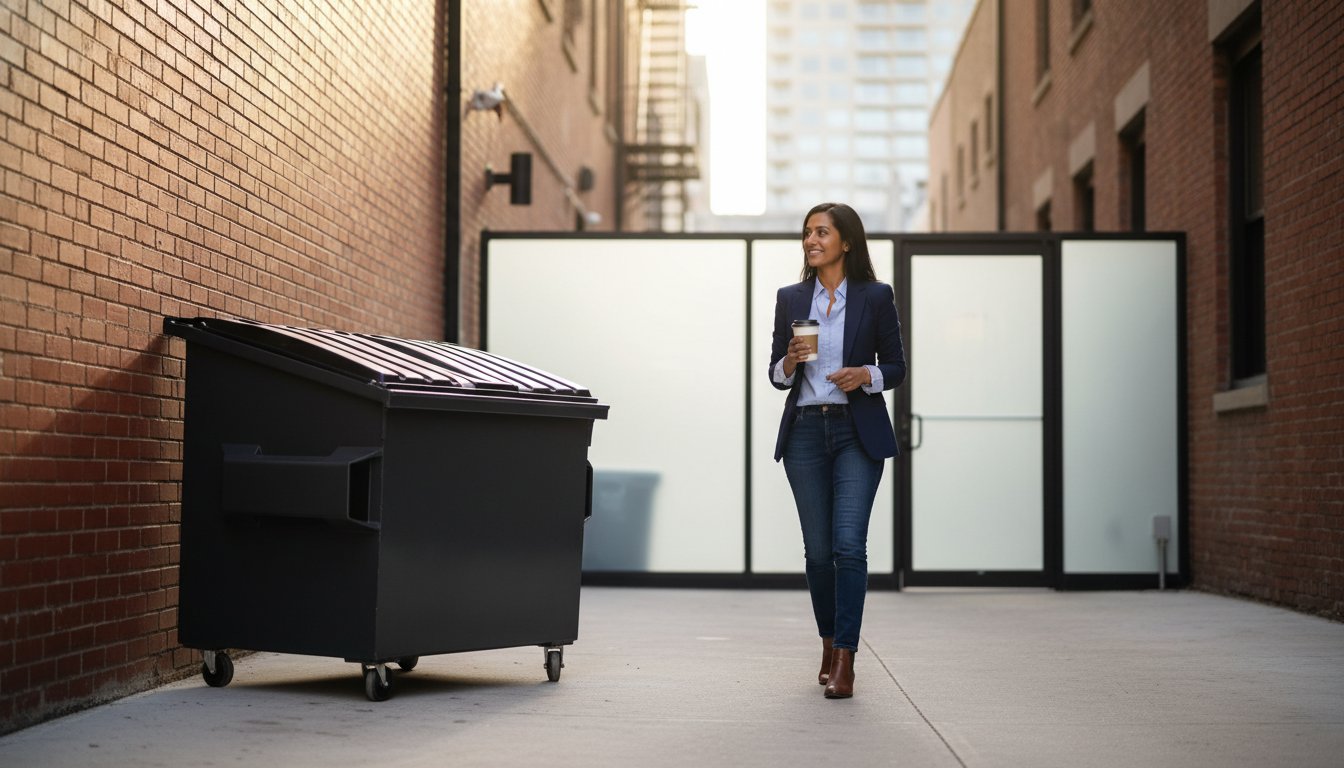
Did you know that businesses in Lower Manhattan have until May 31, 2026, to secure a new agreement under the Commercial Waste Zone program or face potential compliance issues? Keeping your storefront clean shouldn't be a source of constant stress. A reliable front load dumpster service is a fundamental tool for your business, acting as a silent partner that keeps your operations moving without the headache of missed pickups or overflowing bins.
You've likely dealt with waste contracts that feel more like traps, filled with hidden fees and confusing terminology. It's an exhausting way to handle a basic utility. This article promises to help you master the essentials of commercial waste management and select the right service for your specific needs. We'll preview the latest regulations in New York, Illinois, and Massachusetts, giving you the clarity needed to secure transparent pricing and maintain total compliance with local municipal codes.
Key Takeaways
- Understand the mechanics of permanent waste solutions and how scheduled pickups keep your facility clean without manual intervention.
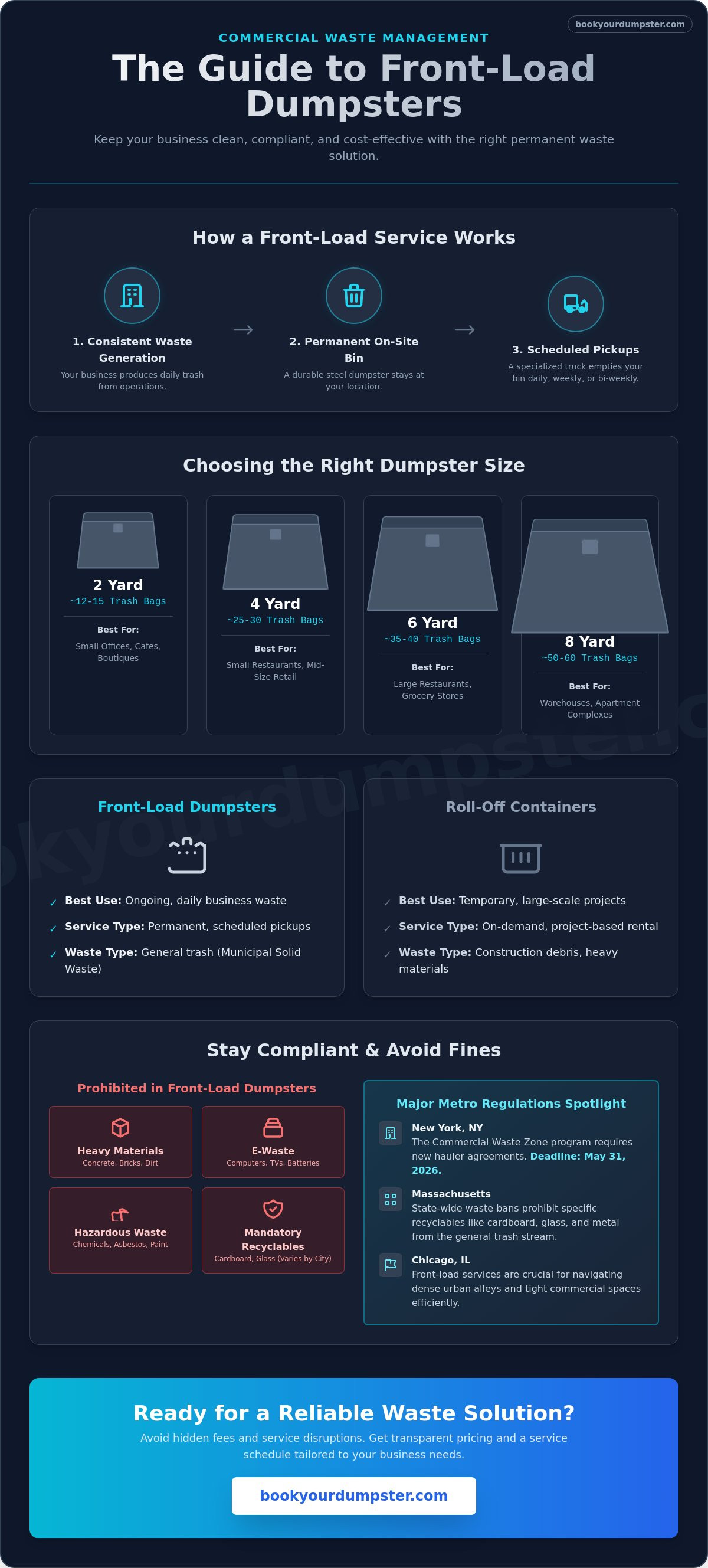
- Learn to identify the ideal container size for your business, ranging from 2 to 8 cubic yards, using our volume-matching rule of thumb.
- Stay compliant with strict municipal regulations in cities like New York and Chicago to avoid costly fines and service disruptions.
- Determine if a permanent front load dumpster service or a temporary roll-off container is the most cost-effective choice for your specific operational needs.
- Discover the essential questions to ask to ensure your waste contract includes transparent pricing without hidden administrative or fuel surcharges.
What is Front Load Dumpster Service and How Does it Work?
A front load dumpster service provides a permanent waste management infrastructure for commercial properties. Unlike the temporary containers you see on construction sites, these bins are designed for long-term placement in alleys, parking lots, or designated enclosures. They offer a high-capacity solution for businesses that generate steady volumes of trash, far exceeding the limits of standard residential curbside pickup. It's a system built for consistency.
The mechanics are highly efficient. A specialized truck equipped with two hydraulic forks on the front approaches the container. These forks slide into reinforced pockets on the sides of the bin. The driver then lifts the entire container over the truck's cab, tipping it upside down into the hopper. This system traces back to the history of the dumpster, specifically the Dempster-Dumpster innovation that revolutionized how urban waste is collected. Because the truck remains in front of the bin during the process, it requires less clearance space than other disposal methods. This makes it a perfect fit for tight urban environments in Chicago or New York.
Durability is a core feature. These containers are built from heavy-gauge steel to withstand years of outdoor exposure and heavy daily use. They are designed to stay put, providing a reliable point of disposal for your staff every single day. You don't have to worry about moving them or managing complex logistics; the service handles the heavy lifting on a fixed schedule.
The Anatomy of a Front Load Container
Design details matter for functionality. Sloped-top containers are common in areas with high precipitation, like Massachusetts, because they allow rain and snow to run off easily. Flat-top designs are often better for enclosures with height restrictions. Every bin features reinforced side pockets for secure truck engagement and heavy-duty lids. These lids are essential. They keep pests out and contain odors, ensuring your property remains professional and clean for customers and employees alike.
Recurring vs. On-Demand Waste Management
Reliability comes from a set schedule. Most businesses choose a frequency based on their volume, such as daily, weekly, or bi-weekly pickups. This recurring service stabilizes your monthly operational costs, allowing for predictable budgeting without the surprise of variable fees. If your business experiences seasonal spikes, you can often request extra pickups to prevent overflow. Managing your waste through Book Your Dumpster USA ensures your schedule is followed with precision, removing the logistical stress of trash accumulation.
Choosing the Right Front Load Dumpster Size
Selecting the correct container size is the most direct way to control your waste management budget. If your bin is too small, you'll deal with unsightly overflows and potential municipal fines. If it's too large, you're paying for air. Standard industry sizes include 2, 4, 6, and 8 cubic yards. Each serves a specific volume of weekly trash. When selecting your front load dumpster service, always consider the physical footprint. Your bin must fit securely within your designated enclosure or alleyway while leaving enough clearance for the truck's forks to engage safely. Measure your space before ordering to avoid delivery day delays.
Weight limits are a critical factor that many business owners overlook. Front-loading trucks use hydraulic lifts designed for municipal solid waste, not heavy construction materials. Never put concrete, dirt, or bricks in these containers. Overloading can damage the truck or the container's side pockets, leading to missed pickups and repair fees. Additionally, you must stay aware of regional regulations like the Massachusetts waste disposal bans. These rules prohibit certain materials, such as cardboard, glass, and electronics, from entering the general waste stream. Proper sorting ensures you stay compliant and avoid service interruptions. Consult with the experts at Book Your Dumpster USA to determine your ideal volume and frequency.
Small to Mid-Size Solutions (2 to 4 Yards)
A 2-yard bin is the perfect entry point for small offices, boutiques, or cafes with limited waste output. It's roughly the size of a large pickup truck bed. This compact footprint is ideal for tight urban alleys in places like Queens or downtown Chicago. If your business has more foot traffic, the 4-yard option is the industry's 'sweet spot.' It handles the daily refuse of a medium-sized retail shop or a small restaurant without taking up excessive parking lot space. It offers a balance of capacity and convenience for growing businesses.
Large Commercial Capacities (6 to 8 Yards)
For high-volume operations, you need a 6 or 8-yard container. These are the standard for apartment complexes, large restaurants, and warehouses. An 8-yard bin is particularly effective for businesses dealing with massive amounts of cardboard and packaging waste. When deciding between sizes, consider your pickup frequency. Sometimes, choosing one 8-yard bin is more cost-effective than two 4-yard bins, provided you have the space. However, if your enclosure is small, two smaller bins might offer better accessibility for your staff. Always prioritize a size that prevents the lid from being propped open by excess trash.
Front Load vs. Roll-Off: Which Does Your Project Need?
Stop treating waste containers as interchangeable tools. The choice between a front load dumpster service and a roll-off rental depends entirely on your project's duration and the physical constraints of your site. Many business owners ask if they can simply use a roll-off for their daily operations. While possible, it's rarely the most efficient or cost-effective route. Understanding the mechanical and financial differences between these two systems is essential for maintaining a lean operational budget.
Project duration is the primary filter for your decision. Front-loaders are permanent fixtures. They stay on-site for years, serviced on a recurring schedule that keeps your property clean. Roll-offs are temporary. They arrive for a specific job and leave when the project ends. Access requirements also differ significantly. A front-loading truck requires substantial overhead clearance, often 15 to 25 feet, to lift and tip the bin into the hopper. In contrast, a roll-off truck needs linear space, requiring roughly 60 feet of straight-line room to drop the container safely. Measure your vertical and horizontal space before you commit to a service style.
Cost structures reflect these operational differences. With a front load dumpster service, you typically pay a flat monthly fee based on the container size and pickup frequency. This provides predictable budgeting. Roll-off pricing is usually based on a per-haul rate plus tonnage fees, which can fluctuate wildly depending on the weight of your debris. If you need a stable, long-term solution, stick with the front-loader.
When to Choose Front Load Service
Select a front-loader for ongoing operations like restaurants, retail stores, and office buildings. These businesses generate predictable waste streams that don't vary much from week to week. This setup is also the best choice when you need an aesthetically clean environment. Front-loaders fit neatly into permanent enclosures, helping you comply with NYC business recycling rules by providing a dedicated space for sorting materials. It's the professional choice for a permanent storefront.
When Roll-Off is the Better Option
Choose a roll-off for construction, major cleanouts, or one-time renovation projects. These containers handle bulky items and heavy materials that would exceed the weight limits of a standard front-loading truck. If you're managing a job site, review our guide on construction debris removal to find the right capacity. Roll-offs are the heavy lifters of the industry, designed to be filled once and hauled away, making them the only logical choice for high-intensity, short-term waste generation.
Commercial Waste Compliance in Major Metro Areas
Operating a business in high-density urban environments requires more than just a bin; it requires strict adherence to local codes. In Manhattan and Queens, sidewalk clearance is a major legal hurdle. You cannot simply place a container wherever it fits. If your front load dumpster service container sits on city property, you must secure a Right-of-Way permit. In New York City, these permits typically cost between $135 and $385. Failing to display the proper documentation can result in immediate fines and service interruptions. New York is also phasing in the Commercial Waste Zone (CWZ) program. Businesses in Lower Manhattan must have an authorized hauler agreement in place by May 31, 2026. Stay ahead of these deadlines to avoid logistical bottlenecks.
State-specific mandates add another layer of complexity. Massachusetts has a strict list of 23 materials banned from landfills, including cardboard, glass, and electronics. You must separate these items from your general waste stream to remain compliant. In Illinois, the responsibility for environmental permitting recently transferred to the Department of Environment Bureau of Environmental Permitting & Inspection (DOE BEPI). Check your local requirements frequently. Regulations change, and the cost of non-compliance far outweighs the effort of proper planning. Use our front load commercial waste pickup to ensure your business stays on the right side of the law.
Urban Placement and Access Challenges
Narrow alleys in Chicago and steep grades in other metro areas demand precision. Before your bin arrives, verify that the path is clear of low-hanging wires and tight corners that could block a heavy-duty truck. If your business is in a high-traffic area, illegal dumping is a constant threat. Install lock bars on your containers. This simple hardware prevents unauthorized users from filling your bin, which protects you from overweight fees and ensures you have space for your own refuse. Practical security keeps your overhead low.
Navigating Local Waste Regulations
Noise ordinances are a common friction point in residential-adjacent zones. Many cities restrict heavy machinery operations during early morning hours to maintain community standards. Coordinate your pickup window to align with these local rules. You should also monitor 'Clean Curb' initiatives, which are increasingly moving dumpsters off the sidewalk and into designated on-street zones to improve pedestrian flow. For a deeper look at regional specifics, review our local dumpster rental guides. These resources provide the granular detail needed to manage waste in NY, IL, and MA without the stress of unexpected citations.
Secure Your Front Load Service with Book Your Dumpster USA
Managing waste shouldn't be your second job. Book Your Dumpster USA acts as your pragmatic partner in an industry often clouded by opaque contracts and unreliable schedules. We've eliminated the logistical stress of commercial waste by focusing on what matters: reliability and pricing integrity. Unlike traditional haulers who bury costs in fine print, our model is built on total transparency. You won't find hidden administrative fees or sudden fuel surcharges on your bill. We provide a straightforward front load dumpster service that respects your bottom line and your schedule. Our goal is to move you from a state of clutter to a state of resolution with minimal effort.
Punctuality is our standard, not a goal. Our advanced logistics network is designed to ensure your bins are never overflowing, which protects your property's professional image and keeps you compliant with local health codes. We've modernized the entire process with a streamlined online booking system. This digital-first approach allows you to secure your service and move on to more important business tasks in minutes. You get the efficiency of a modern tech company combined with the grit of a traditional industrial partner. This focus on pricing integrity acts as our verbal handshake with every client we serve.
The Book Your Dumpster USA Advantage
Our team brings deep local expertise to high-density markets across NY, NJ, IL, MA, and SF. We understand the specific permitting requirements and access challenges unique to these urban centers. Whether you need a permanent solution or a temporary 10-yard dumpster for a minor cleanup project, we have the inventory ready for dispatch. Our professional drivers are specifically trained for precision placement in difficult spots. They navigate the tight corners of Queens and the narrow alleys of Chicago with ease, ensuring your container is placed exactly where your staff needs it without risking damage to your property or blocking essential access points.
How to Start Your Commercial Service Today
Stop overcomplicating your waste disposal. Follow these three steps to resolve your waste management challenges and lock in a reliable front load dumpster service today:
- Step 1: Use our online tool to select your city and business type. This ensures we account for all local municipal codes and specific regional regulations.
- Step 2: Choose your bin size based on our expert volume-matching recommendations. We help you avoid the trap of paying for unused space.
- Step 3: Schedule your pickup frequency and finalize your agreement with our 'No-Nonsense' pricing model.
Don't let trash accumulation disrupt your operations or lead to expensive fines. Get a Quote for Front Load Service and experience a higher standard of reliability today.
Streamline Your Commercial Waste Management
Effective waste disposal is a cornerstone of a successful business operation. You've learned how to select the ideal bin size for your volume and the importance of navigating complex urban regulations in cities like New York and Chicago. Securing a permanent front load dumpster service ensures your property remains clean and professional while stabilizing your monthly overhead. Don't let logistical stress or hidden fees disrupt your focus on growth. Reliable waste removal shouldn't be a luxury. It's a tool that works in the background so you don't have to.
Book Your Dumpster USA provides the expertise needed for precise urban logistics and the pricing integrity you deserve. Our modern online booking system removes the friction from scheduling, giving you immediate control over your facility's needs. Take the final step toward a cleaner, more efficient storefront today. Book Your Front Load Dumpster Service Now and experience the relief of a waste solution that finally works as hard as you do.
Frequently Asked Questions
What is the difference between a front load and a rear load dumpster?
Front load trucks use hydraulic forks to lift containers over the cab for emptying. Rear load trucks utilize a hopper at the back and are typically used for manual trash collection or smaller carts. Front load systems are the industry standard for high-volume commercial waste because they're more efficient and require less manual labor.
How often can my front load dumpster be picked up?
You can schedule pickups daily, weekly, or bi-weekly depending on your specific volume. Match your frequency to your waste generation to avoid overflows and health code violations. A reliable front load dumpster service allows for flexible scheduling that scales as your business needs change throughout the year.
Are there items I cannot put in my commercial front load dumpster?
Prohibited items include hazardous chemicals, medical waste, electronics, and heavy debris like concrete or dirt. Massachusetts law specifically bans 23 materials from landfills, including cardboard and glass. Check your local municipal codes to ensure you aren't mixing banned recyclables with your general trash stream.
Do I need a permit for a front load dumpster on my business property?
Permits aren't necessary if the container stays on private property. If the bin occupies a public sidewalk or street, you must obtain a Right-of-Way permit. In New York City, these permits cost between $135 and $385. Always verify property lines before finalizing your bin placement.
How much space does a front-loading garbage truck need to service my bin?
A front-loading truck requires at least 15 feet of vertical clearance to tip the container safely. It also needs approximately 40 to 50 feet of linear space for a straight-line approach. Clear all overhead obstructions like low-hanging wires or tree limbs to ensure the driver can engage the side pockets without incident.
Can I change my pickup frequency if my business waste volume increases?
You can modify your pickup schedule to accommodate seasonal spikes or permanent business growth. Contact your provider to adjust your front load dumpster service frequency before your bin reaches capacity. This proactive approach prevents unsightly overflows and keeps your property looking professional for customers.
What happens if my dumpster is blocked by a vehicle on pickup day?
The driver won't be able to service the bin if a vehicle obstructs the approach. This results in a missed pickup and often triggers a "dry run" or trip fee. Ensure your enclosure and the surrounding 50 feet of access space remain clear during your scheduled service window.
Does front load service include recycling options?
Recycling is a standard component of many commercial waste agreements. Cities like Chicago and Boston have strict mandates requiring businesses to separate cardboard, metal, and glass from general refuse. We provide dedicated containers to help your business stay compliant with these local recycling laws and avoid potential fines.


