

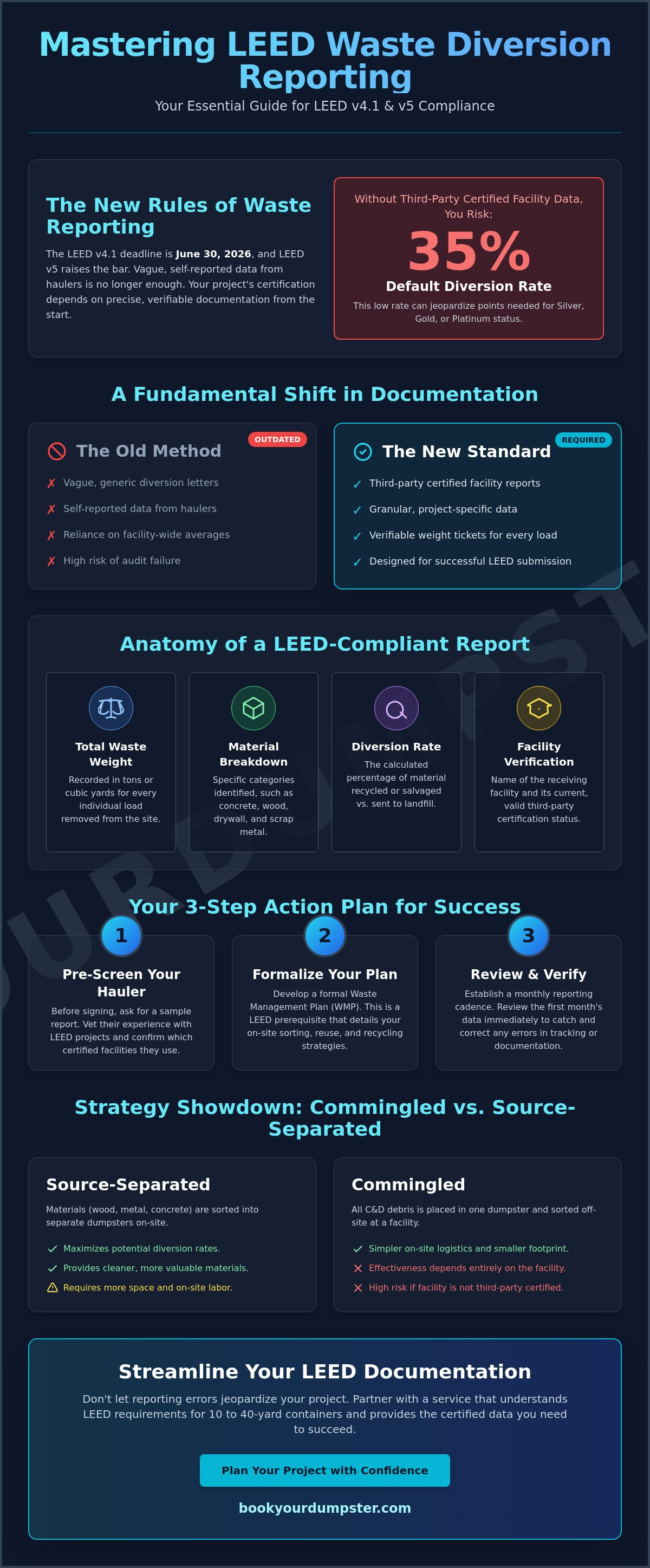
Your project's LEED points are won during the procurement phase, not at the end of the job. With the June 30, 2026, deadline for LEED v4.1 registration arriving and LEED v5 rules setting a higher bar, requesting a waste diversion report for LEED now requires third-party certified facility data or accepting a dismal 35% default rate. You can't rely on vague, self-reported letters from haulers anymore. It's a logistical shift that demands immediate attention.
It's stressful to chase down inconsistent data or realize your commingled loads don't meet the new, more rigorous documentation standards. You shouldn't have to risk your project's certification because of poor reporting. This guide simplifies the entire process. You'll learn exactly how to request, verify, and submit reports that the USGBC will actually accept. We provide a clear checklist of required data points and a reliable workflow to ensure your waste management plan stays on track from the first day on-site to the final credit approval.
Key Takeaways
- Understand why a diversion report is the backbone of your MRc5 credits and exactly what data points USGBC auditors look for.
- Master the step-by-step process of requesting a waste diversion report for LEED from your hauler, including pre-screening for LEED experience.
- Compare source-separated versus commingled waste strategies to determine which path maximizes your diversion points under 2026 standards.
- Learn how to navigate common pitfalls like missing weight tickets and non-certified facilities before they jeopardize your certification.
- Discover how professional dumpster services streamline documentation for projects requiring 10 to 40-yard containers.
What is a LEED Waste Diversion Report and Why Is It Critical?
A LEED Waste Diversion Report is the primary evidence for your project's sustainability performance. It's a comprehensive document provided by your waste hauler that tracks the exact weight and final destination of all construction and demolition (C&D) debris. This report is the backbone of the Leadership in Energy and Environmental Design (LEED) "Construction and Demolition Waste Management" credit, specifically MRc5 in v4 and v4.1. Without this documentation, you can't prove you diverted waste from landfills, and you won't earn the associated points.
Simple dumpster receipts or generic invoices won't cut it for auditors in 2026. The USGBC now demands granular data that connects specific loads to your project site. If your documentation is sloppy, you risk losing points that are often the difference between "Certified" and "Silver" status. The financial stakes are real. Failed certification can lead to contract penalties, missed tax incentives, or a damaged reputation with developers who prioritize green building standards. When you're requesting a waste diversion report for LEED, you're protecting the project's bottom line and your professional standing.
Key Data Points Every LEED Report Must Include
A compliant report needs more than just a total weight. Auditors scrutinize the specifics to ensure your diversion claims are legitimate and verifiable. Ensure your hauler provides the following details:
- Total weight of waste: Recorded in tons or cubic yards for every individual load.
- Material breakdown: Specific categories like concrete, wood, drywall, and scrap metal must be identified.
- Diversion rate: The calculated percentage of material recycled or salvaged versus what went to the landfill.
- Facility verification: The name of the receiving facility and its current third-party certification status.
LEED v4.1 and v5 Updates for Waste Reporting
The rules are changing fast. While registration for LEED v4.1 closes on June 30, 2026, many projects are already looking toward LEED v5, which was released in April 2025. The newest standards shift away from facility-wide averages toward project-specific data. Under v5, you can no longer use simple diversion letters from a facility. You must use a third-party certified facility or accept a low 35% default rate. Requesting a waste diversion report for LEED in this new environment means you must verify your hauler's downstream partners before the first container arrives on-site. Modern projects now favor digital tracking over manual spreadsheets to reduce human error and speed up the final submission process.
Failing to secure accurate reports isn't just a clerical error; it's a project management failure. You need to establish the reporting cadence during the bidding phase. This ensures your hauler understands the 2026 requirements for third-party verification and project-specific percentages. Reliable data ensures you aren't scrambling for missing tickets during the final audit.
How to Request a LEED-Compliant Waste Diversion Report
Securing your LEED credits starts before the first dumpster lands on your site. You can't fix bad data after the waste is gone. Follow these steps to ensure you are requesting a waste diversion report for LEED that meets every USGBC requirement. Start by pre-screening your hauler. Not every company has the back-office infrastructure to handle complex documentation. Ask for a sample report before signing any service agreement to verify they track the specific metrics you need.
Define your reporting frequency early. Monthly reporting is the industry standard for commercial projects. It allows you to catch reporting gaps or missing weight tickets before they become project-ending issues. Next, formalize your Waste Management Plan (WMP). This is a LEED prerequisite, not an option. Your plan should detail exactly how your team is reusing and recycling C&D materials to hit your target diversion rate. Communicate these separation requirements to your site crews immediately. A report is only as good as the sorting on-site. Finally, review the first month's data as soon as it arrives. If the facility names or weights look off, fix the process now.
Questions to Ask Your Dumpster Provider Before Delivery
Use these specific questions to vet your provider before booking. Ask: "Can you provide a project-specific diversion report rather than a facility average?" This is vital for LEED v5 compliance. "Which RCI-certified facilities do you use for commingled loads?" Using uncertified facilities might drop your default diversion rate to 35%. Also, confirm their turnaround time. Ask: "What is your turnaround time for monthly tonnage reports?" You need these for your own internal tracking and LEED Online uploads.
Integrating Reporting into Your Dumpster Rental Agreement
Don't leave reporting to a verbal handshake. Formalize it in your roll-off dumpster rental contract. Specify that monthly reports are a condition of payment. This creates immediate accountability. Your agreement must also clearly state the "no-commingling with hazardous waste" rule. Contamination can void an entire load's diversion value, ruining your percentages. If you have "Zero Waste" project goals, put them in writing. This ensures the hauler prioritizes facilities that support high-recovery rates. If you need a partner who understands these logistical demands, consider scheduling your LEED-compliant service with a provider that prioritizes data transparency.
Commingled vs. Source-Separated: Choosing Your Strategy
Your choice between source separation and commingled waste determines the complexity of requesting a waste diversion report for LEED. It isn't just a matter of site preference; it directly impacts your credit calculations under the 2026 framework. Source separation involves using dedicated dumpsters for specific materials like wood, metal, or concrete. Commingled waste allows you to toss all recyclables into a single container for sorting at a Material Recovery Facility (MRF). While commingled is easier for your crew, the 2026 LEED v5 standards heavily incentivize source separation to ensure higher purity and reuse rates.
Logistical constraints often dictate your container sizes. For source separation, 10-yard dumpsters are ideal for heavy, dense materials like masonry or scrap metal. Larger 30-yard dumpsters are better suited for bulky items like untreated wood or cardboard. Following EPA guidelines on C&D materials helps you identify which streams offer the highest recovery value. If you have the space, separating at the source is the most reliable way to secure maximum points because the weight tickets provide indisputable proof of diversion.
The Pros and Cons of Source Separation
Source separation offers the highest diversion accuracy. It often results in lower "tip fees" because clean, separated loads like scrap metal or concrete can sometimes be dropped off for a lower cost or even a rebate. However, this strategy requires significant on-site coordination and a larger footprint for multiple containers. It's often the best approach for sprawling sites in suburban Illinois or Massachusetts where space isn't at a premium. Effective construction debris removal in these scenarios relies on a hauler who can manage a complex pull schedule across various material streams.
The Commingled Reality in Urban Projects
In tight urban environments like New York or San Francisco, you likely won't have room for more than one dumpster at a time. Commingled containers are often your only practical choice. The danger here is the "Facility Average" trap. Many haulers provide a generic letter stating the facility's overall recycling rate, but LEED v5 auditors now demand project-specific data or third-party certification. If your MRF isn't certified, you might be forced to accept a default diversion rate of only 35%, even if the facility claims to recycle 70% of its intake. When requesting a waste diversion report for LEED for a commingled project, insist on seeing the facility's third-party credentials before the first load is pulled. This prevents a documentation disaster during your final submission.
Common Roadblocks in LEED Reporting and How to Solve Them
Roadblocks are inevitable on active job sites. Even the most organized contractors face data gaps that can jeopardize an entire credit. One of the most frequent issues is missing weight tickets or "lost" loads within a hauler's system. If a truck leaves the site but its data never hits the report, your diversion percentage drops. Another major hurdle is the certification status of the facility. If your hauler switches to a closer, non-certified facility without telling you, your project-specific data becomes invalid under v5 rules.
You also need to watch for unit measurement errors. USGBC requires weight in tons for final submissions. Some haulers provide volume in cubic yards, which requires a conversion factor that auditors often challenge. Finally, contamination remains the silent killer of recycling goals. When requesting a waste diversion report for LEED, you must ensure every load is verified as "clean" by the receiving facility. A single load of contaminated cardboard can wipe out weeks of progress. This is why proactive monitoring is non-negotiable.
Solving the 'Missing Ticket' Crisis
Stop chasing paper tickets at the end of the project. Implement a digital manifest system for every container that leaves your site. Assign a site supervisor to log the date, time, and hauler name for every pull. Reconcile your hauler's invoices against your internal log and the diversion reports every month. If a ticket is missing, find it while the driver still remembers the load. Take photos of full dumpsters before they are hauled. This serves as visual proof of the material type and volume if a weight ticket is ever contested or lost. Consistent reconciliation prevents a documentation nightmare during the final audit.
Dealing with Contamination and Rejected Loads
Contamination is often a training issue. One bag of general trash or food waste can turn a "recycling" dumpster into a "landfill" load instantly. This rejection is costly and lowers your diversion rate. Train every subcontractor on the importance of the diversion report during your site orientation. Clearly label every container and use lids to prevent unauthorized dumping from neighbors. For high-value, easy-to-contaminate streams like cardboard or untreated wood, use smaller 10 yard dumpsters. These are easier to monitor and less likely to become a catch-all for general site trash.
Managing these logistics shouldn't be your full-time job. If you're tired of chasing down missing data or dealing with uncertified haulers, it's time to switch to a reliable LEED-compliant waste partner who understands the stakes of 2026 reporting.
Streamlining Your LEED Documentation with Book Your Dumpster USA
Managing the logistical chaos of a construction site is hard enough without the added pressure of USGBC documentation. Book Your Dumpster USA has modernized waste management by focusing on reliability and data transparency. Whether your project is in New York, New Jersey, or Illinois, we provide the infrastructure needed to secure your credits. Our process eliminates the stress of requesting a waste diversion report for LEED by delivering pragmatic, project-specific data that aligns with 2026 standards. You get the numbers you need without the typical hauler runaround.
Efficiency in waste diversion is directly tied to your container strategy. Book Your Dumpster USA provides a full range of sizes, from 10 to 40 yards, to support every material stream. Using the right container size optimizes your diversion report accuracy. For example, a 10 Yard Dumpster is the professional choice for heavy, high-value materials like scrap metal or concrete. Using a 40 Yard Dumpster for bulky, light materials like untreated wood or cardboard prevents overflow and contamination. By matching container capacity to material density, you ensure your weight tickets are clean and your diversion percentages stay high. We also offer 20 Yard Dumpster and 30 Yard Dumpster options to bridge the gap for mixed debris projects.
We prioritize pricing integrity. You won't find hidden fees for sustainability data or administrative surcharges for tonnage reports. Our digital-first approach ensures that your monthly reports are accurate, punctual, and ready for upload to LEED Online. Book Your Dumpster USA acts as a high-functioning tool for your project management team, removing friction from the waste removal process so you can focus on building. Our goal is to provide a verbal handshake backed by digital precision.
Why Contractors Choose Book Your Dumpster USA for LEED Projects
Contractors rely on us because we speak the language of construction logistics, not just trash. We understand that a missing weight ticket is a project management failure. Our team has extensive experience with major commercial renovations and the specific dumpster rental requirements they demand. We also bring local expertise to the table, helping you navigate regional recycling regulations in markets like Massachusetts and San Francisco. We provide direct, no-nonsense communication regarding facility data and tonnage, ensuring your documentation stands up to auditor scrutiny.
Ready to Start Your LEED Project?
Booking a LEED-compliant dumpster shouldn't be complicated. Our online system allows you to specify your reporting needs at the moment of scheduling. If you're managing a complex site with multiple waste streams, contact our team at Book Your Dumpster USA for custom waste management plan support. We help you map out your container pulls to maximize diversion and minimize costs. Don't leave your sustainability credits to chance with a hauler who doesn't understand the 2026 framework for requesting a waste diversion report for LEED. Take control of your site's data today. Book your LEED-compliant dumpster today and get the professional reporting your project deserves.
Secure Your Sustainability Credits with Precision
Your project's LEED certification depends on the accuracy of your waste data. Successful reporting starts with choosing the right container strategy and vetting your hauler's downstream facilities long before the first load leaves the site. Mastering the process of requesting a waste diversion report for LEED ensures you aren't left scrambling during the final project audit. Reconcile your weight tickets monthly to catch errors while they're still fixable. This proactive approach keeps your documentation clean and your credits secure.
We provide the logistical support and transparent reporting needed to meet 2026 standards. With a full range of 10 to 40 yard roll-off containers and deep expertise in NY, NJ, IL, and MA waste regulations, we streamline your documentation process from start to finish. You focus on the build; we'll handle the data. Get a Professional Quote for Your LEED Project Dumpster today and move your project one step closer to successful certification. You've done the hard work; make sure you get the credit for it.
Frequently Asked Questions
Can I use a facility average for my LEED v4.1 waste diversion report?
You can use a facility's average recycling rate under LEED v4.1 if the facility is third-party certified by a recognized organization like the Recycling Certification Institute. If the facility lacks this certification, you may be restricted to a much lower default diversion rate. Always confirm the facility's current certification status before your first dumpster pull to avoid losing points during the final audit process.
What happens if my hauler doesn't provide a waste diversion report?
You risk losing all "Construction and Demolition Waste Management" credits if your hauler fails to deliver the required documentation. Without these reports, you have no verifiable proof that any material was diverted from the landfill. To protect your project's certification, ensure you are requesting a waste diversion report for LEED during the initial contract phase with a provider that has a proven track record.
Does LEED require weight tickets for every single dumpster load?
Yes, LEED requires specific documentation for every load of waste that leaves your project site. You must track the weight, material type, and final destination facility for every container. Digital tracking systems are now the industry standard for this task. Reconcile these tickets against your hauler's monthly reports immediately to identify and fix any missing data points before the project concludes.
Is there a difference between 'diversion' and 'recycling' in LEED reporting?
Diversion is a broad category that includes recycling, salvaging for reuse, and composting. Recycling specifically refers to processing waste into new raw materials. LEED tracks your total diversion rate because it values any method that keeps debris out of a landfill. This includes crushing concrete for on-site fill or donating usable cabinets and fixtures to local non-profit organizations for reuse in other projects.
How do I calculate the diversion rate for a commingled dumpster?
You calculate the rate by multiplying the total weight of the load by the receiving facility's certified recovery percentage. For example, if a 5-ton load goes to a facility with a 70% certified diversion rate, you've diverted 3.5 tons. Under the newest 2026 standards, you must use the facility's third-party verified rate or accept a default 35% rate if they aren't certified.
Can 10-yard dumpsters be used for LEED source separation on small sites?
10-yard dumpsters are the ideal choice for source separation on tight urban job sites where space is limited. Their small footprint allows you to place multiple containers for specific material streams like scrap metal, clean concrete, or untreated wood. This strategy often yields higher diversion percentages than a single large commingled container and provides indisputable weight data for your final LEED submission.
What are the most common materials that count toward LEED diversion?
Concrete, wood, scrap metal, and cardboard are the primary materials that contribute to your diversion totals. Other qualifying materials include drywall, asphalt shingles, and carpet. It's vital to train your site crew to identify these materials and keep them free of general trash. Contamination from food waste or hazardous materials can disqualify an entire load from being counted toward your project's diversion goals.
Do LEED reports cost extra when renting a dumpster?
Some haulers charge administrative fees for the detailed tracking required for LEED, but professional providers often include this data in their standard commercial service. When you are requesting a waste diversion report for LEED, clarify the reporting costs during the quoting process. Transparency in pricing is essential for managing your project budget while ensuring you receive the high-quality data necessary for successful USGBC credit approval.


