
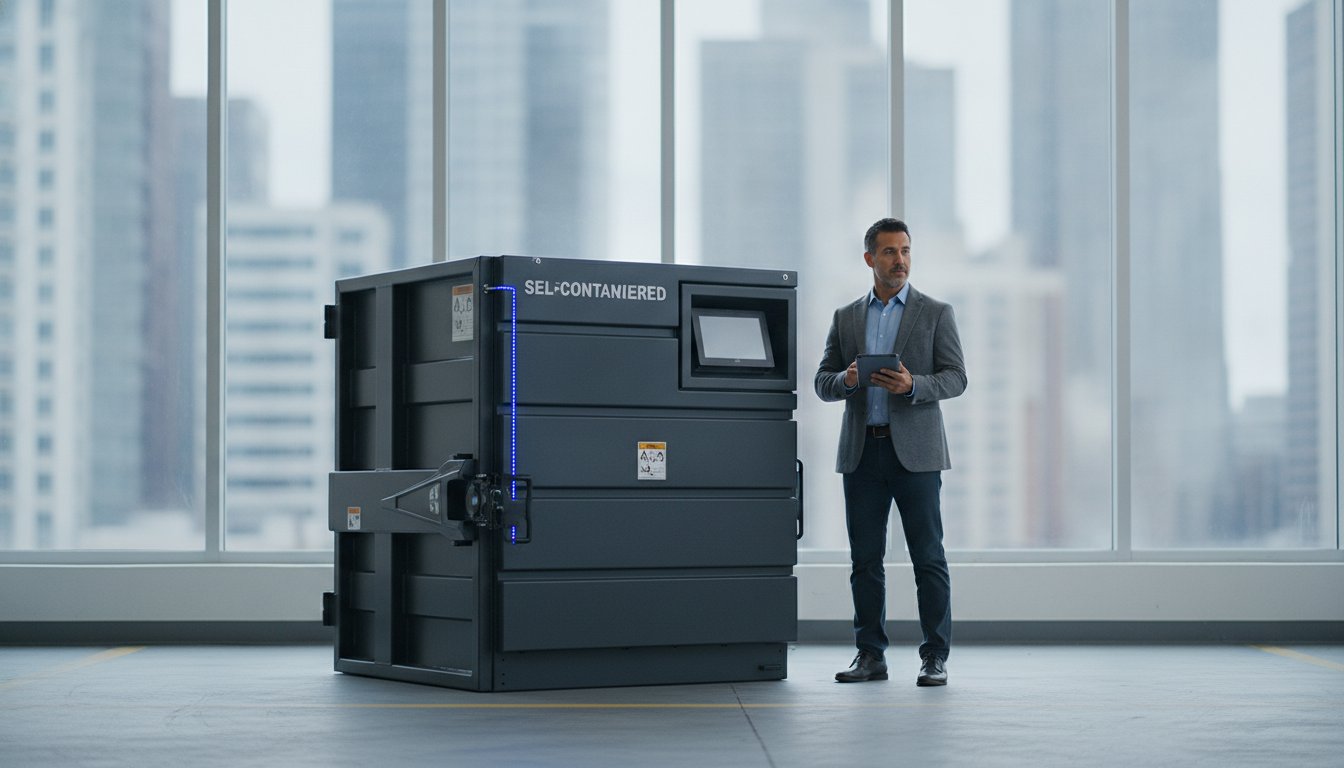
How much is your current waste management strategy leaking from your bottom line every month? If you're managing a grocery store, restaurant, or hospital, you know that standard open-top containers aren't built for liquid-heavy waste. Traditional dumpsters lead to foul odors, pest infestations, and constant, expensive hauls that eat into your margins. Invest in a professional self contained compactor service to stop the leaks and compress your overhead by packing significantly more waste into every load.
We understand that managing high-volume organic waste feels like a losing battle against rising fees and the strict 2026 disposal mandates now hitting businesses. You need a waste solution that keeps your site sanitary while making your monthly budget predictable. Use this guide to get the essential data required to streamline your operations with a 100% leak-proof system. We'll examine the latest 2026 regulatory shifts, explain how to reduce your pickup frequency, and help you select the right equipment to regain control of your loading dock.
Key Takeaways
- Identify why liquid-tight designs are essential for managing organic waste without leaks or odors.
- Apply the 30-yard rule to decide when to upgrade from standard bins to high-volume equipment.
- See how a professional self contained compactor service lowers disposal costs by reducing pickup frequency.
- Prepare your site with the correct concrete pad and 3-phase power specifications to ensure a seamless installation.
- Navigate 2026 commercial waste regulations with local expertise across the Northeast and Midwest.
What is a Self-Contained Compactor Service?
A self-contained compactor is a specialized waste management system where the compaction ram and the storage container are engineered as a single, inseparable unit. This integrated design creates a hermetically sealed environment that prevents liquids from escaping. If your facility generates significant amounts of "wet" waste, a professional self contained compactor service is the only reliable way to maintain sanitation and regulatory compliance. It's a heavy-duty tool designed for heavy-duty problems.
When the unit reaches capacity, a roll-off truck picks up the entire machine. The driver hauls it to a disposal site, empties the contents, and returns the unit to your concrete pad. This process eliminates the mess often associated with disconnecting separate containers. It's the preferred choice for grocery stores, hospitals, and large-scale restaurants that can't risk leaks or pest infestations. Relying on a self contained compactor service ensures your facility meets modern health standards while maximizing the utility of your loading dock.
The Mechanics of Waste Compaction
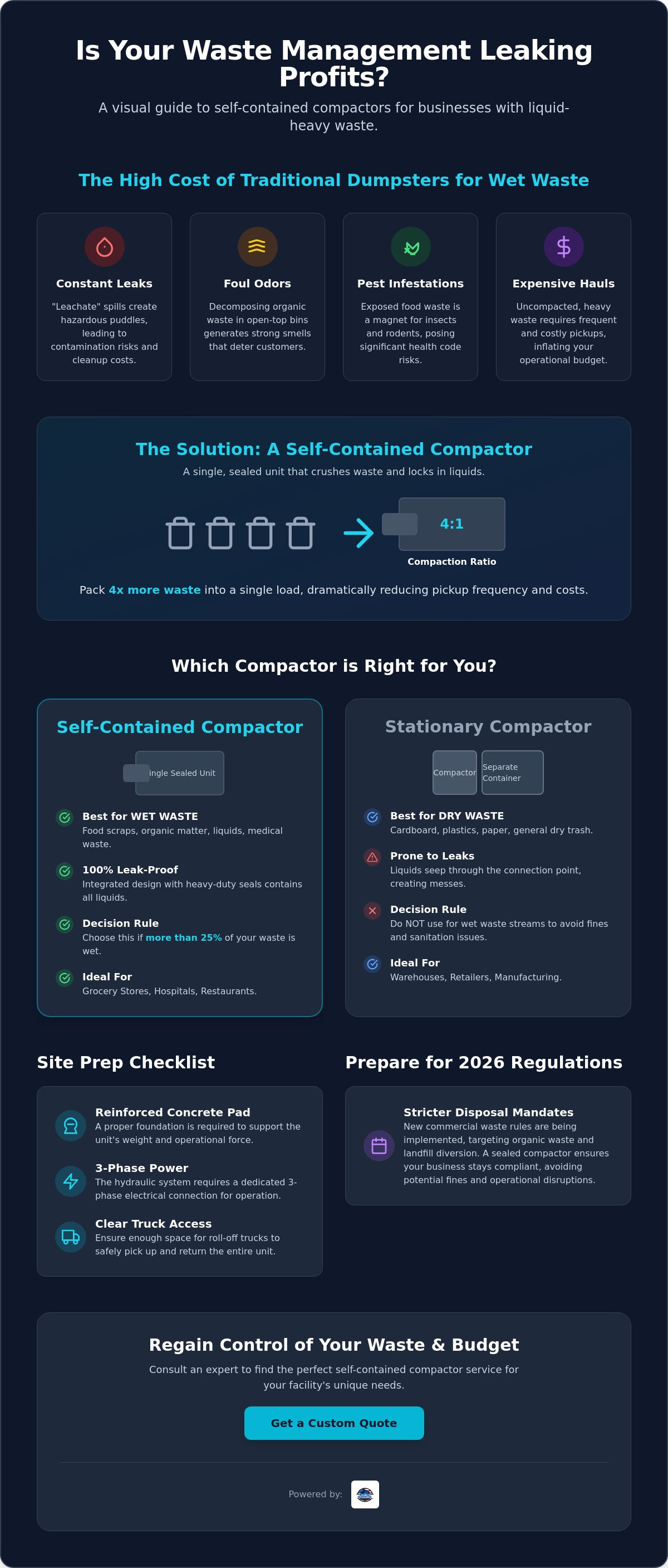
The efficiency of this system relies on a powerful hydraulic ram that crushes materials into a fraction of their original volume. Most units achieve compaction ratios of at least 4:1. This means you can fit four times as much trash into the container compared to a standard dumpster. This process of Waste Compaction significantly reduces the frequency of hauls, lowering your carbon footprint and operational costs simultaneously.
Integrated units are typically available in sizes ranging from 15 to 35 cubic yards. The sealed design keeps leachate, the contaminated liquid that drains from decomposing waste, fully contained within the steel walls. This containment is critical for preventing groundwater contamination and keeping your site free of odors and insects. You get a cleaner facility and fewer headaches from local health inspectors.
When to Choose Self-Contained over Stationary
Base your decision on the composition of your waste stream. If more than 25% of your trash consists of organic matter, liquids, or food waste, choose a self-contained model. Stationary compactors are designed for dry materials like cardboard or plastic. Using them for wet waste will result in puddles, smells, and health code violations. Don't make the mistake of using the wrong tool for a messy job.
Space is another major factor. Self-contained units generally occupy a smaller footprint than breakaway systems because they don't require the extra clearance needed for a separate container attachment. For businesses in dense urban areas with tight alleys, this compact design is a logistical necessity. If you need help determining the right size for your facility, visit Book Your Dumpster USA to consult with an expert. Maintaining a liquid-tight seal isn't just about cleanliness; it's about protecting your business from the fines and reputation damage caused by a leaking dumpster.
Self-Contained vs. Stationary Compactors: A Comparison
Choose the right machinery to avoid unnecessary maintenance costs and health code violations. The primary difference lies in the physical connection between the compaction ram and the storage container. In a stationary system, the compactor is bolted to the ground and the container is a separate, detachable piece. A self-contained unit integrates these two components into one sealed machine. Relying on a professional self contained compactor service ensures that your equipment matches your specific waste stream, preventing the logistical mess of using the wrong tool for the job.
Self-contained units are the industry standard for wet or organic waste. Use them if your business generates food scraps, medical waste, or saturated materials that produce leachate. Stationary units are designed strictly for dry recyclables like cardboard and plastic. If you attempt to process wet waste in a stationary unit, liquids will seep through the connection point. This creates a sanitation nightmare and attracts pests. For a broader perspective on optimizing your facility's output, refer to this commercial waste management guide from the EPA.
Key Technical Differences
Seal integrity is the most critical technical factor. Self-contained units utilize heavy-duty gaskets to ensure the entire machine remains liquid-tight during operation and transport. This prevents hazardous spills on your concrete pad or the public roadway. Stationary units lack this seal because the container must break away from the ram for emptying. Maintenance profiles also differ significantly. Stationary units require permanent ground anchors to withstand the force of the ram pushing against a separate container. When you utilize a professional self contained compactor service, the entire unit is hauled away. This keeps all mechanical components together and simplifies the cleaning process at the disposal site.
Choosing the Right Unit for Your Facility
Evaluate your loading method to ensure maximum efficiency. You can select dock-fed units that sit flush with your warehouse floor or ground-fed units for manual loading at the street level. Some high-volume facilities even use chutes to move waste directly from internal production lines into the compactor hopper. Regardless of the loading style, verify your electrical capacity. Most industrial units require 208, 230, or 460V 3-phase power to generate the necessary compaction force. Safety features are mandatory. Prioritize units equipped with emergency stops, keyed controls, and clear operational indicators. If you aren't sure which configuration fits your loading dock, check our commercial service details to find a solution that matches your daily volume.
Is a Compactor Service Right for Your Business?
Stop paying for the transport of air. Many businesses reach a tipping point where traditional waste collection becomes a logistical and financial burden. Apply the 30-yard rule to your current operation. If you fill three 10-yard dumpsters per week, it's time to upgrade. A professional self contained compactor service replaces frequent, low-density pickups with high-density hauls that maximize every dollar spent on disposal.
Calculating your return on investment requires looking beyond the monthly rental fee. Compare the cost of daily roll off dumpster rental pickups, including fuel surcharges and environmental fees, against a single weekly compactor haul. Consolidating your waste into one high-capacity unit also frees up valuable real estate on your loading dock. Beyond the numbers, an enclosed system provides immediate security. It prevents unauthorized dumping from neighbors and stops scavengers from creating a mess around your bins. It's a pragmatic move for any facility manager who values site control and cost predictability.
The "Wet Waste" Threshold
Grocery stores and food processors face unique challenges that standard dumpsters can't handle. If your waste stream is saturated, it's heavy and prone to leaking. Compaction helps manage this weight by removing air pockets, though you must monitor the unit to avoid exceeding legal road weight limits during transport. The sealed nature of the unit also prevents dumpster fires by cutting off oxygen and protecting the contents from external ignition sources. It effectively contains environmental runoff, ensuring you don't face fines for leachate reaching local storm drains. Don't wait for a health department citation to modernize your equipment.
Operational Efficiency and Sustainability
Switching to a self contained compactor service immediately improves your site's professional appearance. You'll eliminate the sight of overflowing open-top containers and the associated odors. This transition also streamlines your labor costs. Your staff will spend less time making multiple trips to various bins across the property. From a sustainability perspective, reducing truck traffic on your site lowers your carbon footprint and minimizes wear and tear on your asphalt. It's a cleaner, faster, and more responsible way to handle commercial waste in 2026. Make the switch to resolve your logistical stress with one permanent solution.
Site Preparation and Local Logistics in 2026
Installing industrial equipment requires more than just an open spot in your parking lot. You must prepare a reinforced concrete pad capable of supporting a loaded 30-ton unit. Standard asphalt will buckle under the pressure of a fully packed compactor and the weight of the roll-off truck during pickup. Ensure the pad is perfectly level to maintain the integrity of the hydraulic seals and prevent mechanical strain on the ram. If your surface isn't ready, your self contained compactor service won't function reliably.
Electrical specifications are non-negotiable. Coordinate with a licensed electrician to install a dedicated 208V, 230V, or 460V 3-phase power supply near the installation site. Use weather-proof disconnect switches to protect the system from the elements. Beyond power, verify your clearance. Roll-off trucks require at least 25 feet of overhead clearance and a wide turning radius to maneuver the unit into place. If your loading dock is in a tight corner, you'll need a site assessment before delivery. Schedule a site consultation to confirm your facility meets these technical requirements.
Urban Site Challenges
Operating in high-density areas like Queens or San Francisco presents unique hurdles. Narrow alleys often restrict the size of the unit you can install, sometimes forcing a shift to a smaller 15-yard model. You must also navigate strict 2026 noise ordinances. Many cities now limit the hours for heavy equipment operation to prevent disturbing residential neighbors. Coordinate with local utilities early if you need new power drops in older industrial zones. In cities like Chicago, permitting for permanent street-side placement involves rigorous safety inspections. Don't overlook these local regulations or you'll face costly delays and fines.
The Installation Checklist
- Verify Pad Levelness: A tilted pad causes uneven wear on the hydraulic ram and can lead to premature seal failure.
- Install Guide Rails: Steel rails bolted to the pad assist the driver in precise unit placement every time. This protects your building and the equipment from accidental impact.
- Set Up Remote Monitoring: Use 2026-standard "fullness" sensors to receive alerts when the unit reaches 80% capacity. This prevents overfilling and allows you to schedule hauls proactively.
- Check Accessibility: Ensure there are no low-hanging wires, tree branches, or parked cars blocking the truck's approach on pickup days.
Successful logistics depend on precision. By following these preparation steps, you ensure that your self contained compactor service runs without interruption. A well-prepared site is the foundation of a stress-free waste management strategy.
Why Choose Book Your Dumpster USA for Your Compactor Needs?
Managing commercial waste shouldn't be your second job. At Book Your Dumpster USA, we move you from logistical clutter to a state of resolution with one phone call. Our team provides local expertise across New York, New Jersey, Illinois, and Massachusetts, navigating the specific permitting and zoning hurdles unique to each region. We don't just drop off equipment; we provide a professional self contained compactor service that integrates into your daily operations without friction. You get a partner who understands that reliability is the only metric that matters when your loading dock is full.
Transparency is the foundation of our business model. You'll never find hidden environmental fees or surprise fuel surcharges in our billing. We provide clear, upfront dumpster rental prices so you can manage your 2026 budget with total confidence. Our solutions are fully integrated to handle every stage of your growth. Whether you need a temporary 10-yard bin for a seasonal cleanout or a permanent, high-capacity self contained compactor service for daily wet waste, we manage the entire lifecycle of your waste stream from a single account.
Digital-First Waste Logistics
Modern waste management requires modern tools. Our streamlined online system makes scheduling hauls as easy as booking a standard dumpster. You'll have access to real-time tracking and communication for every pickup and return, so you're never left wondering when the truck will arrive. This digital-first approach removes the guesswork and administrative burden from your facility manager. You also get direct access to expert account managers who understand the specific sanitation requirements of your industry, from healthcare to food service.
Reliability You Can Bank On
Equipment downtime isn't an option for a high-volume facility. We provide comprehensive maintenance and repair support to ensure your compactor never stops moving. Our service schedules are flexible, allowing you to adapt your haul frequency as your seasonal waste volume changes. We maintain a strict commitment to punctuality that respects your facility's tight loading window. If you're ready to modernize your site, contact Book Your Dumpster USA today to secure a solution that works as hard as you do.
Safety and Training Compliance
Operational safety is a critical component that most guides ignore. When we install your unit, we prioritize staff safety by highlighting emergency stop procedures and keyed control protocols. Our team provides the resources you need to ensure every employee knows how to safely operate the hydraulic ram and identify potential blockages. This focus on safety reduces your liability and prevents workplace injuries. By combining high-functioning tools with proper training, we help you maintain a secure, efficient, and compliant waste management environment.
Take Control of Your 2026 Waste Strategy
Transition your facility from a state of constant mess to a high-functioning waste operation. You now understand that liquid-tight containment is the only way to meet 2026 sanitation standards and that high-density compaction pays for itself by slashing pickup frequency. Whether you're navigating tight alleys in San Francisco or preparing a reinforced concrete pad in New York, the right equipment removes the logistical stress of high-volume wet waste. Don't wait for a health code violation to force your hand; modernize your loading dock today.
Our team provides specialized liquid-tight equipment and 24/7 support for commercial accounts across NY, NJ, IL, MA, and SF. We handle the technical specifications and electrical coordination so you can focus on your core business. Stop letting odors and rising haulage fees dictate your monthly overhead. Request a Commercial Waste Analysis from Book Your Dumpster USA today to lock in a professional self contained compactor service. Resolve your waste challenges now and build a cleaner, more efficient future for your facility.
Frequently Asked Questions
How much space is required for a self-contained compactor?
Plan for a concrete pad approximately 10 feet wide by 40 feet long to accommodate the machine and the truck's approach. You must also ensure there is at least 25 feet of vertical clearance. This allows the roll-off truck to lift and tilt the unit during pickup without striking overhead wires, tree limbs, or building overhangs.
What is the difference between a liquid-tight and a standard compactor?
Liquid-tight units feature a full-door gasket and an integrated reservoir designed to hold fluids without leaking. Standard stationary compactors are not sealed and allow liquids to seep out at the connection point. If you manage food waste or organic matter, a professional self contained compactor service is the only way to prevent foul odors and health code violations.
Can I rent a self-contained compactor for a short-term project?
Yes, you can secure these units for short-term needs such as seasonal production spikes or large-scale facility cleanouts. Most providers require a minimum service period, often 30 days, to offset the costs of transport and electrical setup. Verify that your project site has the necessary power and concrete surfacing before requesting a temporary installation.
How often does a self-contained compactor need to be emptied?
Most high-volume commercial users schedule hauls once every one to two weeks depending on their specific waste output. Don't guess your capacity. Use integrated "fullness" sensors to monitor the unit in real-time. This ensures you only schedule a haul when the container reaches 80% capacity, which maximizes your investment and reduces truck traffic on your site.
What electrical power is needed for a commercial compactor?
Industrial-grade compactors typically require 208V, 230V, or 460V 3-phase power to operate the hydraulic ram. You must hire a licensed electrician to install a dedicated circuit and a weather-proof disconnect switch near the unit's permanent location. Single-phase residential power is almost never sufficient for the force required to compress high-density commercial waste.
Do self-contained compactors require special permits in New York or Chicago?
Yes, major cities like New York and Chicago have strict permitting requirements for permanent waste equipment. In New York, you must follow DSNY guidelines regarding sidewalk clearance and public right-of-way. Chicago requires specific zoning permits to ensure the unit doesn't block emergency access. Always check local municipal codes before pouring a concrete pad for a new self contained compactor service.
What happens if the compactor breaks down or leaks?
Contact your service provider immediately to trigger a maintenance dispatch. Most commercial agreements include 24-hour repair support to resolve hydraulic failures or mechanical jams. To prevent leaks, inspect the door gaskets monthly for signs of wear or debris buildup. Proactive maintenance is the best way to avoid sanitation hazards and equipment downtime.
Can a self-contained unit handle cardboard and wooden pallets?
These machines process cardboard with high efficiency, but you should avoid loading wooden pallets. Pallets often splinter under pressure, which can jam the ram or puncture the container's internal seals. If your facility generates a high volume of pallets, use a separate 40-yard dumpster for dry wood to protect your compactor from expensive mechanical damage.


