

Does your current contract clearly define who pays when the dumpster overflows? A single misunderstanding about subcontractor responsibilities for waste disposal can lead to thousands of dollars in unexpected back-charges and project delays. You already know that a cluttered job site is a safety hazard and a magnet for disputes. With national average landfill tipping fees hitting $62.28 per ton, leaving waste management to chance is a risk your profit margins can't afford.
We'll help you master the legal and logistical framework of job site waste management to ensure compliance and safety. You'll learn how to navigate the January 2026 phase-out of paper hazardous waste manifests and the new PFAS monitoring requirements affecting 23 industrial sectors under the 2026 MSGP. This article provides clear contractual language for disposal and a repeatable checklist for site cleanup that keeps your project moving. From understanding the $45 minimum weight charges at Kiefer Landfill to managing RCRA compliance, we've got the facts you need to stay in control.
Key Takeaways
- Identify your legal standing as a "Generator of Waste" to properly define liability and prevent contract disputes.
- Draft precise "Scope of Work" clauses that account for regional compliance standards and strict local disposal rules.
- Use a daily inspection checklist to manage material segregation and maintain a safe, high-velocity work environment.
- Coordinate debris flow by selecting the correct container size, from 10-yard heavy-material bins to 40-yard bulk dumpsters.
- Master subcontractor responsibilities for waste disposal to protect your project profitability and avoid unexpected back-charges.
Understanding the Scope of Subcontractor Waste Liability
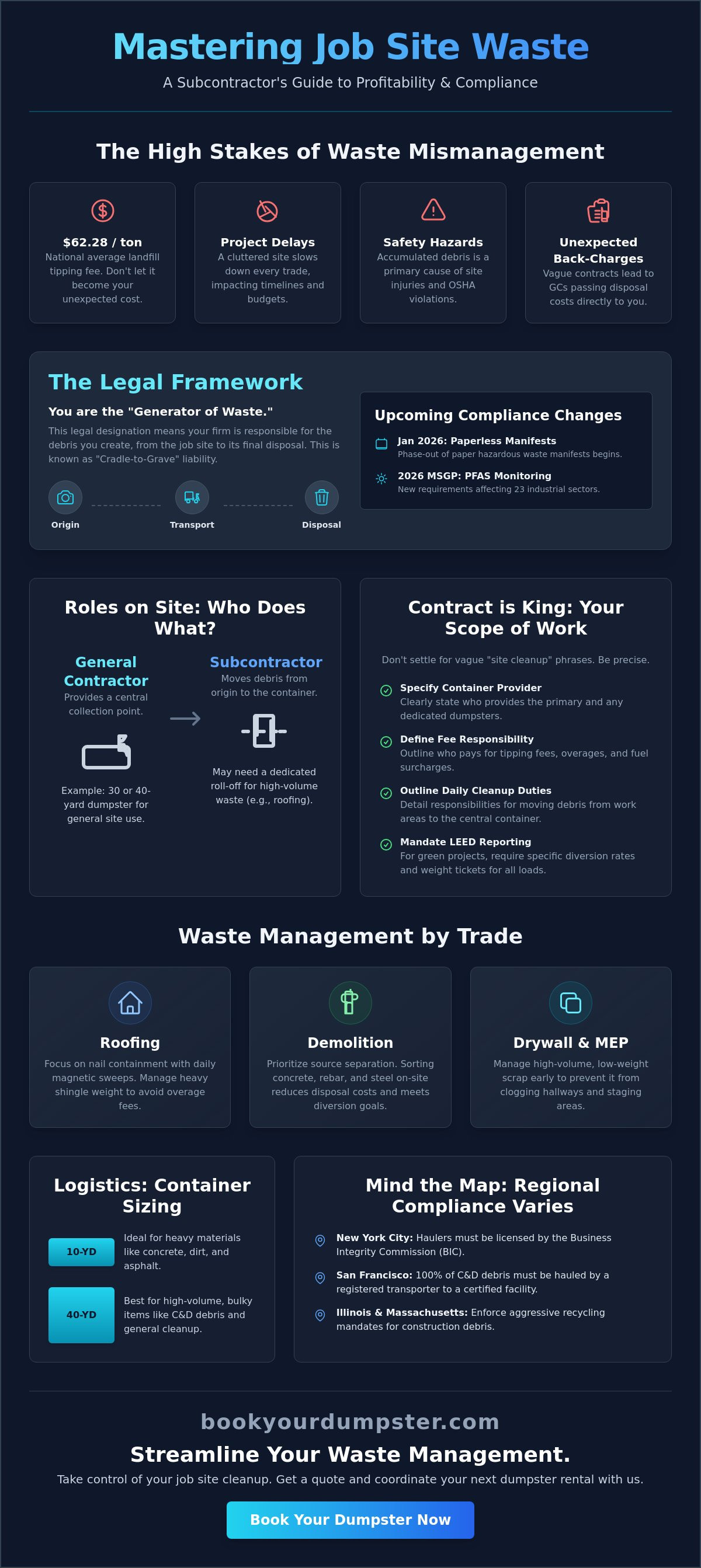
In the eyes of the law, the entity that creates debris is the "Generator of Waste." This designation carries significant legal weight. If your crew tears out old drywall or replaces lead-shielded pipes, you are legally responsible for that material from the moment it becomes waste. This concept, often called "Cradle-to-Grave" liability, means your firm is accountable for the waste until it reaches its final disposal site. Failing to understand these subcontractor responsibilities for waste disposal can lead to massive environmental fines or litigation long after you have left the job site.
Effective project management relies on established waste management principles to keep the site functional. There is a clear distinction between "work area cleanliness" and "final debris haul-away." Cleanliness is about safety; it involves keeping walkways clear of tripping hazards. Haul-away is the logistical act of removing that waste from the property. If your contract doesn't specify who handles the latter, you might find yourself hit with an unexpected back-charge. Poor waste management slows down every trade on site and drags down your safety rating.
General Contractor vs. Subcontractor Roles
Standard AIA and AGC contracts typically state that the General Contractor (GC) provides a central collection point, like a 30-yard or 40-yard dumpster. However, the subcontractor is responsible for moving their debris from the point of origin to that container. Don't assume the GC's laborers will clean up after your team. If your scope involves high volumes of specialized waste, such as concrete or roofing tear-offs, you may be required to provide your own dedicated roll-off container. Always verify the "Debris Removal" clause in your specific agreement before the first day of work. Clear boundaries prevent disputes.
The Legal Consequences of Non-Compliance
Ignoring site cleanup isn't just unprofessional; it's illegal. OSHA standards for walking-working surfaces require that all areas be kept clean and orderly. Accumulated debris is a primary cause of site injuries. Additionally, the EPA strictly regulates the disposal of hazardous materials like lead, asbestos, and mercury. If your team mishandles these, the resulting fines can easily exceed your project's profit. Local municipalities also issue citations for improper waste storage on sidewalks or streets. Keep your site compliant to protect your safety rating and your bottom line. Clean sites are profitable sites.
Contractual Obligations and Regional Compliance Standards
Clarity in your contract is your best defense against project friction. Don't settle for vague "site cleanup" phrases in your Scope of Work. Specify exactly who provides the container, who pays the tipping fees, and who is responsible for daily debris migration. When drafting these clauses, clearly outline the subcontractor responsibilities for waste disposal to prevent the general contractor from passing down unexpected costs. If you are working on a LEED-certified project, your contract must also mandate specific diversion rates and weight tickets for every load hauled away. Accurate reporting is non-negotiable for green building credits.
Legal liability doesn't end with the contract. Many states enforce strict hazardous waste management for contractors, requiring you to document the movement of any restricted materials. In New York City, for example, you must navigate the Business Integrity Commission (BIC) rules. You cannot simply hire any hauler; they must be BIC-licensed to operate on commercial sites. Similarly, Illinois and Massachusetts have aggressive recycling mandates for construction and demolition (C&D) debris. Failing to sort your metal, wood, and cardboard can result in rejected loads and heavy penalties at the scale.
Specific Trade Responsibilities
- Roofing: Focus on nail containment and shingle weight. Use magnetic sweepers daily to prevent tire punctures and safety claims.
- Demolition: Prioritize source separation. Sorting concrete, rebar, and structural steel at the point of origin often reduces disposal costs and meets diversion goals.
- Drywall and MEP: These trades generate high-volume, low-weight scrap. Manage these materials early to prevent them from clogging hallways and staging areas.
Regional Variations in Disposal Laws
Local laws change the way you manage a job site. San Francisco requires 100% of C&D debris to be hauled by a registered transporter to a certified facility. In New Jersey, the DEP strictly monitors solid waste transporter licensing, making it critical to verify your provider's credentials. If your project is in a dense urban area like Boston or Chicago, sidewalk and street-side dumpster placement requires specific permits and safety lighting. To ensure your site stays compliant with local container requirements, check available inventory for your specific zip code. Knowing the local rules before you break ground prevents work stoppages and keeps your crew productive.
The Subcontractor Waste Disposal Checklist
Execution on the job site is where your profit is either protected or lost. While contracts set the rules, a systematic daily approach ensures you meet your subcontractor responsibilities for waste disposal without incurring penalties. Use this checklist to maintain a high-velocity workflow and keep your crew focused on production rather than cleaning up avoidable messes. A tidy site is a productive site; it reduces the time spent moving materials twice and keeps the general contractor off your back.
- Daily Work Area Inspection: Walk your zone at the end of every shift. Identify and remove tripping hazards, loose scrap, and piles that block trade movement.
- Material Segregation: Don't mix everything into one pile. Separate wood, metal, and cardboard at the source to meet diversion goals and reduce landfill volume.
- Hazardous Material Identification: Isolate restricted substances immediately. Tag them clearly and move them to a designated, secure staging area to prevent accidental cross-contamination.
- Dumpster Loading Efficiency: Load heavy materials like concrete or brick first. Keep debris level with the top of the container; haulers cannot legally transport "top-heavy" or overflowing loads.
- Documentation: Collect and file every weight ticket. These receipts are your proof of compliance and are essential for final payment and project closeout.
Safety and Site Maintenance Items
Safety is a direct result of cleanliness. Use magnetic sweepers daily to collect nails and metal shards that cause punctures and injuries. Secure lightweight materials like foam insulation or plastic wrap; wind-blown litter can lead to municipal fines and neighbor complaints. Never block access to fire extinguishers, electrical panels, or emergency exits with debris. Keep these life-safety points clear at all times to maintain your safety rating and avoid OSHA citations.
Administrative and Reporting Tasks
Your responsibility extends to the paperwork. Submit waste diversion reports promptly to help the project meet its green building or LEED requirements. If you notice a dumpster is nearing capacity or has been damaged by another trade, report it to the project manager immediately to schedule a swap. Before tossing specialized materials, verify that they are permitted under the dumpster rental agreement. Prohibited items often trigger heavy surcharges that can erase the profit from your change orders. Stay organized, stay documented, and stay profitable.
Logistics: Coordinating Dumpsters and Debris Flow
Logistics is the engine of a clean job site. If your dumpsters are poorly placed or the wrong size, your crew wastes expensive labor hours walking debris across the lot. Efficient subcontractor responsibilities for waste disposal include more than just cleaning up; they require a physical strategy for how waste leaves the building and enters the container. You must synchronize your debris flow with your production schedule to prevent bottlenecks that stall following trades.
Managing your waste stream also requires a choice between "co-mingled" and "source-separated" methods. Co-mingled waste is faster for your crew because everything goes into one bin, but it often carries higher tipping fees at the sorting facility. Source-separated waste requires more bins and better organization on-site but significantly lowers disposal costs for recyclable materials like metal or clean wood. Decide on this strategy before the first roll-off arrives to ensure your team knows exactly where every scrap belongs.
Matching Dumpster Sizes to Trade Needs
Container selection is a matter of physics and weight limits. A 10-yard dumpster is the industry standard for concrete, masonry, and tile subcontractors. These materials are incredibly heavy; filling a larger container with brick or dirt would make it impossible for a standard roll-off truck to lift legally. Conversely, 30 and 40-yard containers are designed for large-scale commercial cleanouts, roofing tear-offs, and light-frame demolition where volume, not weight, is the primary concern. For a detailed breakdown of how much your specific debris will weigh, refer to the Ultimate Guide to Construction Debris Removal. Matching the bin to the material prevents overage fees and transit delays.
Optimizing Site Access
Placement is just as vital as size. You need a clear, level path with at least 22 feet of vertical clearance for the truck to drop and pick up the container. In dense urban environments like Queens or San Francisco, you'll likely need street permits and safety cones to hold the space. If you're working on a finished driveway or sensitive surface, use specialized placement techniques like "boarding" to distribute the weight of the dumpster and prevent cracking. To keep your project moving without interruption, schedule your next dumpster switch-out at least 24 hours before your current bin hits the fill line. This proactive approach eliminates downtime and keeps your work area clear for the next phase of construction.
Streamlining Waste Management with Book Your Dumpster USA
Managing your job site is complex enough without chasing down a waste hauler who fails to show up. Book Your Dumpster USA removes that friction. We provide a digital-first platform designed for the modern contractor. You can browse inventory, select your size, and schedule a delivery in minutes. This speed is essential for maintaining subcontractor responsibilities for waste disposal without pulling your crew away from their primary tasks. We operate with total transparency; the price you see is the price you pay, allowing you to estimate project costs with pinpoint accuracy.
Our service footprint covers key construction hubs across New York, New Jersey, Illinois, and Massachusetts. Whether you are navigating NYC’s BIC regulations or Massachusetts' recycling mandates, we provide the equipment that keeps you compliant. If you are unsure about the specifics of container types, our team offers expert support for selecting the right roll off dumpster rental for your trade. We don't just drop a box; we act as a logistical partner in your project's success.
Why Contractors Trust Our Logistics
Punctuality is our core promise. On a high-velocity job site, a late dumpster delivery can stall an entire demolition crew or roofing team. We understand that time is money. That's why we offer direct communication with local dispatchers. You get real-time updates instead of vague windows. Our rental periods are also designed for the reality of construction. If a project accelerates or faces a weather delay, we offer the flexibility to adjust your schedule. We move at your pace, ensuring that waste removal is never the reason for a project delay.
Next Steps for Your Project
Don't wait for the debris to pile up. Use our online size guide to calculate your volume needs based on the trade-specific data we've discussed. Once you know your requirements, secure your container for the next phase of your build. Proactive scheduling is the final step in mastering subcontractor responsibilities for waste disposal and protecting your bottom line. Take control of your site logistics right now. Book your next project dumpster today and experience a waste management service that works as hard as your crew does.
Master Your Job Site Logistics
Mastering subcontractor responsibilities for waste disposal requires a blend of contractual precision and active site management. You now have the framework to define legal liability, navigate regional mandates, and execute a daily cleanup checklist that protects your profit margins. By matching trade-specific debris to the correct container size and maintaining clear documentation, you remove the logistical stress that often leads to project friction and back-charges. Efficient waste management isn't just about cleaning up; it's about maintaining the high-velocity workflow your project demands.
We make this process effortless across NY, NJ, IL, MA, and SF. Our inventory includes everything from 10-yard heavy-duty bins for masonry to 40-yard bulk containers for commercial cleanouts. Every unit is available through our streamlined online booking system, providing you with transparent pricing and reliable delivery windows. Stop wasting valuable labor hours on inefficient debris flow and opaque communication. Use a tool built for the modern contractor.
Simplify your site logistics—Book Your Dumpster now
Take control of your next project today. Your clean, compliant, and profitable job site is just a few clicks away.
Frequently Asked Questions
Is a subcontractor responsible for providing their own dumpster?
Contractual language determines this responsibility. While general contractors often provide a central 30 or 40-yard dumpster for shared use, subcontractors with high-volume or heavy debris, such as masonry or roofing crews, are frequently required to provide their own roll-off containers. Check your "Scope of Work" clause to see if you must manage your own haul-away or simply move debris to the GC's collection point.
What happens if a subcontractor puts hazardous waste in a general dumpster?
Contaminating a general waste stream with hazardous materials leads to immediate load rejection and substantial environmental fines. Under "Cradle-to-Grave" liability, you remain responsible for the waste even if it is mixed. With the January 2026 phase-out of paper manifests, you must now use electronic systems to track restricted substances. Improper disposal can trigger OSHA citations and EPA enforcement actions that far exceed your project's profit.
How does OSHA regulate construction site waste disposal?
OSHA focuses on site safety rather than environmental disposal. Standard 1926.25 requires that all walking-working surfaces be kept clear of scrap lumber, protruding nails, and general debris. Failure to maintain a clean site is a primary cause of tripping hazards. To meet your subcontractor responsibilities for waste disposal, you must perform daily inspections and ensure all waste is removed from work areas to prevent workplace injuries and citations.
Can a general contractor back-charge a subcontractor for cleanup?
Yes, general contractors routinely issue back-charges if a subcontractor fails to maintain their designated work area. If the GC's laborers have to move your scrap to the dumpster, they will deduct that labor cost plus an administrative fee from your final payment. Maintain a daily cleanup log and take photos of your cleared area to provide evidence of compliance and protect your project's bottom line from these deductions.
What are the most common prohibited items in construction dumpsters?
Prohibited items typically include wet paint, tires, lead-acid batteries, and asbestos-containing materials. Newer regulations in 2026 also focus on materials containing PFAS compounds. Putting these in a standard roll-off container triggers expensive sorting fees and potential legal action. Always review your rental agreement before disposing of specialized liquids or chemicals. If you aren't sure if an item is allowed, isolate it until you receive confirmation from the hauler.
How do I estimate the weight of construction debris for a subcontractor bid?
Estimate weight by multiplying the volume of material by its average density. For example, concrete weighs approximately 4,000 pounds per cubic yard, while loose shingles weigh about 200 pounds per square. Factoring in local tipping fees, such as the $61.35 per ton rate at Kiefer Landfill, is critical for accurate bidding. Use these subcontractor responsibilities for waste disposal as a guide to prevent overage fees from eroding your profit margins on heavy-haul projects.
Do I need a permit for a dumpster on a commercial job site?
Permits are mandatory if the dumpster occupies public space, such as a street, sidewalk, or alleyway. If the container stays on private property within the job site's boundaries, a municipal permit is usually not required. However, dense urban areas like Queens or Boston have specific safety lighting and placement rules even on private sites. Always verify local zoning ordinances with the city's building department before scheduling your delivery to avoid work stoppages.
What is the best dumpster size for a roofing subcontractor?
A 20-yard or 30-yard dumpster is typically the most efficient choice for standard asphalt shingle tear-offs. These sizes balance volume needs with weight restrictions for roll-off trucks. If you are working with heavy clay tiles or slate, a 10-yard dumpster is better suited to handle the extreme weight without exceeding legal hauling limits. Choose your size based on the total "squares" of roofing to minimize the number of switch-outs and keep the project on schedule.


